1. Why Drying Method Matters: Moisture, Enzymes & Volatile Retention
Drying halts the biochemical cascade triggered during withering and oxidation. Fresh tea leaf holds 75–80% water; by the time it reaches the drying stage—after rolling or shaping—moisture sits around 60–70%. Residual polyphenol oxidase, peroxidase, and other enzymes remain active until heat denatures them or water activity drops below ~0.6. If drying is too slow or too cool, oxidation continues unpredictably; if too fast or too hot, you drive off the volatile monoterpenes, esters, and aldehydes that define aroma.
The four methods compared here occupy different points on the speed–temperature–airflow triangle. Sun-drying is slow and gentle (typically 25–40 °C ambient, 6–48 hours depending on humidity), preserving heat-sensitive linalool, geraniol, and floral lactones but offering little control. Tumble drying (rotary drum, sometimes called firing in black-tea parlance) uses forced hot air at 90–120 °C for 15–25 minutes, denaturing enzymes fast and hitting target moisture reliably, though some top-notes flash off. Tray or oven drying gives precise temperature dialling—useful for oolongs and greens that benefit from a slower 'baking' finish—but static air can leave wet pockets. Freeze-drying sidesteps heat entirely, sublimating ice at –30 to –50 °C under vacuum; volatile loss is minimal, but the porous, brittle structure rehydrates oddly and shelf life can be shorter once the seal breaks.
In practical terms, volatile retention is why sun-dried Silver Needle whites smell of hay and honeysuckle, why drum-fired Assam CTC smells malty and robust rather than floral, and why the handful of freeze-dried speciality greens on the UK market re-steep with startling intensity but sometimes lack the 'cooked' umami backbone of pan- or oven-finished sencha.
2. Sun-Drying: Tradition, Terroir & the Weather Gamble
Sun-drying is as old as tea itself. Farmers in Fujian and Yunnan still spread withered leaf on bamboo mats or raised racks, turning by hand every few hours until moisture drops to 3–6%. Ambient temperature, relative humidity, wind, and cloud cover all govern the rate; a breezy, low-humidity day may finish a batch in six hours, while overcast monsoon conditions can stretch to two days. Because enzyme deactivation is gradual, some residual oxidation continues—desirable in white teas like Bai Mu Dan, where it deepens honey and apricot notes, but risky in greens unless a brief pan-firing step arrests it first.
Volatile compound studies show sun-drying preserves linalool oxide, nerolidol, and (in whites) the delicate furanones and methyl salicylate that evoke jasmine and cut grass. The trade-off is batch-to-batch variation: a sudden rainstorm or humidity spike can push final moisture above 6%, inviting mould during storage, or cause uneven drying that leaves stem centres damp. Producers with covered, south-facing drying yards and good airflow achieve more consistency, but weather remains the wild card.
For UK buyers, sun-dried teas—particularly white and some artisan oolongs—command a premium for their 'natural' processing and nuanced aromatics. Check the packaging date and store in a cool, dark cupboard; sun-dried leaf is often less shelf-stable than oven- or tumble-dried equivalents. Many specialist subscription services now highlight processing method in their monthly notes, making it easier to compare sun versus mechanical drying side by side.
The Weather Window
Sun-drying works best in low-humidity microclimates (30–50% RH, gentle breeze). If you see 'sun-dried' on the label but harvest notes mention monsoon season, expect deeper oxidation and check the batch moisture wasn't rushed by a final oven pass.
3. Tumble (Rotary Drum) Drying: Speed, Scale & the Black-Tea Standard
Tumble or rotary-drum dryers are the backbone of high-volume orthodox and CTC black-tea production. The machine is a large, perforated cylinder that rotates slowly while hot air (typically 90–120 °C inlet, 50–60 °C exhaust) flows through. Leaf enters at one end, tumbles through the drum for 15–25 minutes, and exits at target moisture—usually 2–3%—with enzymes fully denatured and colour fixed. Some designs use multiple passes or zoned temperature profiles to balance speed and aroma retention.
The physics are straightforward: high air velocity drives evaporation, constant tumbling exposes all surfaces, and short residence time minimises thermal degradation. Volatile loss is real but selective—low-boiling acetaldehyde and some esters flash off, while higher-boiling geraniol, methyl jasmonate, and the Maillard-derived pyrazines and furans (the 'baked bread' and malty notes in black tea) develop or survive. This is why drum-dried Assam or Kenyan CTC smells robustly malty rather than green or floral; the method actively shapes the flavour profile.
Fluid-bed dryers—a variant where leaf is suspended on an upward jet of hot air—offer even faster moisture removal and are popular for CTC 'fines' and some green teas in China and Japan, though they can be harsher on whole-leaf grades. For UK buyers, tumble-dried teas are the norm in everyday breakfast blends and single-estate blacks. Quality is less about the drying method per se and more about upstream processing—plucking standard, withering control, rolling pressure—and how recently the tea was packed. Look for harvest and packaging dates; even well-dried black tea will stale noticeably after eighteen months.
Why 'Firing' Isn't Roasting
In black-tea jargon, 'firing' means tumble drying, not the slow charcoal roast applied to some oolongs. If you want genuine roast character—toasted grain, caramel—seek teas labelled 'charcoal baked' or 'refired,' not just 'fired.'
4. Oven & Tray Drying: Precision, Small Batches & the Oolong Finish
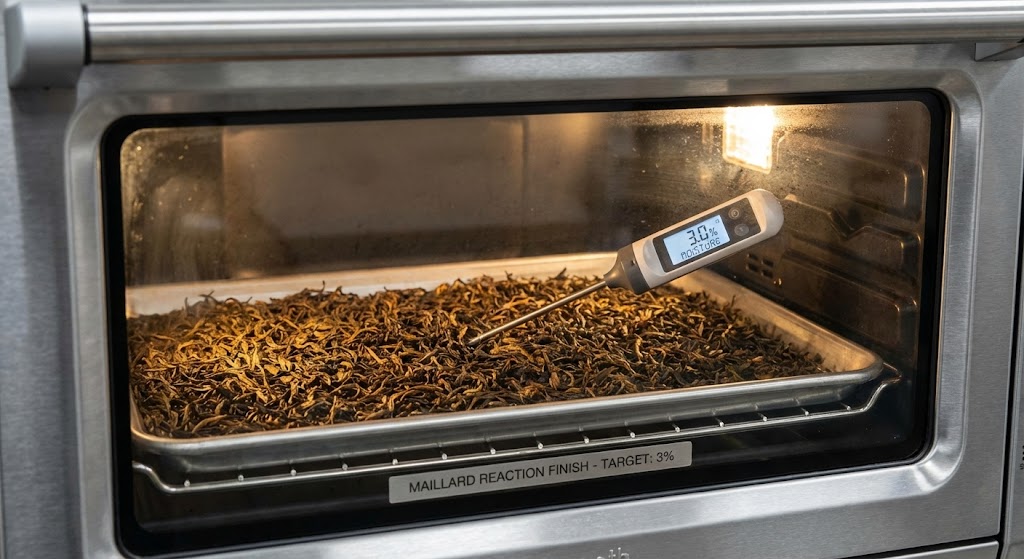
Tray or chamber ovens—where leaf rests on perforated trays or mesh racks in a heated, optionally ventilated cabinet—give producers dial-in control over temperature, airflow, and time. This method is common for small-batch oolongs, Japanese greens that require a gentle 'finishing' bake after steaming, and artisan whites. Temperatures range from 70 °C (for a slow white-tea finish) to 110 °C (for a final moisture push in rolled oolong), and drying times stretch from 30 minutes to several hours, sometimes with rest intervals to let moisture redistribute from stem to leaf.
The advantage is precision: a tea master can nudge aroma development by holding at 80 °C to coax out floral esters, or ramp to 100 °C to lock in a toasty, baked character. The disadvantage is uneven airflow—leaf at the centre of a deep tray may retain moisture while edges over-dry—so attentive turning or thin layers are essential. Static-air ovens (no fan) exacerbate gradients; convection models improve uniformity but still lag behind the turbulence of a tumble dryer.
Home experimenters often replicate this method in a domestic oven, spreading foraged or garden-grown leaf on baking trays at 60–80 °C with the door ajar. It works, but moisture metering is tricky without a gram scale and patience; our general drying guide covers target weights and troubleshooting. Commercially, oven-dried teas—particularly Taiwanese high-mountain oolongs and some Indian Nilgiri specialities—are prized for their layered aromatics and the producer's ability to 'tune' the finish. UK buyers will find them at specialist retailers and in curated gift assortments that showcase processing diversity.
5. Freeze-Drying (Lyophilisation): Maximum Volatiles, Minimum Heat
Freeze-drying removes water by sublimation—frozen leaf is placed in a vacuum chamber where ice transitions directly to vapour at –30 to –50 °C, bypassing the liquid phase and the heat that would drive off aromatics. The result is a sponge-like, intensely fragrant product with volatile retention often cited at 90–95% compared to fresh leaf, far above any thermal method. Rehydration is near-instant, and the flavour 'pop' can be startling—grassy, floral, almost raw.
The catch is threefold. First, cost: freeze-dryers are capital-intensive and energy-hungry, making lyophilised tea a niche luxury (you'll occasionally see it in high-end matcha or single-cultivar Japanese greens). Second, texture: the porous structure crumbles easily, and some drinkers find the mouthfeel 'thin' or the liquor less rounded than conventionally dried equivalents—possibly because Maillard and caramelisation reactions, which add body, require heat. Third, shelf life: the open structure accelerates oxidation and moisture uptake once the vacuum seal breaks, so freeze-dried teas often come in small, nitrogen-flushed sachets and should be used within weeks of opening.
Freeze-drying remains rare in orthodox tea; its true home is instant tea powders, some herbal infusions (where colour and aroma retention matter more than 'cooked' notes), and experimental micro-lots. A handful of Japanese producers have released freeze-dried sencha and gyokuro since around 2022, targeting the speciality market. UK availability is limited to online specialists and occasional matcha gift sets that include a freeze-dried component for novelty. If you try one, brew at slightly lower temperatures (60–70 °C) to avoid the 'raw' edge and compare directly against a drum-dried or oven-finished counterpart to appreciate the aromatic difference.
Use It or Lose It
Freeze-dried tea oxidises faster than heat-dried once exposed to air. Decant into an opaque, airtight tin and aim to finish within four weeks; the initial aroma intensity won't last.
6. Final Moisture Content: The 2–5% Target & Why It Matters
Regardless of method, the industry consensus is that finished tea should land between 2% and 5% moisture by weight. Below 2%, leaf becomes brittle—easy to shatter into dust during packing and prone to staling as residual lipids oxidise without the protective 'cushion' of bound water. Above 5%, water activity climbs high enough for mould spores (especially Aspergillus and Penicillium) to germinate, and enzymes retain enough mobility to drive slow, uncontrolled oxidation that turns the tea stale, flat, or musty.
Measuring moisture accurately requires either a calibrated moisture analyser (standard in factories) or a simple home proxy: weigh a small sample, dry it completely in a low oven (100 °C, 2–3 hours), then re-weigh. The difference, divided by the original weight, gives moisture percentage. Well-dried tea should feel crisp and snap cleanly; if it bends or feels leathery, moisture is likely above 6%. Conversely, tea that crumbles to powder at the slightest touch has been over-dried or is very old.
Different tea types tolerate slightly different endpoints: delicate whites and greens often target 3–4% to preserve aroma, while robust blacks can sit at 2–3% for maximum shelf stability. Pu-erh, which undergoes post-fermentation, is an outlier—raw sheng is dried to ~5–7% to allow continued microbial activity during aging, and proper storage (cool, stable humidity) becomes critical. For everyday buying, check that packaging is intact, opaque or foil-lined, and dated; even perfectly dried tea will degrade if stored in a clear jar on a sunny windowsill.
7. Volatile Compounds: What Each Method Preserves or Loses
Tea aroma is a cocktail of several hundred volatile organic compounds—terpenoids (linalool, geraniol, nerolidol), esters (methyl salicylate, hexyl acetate), aldehydes (hexanal, benzaldehyde), ketones, lactones, and nitrogen heterocycles. Their retention during drying depends on boiling point, polarity, and exposure time to heat. Sun-drying at ambient temperature spares the lightest, most heat-sensitive molecules—linalool oxide (floral), nerolidol (woody-floral), and furanones (caramel-sweet)—but the long duration allows some volatiles to simply evaporate into the air.
Tumble drying at 90–120 °C for 15–25 minutes strips low-boiling acetaldehyde and some green-leaf volatiles (C6 aldehydes) but promotes Maillard reactions that generate pyrazines (nutty, roasted) and furans (caramel, bready). The net effect is a shift from 'fresh and floral' toward 'malty and robust'—exactly what black-tea production aims for. Oven drying at intermediate temperatures (70–100 °C) occupies the middle ground, especially if done in stages: an initial 80 °C pass to set the leaf, a rest to redistribute moisture, then a final 100 °C push to hit target dryness. This two-step approach is common in fine oolongs and preserves both floral top-notes and developed, baked undertones.
Freeze-drying keeps almost everything—volatile profiles of lyophilised sencha closely mirror fresh leaf—but because there's no heat, you miss the Maillard and caramelisation chemistry that adds complexity. Some tasters describe freeze-dried greens as 'one-dimensional' despite their intensity. The trade-off is real: maximum aromatic fidelity versus the rounded, evolved character that gentle heat confers. Understanding this helps decode tasting notes—if a white tea is labelled 'sun-dried, hay and apricot,' expect a soft, layered profile; if a black is 'tumble-dried, malty and brisk,' expect boldness and less floral nuance.
Aroma ≠ Flavour Alone
Volatile retention drives aroma, but mouthfeel and sweetness come from non-volatile polyphenols, amino acids, and polysaccharides—heat affects those too. A well-dried tea balances both, so don't judge solely by scent.
8. Buying Advice for UK Tea Drinkers: What to Look For & Where to Find Transparency
Most commodity tea—supermarket breakfast blends, everyday teabags—is tumble-dried, and the method won't appear on the label. That's fine for daily drinking, but if you're exploring speciality leaf or care about processing provenance, seek retailers and subscription boxes that disclose drying technique alongside cultivar, harvest date, and elevation. Transparent producers will note 'sun-finished,' 'charcoal-baked,' 'oven-dried at 85 °C,' or similar; vague terms like 'artisan-crafted' mean little without specifics.
When comparing teas of the same type—say, two Bai Hao Silver Needles, one sun-dried and one oven-finished—taste side by side at the same brewing parameters. Sun-dried whites often open with brighter florals that fade gracefully over multiple infusions; oven-dried versions may start more muted but hold flavour longer and cost less due to lower spoilage risk. For oolongs, a slow charcoal bake (technically a post-drying roast, but related) adds toasted grain and caramel; if that appeals, look for 'medium roast' or 'traditional fired' on the label. For blacks, freshness trumps method—tumble-dried Assam from this year will outperform sun-dried Darjeeling from two years ago.
Storage at home mirrors the factory's goal: keep moisture and light out. Opaque tins, foil-lined pouches, or dark glass jars in a cool cupboard (not the fridge—condensation risk) will preserve well-dried tea for twelve to eighteen months. Pu-erh and some dark oolongs benefit from slightly higher humidity (50–60%) in dedicated storage, but that's an exception. If you're experimenting with home drying or growing your own, aim for the 2–5% moisture band, store small batches, and drink within six months—amateur drying rarely matches factory shelf-stability. Above all, let your palate guide you: the 'best' drying method is the one that delivers the flavour and aroma you enjoy, whether that's the wildflower delicacy of sun-dried white, the malty punch of drum-fired black, or the experimental intensity of freeze-dried green.
Harvest Date > Drying Method
A poorly stored, year-old sun-dried tea will taste worse than a fresh tumble-dried equivalent. Always prioritise recent harvest and proper packaging over romanticism about 'traditional' methods.
Comments