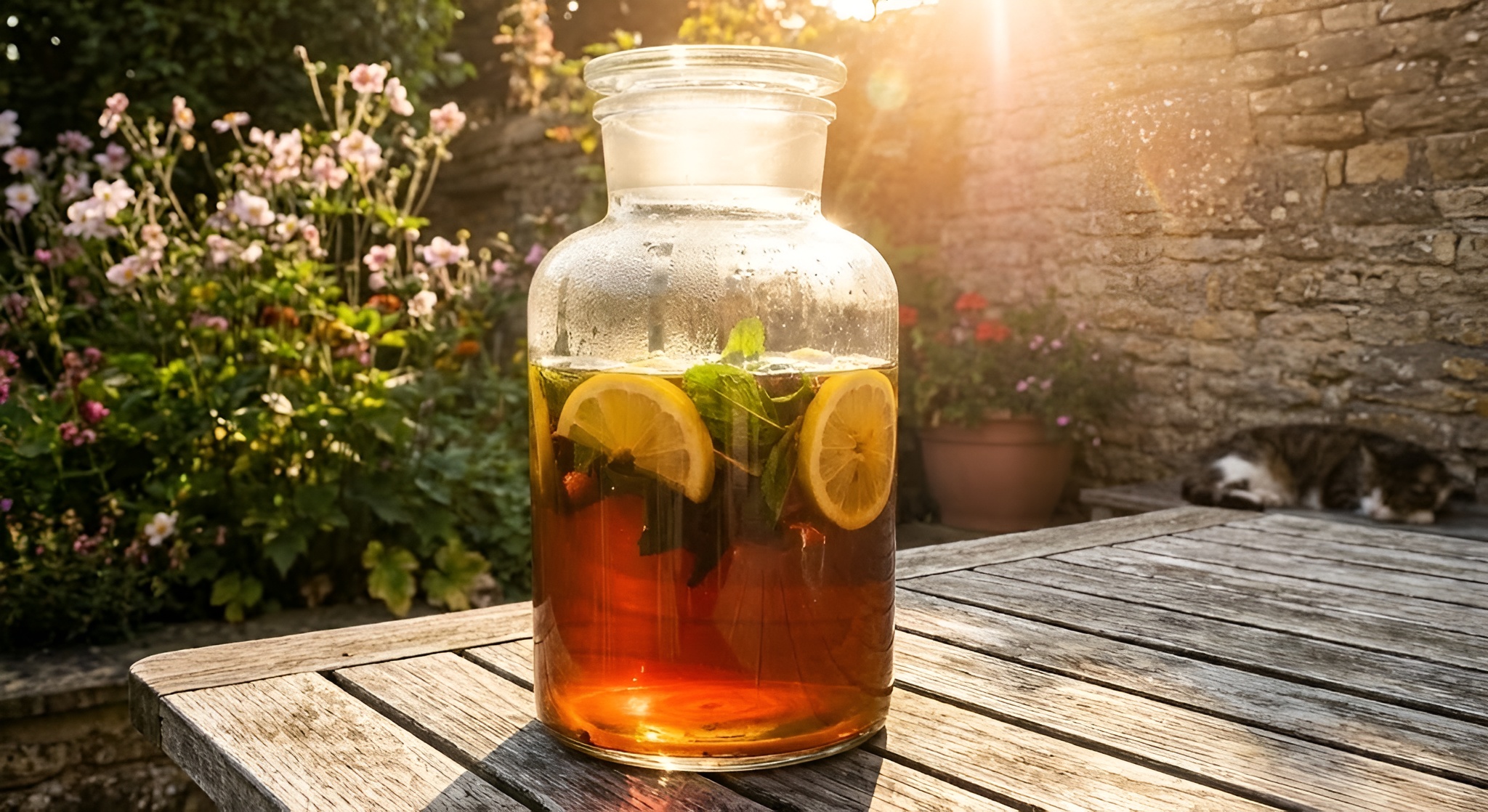
1. What Is Sun Tea and Why Brew It?
Sun tea is made by placing tea leaves (usually in a porous bag or loose) and cold or room-temperature water in a transparent container, then setting the vessel in direct sunlight for several hours. Solar radiation warms the water gradually—typically to between 25°C and 40°C in UK summer conditions—gently extracting caffeine, polyphenols, and aromatic compounds without the vigorous agitation and rapid temperature change of conventional steeping. Proponents argue this slow extraction produces less bitterness, lower astringency, and a rounder mouthfeel, particularly with delicate teas such as white or green varieties.
The method gained popularity in North America during the mid-20th century, especially in warmer states where ambient temperatures could push jar interiors above 50°C. In the UK, where even a sunny July afternoon may yield only 20–22°C air temperature, sun tea brewing is more marginal: you'll need several hours of uninterrupted sun on a south-facing spot to achieve meaningful extraction. The aesthetic and ritual appeal—watching colour slowly seep from leaf to liquid—remains a draw, but British brewers must reckon with cooler baselines and shorter peak-sun windows than their counterparts in Mediterranean or subtropical climates.
2. The Microbiology of Solar Brewing: Understanding Bacterial Risk
Water held at temperatures between roughly 5°C and 60°C—the so-called 'danger zone' in food safety—allows many bacteria to reproduce. Sun tea typically sits in this range for the entire brew: even on a warm UK day, a glass jar in full sun may reach an internal temperature of only 28–35°C, well below the threshold where most pathogens are killed or inhibited. Alcaligenes viscolactis, a Gram-negative bacterium sometimes present on dry tea leaves or in tap water, thrives in lukewarm, nutrient-dilute environments and can form a ropy, viscous film if left unchecked. Other organisms of concern include coliform bacteria (indicators of faecal contamination, though not always pathogenic themselves) and, in rare cases, Bacillus cereus spores that can survive on improperly stored tea.
Laboratory studies have shown that sun tea brewed for six to eight hours without boiling can harbour bacterial counts in the 10⁴–10⁶ colony-forming units per millilitre range, levels that may cause mild gastrointestinal upset in sensitive individuals. The UK's Food Standards Agency does not maintain specific guidance on sun tea, but general ready-to-drink beverage regulations assume pasteurisation or refrigeration; homemade sun tea falls into a regulatory grey area. Crucially, the acidity of brewed tea (pH typically 4.5–5.5) offers some protection—lower than neutral water—but it is not sufficient to halt all microbial growth over many hours at ambient temperature.
Understanding this risk doesn't mean abandoning sun tea; it means applying the same time-and-temperature controls used in other home food preservation. Keep brewing windows short, start with the cleanest possible water and equipment, and refrigerate the finished product promptly.
The Four-Hour Rule
Limit sun-tea steeping to a maximum of four hours in British conditions. Beyond that window, bacterial doubling times in the 25–30°C range can push counts into the risky territory even with clean starting materials.
3. Choosing the Right Container and Water
Container choice is non-negotiable for safe sun tea. Use only borosilicate glass or other food-grade glass jars that can withstand thermal shock and UV exposure. Before each use, sterilise the vessel by boiling it in water for ten minutes or running it through a dishwasher cycle at 65°C or higher. Avoid repurposing jars that previously held pickles, sauces, or other acidic foods unless you can be certain all residue and biofilm have been removed; even trace organic matter provides a nutrient base for bacteria.
Plastic containers—especially those not marked food-safe or designed for cold beverages—can leach phthalates, BPA, or other plasticisers when warmed by sunlight. Metal vessels (stainless steel, aluminium) are generally safe in terms of microbial growth but can impart off-flavours and may not allow UV penetration, which some brewers believe contributes to flavour development. Ceramic or opaque containers defeat the purpose of solar heating.
For water, start with freshly drawn cold tap water that meets UK drinking-water standards (regulated under the Water Supply Regulations 2016). If your local supply is chlorinated, consider filtering through activated carbon to remove residual chlorine, which can dampen tea aromatics; however, do not use distilled or deionised water, as the complete absence of minerals can make extraction sluggish and flavour flat. A moderate mineral load—around 50–150 mg/L total dissolved solids—is ideal for balanced extraction. If you have concerns about microbial quality, boil the water first, let it cool to room temperature, and then add the tea; this pre-sterilisation step eliminates waterborne bacteria but adds an extra 20–30 minutes to your workflow.
Jar Size Matters
Use containers between 1 and 2 litres. Larger volumes take longer to warm and cool, extending time in the danger zone; smaller jars heat faster but may over-concentrate if you forget them in strong sun.
4. Selecting Tea: Which Styles Work Best and Which to Avoid
Not all teas are equally suited—or safe—for sun brewing. Fully oxidised black teas from established estates (Assam, Ceylon, Kenyan blends) are generally the lowest-risk choice: the firing process typically reaches 90–120°C, reducing surface microbial loads, and the robust polyphenol profile tolerates slow extraction without turning muddy. Orthodox-rolled blacks, such as Yunnan gold or Keemun, often yield particularly smooth sun-brewed infusions with notes of malt and dried fruit.
Green and white teas can work but require extra vigilance. Their lower firing temperatures (60–80°C for many pan-fired greens, sometimes only withering for whites like Fuding Silver Needle) mean higher baseline microbial counts on the leaf. If you do brew these styles in the sun, halve the steeping time to two hours maximum, and use only teas from producers you trust for rigorous hygiene. Oolongs occupy a middle ground: high-fired varieties (Wuyi rock teas, heavily roasted Tie Guan Yin) behave much like blacks and are safe; lightly oxidised, minimally roasted 'jade' oolongs should be treated like greens.
Avoid altogether: raw (sheng) puerh, which can harbour yeasts and moulds from fermentation; heavily scented or flavoured blends (jasmine, Earl Grey) where the additions may introduce spoilage organisms; and any tea stored in damp or unclean conditions. Herbal infusions—rooibos, chamomile, peppermint—technically fall outside true tea but are often used in sun brewing; treat them as high-risk unless you pre-boil the water, since dried herbs can carry soil bacteria and lack tea's natural antimicrobial polyphenols.
5. Step-by-Step: Brewing Sun Tea in British Summer Conditions
Step 1: Sterilise your container. Boil a 1.5-litre glass jar and its lid for ten minutes, or run through a dishwasher at ≥65°C. Allow to cool completely before handling.
Step 2: Measure tea and water. Use approximately 10–12 grams of loose-leaf tea (about four teaspoons) per litre of water—slightly more than you would for gongfu but less than a strong builder's brew. Fill the jar with cold tap water, leaving 2–3 cm headspace to allow for thermal expansion.
Step 3: Position in sunlight. Place the sealed jar on a stable, south-facing surface—a garden table, patio stone, or wide windowsill—where it will receive uninterrupted direct sun. In June or July, mid-morning to early afternoon (10:00–14:00 BST) offers the strongest UV and warmest ambient temperatures. Avoid shaded spots or surfaces that retain heat (dark tarmac, metal), which can create uneven warming.
Step 4: Monitor time and temperature. Set a timer for two to four hours depending on leaf type and personal taste preference. If you have a cooking thermometer, check the water temperature after two hours; if it has not reached at least 25°C, either move the jar to a sunnier spot or accept a lighter brew. Do not leave the jar out overnight or extend brewing beyond four hours.
Step 5: Strain and refrigerate immediately. Remove the tea leaves (pour through a fine-mesh strainer or lift out bags), transfer the liquid to a clean, lidded jug or bottle, and place in the refrigerator within 30 minutes. Rapid cooling halts bacterial multiplication. Consume within 24 hours for best flavour and safety.
Cloudy Days? Skip It
If the forecast shows intermittent cloud or temperatures below 18°C, opt for grandpa-style or cold-brew in the fridge instead. Weak, inconsistent sunlight leaves your tea in the danger zone longer without enough heat to drive extraction.
6. Recognising Spoilage and Safe Storage
Even with careful technique, spoilage can occur. Before drinking, inspect your sun tea for these warning signs: a viscous, ropy texture or visible threads in the liquid (indicating Alcaligenes viscolactis); off-odours reminiscent of wet cardboard, grass clippings, or sour milk; or any surface film or sediment that wasn't present immediately after straining. If you observe any of these, discard the entire batch—do not taste it.
Safe storage is straightforward: keep brewed sun tea in a sealed container at ≤5°C (standard UK fridge temperature) and consume within 24 hours. After this window, polyphenol oxidation and residual enzymatic activity can degrade flavour even if bacterial counts remain low. Do not re-brew or 'top up' a batch with fresh water once it has been refrigerated; each brewing cycle should be discrete to maintain traceability and hygiene.
If you plan to serve sun tea at a garden party or picnic, transfer it to an insulated jug with ice packs rather than leaving it at ambient temperature. In warm weather (≥25°C), tea held outdoors for more than two hours re-enters the danger zone. Label homemade batches with the brew date if storing multiple containers, and wash all serving jugs in hot, soapy water between uses.
7. Flavour Profile and When Sun Tea Shines
When brewed safely, sun tea's signature characteristic is a rounded, low-astringency mouthfeel with attenuated bitterness. The slow, cool extraction preferentially dissolves theanine, simple sugars, and lighter volatile compounds while leaving behind some of the larger, more astringent catechin polymers that dominate in boiling-water brews. The result is a drink that feels softer on the palate, with sweetness coming forward and any vegetal or mineral notes muted.
Sun tea works particularly well as a base for iced drinks: its inherent smoothness means it doesn't cloud or turn harsh when chilled, and it pairs cleanly with citrus, mint, or a spoonful of honey. In British summer, where iced tea is less culturally embedded than in North America, sun-brewed black tea offers a gentle on-ramp for those accustomed to hot builder's brews. It also suits sparkling-tea cocktails: carbonate cold sun tea with a soda siphon or mix with tonic water for a refreshing, low-alcohol aperitif.
That said, sun tea will never deliver the complexity or layered aromatics of a carefully executed gongfu session or even a well-timed Western steep. If you prize the bright, grassy snap of a first-flush Darjeeling or the roasted depth of a Wuyi oolong, conventional hot water remains the superior extraction method. Sun tea's charm lies in its ease and its forgiving nature, not in pushing the boundaries of what tea can express.
Sweetness Without Sugar
Because slow extraction highlights theanine and residual leaf sugars, many drinkers find sun tea needs little or no added sweetener—a useful trick if you're trying to reduce sugar intake.
8. Alternatives: Cold-Brew and Other Low-Temperature Methods
If the bacterial risks of sun tea feel too high—or if British weather refuses to cooperate—refrigerator cold-brewing offers a safer alternative with a similar flavour profile. Place tea and cold water in a sealed jar or jug, refrigerate at 4°C for 8–12 hours (overnight works well), then strain and serve. The lower temperature halts microbial growth entirely, and the extended contact time compensates for reduced molecular activity, yielding a smooth, sweet infusion. Cold-brew is particularly forgiving with green and white teas, which can turn bitter if over-steeped in hot water but remain mellow even after twelve hours in the fridge.
Another option is the flash-chill method: brew tea hot using a reduced water volume and a slightly shorter steep time, then pour directly over a large quantity of ice. This technique, common in speciality coffee, locks in aromatics through rapid cooling and dilutes the concentrate back to drinking strength. It sidesteps the time-in-danger-zone issue of sun tea while preserving more volatile top notes than either solar or overnight cold-brewing.
Finally, grandpa-style brewing—leaves continuously steeped in a lidded glass or thermos with occasional top-ups of hot water—shares sun tea's hands-off appeal but relies on boiling water for safety and fuller extraction. It won't give you the same cool refreshment on a hot day, but it's a useful fallback when clouds roll in or you're short on fridge space.
Hybrid Approach
Brew sun tea for just two hours to capture the solar aromatics, then move the jar to the fridge for an additional four to six hours. You get gentle flavour development with minimal bacterial risk.



Comments