1. What Information UK Law Requires on Tea Labels
Under the Food Information Regulations 2014 (as retained EU law), pre-packaged tea sold in the UK must display the product name, net quantity, best-before date, name and address of the food business operator, and a country or place of origin if its omission would mislead. The country-of-origin rule means that "black tea" alone is insufficient if the tea comes from outside the UK; you will nearly always see "Produce of India," "Product of China," or a similar statement. Importantly, there is no mandatory requirement to declare leaf grade, estate name, harvest season, processing style or cultivar—these appear only when a packer chooses transparency or needs to justify a premium price.
Ingredient lists must name every component in descending order by weight, so a breakfast blend labelled "Black tea (Assam, Ceylon, Kenyan)" tells you those three origins are present but not their proportions. Flavoured teas must list "natural flavouring" or "flavouring," and any allergens (rare in pure tea, but watch for added milk powder or nuts in chai blends). Nutrition labelling is compulsory for most pre-packed foods, though pure tea infused without milk or sugar contributes negligible energy and is often exempted under small-producer rules. Beyond these statutory minimums, everything else on the label—flush, elevation, garden name, tasting notes—is voluntary disclosure, making it both more valuable and more prone to embellishment.
2. Geographic Origin: From Country to Single Estate
Country-of-origin statements range in precision from "Product of multiple origins" (a legal catch-all for global blends) to named estates with GPS coördinates. Country level—"Product of India"—is the regulatory minimum and tells you little about terroir or quality; India produces everything from Kangra green to Nilgiri CTC. Region level—"Assam," "Darjeeling," "Uva"—is more useful, especially for protected geographical indications (PGIs): Darjeeling, for instance, is a registered PGI in the EU (and recognised in UK law), meaning only tea grown in defined districts of West Bengal may use the name. Compliance is monitored by the Tea Board of India, and packets bearing the Darjeeling logo with a registration number offer a degree of traceability absent from generic "Indian black tea."
Single-estate or garden names—"Castleton Estate SFTGFOP1," "Glenburn Second Flush"—represent the highest transparency but are unregulated in UK labelling law. Anyone can print a romantic estate name; verification requires cross-referencing against auction catalogues (many premium gardens sell via Kolkata or Colombo auctions, where lot numbers and dates are public) or checking the producer's own website for harvest records. Some specialist importers now include batch or lot numbers and even QR codes linking to picking dates and factory notes, approaching the traceability standard long common in speciality coffee. When a label offers this level of detail, it signals a supply chain confident enough to invite scrutiny—a positive indicator even before you taste the tea.
Look for the PGI Logo
Country labels tell you almost nothing about quality; regional names like Darjeeling are legally protected in the UK and EU, so check for the official certification mark to ensure you're getting genuine, traceable tea from the defined growing area.
3. Leaf Grade Codes: Orthodox and CTC Systems
Leaf-grade abbreviations were developed by colonial tea boards to describe leaf size and appearance after processing, not cup quality. The orthodox grading system for whole-leaf and broken-leaf teas uses a cascading alphabet: OP (Orange Pekoe, whole leaf), FOP (Flowery Orange Pekoe, young leaves with tip), GFOP (Golden Flowery,含 golden tips), TGFOP (Tippy Golden Flowery), FTGFOP (Finest Tippy) and SFTGFOP (Super Fine Tippy), sometimes followed by a numeral (1 for best, ascending numbers for lower selections). A Darjeeling labelled SFTGFOP1 should contain many unbroken leaves and a high proportion of silver or golden tips—but the grade says nothing about terroir, plucking date or factory skill. Poorly stored SFTGFOP will taste stale; fresh, well-made FOP can be revelatory.
Broken grades—BOP (Broken Orange Pekoe), FBOP, GBOP—denote smaller orthodox particles that brew faster and darker, common in stronger breakfast blends. Fannings (BOPF) and dust (PD, D) are the finest orthodox grades, typically reserved for teabags where rapid extraction matters more than nuanced aroma. The CTC system (Crush, Tear, Curl) produces uniform pellets graded chiefly by screen size: BP (Broken Pekoe, ~2 mm), PF (Pekoe Fannings, ~1.5 mm), PD (Pekoe Dust, sub-1 mm). CTC dominates commodity black tea from Assam, Kenya and parts of Sri Lanka; it is engineered for strength and colour, not complexity, and grade differences matter mainly to blenders calibrating extraction rates. If a label omits any grade—common on supermarket own-brands—assume a blend of fannings or dust chosen for cost, not character.
4. Harvest Information: Flush, Plucking Standard and Dates
Flush refers to the seasonal growth cycle and is most explicit on Darjeeling and Assam labels. First flush (March–April) yields light, astringent, floral teas prized for brightness; second flush (May–June) delivers fuller body, muscatel notes and higher prices at auction. Monsoon or rain flush (July–September) is cheaper and bolder, often destined for blends, while autumnal flush (October–November) offers mellow, slightly sweet character. Japanese green teas follow a parallel nomenclature: shincha (first spring harvest), ichibancha (first picking), nibancha (second), and so on. A label that prints the flush signals a tea made from a defined harvest window—valuable transparency. Omission usually means a year-round blend or off-season leaf.
Plucking standard—"two leaves and a bud," "tippy golden," "imperial plucking"—describes what the plucker took from the bush. Fine teas specify this because younger shoots contain more amino acids, volatile oils and catechins. Harvest or packing dates appear on premium single-estate and Japanese teas, where freshness drives value; a sencha labelled "Harvested May 2026, Best Before May 2027" tells you it is at peak aromatic life. Bulk-market teas rarely carry harvest dates, relying instead on generic best-before windows of two or three years—a sign that age is considered irrelevant or that the contents are a blend of multiple seasons. When comparing similar teas, a stated harvest date is a mark of confidence and an invitation to judge freshness yourself.
Flush Tells You Flavour and Value
A label that specifies first or second flush reveals both harvest timing and character—from bright, floral spring teas to muscatel-rich summer pickings. If the flush is missing, assume the tea comes from multiple pickings blended for consistency.
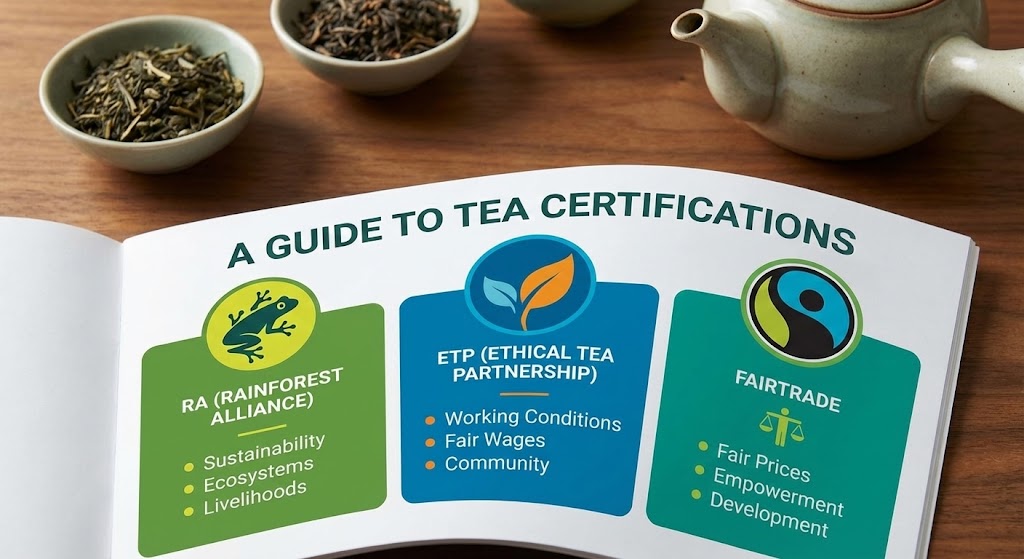
5. Certification Marks: Organic, Fairtrade, Rainforest Alliance and Carbon Labels
Organic certification in the UK is regulated by law; any tea labelled "organic" must come from holdings certified by a recognised body (Soil Association, OF&G, EU-equivalents recognised under the GB Organic regime post-Brexit). Certification prohibits synthetic pesticides, herbicides and fertilisers, requires crop rotation or green-manure practices, and is audited annually. The Soil Association symbol is the most familiar in Britain and often commands a retail premium, though the sensory difference between organic and conventional tea depends more on terroir and processing than input regime. Organic status says nothing about labour conditions, carbon footprint or cup quality—only that agrochemical use is restricted.
Fairtrade (certified by Fairtrade International and labelled with the FAIRTRADE Mark) guarantees a minimum price to producer coöperatives, a social premium for community projects, and standards around labour rights and democratic governance. Rainforest Alliance Certified (green frog logo) focuses on environmental sustainability, biodiversity and improved farmer livelihoods but does not set a floor price. Both are independently audited and offer more accountability than unverified "ethical sourcing" claims. Newer marks include Carbon Trust Footprint labels (measuring and sometimes offsetting life-cycle emissions) and B Corp certification (whole-business social and environmental performance). All are more meaningful than vague terms like "responsibly sourced" or "sustainable," which lack third-party verification. When a label carries multiple certified marks—say, Organic and Fairtrade—you can infer a producer willing to absorb the cost and complexity of meeting overlapping standards, a proxy for seriousness if not a guarantee of superior flavour.
6. Blends Versus Single-Origin: What "Pure" and "Estate" Really Mean
The word "blend" is honest when used—"English Breakfast Blend," "House Blend No. 8"—but many everyday teas are blends without saying so, relying on country-of-origin statements that mask the mix. A packet reading "Black Tea (Product of India, Kenya, Sri Lanka)" is a blend of three origins, proportions undisclosed and potentially variable batch to batch. Master blenders at large tea companies defend this practice as ensuring year-round consistency despite seasonal and terroir variation; critics argue it erases traceability and commodifies tea. If a label does not declare blend status and lists only one origin or estate, it is safer—but not guaranteed—to assume single-origin content.
"Single estate," "single garden," "single origin" and "pure Ceylon" are powerful marketing terms with no binding legal definitions in UK food law. A "single estate" label should mean tea from one named property in one harvest, but without a verifiable estate name, lot number or certification (some PGI schemes and speciality importers offer this), you are trusting the packer's word. "100% pure" usually means no added flavourings or other plant material (a useful assurance for unflavoured teas) but does not preclude blending teas from multiple estates or countries of the same type. When shopping for single-origin character—terroir-driven Darjeeling, a specific Yunnan cultivar, a named Japanese garden—look for named estates, harvest dates, lot numbers and, ideally, links to independent records such as auction reports. The more a label invites you to verify its claims, the more likely those claims are true.
Check the Origin List Carefully
If a packet lists multiple countries in the ingredients—"Product of India, Kenya, Sri Lanka"—you're buying a blend with undisclosed, potentially variable proportions. Single-estate or single-origin labels offer true traceability, though the term itself isn't legally policed.
7. Processing and Style Descriptors: Oxidation, Rolling and Firing Methods
Terms like "orthodox," "CTC," "hand-rolled," "pan-fired," "steamed" and "charcoal-roasted" describe manufacturing technique and are enormously helpful when present—but rare outside speciality tea. Orthodox processing preserves whole or gently broken leaves through withering, rolling, oxidation and drying; it is slower, more artisanal and dominant in premium Darjeeling, oolong, white and many Chinese greens. CTC (Crush-Tear-Curl) mechanically shreds the leaf into uniform granules, accelerating oxidation and producing strong, quick-brewing blacks favoured in teabags and chai. A label that says "orthodox Assam" or "CTC blend" immediately tells you what to expect in the cup: complexity versus strength, nuance versus convenience.
For oolongs, oxidation level may be stated as a percentage ("30% oxidised," "80% oxidised") or descriptively ("light," "dark"), helping you anticipate whether the tea will taste green and floral or rich and roasted. "Stone-ground," "shade-grown," "pan-fired," "oven-dried" appear on Japanese and Chinese greens and signal specific craft traditions—shade-growing boosts chlorophyll and L-theanine in gyokuro and matcha; pan-firing in a wok creates the toasted, chestnut notes of Longjing. "Withered 16 hours," "slow-roasted over longan wood" and similar process notes are the domain of geek-tier micro-lots, often sold by importers who include detailed spec sheets or links to producer diaries. When you see this level of transparency, you are no longer reading marketing—you are reading a recipe, and the tea inside is likely made by someone who wants you to understand their work.
8. Red Flags and Unregulated Marketing Language
Certain words on UK tea labels are unregulated and semantically empty: "premium," "luxury," "artisan," "gourmet," "finest," "select" and "reserve" have no legal definitions and can be applied to any tea at any price. They are not false—just vague—and their presence should prompt you to look for concrete detail elsewhere on the label. Does "premium blend" name its origins, state a grade or offer a harvest date? If not, the word "premium" is doing all the work. Similarly, "hand-picked" sounds artisanal but is standard practice on most estates (mechanical harvesting is rare outside a few Australian and Georgian plantations); it is only meaningful when contrasted with "machine-harvested," which almost no label will admit to.
Geographic vagueness is another warning sign: "Himalayan tea" could mean Darjeeling, Nepal, Kangra or even Yunnan, each with different character. "High-grown" or "estate-grown" without naming the estate or altitude is scenery without substance. Tasting notes—"hints of bergamot," "notes of honey and orchid"—are subjective and, unless the tea is lab-tested for specific volatile compounds (rare, though some high-end importers now publish analytical reports), they reflect the copywriter's palate or aspiration, not a measurable standard. None of this makes the tea bad, but it does mean you should calibrate your expectations to verifiable facts—origin, grade, certification, harvest detail—rather than purple prose. The best labels let the tea speak through data; the weakest ask you to trust the adjectives.
Ignore 'Premium'—Demand Proof
Words like "premium," "luxury" and "artisan" have no legal meaning and can appear on any tea. Treat them as marketing noise and look instead for concrete claims: named origins, flush dates, or recognised grades.


Comments