1. What Is Tea Leaf Moisture Content—and Why It Matters at Every Stage
Moisture content is defined as the mass of water in a sample divided by the total mass of that sample, expressed as a percentage. A freshly plucked tea shoot may carry 75–80 % moisture; after wilting it drops to 60–70 %; by the end of drying or firing, shelf-stable leaf sits at 2–5 %. These thresholds are not arbitrary: each processing stage depends on a narrow moisture window to deliver the intended chemical changes without over-accelerating polyphenol oxidase, peroxidase or other enzymes, and without creating conditions for microbial growth.
During wilting, controlled moisture loss concentrates soluble amino acids and sugars, softens cell membranes and primes the leaf for rolling without tearing. If wilting proceeds too far—say, below 55 %—the cell walls become brittle, rolling ruptures cells unevenly and the resulting liquor tastes harsh. Conversely, rolling leaf still above 70 % moisture risks compacting water rather than expressing juice, yielding weak oxidation. After final firing, any moisture above 6 % dramatically shortens shelf life: residual water plasticises cell walls, sustains slow enzymatic drift and allows volatile monoterpenes and esters to hydrolyse or evaporate, flattening aroma within weeks instead of months.
In practical terms, moisture content governs texture, chemistry and microbiology simultaneously. Producers in Hangzhou, Uji and Darjeeling measure it at intake (to decide wilting duration), mid-process (to time the shift from rolling to oxidation) and post-firing (to confirm the batch meets export or domestic shelf-life standards). For the home buyer, understanding these benchmarks means you can recognise when stored tea has drifted out of spec and take corrective action before flavour deteriorates irreversibly.
The 3 % Rule
Finished tea held below 3 % moisture stays stable for a year or more in sealed storage; above 6 % it may degrade noticeably within three months, especially in warm UK kitchens.
2. The ISO Oven-Drying Method: Why 105 °C and Constant Weight
The international reference standard (ISO 1573:1980, reaffirmed in later editions) prescribes drying a known mass of tea at 103 ± 2 °C under atmospheric pressure until successive weighings, spaced one hour apart, differ by less than 1 mg per gram of sample. In practice, laboratories use forced-air ovens set to 105 °C, weigh 2–5 g of leaf in a pre-dried glass dish, and record mass every 60–90 minutes until equilibrium. The difference between initial and final mass, divided by initial mass, is the moisture percentage.
Why 105 °C? At atmospheric pressure, free water evaporates near 100 °C, but tightly bound water within cellulose and hemicellulose cell-wall matrices may require slightly higher temperatures to desorb fully. Exceeding 110 °C risks pyrolysing volatile oils, decomposing some polyphenols and generating artefactual mass loss that overstates true moisture. The constant-weight criterion ensures that all mobile water has departed and that the remaining mass genuinely represents dry matter.
Commercial estates and research institutes rely on this method for calibration and dispute resolution. A shipment contract might stipulate ≤ 5 % moisture by ISO oven test; if a buyer's rapid meter reads 6.2 % and the seller disputes it, an accredited lab will oven-dry duplicate samples and the oven result prevails. The chief drawback is time: reaching constant weight can take four to six hours, rendering the method unsuitable for real-time process control on a busy production line.
3. Infra-Red Moisture Balances and Capacitance Meters: Speed Versus Precision
To bridge the gap between laboratory accuracy and factory speed, producers deploy two faster technologies: halogen or infra-red moisture balances and capacitance (dielectric) moisture meters. An infra-red balance places the sample on a built-in scale beneath a halogen lamp; the lamp heats the leaf to a user-set temperature (typically 105 °C) and the display shows real-time mass loss, terminating automatically when the rate of change falls below a threshold. Results appear in five to fifteen minutes, close enough to the oven method that many factories use IR balances for routine batch release, provided they validate the instrument against oven baselines monthly.
Capacitance meters work on a different principle: water has a dielectric constant near 80, while dry cellulose sits around 2–4. By pressing electrodes into a sample or passing leaf between capacitor plates, the meter infers moisture from the bulk dielectric response. Readings are instantaneous—often under ten seconds—but accuracy depends on leaf density, particle size, temperature and the specific calibration curve loaded into the device. A meter calibrated for CTC black tea will over- or underestimate whole-leaf oolong moisture unless recalibrated.
Both technologies demand regular cross-checking. In a 2022 study comparing eighteen commercial moisture meters against ISO oven drying, infra-red balances averaged ± 0.4 percentage points' deviation across green, oolong and black samples, while handheld capacitance meters showed ± 1.2 points and occasionally drifted by 2–3 points when leaf temperature exceeded 25 °C. Producers therefore treat rapid meters as process-monitoring tools—fast enough to decide when to halt a drying cycle—but archive oven-test certificates for every export batch.
Calibration Cadence
Estates running IR balances or capacitance probes typically oven-verify at least one sample per shift during peak season, updating calibration offsets if drift exceeds 0.5 percentage points.
4. Target Moisture at Each Processing Stage: Wilting to Final Firing
Fresh leaf arrives at the factory carrying 75–80 % moisture. [[Leaf-wilting-physics-moisture-membranes-enzymes|Wilting]]—whether by spreading on bamboo trays indoors, tumbling in a trough under ambient air, or mechanically in a heated chamber—reduces that figure to a range tuned to the tea type. White and green teas are typically wilted only lightly, to 68–72 %, because minimal cell rupture is desired and enzymes will soon be deactivated by steam or pan-firing. Oolong producers wilt to 62–68 %, then manipulate the leaf further through shaking or tossing to induce edge bruising; the lower moisture makes edges more friable, concentrating oxidation where cell walls break. Black-tea orthodox wilting targets 60–65 %, soft enough for rolling but with sufficient turgor to express juice cleanly.
After rolling, moisture drops another few points through evaporation and juice exudation, commonly settling around 58–62 % at the start of oxidation. If oxidation is prolonged—two to four hours for a full-bodied Assam—moisture may creep lower still, which is why some factories mist the oxidation room or cover trays with damp cloth to prevent desiccation that would halt enzyme activity prematurely. By the time leaf enters the dryer, residual moisture sits near 55–60 %.
Final firing or drying must reduce moisture swiftly to 2–5 % to arrest all enzymatic and microbial activity. CTC black tea often exits continuous-belt dryers at 2.5–3.5 %; Chinese greens and oolongs may finish slightly higher, 3–5 %, because gentler heat preserves volatile monoterpenes. Immediately post-firing, leaf is hygroscopic and will re-absorb moisture from ambient air; factories therefore cool the batch in a climate-controlled room, then pack into lined chests or foil-laminate pouches within hours. Any delay—especially in monsoon regions—can push moisture back above 5 %, necessitating re-firing before export.
5. Equilibrium Moisture Content and Long-Term Storage Drift
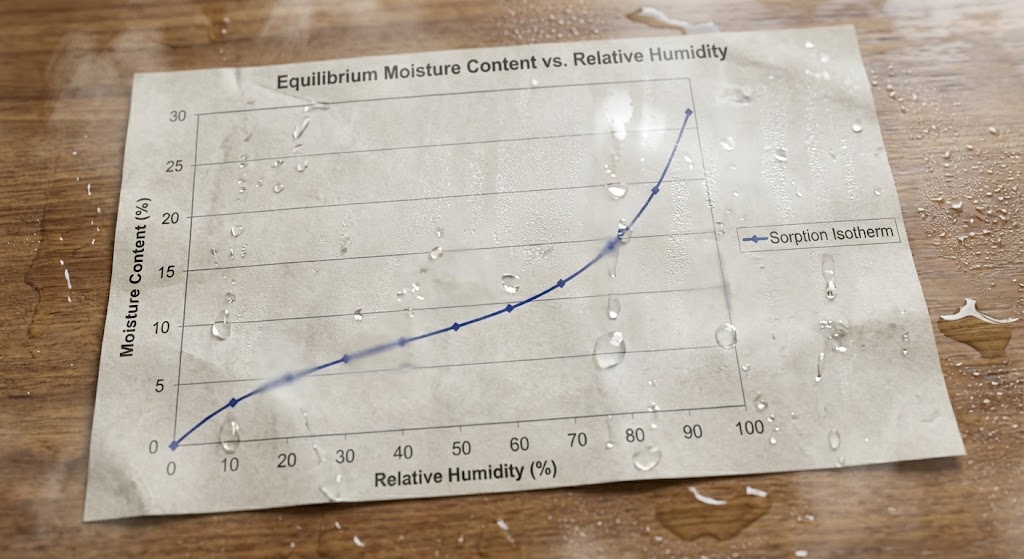
Even a perfectly dried tea does not remain at 3 % moisture indefinitely. Cellulose, hemicellulose and residual pectins are hygroscopic polymers: they adsorb water vapour from the surrounding air until the chemical potential of water in the leaf matches that in the headspace, a state called equilibrium moisture content (EMC). EMC is governed by temperature and relative humidity according to a sorption isotherm, a curve unique to each material. For typical tea leaf at 20 °C, 60 % RH yields an EMC near 8–9 %; 50 % RH corresponds to roughly 6–7 %; 40 % RH sits around 5 %. In a heated British living room in winter (often 18–20 °C, 45–55 % RH), unsealed tea will drift toward 6–7 % moisture over weeks.
This drift matters because moisture above 6 % accelerates chlorophyll pheophytinisation, lipid peroxidation and Maillard browning, all of which dull green teas' vegetal brightness and shift oolongs toward stale, papery notes. [[Airtight-caddies-storing-loose-leaf|Airtight caddies]] slow the process by isolating the tea from room air, but any air trapped in the headspace will eventually equilibrate with the leaf; a half-full tin in a humid kitchen can still see moisture creep over months.
Commercial warehouses in origin countries maintain 15–20 °C and 50–60 % RH, accepting that packaged tea will settle near 5–6 % EMC. Export-grade leaf destined for the UK is often nitrogen-flushed or vacuum-sealed in multi-layer foil pouches to eliminate headspace humidity entirely, holding moisture below 4 % for a year or more. Once you open the pouch at home, the clock starts: re-seal promptly, store in a cool cupboard away from the kettle, and consider decanting large quantities into smaller opaque caddies so each opened portion spends less time exposed to air.
Headspace Matters
A caddy filled to the brim leaves minimal air; a half-empty tin traps more moisture vapour. Transfer small daily portions to a separate container and keep the bulk sealed to minimise cumulative exposure.
6. Home Methods to Assess Moisture: Tactile Snap, Acoustic Crackle and Visual Cues
You do not need a laboratory oven to detect whether stored tea has absorbed humidity or dried out. Three simple tests—snap, sound and sheen—reveal moisture drift with surprising reliability, because water plasticises cellulose and alters mechanical and optical properties in predictable ways.
Tactile snap: Take a whole leaf or a tightly rolled oolong ball between thumb and forefinger and apply gentle pressure. Well-dried tea (3–4 % moisture) will fracture cleanly with an audible crack, leaving sharp, brittle edges. Leaf that bends or compresses before breaking—especially if it springs back slightly—has likely climbed above 5–6 %. [[Rolled-twisted-leaf-shape-affects-flavour|Tightly rolled shapes]] such as Tieguanyin pearls or gunpowder green should shatter into angular fragments; if they merely dent, moisture has crept in.
Acoustic crackle: Rub a pinch of leaf between your palms or shake it in a closed fist near your ear. Crisp, dry tea emits a sharp rustling or crackling sound as brittle fragments collide. Soft, muted rustling—more of a papery whisper—indicates plasticised cell walls and elevated moisture. This test works especially well for Japanese sencha and Chinese mao feng, where whole leaves retain structural definition.
Visual sheen: Properly dried leaf often displays a subtle lustre—polyphenol and wax layers on the cuticle catch light when cell walls are rigid. As moisture rises, the cuticle softens and the surface appears duller, sometimes taking on a matte, almost dusty cast. Conversely, over-dried tea (below 2 %) may look excessively brittle, with fractured edges and a faded, straw-like colour, signalling that volatile oils have evaporated alongside the water.
7. When Moisture Goes Wrong: Recognising and Rescuing Affected Tea
Excessive moisture manifests in three progressive stages. Stage one (6–8 % moisture): aroma flattens noticeably; bright top notes—jasmine, citrus peel, fresh-cut grass—fade first because light esters and aldehydes hydrolyse or oxidise. The leaf still looks normal and brews without off-flavours, but the cup lacks complexity. Stage two (8–12 %): the leaf feels soft or spongy, colour shifts toward brown or grey-green, and the liquor develops stale, cardboard or musty undertones as lipid peroxides accumulate and residual enzymes degrade chlorophyll. Stage three (above 12–15 %): visible mould—white, green or black patches—appears on the surface or inside compressed cakes; the tea is unsafe and must be discarded.
If you catch drift at stage one, gentle re-firing can restore crispness. Spread the leaf in a thin layer on a baking tray and place in a preheated oven at 80–90 °C (fan off, door slightly ajar) for 20–40 minutes, stirring every ten minutes. Monitor closely: you want to drive off absorbed moisture without toasting or caramelising the leaf. Remove when the snap test returns a clean fracture and aroma revives. This technique works well for sencha, Earl Grey and lightly oxidised oolongs; heavily roasted teas such as Lapsang souchong tolerate slightly higher temperatures (up to 100 °C) because the existing roast flavour masks minor thermal notes.
Stage-two tea is harder to rescue: the chemical damage—pheophytin formation, aldehyde polymerisation—is largely irreversible, though re-firing will arrest further decay and may yield a drinkable, if diminished, brew. For high-value oolongs or aged puerh approaching stage two, some collectors employ controlled low-temperature baking (60–70 °C for several hours) in a food dehydrator, which gently equilibrates moisture without adding roast character. Prevention, however, remains simpler than cure: opaque, airtight storage in a cool, stable environment will hold most teas at 3–5 % moisture for six months to a year in the UK climate.
The Sniff Test
Before re-firing, smell the dry leaf closely. A clean, albeit faint, aroma suggests stage-one drift; musty, sour or fungal notes indicate stage two or three—compost the tea rather than risk mycotoxins.
8. Buying and Storing for Moisture Stability: What UK Buyers Should Check
When purchasing premium greens, jasmine-scented teas or high-grade oolongs online or from specialist retailers, packaging type and production date are the two most reliable proxies for moisture stability. Look for nitrogen-flushed or vacuum-sealed foil-laminate pouches with a clearly printed harvest or processing month. Tea packed within four weeks of firing and sealed under inert gas will typically arrive at 3–4 % moisture and remain stable for a year unopened. Teas sold in paper-lined tins or simple plastic zip-lock bags have usually equilibrated with ambient warehouse humidity—often 5–7 %—and will have a shorter flavour window once opened.
For everyday builders' blends and robust chai, moisture creep is less critical because the bold, malty or spiced profiles mask subtle aroma fade. Even so, buying in quantities you will consume within three to four months minimises the risk of stage-one drift. Speciality single-estate blacks, delicate first-flush Darjeelings and competition-grade oolongs merit the same care you would give Japanese greens: decant into double-lidded tins or UV-opaque glass jars, store away from heat and light, and perform the snap test monthly if you plan to keep the tea beyond six months.
Finally, avoid storing tea in the kitchen unless you have a dedicated cupboard far from the kettle and cooker. Steam from boiling water and cooking raises local humidity transiently but repeatedly, nudging EMC upward with each exposure. A cool, dark hallway cupboard or a bedroom shelf maintains more stable conditions. If you live in an especially humid region—coastal Cornwall, for instance—consider adding a small silica-gel sachet (food-grade, indicating type) to each caddy, replacing it every few months when the crystals change colour. The silica will buffer minor humidity swings, keeping your tea closer to its intended moisture target and preserving the bright, layered aromatics that first drew you to loose-leaf in the first place.
Seasonal Strategy
UK humidity peaks in autumn and winter. Buy delicate greens in spring or early summer and consume them by October; purchase robust blacks and roasted oolongs in autumn for reliable winter drinking.
Comments