1. Why Water Is Not Neutral: The Chemistry of Extraction
Tea brewing is competitive solubility. Water dissolves catechins, caffeine, amino acids, volatile aldehydes, and polysaccharides at different rates, and the mineral load in that water determines which compounds extract first, which bind and precipitate, and which remain in solution to reach your palate. Pure H₂O—distilled or deionised—extracts ferociously but tastes flat, because it lacks the buffering capacity and ionic strength that shape mouthfeel. Tap water, by contrast, carries 100–400 mg/L of total dissolved solids (TDS) in most UK cities, dominated by calcium (Ca²⁺), magnesium (Mg²⁺), bicarbonate (HCO₃⁻), and trace chloride or sulphate. These ions do not merely dilute the brew—they react with it.
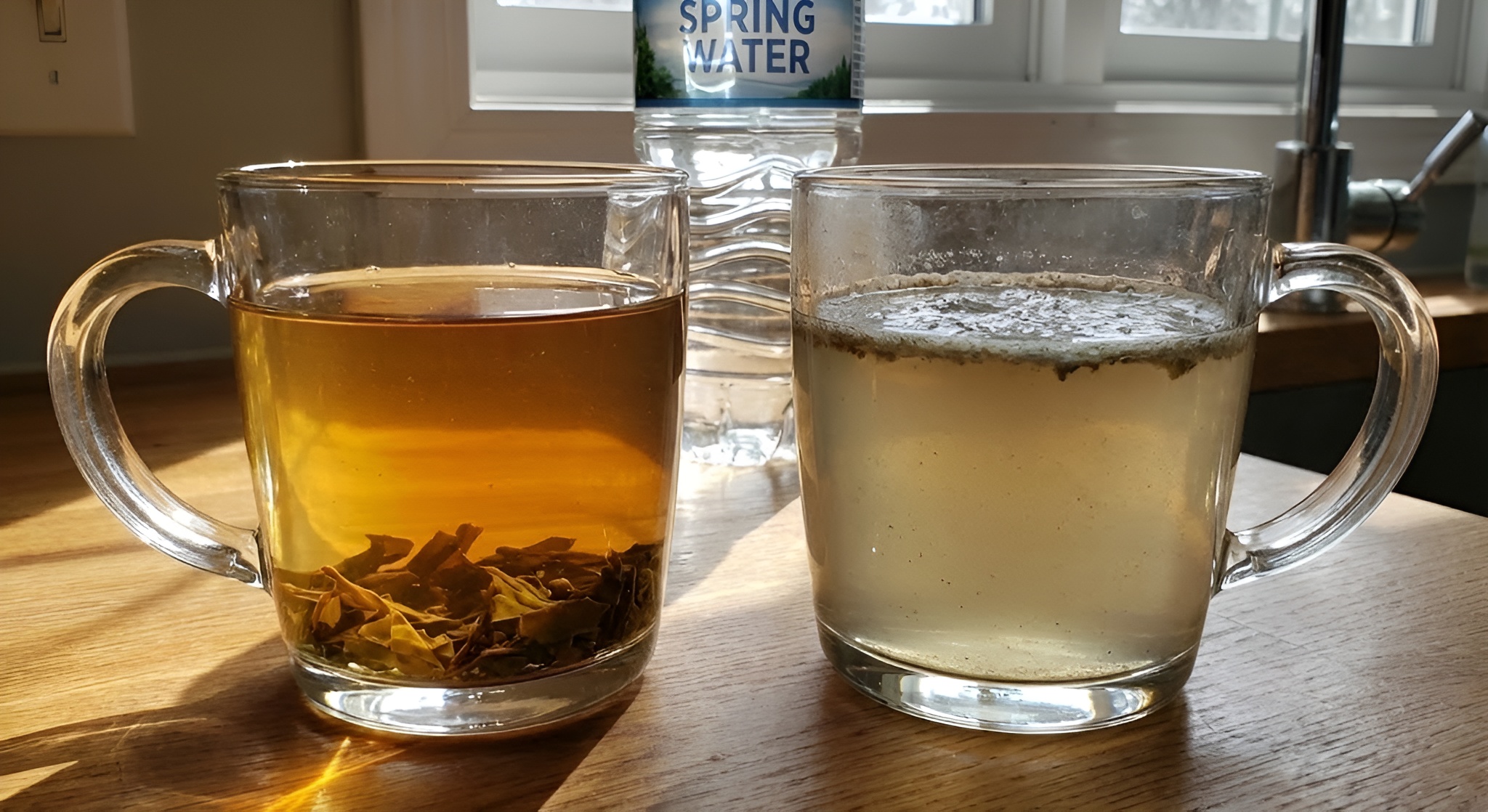
Calcium and magnesium form complexes with polyphenols, particularly the gallate esters (epigallocatechin gallate, theaflavin-3-gallate) that give tea astringency and colour. In hard water, these complexes precipitate as insoluble salts, which is why you see a chalky scum on the surface and a paler liquor beneath. Bicarbonate acts as a pH buffer, raising the brew's alkalinity and slowing the extraction of acids (which contribute brightness); water above pH 8 makes even a lively Darjeeling taste dull. Meanwhile, chloride and sulphate—common in treated municipal supplies—can amplify bitterness or introduce metallic off-notes at concentrations above 50 mg/L. The ideal brewing water sits in a narrow band: low to moderate hardness (50–150 mg/L CaCO₃), neutral to slightly acidic pH (6.5–7.5), minimal chlorine, and enough dissolved oxygen to carry volatile aromatics into the headspace above the cup.
2. Hard vs. Soft Water: The UK Postcode Lottery
Britain's water hardness follows its geology. South-east England—London, Essex, Kent, Sussex, Hertfordshire—sits on chalk and limestone aquifers that push calcium carbonate above 250 mg/L (classified as 'very hard'). The Midlands and East Anglia vary from moderately hard (150–200 mg/L) to hard, depending on borehole depth. The north and west—Scotland, Wales, Cornwall, the Lake District—draw from granite, slate, and old red sandstone, yielding soft water below 100 mg/L. If you have moved from Edinburgh to Enfield, or Bristol to Inverness, you have tasted this difference: the same breakfast blend can shift from malty-sweet to astringent-filmy simply by crossing a water-authority boundary.
Water quality is not just hardness. Temporary hardness (calcium and magnesium bicarbonates) can be reduced by boiling, which precipitates the minerals as limescale inside your kettle; permanent hardness (sulphates and chlorides) cannot. London tap water is both hard and heavily chlorinated to meet microbiological standards, so even after filtration you may detect a sharp, swimming-pool edge in delicate teas. Conversely, extremely soft water—below 30 mg/L—can over-extract, pulling harsh tannins and astringency from black teas that would taste smooth in moderately hard water. Professional tasters often target 80–120 mg/L as the sweet spot, enough ionic strength to balance extraction without forming visible precipitates.
Know Your Local Geology
Britain's water hardness mirrors its bedrock: chalk aquifers in the south-east deliver very hard water (>250 mg/L), while granite terrain in Scotland, Wales, and Cornwall yields soft water below 100 mg/L—enough to transform the same tea from malty-sweet to astringent.
3. Temperature Precision: Why 100°C Is Not Always Right
Most British tea drinkers boil the kettle, wait for the click, and pour. For everyday black breakfast blends—engineered to withstand hard water and high temperatures—this works. For green, white, oolong, or high-grown speciality teas, boiling water is a blunt instrument that scalds chlorophyll, denatures L-theanine, and drives off volatile terpenes before you have even closed the lid. The chemistry is straightforward: catechin extraction accelerates exponentially above 70°C, caffeine solubility doubles between 60°C and 90°C, and delicate esters (linalool, geraniol) volatilise rapidly above 85°C. A Japanese sencha brewed at 100°C will taste grassy-bitter and lose its umami sweetness; the same leaf at 70°C yields a jade-green liquor with pronounced amino-acid richness.
Temperature control is harder than it sounds. Standard electric kettles overshoot their click-off point by 3–8°C, so 'boiling' can mean 102–103°C at the element. Waiting 30–60 seconds after the boil allows the water to settle to 90–95°C, suitable for robust black teas and dark oolongs. For greens and whites, you need either a variable-temperature kettle (widely available in the UK from brands like Sage, KitchenAid, and Bosch) or a simple thermometer and patience. The target ranges used by professional tasters are: 60–70°C for gyokuro and shade-grown greens, 70–80°C for Chinese greens and white teas, 80–90°C for oolongs and first-flush Darjeelings, 95–100°C for black teas and pu-erh. These are not arbitrary: they map onto the thermal stability of the compounds you want in the cup.
4. The Case Against Reboiling: Oxygen, Minerals, and Flat Flavour
Many UK households leave water in the kettle overnight and reboil it the next morning. This is convenient but harmful. Each heating cycle drives off dissolved oxygen, which is surprisingly important to flavour perception: oxygen carries volatile aromatics into the vapour phase, where they reach your nose; it also participates in oxidation reactions that develop sweetness and complexity during the first seconds of infusion. Reboiled water tastes noticeably flatter, especially in white and green teas that rely on delicate floral and grassy volatiles. Laboratory measurements show dissolved oxygen dropping from ~8 mg/L in fresh tap water to <4 mg/L after a third boil, and sensory panels consistently rate reboiled brews as duller and more bitter.
Reboiling also concentrates minerals. Each cycle evaporates a small volume of water, leaving behind calcium, magnesium, and bicarbonate in a slightly more concentrated solution. In hard-water areas, this accelerates limescale deposition and intensifies the chalky, filmy character of the brew. The fix is simple: empty and refill your kettle with fresh, cold water before every session. If you need to brew multiple pots in quick succession, boil once and hold the hot water in a thermal carafe rather than reboiling the same charge. The difference is subtle with robust blends but dramatic with high-quality loose leaf.
Never Reboil Your Kettle
Each heating cycle drives off dissolved oxygen—essential for carrying aromatics and developing sweetness—and concentrates minerals, leaving reboiled water noticeably flatter, especially in delicate white and green teas.
5. Kettles, Limescale, and Material Choices
The kettle is not inert. Limescale—the white, chalky crust that forms on elements and spouts—is precipitated calcium carbonate. Every time you boil hard water, a fraction of the temporary hardness drops out as scale, which then acts as a nucleation site for further deposition. A heavily scaled kettle releases calcium flakes into the brew, clouding the liquor and amplifying the minerally, flat taste. Descaling with citric acid or white vinegar (monthly in hard-water areas, quarterly in soft) is essential maintenance, not optional fussiness.
Material matters more than marketing suggests. Stainless steel is inert, durable, and easy to descale; it is the professional standard. Glass kettles look elegant and show you the water boiling, but the heating element is often exposed, making limescale removal fiddly. Plastic interiors—common in budget models—can leach bisphenol A (BPA) or phthalates at high temperatures, introducing rubbery or chemical off-notes; the risk is low in BPA-free designs, but stainless steel eliminates it entirely. Variable-temperature kettles cost £50–120 in the UK (2026) and are the single best upgrade for serious tea drinkers: they hold water at preset temperatures (typically 60°C, 70°C, 80°C, 90°C, 100°C) for 20–30 minutes, removing guesswork and delivering consistent results. Look for models with concealed elements (easier to clean), auto-shutoff, and at least 1.5 L capacity.
6. Filtration and Bottled Water: Practical Interventions
If your tap water is hard (check your water company's annual report or test with a TDS meter; >200 mg/L CaCO₃ is the threshold where most people notice problems), filtration is the most cost-effective fix. Standard jug filters—Brita, BWT, supermarket own-brands—use ion-exchange resin to swap calcium and magnesium for sodium, typically reducing hardness by 50–70%. A filtered brew from London tap water will taste closer to a Scottish brew from the mains, with brighter colour, cleaner flavour, and no scum. Cartridges last 4–6 weeks (or ~150 L) and cost £5–8; over a year, you spend £40–60 for dramatically better tea. The downside: ion exchange slightly raises sodium levels (by ~20 mg/L), which is negligible for most people but worth noting if you are on a low-sodium diet.
For chlorine and organic contaminants, activated-carbon filters (often combined with ion exchange in premium cartridges) adsorb chlorine, chloramines, and some pesticides, eliminating the swimming-pool taste common in treated water. If your area uses chloramination (check with your supplier; some London boroughs do), standard carbon filters are less effective; a reverse-osmosis (RO) system is the gold standard but expensive (£200–500 installed) and wasteful (4–5 L of wastewater per litre of product). Bottled water is an option: choose low-mineralisation spring water (e.g. Volvic, Lochnagar, Highland Spring) with TDS 50–150 mg/L; avoid high-mineral waters (Evian, Vittel) that behave like hard tap water. At ~£1 per 2 L, bottled water is viable for special teas but uneconomical for daily drinking.
Filter If You're Above 200 mg/L
Standard jug filters cut hardness by 50–70% using ion exchange, costing £40–60 a year—a modest outlay for brighter colour, cleaner flavour, and no scum if your tap water exceeds 200 mg/L calcium carbonate.
7. Matching Water to Tea: Practical Guidelines
Different teas tolerate—or require—different water profiles. Robust black teas (Assam, Ceylon, English Breakfast blends) are formulated to survive hard water and high temperatures; they taste malty and full-bodied in moderately hard water (100–150 mg/L) and can become thin or sour in very soft water. If you live in a soft-water area and your breakfast tea tastes weak, try a firmer, more astringent leaf or add a pinch of bicarbonate of soda (an old trick in professional cupping labs). Delicate blacks—Darjeeling first flush, Keemun, Yunnan gold—need softer water (<100 mg/L) and slightly cooler temperatures (85–90°C) to preserve floral and fruity notes; hard water makes them dull and filmy.
Green and white teas are unforgiving. They need low-mineral water (50–100 mg/L), low chlorine, and precise temperature (70–80°C). If your tap water is hard, filtration is non-negotiable. Oolongs span a wide range: lightly oxidised high-mountain oolongs (Ali Shan, Baozhong) behave like greens and need soft water; heavily roasted Wuyi or Taiwanese reds tolerate harder water and hotter pours. Pu-erh—both raw and ripe—prefers soft to moderately hard water and very high temperatures (95–100°C); the tannins and aged complexity are robust enough to handle a vigorous boil. In practice, if you filter your water and use a variable-temperature kettle, you can brew anything well; if you must choose one or the other, filter first—bad water ruins even the best leaves.
8. Testing and Troubleshooting: When to Change Your Water
The simplest test is observation. If you see a rainbow film or chalky scum on the surface of your tea, your water is too hard. If the liquor tastes flat, metallic, or chlorinated, suspect treatment chemicals or reboiled water. If delicate teas taste bitter and astringent despite correct timing, your water may be too hot (check with a thermometer) or too soft (paradoxically, very soft water can over-extract). A TDS meter (£10–20 online) gives you a single number—measured in mg/L or ppm—that correlates roughly with hardness; aim for 80–150 mg/L for general brewing. For precise hardness, pH, and chlorine levels, water-testing kits (£15–30 for a multi-parameter strip kit) are available from aquarium suppliers and home-brew shops.
If your filtered or bottled water still produces poor results, revisit your brewing parameters: dose (2–3 g per 200 mL for most teas), time (2–4 minutes for blacks, 1–3 minutes for greens), and temperature. If the tea is good in a café but bad at home, the water is the likeliest culprit. Conversely, if all your teas—regardless of type—taste the same, the problem is probably over-extraction or under-dosing rather than water. Keep notes: tea is a matrix of variables, and isolating water quality from leaf quality, freshness, and technique requires patience. But once you have your water right—soft or filtered, fresh, correctly heated—you will taste a step-change in clarity, brightness, and complexity that no amount of expensive leaf can replicate with bad water.
A TDS Meter Tells the Story
Surface scum signals hard water; flat or metallic taste points to reboiling or chlorine. A TDS meter (£10–20) gives you a hardness proxy in seconds; aim for 80–150 mg/L for balanced extraction across most teas.



Comments