1. What Is Teapot Glazing—and Why Chemistry Matters
A ceramic glaze is a glassy coating applied to bisque-fired clay and fused to the surface during a second, higher-temperature firing. It is not paint or lacquer: it is a molten mixture of silica (SiO₂), alumina (Al₂O₃), and flux oxides—most commonly sodium, potassium, calcium, or magnesium—that cools into an amorphous solid bonded chemically to the clay body. The exact proportions of these oxides, together with the peak kiln temperature and atmosphere (oxidising or reducing), determine whether the finished glaze is glossy or matt, porous or vitreous, prone to crazing or dimensionally stable.
For teapots, glaze chemistry governs three performance characteristics that matter in daily use. Heat retention depends on the glaze's infrared emissivity: a dense, glossy glaze radiates less energy than a matt surface, keeping water hotter for longer. Flavour neutrality requires a fully vitrified, non-porous surface that neither leaches metal ions nor absorbs volatile aromatic compounds from the tea. Stain resistance hinges on the absence of micro-cracks (crazing) and surface porosity, both of which allow thearubigrin polymers and other coloured oxidation products to penetrate and discolour the glaze over time.
Understanding these relationships allows you to read a teapot's likely behaviour from its surface: a high-gloss, uncracked interior signals a high-silica glaze fired hot enough to reach full vitrification, while a soft matt finish or visible crazing warns that tannin staining and flavour carryover are inevitable. In the sections that follow, we examine each oxide's role, the historical evolution of glaze formulas in teaware, and the practical tests you can perform at home or in a shop to assess a pot's chemistry without access to a laboratory.
2. The Core Oxide System: Silica, Alumina & Fluxes
Every teapot glaze is built on the same three-component system. Silica (SiO₂) is the glass-former: pure quartz melts at 1,710 °C, far above practical kiln temperatures, but when mixed with fluxes its melting point drops to 1,200–1,300 °C, allowing it to flow and fill surface irregularities before solidifying into a smooth, chemically inert coating. A glaze with 65–75 % silica by weight, fired to cone 9 or higher, will be dense, hard, and resistant to both chemical attack and mineral deposition from hard water.
Alumina (Al₂O₃) stabilises the melt and controls viscosity: without it, high-silica glazes run off vertical surfaces during firing. Alumina also raises the softening point and imparts mattness at higher concentrations—12–15 % produces a satin finish, while 18–20 % yields a dry, opaque surface. Matt glazes feel pleasant to the touch but are inherently more porous than glossy glazes, because the alumina forms microscopic crystals that disrupt the glassy matrix. For teapots used with astringent black teas, this porosity is a liability: even slight surface roughness provides anchor points for tannin polymers, leading to permanent brown staining within months.
Fluxes—oxides of sodium, potassium, calcium, magnesium, zinc, or barium—lower the melting point and adjust thermal expansion. Feldspars (potassium and sodium aluminosilicates) are the workhorses of high-fire glazes, contributing both flux and additional silica; calcium oxide (from whiting or wollastonite) produces durable, low-expansion glazes ideal for teaware that must withstand thermal shock when boiling water hits a cold pot. Barium and zinc fluxes create lustrous, low-expansion surfaces but are less common in food-safe applications due to historical toxicity concerns, though modern formulations are tightly regulated in the UK and EU.
The 10:1 Silica-to-Flux Rule
A robust, daily-use teapot glaze typically holds a molar ratio of silica to total flux oxides near 10:1 and an alumina content of 10–12 %. Recipes far outside these bounds will either craze (too much flux), crawl during firing (too much alumina), or remain under-fired and porous.
3. Firing Temperature, Vitrification & Porosity
Glaze chemistry on paper means little until the kiln translates formula into fired reality. Vitrification—the transformation of a powdery, porous coating into a dense, glassy solid—requires both adequate time at temperature and a peak high enough to melt the flux network fully. Most teapot glazes are fired in one of three ranges: low-fire earthenware (cone 06–04, roughly 1,000–1,100 °C), mid-range stoneware (cone 4–7, 1,180–1,240 °C), or high-fire stoneware and porcelain (cone 9–11, 1,260–1,320 °C).
Low-fire glazes rely on high flux content—often lead or alkaline frits—to melt at accessible temperatures. They are bright, colourful, and inexpensive to produce, but remain slightly porous even when correctly fired: water absorption is typically 3–8 % by weight, enough to trap tea oils and develop off-flavours over time. High-fire glazes, by contrast, achieve near-zero porosity (< 0.5 % absorption) and exceptional hardness, resisting both scratching and tannin infiltration. Hard-paste porcelain teapots, fired to cone 10 or 11, are often glazed with simple feldspathic recipes (potash feldspar, silica, whiting) that mature into smooth, neutral surfaces indistinguishable from glass under a hand lens.
The practical test is simple: if you can write on the interior glaze with a graphite pencil and the mark does not wipe away cleanly with a damp cloth, the surface is porous and will stain. A fully vitrified glaze sheds pencil graphite, coffee, and tea tannins with equal ease, because there are no open pores for pigment molecules to lodge in. When shopping, ask the maker or retailer for the cone or firing temperature; if that information is unavailable, a visual check for crazing and a tactile assessment (glossy and glass-smooth vs. slightly rough) will guide you.
4. Crazing: Thermal Expansion Mismatch & Long-Term Staining
Crazing is the fine network of cracks that appears in a glaze days, months, or years after firing, when the glaze's coefficient of thermal expansion (CTE) exceeds that of the underlying clay body. During cooling from peak temperature, both glaze and clay contract; if the glaze shrinks more, it ends up in tension and eventually fractures to relieve stress. The cracks themselves are harmless—crazing does not compromise structural integrity—but they provide channels for water, tea oils, and tannin polymers to penetrate beneath the glaze surface, causing permanent brown or yellow staining that no amount of scrubbing will remove.
High-sodium and high-potassium glazes are especially prone to crazing, because alkali oxides have large ionic radii and expand significantly when heated. Replacing a portion of the alkali flux with calcium, magnesium, or lithium lowers the CTE and improves glaze-body fit. Potters can also adjust the clay body—adding silica sand or grog raises the body's expansion, reducing the mismatch—but for consumers the message is straightforward: inspect the interior for crazing before purchase, and avoid any pot that shows a crackle pattern unless you intend to dedicate it to a single tea type where seasoning is acceptable (as in traditional unglazed Chaozhou or Yixing practice).
Once crazing has occurred, staining is inevitable. The polyphenol oxidation products in black tea—principally thearubigins and theaflavins—are large, sticky molecules that lodge in sub-micron cracks and polymerise further in situ, deepening the discolouration with every brew. Bleach and strong alkalis can lighten surface stains but do not reach the embedded pigment; the only permanent remedy is to regrind and reglaze the pot, which is rarely economical. For daily-use teapots in the UK, where robust black teas dominate consumption, a craze-free, high-fire glaze is essential.
The Boiling-Water Stress Test
Fill a new teapot with boiling water, let it stand two minutes, then empty and inspect the interior under bright light. If hairline cracks appear immediately, the glaze is under-compression and will craze further; return it. A sound glaze shows no change.
5. Thermal Emissivity: How Glaze Surface Affects Heat Retention
A teapot loses heat through three pathways: conduction into the table or air, convection from the outer surface, and radiation as infrared energy. Emissivity—the efficiency with which a surface radiates thermal energy—varies with both material and finish. Polished metal has an emissivity near 0.05 (very low, which is why silver teapots retain heat well when polished), while matt ceramic surfaces approach 0.95 (very high). Glossy ceramic glazes fall in between, typically 0.85–0.90, because the smooth, glassy layer reflects a small fraction of infrared back into the pot.
This difference is small in absolute terms—perhaps 0.5–1.0 °C slower cooling over five minutes—but it compounds with pot geometry and wall thickness to determine whether a tea remains at an ideal 80–85 °C for a second or third infusion or drops below 75 °C and turns astringent. High-silica glossy glazes, especially when applied over thick stoneware or porcelain bodies, offer the best thermal performance for Western-style brewing, where a single large pot must hold temperature for several minutes. Matt glazes, with their higher emissivity, are better suited to gongfu practice, where each infusion is brief and heat loss between rounds is negligible.
Colour also plays a minor role: dark glazes absorb and re-radiate infrared more efficiently than pale glazes, though the effect is swamped by emissivity differences. In practical terms, a glossy white porcelain teapot and a glossy black stoneware pot of identical shape and wall thickness will perform almost identically, while a matt-glazed pot of any colour will cool measurably faster. If you brew large volumes and value every degree of retained heat, prioritise high-gloss interiors; if you prefer the aesthetic of a satin or eggshell finish, accept a slightly shorter temperature hold and preheat the pot thoroughly.
6. Flavour Neutrality & Metal-Ion Leaching
A truly neutral teapot glaze contributes nothing to the flavour of the infusion: no metallic notes, no alkalinity, no residual kiln gases. Achieving this requires a fully vitrified surface free from soluble metal oxides and a final firing atmosphere that burns off organic contaminants. High-silica, high-alumina glazes fired in oxidation are inherently stable; the silica-alumina network is inert in weak acids (tea typically has a pH of 4.5–5.5), and the alkali and alkaline-earth fluxes are locked into the glassy matrix rather than exposed at the surface.
Problems arise when potters use under-fired glazes, high concentrations of soluble metal colourants, or reduction atmospheres that leave residual carbon. Copper, cobalt, and manganese oxides are common glaze colourants; if the glaze is immature or chemically unbalanced, trace amounts can leach into hot water, imparting metallic or bitter off-notes. Lead and cadmium, though now banned in food-contact ceramics sold in the UK and EU, may still appear in vintage teapots or imports from jurisdictions with lax regulation. The UK's Ceramic Ware (Safety) Regulations 2015 set strict migration limits (lead < 0.8 mg/L, cadmium < 0.07 mg/L), and reputable makers exceed these comfortably, but when purchasing antique or unbranded teapots caution is warranted.
To assess neutrality without laboratory analysis, brew a plain hot-water 'tea' in the pot: fill it with freshly boiled water, let it stand five minutes, pour into a white cup, and taste. Any metallic, earthy, or musty note indicates either glaze leaching or residual odour from previous use. A clean pot yields water that tastes of nothing. If you detect flavour, wash the pot thoroughly with bicarbonate of soda, rinse, and repeat the test; persistent off-notes suggest a problem with the glaze itself rather than surface contamination. For UK buyers seeking guaranteed neutrality, stick to branded porcelain or stoneware teapots from established makers, and avoid heavily decorated or intensely coloured interiors unless the maker provides a food-safe certificate.
The White-Cup Water Test
Before first use, steep plain boiled water in the pot for five minutes and pour into a white cup. If the water shows colour, turbidity, or flavour, the glaze is either immature or contaminated; do not use the pot for tea.
7. Glazed vs. Unglazed Interiors: Tradition & Trade-Offs
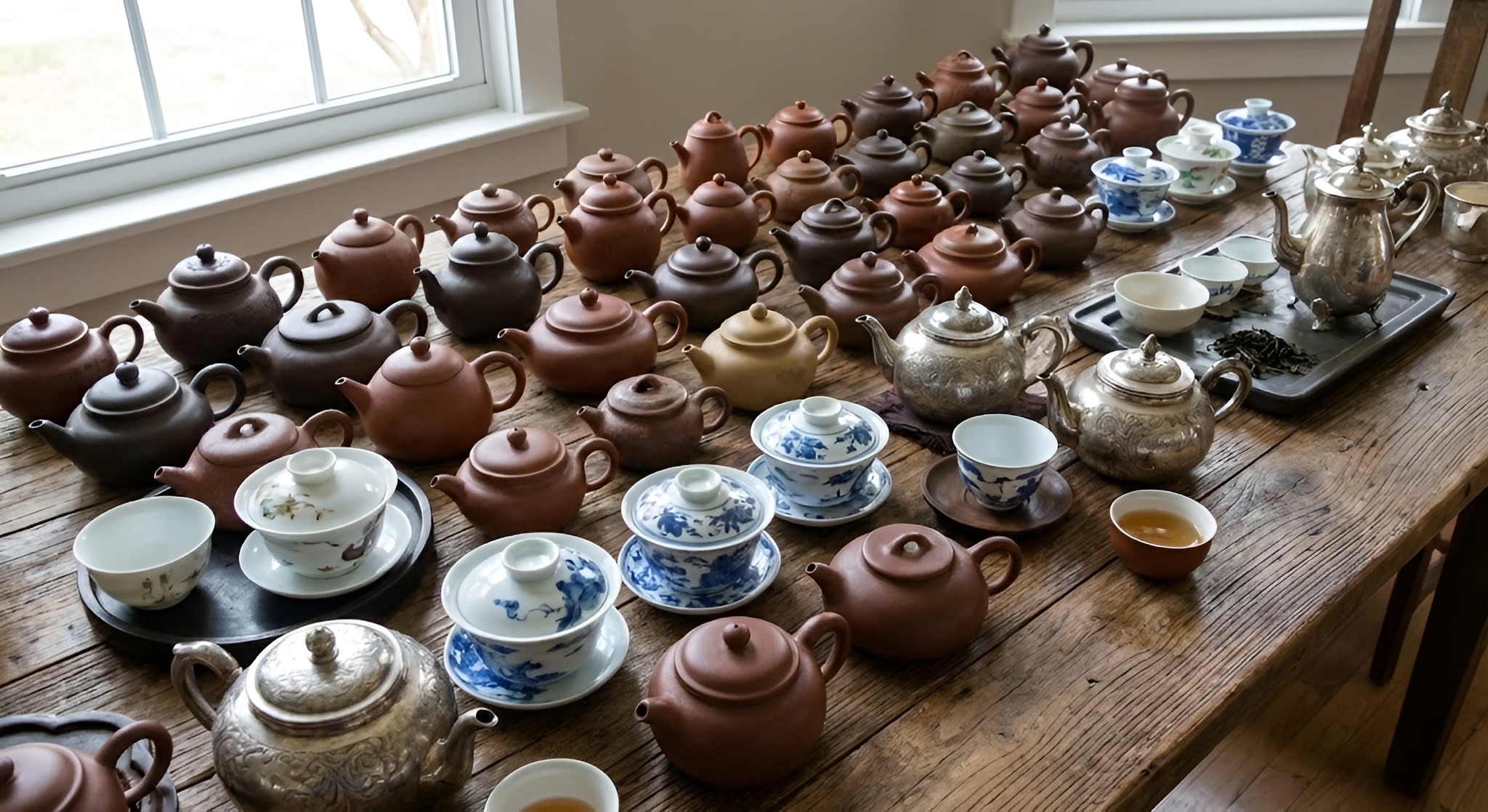
Western ceramic teapots are almost universally glazed inside and out, a convention inherited from eighteenth-century European porcelain manufactories that prized cleanliness, ease of washing, and visual uniformity. Glazing the interior guarantees flavour neutrality and allows a single pot to serve any tea without carryover. By contrast, traditional Chinese Yixing, Japanese Tokoname, and Korean Banko teapots are often left unglazed, or glazed only on the exterior, so that the porous clay absorbs tea oils and develops a seasoned patina over hundreds of infusions.
This seasoning—sometimes called 'raising' the pot—is deliberate: the accumulated oils smooth astringency and add body, and devotees insist that a well-raised pot improves the flavour of a specific tea. The trade-off is irreversible flavour memory. Once an unglazed pot has been used exclusively for, say, a high-roast oolong, it will lend roasted and woody notes to any tea brewed subsequently, making it unsuitable for delicate greens or whites. Unglazed interiors also stain heavily and are impossible to clean to a like-new state; the patina is the point.
For UK households that drink a variety of teas and value convenience, a fully glazed pot is the practical choice. Reserve unglazed teapots for dedicated single-origin brewing if you have the space and inclination; otherwise, prioritise high-fire glazed stoneware or porcelain. If you receive an unglazed pot as a gift and prefer versatility, you can seal the interior with a food-safe ceramic glaze applied cold (available from pottery-supply retailers), though this irreversibly alters the pot's character and is best done only if you will not use it in the traditional manner.
8. Buying Advice: What to Look For in the UK Market
When shopping for a teapot in 2026, glaze chemistry is rarely advertised, but a few observable proxies will steer you toward high-performance options. Country of origin matters: UK, German, and Japanese makers typically fire to cone 9–11 and use well-tested glaze recipes; mass-market imports from lower-cost manufacturers may cut corners with low-fire earthenware glazes that look acceptable but stain within weeks. Weight offers a clue—thick-walled stoneware and porcelain pots are heavier than thin earthenware, and the extra thermal mass improves heat retention regardless of glaze.
Visual inspection is your best tool: hold the pot under bright light and examine the interior for crazing, pinholes, or a rough, chalky texture. Run a fingertip across the glaze—it should feel glass-smooth and slightly cool. Check the join between body and spout interior (a common site for glaze crawling) and the base inside the pot, where glaze application is sometimes skimped. If the seller permits, perform the boiling-water stress test described in section 4; if not, retain your receipt and test at home within the return window.
UK buyers will find high-quality glazed teapots from brands such as London Pottery, Denby, Portmeirion, and Price & Kensington, all of which fire to stoneware temperatures and offer warranties. Japanese imports—especially Tokoname and Banko-ware pots with glazed interiors—are widely available through specialist retailers and combine excellent glaze quality with spout designs engineered to minimise dripping. For those seeking versatility and longevity, prioritise a mid-sized (600–800 ml) stoneware or porcelain pot with a high-gloss, craze-free interior glaze, and plan to use it across your entire tea collection. If you later wish to explore dedicated unglazed pots or experiment with gongfu brewing, add those as specialist tools rather than replacing your workhorse glazed pot, and consult our recommendations for infusers and accessories to round out your setup.
Ask for Cone or Kiln Temperature
Reputable studio potters and small-batch makers will know their firing schedule. A cone-10 oxidation or cone-9 reduction glaze signals serious ceramic engineering; vague answers ('high temperature,' 'really hot') are a red flag.
Comments