1. What Is a Tea Auction and Why Does It Still Matter?
A tea auction is a centralised, time-bound sale where growers (or their appointed brokers) offer lots of loose-leaf tea to the highest bidder—typically blenders, exporters, packers, and large buyers—under standardised terms of payment and delivery. The model dates to 1839 in London (Mincing Lane), moved to Kolkata in 1861 and Colombo in 1883, and today persists in Mombasa (the world's largest by volume, handling Kenyan, Ugandan, Tanzanian, and Rwandan teas), Kolkata, Guwahati, Siliguri, and Coonoor (for Indian teas), and a handful of smaller centres in Sri Lanka, Malawi, and Indonesia. Unlike a retail shop or even a wholesaler, an auction publishes every lot's origin estate or factory code, invoice weight, grade, and—crucially—the price paid, giving the market real-time transparency on quality and demand.
Auctions matter because they remain the primary price-discovery mechanism for commodity and mid-tier teas that make up more than 70 per cent of global black-tea volume. For UK buyers, they offer three advantages: provenance (you know the garden and plucking week), freshness (teas often land in Mombasa or Kolkata within four weeks of manufacture), and cost (no retail or middleman margin, though you pay freight and import yourself). The trade-off is volume, logistics, and the need to cup, blend, or store 10–50 kg before your first pot.
By 2026, digital platforms and estate direct-sales have eroded auction share at the premium end—top Darjeeling first-flushes and Kenyan purples often bypass Kolkata and Mombasa entirely—but for GFOP Assam, BP Kenyan, or Nilgiri Pekoe in commercial quantity, the auction remains unmatched for choice and fairness.
2. The Mombasa Tea Auction: East Africa's Weekly Engine
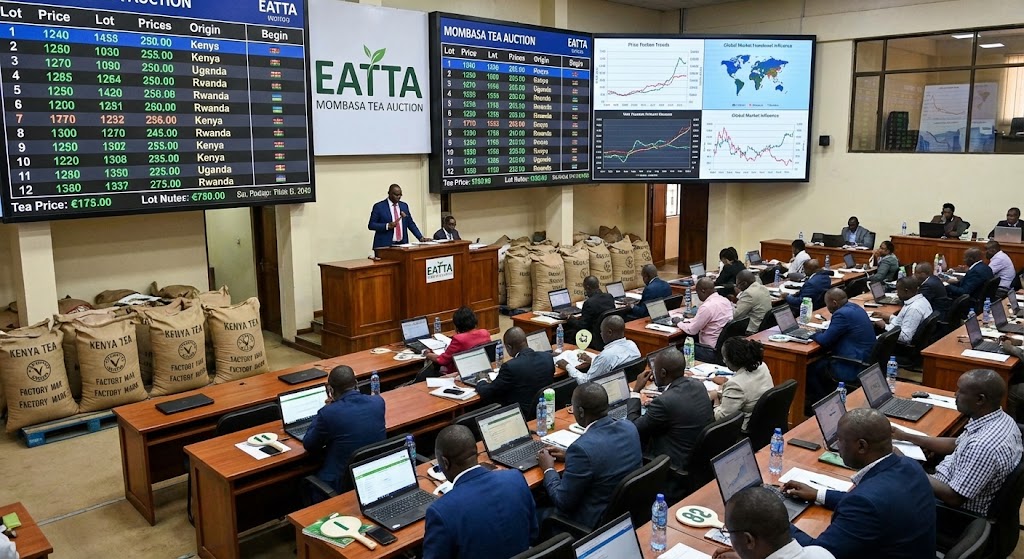
Held every Monday at the East African Tea Trade Association (EATTA) headquarters in Mombasa, Kenya, the Mombasa auction is the world's largest by tonnage, selling roughly 400,000–450,000 tonnes per year of predominantly CTC black tea from Kenya (≈60%), Uganda, Tanzania, Rwanda, Burundi, and a smattering of Malawi and Democratic Republic of Congo lots. The catalogue—published the preceding Wednesday—lists 800–1,200 lots per sale, each identified by a four-letter factory code (e.g., KPCH for a Kericho-area estate), invoice number, net weight, and grade (BP, PF, PD, Dust 1, Fannings, etc.).
UK buyers access Mombasa in one of three ways: (a) registering directly as a buyer through a licensed Mombasa broker (firms like Wm. Whitehead, Export Trading Company, or Chai Trading), who will require proof of UK business registration, VAT number, and often a bank reference; (b) appointing a Nairobi-based buying agent who bids on your behalf and consolidates shipments; or (c) purchasing post-auction from an importer or broker who holds stock in a UK bonded warehouse (less selection, slightly higher per-kilo price, but immediate availability and no freight hassle). Minimum bids are usually one full bag (50–60 kg net), though some brokers will split orders among clients to reach that threshold.
Because Mombasa teas are primarily CTC, the focus is strength, colour, and briskness rather than nuanced aroma; the auction report (a broker's tasting synopsis published alongside the catalogue) uses shorthand like "good colory liquors, useful," "brisk and above average," or "plain and light." Payment is typically net 21 days from sale date, in US dollars, with the buyer arranging collection from the Mombasa warehouse. Shipping to Felixstowe or Southampton takes 4–5 weeks by container; buyers must clear HMRC, pay 20% VAT on the CIF value (duty is zero under the UK–Kenya trade agreement), and arrange onward haulage.
Start with a Broker Consolidation
First-time UK buyers should ask a Mombasa broker if they offer consolidated trial packs—5–10 kg samples drawn from winning lots and air-freighted together—so you can cup multiple estates before committing to a 50 kg bag and sea freight. Some brokers charge a small premium but it avoids costly mistakes.
3. Kolkata, Guwahati, and Siliguri: The Indian Auction Trio
India's tea auctions are split by region: Kolkata (Dooars and some Darjeeling), Guwahati (Assam), Siliguri (Darjeeling and Terai), and Coonoor (Nilgiri, Tamil Nadu). Guwahati is the largest by volume, handling ≈200,000 tonnes/year of orthodox and CTC Assam; Siliguri specialises in premium Darjeeling first- and second-flush; Kolkata covers Dooars and blending-grade Darjeeling; Coonoor is smaller, focused on South Indian orthodox blacks and some green. All operate under the Tea Board of India's auction rules, with sales weekly or fortnightly and catalogues published online (accessible at indiateaportal.com and broker sites).
For UK buyers, the Guwahati and Siliguri auctions are the richest hunting ground: GFOP and TGFOP Assam for single-estate retail packs or café blends, and first-flush Darjeeling SFTGFOP for the specialty market. Registration requires a Tea Board buyer's licence (if purchasing directly) or, more commonly, appointment of a Kolkata broker (firms like J. Thomas, Carritt Moran, or McLeod Russel) who bids on your instruction. You'll need to provide UK business proof, an EORI number (for customs), and agree payment terms—usually sight draft or advance wire, settled within 7–14 days of the sale.
Minimum lots vary: Assam CTC BP might be sold in 40 kg net invoices; orthodox GFOP in 20–30 kg chests; Darjeeling FTGFOP sometimes as little as 10 kg (one chest), especially from smaller estates. The auction catalogue includes the estate name, invoice number, mark (lot code), grade, net weight, number of packages, and garden valuation (the reserve or guide price). Unlike Mombasa, Indian auctions publish the actual hammer price after each sale, so you can track which gardens command premiums and how to interpret week-to-week price swings.
Shipping from Kolkata to the UK takes 5–7 weeks by sea (Nhava Sheva or Kolkata port to Felixstowe); air freight is common for Darjeeling first-flush to preserve the green, muscatel volatiles, cutting transit to 7–10 days but tripling cost. Import duty is zero under the UK–India trade arrangement as of 2026; VAT at 20% applies to (cost + freight + insurance). Many UK buyers use a bonded-warehouse scheme to defer VAT until the tea is withdrawn for domestic sale.
Air-Freight First-Flush, Sea-Freight the Rest
Darjeeling first-flush oxidises and loses its signature muscatel if it sits in a hot container for six weeks; always air-freight those lots. Second-flush and Assam orthodox are more stable—sea freight is fine and saves you £8–£12/kg in shipping.
4. Decoding Auction Grading Codes: Size, Not Quality
Auction catalogues bristle with abbreviations—BP, GFOP, TGFOP1, PF1, Dust 1, Fannings—that describe leaf size and manufacturing style, not inherent quality. A "BP" (Broken Pekoe) CTC from a well-managed Kenyan estate will brew stronger and cleaner than a carelessly made "GFOP" (Golden Flowery Orange Pekoe) from a run-down Indian garden. The grading system evolved in colonial India and Ceylon to standardise sifting screens; buyers use it as shorthand for particle size and therefore infusion speed, but always read it alongside the estate name, season, and the broker's taster note.
Orthodox black-tea grades run from whole-leaf (OP, FOP, GFOP, TGFOP, FTGFOP, SFTGFOP—each prefix adding a claim about tip content or hand-selection) through broken (BOP, FBOP, GBOP, TGBOP) to fannings (BOPF, OF) and dust (PD, D1). CTC grades are simpler: BP (Broken Pekoe, ≈1–2 mm granules, the workhorse of tea-bag blends), PF (Pekoe Fannings, slightly smaller), PD or PF Dust (0.5–1 mm), and Dust 1 or Dust 2 (finest, used for quick-brew bags). Green-tea auctions (rare in Mombasa, more common in Coonoor or direct estate sales) use descriptors like "whole-leaf," "broken," or "young Hyson."
The catalogue will also show invoice net weight (the actual tea, excluding packaging) and tare weight (packaging). You bid and pay on the net. When multiple invoices carry the same mark—"KPCH BP inv 1201–1210"—they are from the same batch and day; bidding is typically per-invoice but some brokers let you take the entire mark at one price. Always cross-reference the auction report: phrases like "good useful teas," "liquors lack brightness," or "well-made, above average" give you the qualitative context the grade alone cannot.
5. Registration, Bidding, and Payment: The Mechanics for UK Buyers
To bid at Mombasa or an Indian auction, you need either (a) direct buyer registration (rare for small-volume UK buyers, as it requires local legal presence or significant import history) or (b) appointment of a licensed broker who bids on your behalf for a commission (typically 1.5–2.5% of hammer price). Most UK tea businesses and serious hobbyists choose route (b): you email your broker each week with instructions ("bid up to $3.20/kg for KPCH BP inv 1205," "buy 20 kg of any TGFOP Assam second-flush under $8.50/kg"), they execute during the live sale (still conducted by voice or silent electronic bidding in the auction hall), and confirm your purchases by close of business.
To set up a broker relationship, contact the firm's export desk (lists are on the EATTA and Tea Board of India websites), provide your UK company registration or sole-trader certificate, VAT and EORI numbers, a trade reference or bank letter, and sign their standard terms. Expect to prepay your first one or two orders by wire transfer before the settlement date; once you've established credit, many brokers offer 7–14 day terms. Payment is in US dollars for Mombasa, Indian rupees (or USD) for Indian auctions, at the exchange rate on settlement day; remember to factor currency risk if sterling is volatile.
For individual enthusiasts or micro-roasters without a business registration, some brokers will informally consolidate small orders (e.g., five hobbyists each wanting 10 kg, grouped into one 50 kg bid) and split shipping; others will refuse below a £500–£1,000 minimum. An alternative is to buy post-auction stock from UK-based importers (Teasenz, Impra UK, or specialist CTC suppliers) who hold inventory in bonded warehouses and sell 5 kg bags at a modest mark-up—less choice, slightly higher price, but no need for broker registration or freight forwarding.
Once you own the tea, you arrange freight: your broker's warehouse in Mombasa or Kolkata stuffs a container or palletises your bags for LCL (less-than-container-load) consolidation. Sea freight Mombasa–UK runs £800–£1,200 for a 20 ft container (holding ≈10 tonnes), plus THC (terminal handling), documentation (£50–£100), and insurance (≈0.5% of value). On arrival at Felixstowe or Southampton, you (or your customs agent) submit the commodity code (0902.xx), pay 20% VAT on CIF, and collect. Air freight costs £4–£6/kg, viable only for Darjeeling first-flush or urgent samples.
Use a Customs Agent for Your First Shipment
HMRC tea classification and VAT deferment can trip up first-timers. A licensed customs clearing agent (fees ≈£75–£150 per shipment) handles entry, bond arrangements, and delivery from port, letting you focus on cupping rather than C88 forms.
6. Online Tea Auctions: Lower Minimums, Faster Delivery, Narrower Range
Alongside the traditional halls, a growing clutch of online auction platforms caters to smaller buyers and direct estate-to-consumer sales. The Indian Tea Board's pilot digital auctions (operational since 2020, expanded in 2024–25) allow registered buyers to bid via web portal on Assam and Darjeeling lots with minimums as low as 5 kg, payment by card or bank transfer, and courier delivery within India or international shipping arranged by the platform. Chai Auction and TeaBid (third-party services) aggregate estates willing to sell smaller parcels, offering English-language interfaces, tasting notes, and sometimes pre-bid samples sent by post.
Advantages for UK buyers: no broker commission (though the platform takes 3–5%), accessible minimums, and faster shipping (estates often use DHL or FedEx for 5–10 kg parcels, arriving in 5–7 days). Disadvantages: narrower selection (many estates reserve online for experimental lots or off-peak volume), less price transparency (winning bids may not be published), and higher per-kilo shipping (courier rates dwarf container LCL once you exceed 20 kg). For a UK café testing three Assam estates before committing to 50 kg, online auctions are ideal; for a blender needing 500 kg of BP Kenyan every quarter, Mombasa remains cheaper and simpler.
A handful of estates in Darjeeling, Nilgiri, and Kenya now run their own annual or seasonal online sales, bypassing auctions altogether. These "direct estate auctions" (often promoted via social media or mailing lists) can yield remarkable first-flush or experimental-cultivar lots at fair prices, but expect limited availability and no standardised grading—each estate invents its own nomenclature.
7. Costs, Duties, and VAT: What UK Buyers Actually Pay
Auction hammer prices are only the start. By the time your Mombasa BP or Guwahati GFOP reaches your UK warehouse, expect the landed cost to include: (a) purchase price, (b) broker commission (1.5–2.5%), (c) warehouse and handling at origin (often bundled, ≈$10–$30 per tonne), (d) freight (sea or air), (e) insurance (≈0.5% of [price + freight]), (f) UK customs entry and agent fees (£75–£150 one-off, or annual retainer), (g) import duty (zero for tea under UK–Kenya and UK–India trade terms in 2026, but check commodity code 0902.10–0902.40 to confirm your shipment qualifies), and (h) VAT at 20% on (cost + insurance + freight).
A worked example: you buy 50 kg of BP Kenyan at the Mombasa auction for $3.00/kg = $150, plus 2% broker commission ($3) = $153. Sea freight (LCL share) ≈$40, insurance $1, origin handling $2 → CIF = $196. At an exchange rate of £1 = $1.27, that's £154. Add UK customs agent (£100 first-time, or £2/kg for repeat clients) → £254. VAT: 20% of £154 = £30.80 (if not deferred via bonded warehouse) → total landed ≈ £284.80, or £5.70/kg. The hammer was $3.00/kg; your landed cost is effectively double once logistics are included. For air-freight Darjeeling, freight alone can exceed the tea's purchase price.
This arithmetic explains why auction buying makes sense at scale: once you're stuffing your own container (10–20 tonnes), per-kilo freight drops to £0.10–£0.15, agent fees spread thin, and you achieve prices 30–50% below UK wholesale. At 5–10 kg, the logistics overhead often negates the saving unless the tea is unavailable retail (e.g., a specific Darjeeling first-flush lot) or you're prepared to absorb the learning cost as an investment in provenance knowledge.
Bond It If You're Reselling
UK VAT-registered businesses should land tea into a bonded warehouse and defer VAT until withdrawal for sale. You pay only when you actually sell and invoice, easing cash flow for stock that might sit three to six months.
8. Where UK Buyers Should Start: A Practical Roadmap
If you're a UK tea business, café, or serious hobbyist contemplating auction access, begin with these steps: First, clarify your annual volume and storage capacity—if you're brewing fewer than 50 kg/year, auction buying is probably overkill; instead, cultivate relationships with subscription services or speciality importers who source auction teas and re-pack in smaller quantities. Second, decide whether you want East African strength (Mombasa CTC BP or PF) or Indian character (Assam GFOP, Darjeeling first-flush); this determines which auction and broker you approach.
Third, request sample catalogues and auction reports from two or three brokers (J. Thomas and Carritt Moran for Indian teas, Wm. Whitehead or Chai Trading for Mombasa) and spend a month reading them alongside published hammer prices—you'll learn which estates are consistent, what seasonal price peaks look like, and how to interpret taster shorthand. Fourth, if possible, visit the UK office of an importer who buys at auction (or arrange a cupping session at a broker's London tasting room, if they maintain one) to physically taste BP versus PF versus GFOP and understand why a $2.00/kg tea and a $6.00/kg tea both carry the label "BP."
Fifth, place a small trial order—one or two 20 kg lots via a broker, or 5 kg through an online platform—to experience the paperwork, shipping timeline, and what 20 kg of loose leaf looks like in your store-room (hint: it's larger than you think). Use that tea to experiment with blending, re-packing, or simply understanding how auction-fresh Assam second-flush differs from the year-old retail equivalent. Finally, track your landed cost per kilogram and compare it against your current wholesale supplier; if the saving is <20% and you're spending hours on logistics, auction buying may not be worth it—but if you're achieving 30–50% saving, sourcing teas unavailable elsewhere, or building a story around single-estate provenance that your customers value, you've found a sustainable model.
Remember that tea auctions are a wholesale channel dressed in romantic provenance; the romance is real—knowing your BP comes from the KPCH factory in Kericho's May harvest, or your SFTGFOP from Castleton's first-flush—but the mechanics are commercial. Approach with a clear volume target, a willingness to learn the jargon, and patience for the first shipment's inevitable hiccups. Once you've mastered one auction and one broker, the system becomes routine, and you gain access to the freshest, most transparently priced teas the global market offers. For many UK buyers, that combination of cost, provenance, and seasonal insight justifies the logistics—and transforms the way they think about tea sourcing altogether.



Comments