1. What Is SCOBY Genetics?
SCOBY genetics refers to the collective genomic blueprint of every microorganism living within your symbiotic culture. Unlike a pure-culture ferment—such as baker's yeast or a single Lactobacillus strain—kombucha is a polyclonal consortium. Each SCOBY contains multiple species of acetic-acid bacteria (principally Komagataeibacter xylinus, K. hansenii, and Acetobacter pasteurianus), lactic-acid bacteria (Lactobacillus spp.), and yeasts (Saccharomyces cerevisiae, Brettanomyces bruxellensis, Zygosaccharomyces bailii, among others). Each species carries its own chromosome and plasmids, and even within a single species individual strains may differ by dozens of genes.
The genetic diversity within a SCOBY determines its metabolic repertoire: which sugars it ferments, which acids and esters it produces, how fast it acidifies tea, and how it responds to temperature swings or novel substrates. When brewers talk about a SCOBY's 'character'—tart versus fruity, robust versus finicky—they are describing the emergent properties of that genetic mix. Because microbes reproduce asexually at different rates and horizontal gene transfer is rare in this context, each batch subtly selects for the fittest strains under your particular conditions, causing the genetic profile to evolve over time.
Modern sequencing targets conserved genomic regions—the bacterial 16S ribosomal RNA gene and the fungal ITS (internal transcribed spacer) region—that act as barcodes. Amplifying and sequencing these fragments from a SCOBY sample reveals not just which species are present, but their relative abundance, enabling you to map your culture's microbial fingerprint with near-clinical precision.
Think Population, Not Recipe
Your SCOBY is an ecosystem, not a fixed formula. Every pellicle hosts a unique population shaped by brewing history, so two SCOBYs from the same mother culture can diverge genetically within a dozen batches if kept in different kitchens.
2. The Core Microbial Players and Their Genetic Markers
At the genetic level, kombucha's symbiosis rests on a handful of key taxa, each contributing essential functions. Komagataeibacter xylinus—formerly Gluconacetobacter xylinus—is the master architect, secreting the long cellulose chains that knit into the floating pellicle. Its genome (~3.4 Mb, sequenced in 2013) encodes a suite of cellulose synthase operons and ethanol dehydrogenase enzymes that oxidise yeast-derived ethanol to acetic acid. The 16S rRNA signature of K. xylinus is so consistent that it serves as a marker for a 'classic' SCOBY; its absence or low abundance often signals drift toward vinegar-like sourness without structural integrity.
Saccharomyces cerevisiae and Brettanomyces bruxellensis supply the alcoholic foundation. S. cerevisiae ferments glucose and fructose into ethanol and CO₂, while Brettanomyces metabolises residual sugars and produces aromatic esters—think tropical fruit or barnyard funk. ITS sequencing distinguishes these yeasts by variable spacer length and sequence polymorphisms; a SCOBY rich in Brettanomyces will yield a more complex, funky brew, whereas Saccharomyces-dominant cultures taste cleaner and carbonate vigorously during second fermentation.
Acetobacter pasteurianus and various Lactobacillus species round out the consortium. A. pasteurianus accelerates acetification in cooler conditions, while Lactobacillus strains produce lactic acid, softening the sharp vinegar edge and contributing a yogurt-like tang. Genetic surveys of SCOBYs from around the world show that diversity peaks in cultures maintained at 20–24 °C with loose-leaf black or green tea, and narrows dramatically in cultures kept above 28 °C or fed only white sugar—conditions that favour fast-growing, acid-tolerant specialists at the expense of slower, flavour-complex strains.
3. DNA Fingerprinting: How Sequencing Identifies Your SCOBY's Strains
DNA fingerprinting for kombucha follows the same amplicon-sequencing workflow used in gut-microbiome research. You begin by extracting total genomic DNA from a small SCOBY sample—typically a 1 cm² plug of pellicle plus a few millilitres of starter liquid. Commercial kits (e.g. Qiagen DNeasy, ZymoBIOMICS) lyse cells and purify DNA in under an hour. Next, you use polymerase chain reaction (PCR) to amplify two targets: the V3–V4 hypervariable region of the bacterial 16S gene (~460 base pairs) and the ITS1 or ITS2 fungal spacer (~300–400 bp). Each fragment is flanked by universal primers that anneal to conserved sequences shared across all bacteria or fungi, ensuring you capture the entire community.
The resulting PCR products are pooled, barcoded with sample-specific molecular tags, and sent for high-throughput sequencing—usually Illumina MiSeq or Nanopore MinION. A typical run returns 50,000–200,000 reads per sample. Bioinformatics pipelines such as QIIME 2, Mothur, or DADA2 trim adapters, filter low-quality reads, cluster sequences into operational taxonomic units (OTUs) or amplicon sequence variants (ASVs), and match each against curated reference databases (SILVA, UNITE). The output is a table listing every detected taxon and its read count, which serves as a proxy for relative abundance.
In 2026, UK brewers can access sequencing through citizen-science platforms (BioBrew, SCOBY Genomics UK) or direct-to-consumer services for £80–£150 per sample, with results delivered as an interactive web dashboard. These tools flag known pathogens, estimate Shannon diversity (a measure of evenness), and compare your SCOBY's profile against a reference library of hundreds of commercial and heirloom cultures. For those who want deeper insight, whole-genome shotgun sequencing (~£400 per sample) resolves strains to subspecies level and reveals functional genes—antibiotic resistance, vitamin synthesis, exopolysaccharide production—that 16S and ITS amplicons cannot distinguish.
Sample the Liquid, Not Just the Mat
The pellicle is rich in cellulose-producing bacteria, but much of the yeast and lactic-acid bacteria reside in the liquid phase. For a complete genetic picture, include equal parts pellicle and starter tea in your DNA extraction.
4. Strain Drift: Why and How SCOBY Genetics Change Over Time
Strain drift is the gradual, non-random shift in a SCOBY's microbial composition driven by selective pressure and stochastic events. Every time you brew a batch, you impose a filter: the microbes best suited to your particular tea, sugar concentration, temperature, and oxygen exposure reproduce faster and contribute more cells to the next generation. Over dozens of batches, this Darwinian winnowing reshapes the community. A SCOBY kept at 18 °C will accumulate cold-tolerant Acetobacter strains; one maintained on oolong tea will favour organisms that metabolise polyphenolic compounds; a culture stored in a sealed jar with minimal headspace will lose obligate aerobes.
Drift is compounded by founder effects during SCOBY propagation. When you peel a thin disc from the mother pellicle to start a new batch, you sample only a subset of the total population—perhaps a few million cells drawn from a culture of tens of billions. If that disc happens to underrepresent Brettanomyces or overrepresent Lactobacillus, the offspring batch will inherit that skew, amplifying the imbalance. Over a year, cumulative drift can reduce Shannon diversity by 20–40 per cent, narrowing the SCOBY to a handful of dominant strains. This loss of redundancy makes the culture more vulnerable to contamination, off-flavours, and failure to acidify.
Environmental shocks accelerate drift. A heatwave that pushes your brewing cupboard to 32 °C may kill temperature-sensitive Brettanomyces while sparing thermophilic Acetobacter. A switch from cane sugar to honey introduces new oligosaccharides that only certain yeasts can ferment, shifting the balance. Even the trace metals in tap water versus filtered water exert selective pressure: copper and chlorine inhibit some strains more than others. The upshot is that no SCOBY remains genetically static; the question is whether drift moves you toward or away from the flavour, acidity, and robustness you want.
Refresh Every Six Months
To counter drift, periodically blend 20 per cent starter liquid from a known, genetically diverse SCOBY source—either a trusted supplier or a frozen backup of your own culture—into your active batch. This genetic top-up restores lost strains without starting from scratch.
5. What Makes a Healthy Pellicle: Genetic and Structural Markers
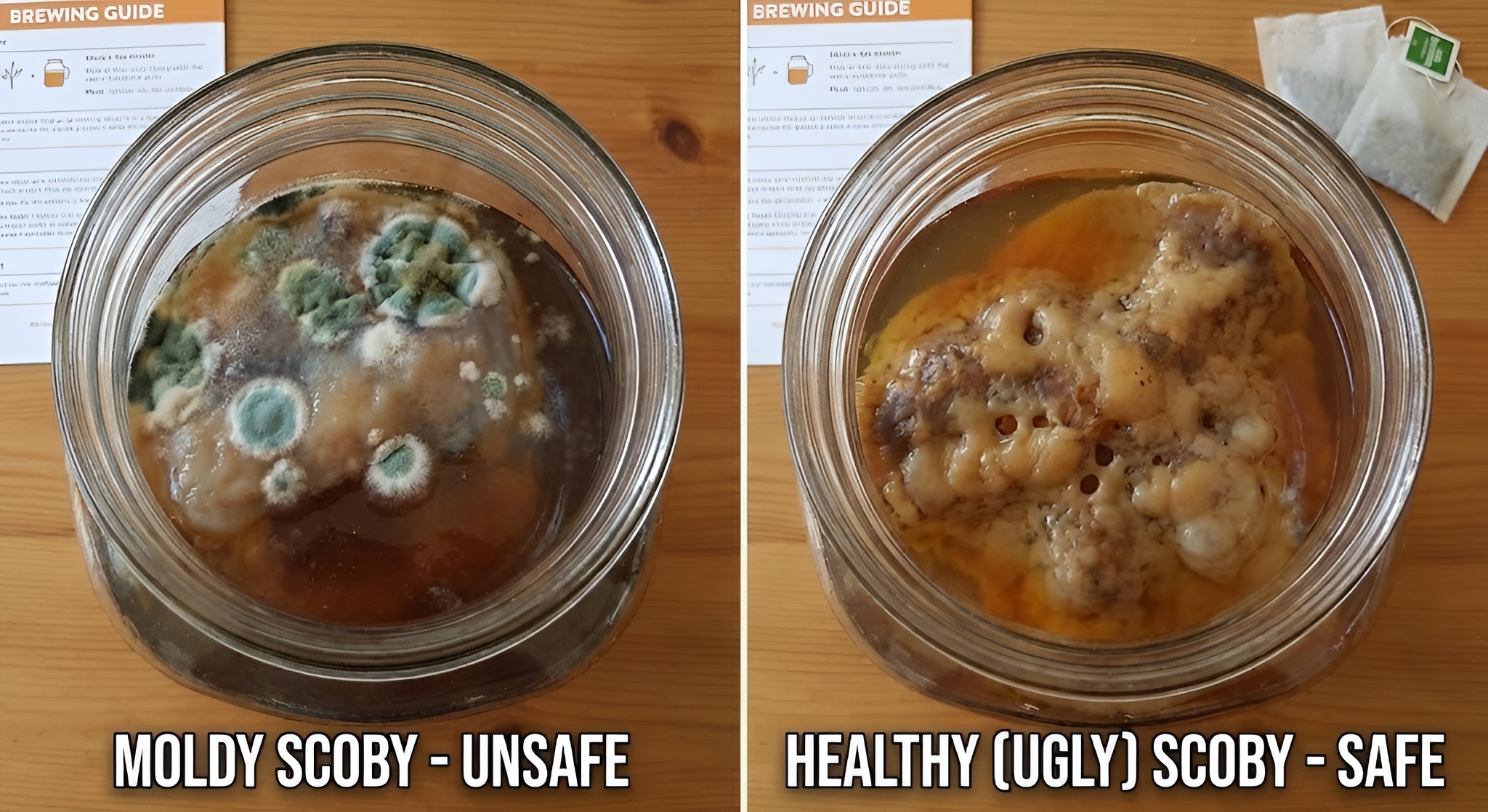
A healthy kombucha pellicle is both a physical structure and a genetic snapshot. Structurally, you want a continuous, 5–15 mm thick cellulose mat that floats or adheres to the liquid surface, off-white to cream in colour, with a smooth upper surface and a shaggy underside studded with yeast clumps. Brown patches, dry cracks, or a slimy texture suggest imbalance. Genetically, health correlates with high Shannon diversity—typically H′ > 2.5 on the 16S side and H′ > 1.5 on the ITS side—and a balanced ratio of acetic-acid bacteria (50–70 per cent of reads) to yeast (20–35 per cent) and lactic-acid bacteria (5–15 per cent).
Key genetic markers of a robust SCOBY include abundant Komagataeibacter xylinus (ensuring cellulose synthesis), presence of both Saccharomyces and Brettanomyces (for primary and secondary fermentation), and at least two Lactobacillus OTUs (for buffering and complexity). Conversely, warning signs include >80 per cent dominance by a single taxon, detection of Candida species other than benign C. stellata, or any reads matching Aspergillus, Penicillium, or coliform bacteria—markers of contamination that sequencing can confirm before visible mould appears.
The pellicle's genetics also govern its resilience to stress. Diverse SCOBYs buffer pH more stably, recover faster from temperature swings, and resist invasion by wild yeasts. Monoculture-like SCOBYs, though they may ferment quickly, are brittle: a single stressor—say, a missed feeding or an accidental chill—can collapse fermentation. For UK brewers aiming to maintain a culture through years of varying conditions, genetic diversity is as important as any single 'super-strain'; it is the redundancy in your microbial toolbox that keeps fermentation predictable and flavour consistent.
6. Practical Applications: Using Genetic Data to Improve Your Brew
Once you have sequencing results in hand, you can make informed interventions. If your SCOBY shows <90 per cent Komagataeibacter and negligible yeast, you know carbonation will be weak and alcohol near zero; the remedy is to inoculate with a yeast-rich starter or lower your fermentation temperature to favour slower, yeast-promoting conditions. If Brettanomyces has vanished, expect flat, one-dimensional flavour—consider blending in a pellicle from a commercial kit known to carry Brettanomyces strains, or pitch a small amount of bottle-conditioned saison or lambic (both rich in Brett) to reintroduce the funk.
Genetic data also guides substrate choice. If sequencing reveals high Lactobacillus plantarum, your culture will thrive on maltose-rich worts or honey, which L. plantarum ferments efficiently; switching from black tea to a malt-tea blend may unlock new complexity. Conversely, a SCOBY dominated by Acetobacter pasteurianus performs best on simple sugars and high-polyphenol teas—think Assam or Ceylon—and will struggle with delicate whites or herbals. By aligning your tea selection with your culture's genetic strengths, you maximise flavour and minimise lag time.
For commercial or experimental brewers, strain isolation opens further possibilities. Using dilution plating and selective media, you can isolate individual colonies, confirm identity by PCR, and propagate pure or defined mixed cultures. This approach—common in the natural-wine world—lets you engineer bespoke flavour profiles: a SCOBY with only K. xylinus and S. cerevisiae for clean, crisp kombucha, or a wild-ferment mix with multiple Brettanomyces strains for sour-beer complexity. While most home brewers will prefer the convenience and resilience of a diverse, self-regulating consortium, knowing your SCOBY's genetics demystifies the process and empowers targeted adjustments rather than trial-and-error tweaking.
Log Each Batch Alongside Genetic Snapshots
Sequence your SCOBY every 20–30 batches and record pH, taste notes, and brewing conditions. Over time, you'll correlate genetic shifts with flavour changes, building a personalised strain–flavour map that guides future interventions.
7. Managing Drift and Maintaining Genetic Stability at Home
Preventing runaway drift requires consistency and occasional reseeding. Keep your brewing environment as stable as possible: fixed temperature (ideally 22–24 °C, aided by a heating mat in winter), the same tea blend and sugar type, and regular feeding schedules. Use the continuous-brew method rather than batch-by-batch propagation; continuous systems draw liquid from the bottom while fresh tea is added at the top, maintaining a large, stable reservoir of all strains and reducing founder effects.
Every six months, cross-reference your active SCOBY with a frozen or dried backup. Freeze-drying or storage in 15 per cent glycerol at –20 °C arrests genetic change, preserving your culture's original profile. When drift becomes noticeable—flavour flattens, fermentation slows, or a sequencing run shows diversity loss—thaw a backup aliquot, rehydrate it in sweet tea, and blend 100–200 ml of the revived starter into your active batch. This genetic rescue restores lost strains without discarding months of adaptation.
Finally, consider joining a UK SCOBY-exchange network. Groups such as Real Kombucha Community and SCOBY Library UK maintain genetically documented cultures that members can request or trade. Bringing in a pellicle from a geographically or methodologically distant source introduces novel strains, broadening your gene pool and buffering against monoculture fragility. Treat your SCOBY as a living library: periodically refresh its contents, document its evolution, and bank copies for future restoration. In this way, genetic drift becomes not a threat but a manageable, even creative, aspect of long-term kombucha brewing.
Freeze-Dry for Long-Term Insurance
Home freeze-dryers (£1,500–£2,000 in 2026) let you preserve SCOBY samples indefinitely at room temperature. Rehydration typically recovers >70 per cent of strains, offering decades-long genetic backup without a lab freezer.
8. UK Resources: Where to Sequence and How to Interpret Results
In 2026, several UK-based services cater to home and small-scale kombucha brewers. BioBrew Labs (London) offers 16S+ITS sequencing for £95, with results in two weeks and an online dashboard showing taxon abundances, diversity indices, and contamination alerts. SCOBY Genomics UK (Edinburgh) charges £120 but includes a consultation call with a microbial ecologist who interprets results and suggests adjustments. Both services accept samples by post: you ship 10–20 ml of starter liquid or a thumbnail-sized pellicle fragment in a sterile tube, and they handle extraction, PCR, and sequencing.
For those comfortable with bioinformatics, open-source pipelines such as QIIME 2 and the R package phyloseq allow you to analyse raw sequencing data yourself. Many university libraries and maker-spaces now host drop-in bioinformatics clinics where you can bring a laptop and work through the pipeline with expert guidance. The learning curve is steep—expect a weekend to master the basics—but the reward is complete control over analysis parameters, custom visualisations, and the ability to re-analyse data as reference databases improve.
Interpreting results requires some microbiology literacy, but the key metrics are straightforward. Relative abundance tells you which strains dominate; Shannon or Simpson diversity quantifies evenness (higher is generally better); Bray–Curtis dissimilarity measures how much your SCOBY differs from a reference or from a previous time point. Most dashboards flag potential pathogens and compare your community structure to a database of known 'good' SCOBYs. If you spot an unfamiliar taxon, cross-reference it in the NCBI or MycoBank databases; many environmental bacteria are harmless passengers that contribute little to fermentation. The real value of sequencing is not chasing perfect microbial purity—kombucha is inherently wild—but tracking trends, diagnosing problems early, and making data-driven decisions when flavour or performance shifts.
Comments