1. What Is a Tea Auction Lot Number?
A lot number is the unique identifier assigned to each batch of tea offered for sale at auction. It appears in the printed or digital catalogue alongside the quantity (usually in kilograms or packages), the grade, and the broker's valuation. Unlike a commercial brand name, the lot code is designed for wholesale trade: it tells professional buyers which producer made the tea, roughly when it was manufactured, and what leaf style or particle size to expect, all without opening a chest or brewing a sample.
The structure varies by auction centre. Kolkata uses an estate code plus invoice serial; Mombasa prefers a warehouse mark plus season letter. Both systems evolved to handle thousands of lots each week while preserving traceability back to the garden gate. For the buyer sitting in a tasting room with a hundred samples, that compressed string of characters is the first filter: it signals whether the lot matches the profile—region, flush, grade—being sought, and whether it is worth the time to cup. For anyone tracing a retail packet back through the supply chain, the lot number is the Rosetta Stone that links final blend to origin estate.
2. Kolkata Auction Lot Codes: Structure and Components
Kolkata (and the linked centre in Siliguri) handles tea from four main growing regions: Darjeeling, Assam, the Dooars, and the Terai. A typical Kolkata lot code takes the form ESTATE-INVOICE-GRADE—for example, MARG-123-FTGFOP1 or HATT-456-GBOP. The estate abbreviation is a two- to five-letter mnemonic assigned by the Indian Tea Association; Makaibari becomes MKBI, Hattiali becomes HATT, Margherita becomes MARG. These codes are public and consistent year to year, so once you learn them you can spot your favourite gardens instantly.
The invoice number is a sequential serial that resets each season (April to March in India). Invoice 001 will be the garden's first dispatch of the year—often prized first-flush Darjeeling or early Assam—while invoices in the 200s or 300s indicate mid-season or rain-flush leaf. Brokers and buyers use the serial as a rough harvest-date proxy: a low number in May signals peak spring character; a high number in September points to autumnal or monsoon make. The final element is the grade—SFTGFOP, TGFOP, FTGFOP1, BOP, BP, PF, etc.—which describes leaf size, tip content, and whether the tea is orthodox (whole-leaf or broken) or CTC (cut-tear-curl pellets). Grade alone does not guarantee cup quality, but it narrows the sensory expectation and reflects the plucking standard and sorting rigour at the factory.
Decode the Invoice for Flush
Invoice numbers below 050 in a Darjeeling catalogue usually mean first flush (late March to April); 050–150 hints at second flush (May–June); anything above 200 is likely monsoon or autumn. Check the sale date to confirm, but the serial is your fastest flush clue.
3. Mombasa Auction Lot Codes: Warehouse Marks and Season Letters
The Mombasa auction dominates East African black tea and uses a different notation. A typical code looks like ABC/45K/BP1 or XYZ/12G/PF1. The first element—ABC, XYZ—is the warehouse mark, a short alphabetic code registered to a specific producer or factory. Kenya Tea Development Agency (KTDA) factories each have a unique mark (e.g., Gatura is GAT, Kiegoi is KIE), as do private estates. The East African Tea Trade Association publishes a register, and experienced buyers memorise the marks of their preferred sources.
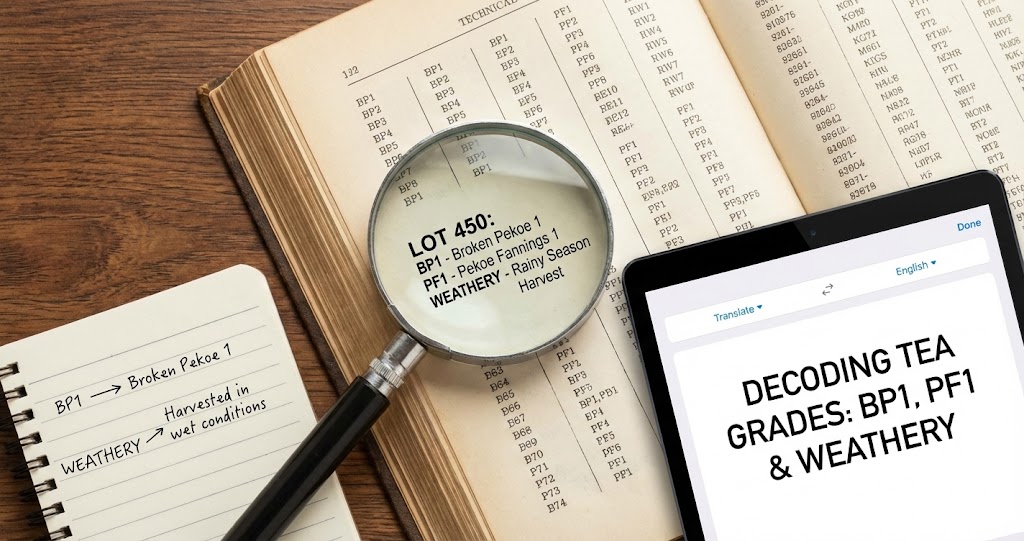
The middle segment combines a serial number and a season letter. The letter runs A through M, corresponding roughly to calendar months or half-months: A and B cover January, C and D February, and so on, with M representing late December. (Some years compress or skip letters depending on the auction calendar.) A lot marked 12E therefore means the twelfth consignment from that factory in early March. Season letters let buyers pinpoint harvest timing without waiting for a full production date, critical in East Africa where rainfall patterns shift quality week by week. The final component is the grade—BP1 (broken pekoe), PF1 (pekoe fannings), PD (pekoe dust), etc.—which again describes particle size and sorting category rather than intrinsic quality, though BP1 and PF1 command premiums over dusts in most markets.
Because Mombasa handles such large weekly volumes—often 6 000–8 000 lots per sale—the warehouse-mark system keeps the catalogue compact while preserving full traceability. UK online buyers can cross-reference the mark to confirm the factory's altitude, rainfall, and historical cup profile before bidding.
4. What the Grade Codes Really Tell You (and What They Don't)
Grade nomenclature varies between orthodox (whole- and broken-leaf) and CTC (pellet) manufacture. Orthodox Darjeeling and high-grown Assam use designations like SFTGFOP (Special Finest Tippy Golden Flowery Orange Pekoe), FTGFOP1, TGFOP, GFOP, and so on down through FOP, OP, and into brokens—FBOP, GBOP, BOP—and fannings. Each letter signals a feature: T for tippy (golden or silver bud content), G for golden, F for finest or flowery, the numeral 1 (or even SF or EX) indicating a factory's top sorting. In practice, tippy whole-leaf grades fetch premiums because they imply careful two-leaf-and-bud plucking and minimal breakage during rolling.
CTC teas—dominant in Assam plains, Dooars, and all of East Africa—use a simpler ladder: BP (broken pekoe), BOP, PF (pekoe fannings), PD (pekoe dust), D (dust), with numerals (BP1, PF1) denoting finer sievings. Dust grades are the smallest particles and brew quickly with strong colour, making them popular for teabags, while BP and PF offer slightly larger leaf and more nuanced liquor. Crucially, grade is not a quality score; a well-made PF1 from a high-elevation KTDA factory can out-cup a poorly handled BP1 from a low-altitude estate. Buyers rely on the physical sample and cupping notes published by the broker, using the grade only to confirm that particle size matches their blend specification or retail format.
The lot code's grade component thus serves as a screening tool: if you are a UK packer sourcing leaf for loose-leaf retail, you filter for TGFOP or FTGFOP1; if you need bag-cut for a breakfast blend, you search BP1 or PF1. The code tells you what is in the chest before you taste, saving hours of irrelevant cupping.
Tip Content ≠ Cup Quality
High tip ratios (FTGFOP, SFTGFOP) look impressive and often fetch premiums, but a tea can be over-tippy—light in body and lacking the mature-leaf tannins that give structure. Always cup; the best liquor balance trumps grade nomenclature.
5. Reading Catalogue Valuations and Reserve Prices
Most auction catalogues list a valuation or upset price alongside each lot—the broker's estimate or the seller's minimum acceptable bid. In Kolkata this figure is expressed in rupees per kilogram; in Mombasa, in US dollars (occasionally Kenya shillings). The valuation reflects recent market trends, the lot's cupping score, seasonal demand, and the estate's brand equity. A first-flush Darjeeling SFTGFOP1 from a renowned organic garden might carry a valuation of ₹800–1 200/kg, while a monsoon-flush Assam BP1 may be listed at ₹250–350/kg.
Valuations are not fixed prices. Competitive bidding can push the hammer price well above valuation if the cup quality surprises or if two buyers need that exact profile for a retail contract. Conversely, a lot may be withdrawn ("W/D") if bids fail to meet the reserve. For UK buyers reviewing post-sale reports, the gap between valuation and final price signals market sentiment: consistent premiums suggest tight supply or exceptional quality; frequent withdrawals point to over-optimistic reserves or a soft demand week.
Learning to interpret valuations in tandem with lot codes sharpens your bidding strategy. A high valuation on invoice 005 from a top Darjeeling estate is predictable—first flush always commands a premium—but a surprisingly high valuation on invoice 150 (late second flush or early monsoon) may flag an unusually good manufacturing result that week, worth investigating through the broker's sample service.
6. Tracing Provenance: From Lot Code to Estate and Terroir
One of the lot code's most powerful uses is provenance verification. In an era when consumers (and retailers) demand transparency, being able to trace a retail pack back to a specific garden and harvest week builds trust and justifies premium pricing. If a UK brand claims "single-estate Darjeeling, first flush 2026," a buyer can request the invoice and lot number, look up the estate code in the ITA register, and confirm that the invoice serial falls in the expected first-flush range (typically 001–050) and that the sale date aligns with April or early May.
For online auction platforms, lot codes become clickable metadata. E-auction portals in Kolkata and Mombasa let registered buyers search by estate code, grade, or season letter, download broker tasting notes, and view scanned samples. This digital traceability has opened wholesale markets to smaller UK importers who lack the resources to station a taster in Kolkata year-round; the lot code is the索引 that makes remote buying feasible and accountable.
Beyond compliance, provenance detail enriches storytelling. A speciality retailer can tell customers, "This is Thurbo estate, invoice 042, second flush 2026, BP1 grade"—a level of specificity that differentiates artisan tea from commodity blends and connects the drinker to the precise hillside and harvest day. In fine-tea circles, collectors even track favourite estates' invoice sequences across years, noting when a garden's peak-quality window falls and adjusting purchase timing accordingly.
Cross-Check Sale Date and Invoice
An invoice number alone does not confirm flush. Always pair it with the auction sale date: invoice 080 sold in early June is likely second flush Darjeeling, but the same invoice sold in August suggests monsoon leaf. The sale date locks in the harvest context.
7. Practical Tips for UK Buyers Using Lot Codes
Build a reference library. Download the current ITA estate-code list and the EATTA warehouse-mark register; print or bookmark them. After a few months of regular catalogue review, you will recognise your preferred producers on sight, and bidding decisions accelerate. Many UK importers keep a spreadsheet mapping lot codes to cupping scores, so patterns—"Hattiali invoices 030–060 consistently deliver malty brightness"—become visible over seasons.
Use lot codes to time purchases. If you know a Kenyan factory's high-elevation peak falls in season letters F–H (March–April), filter your Mombasa searches for those letters and prioritise sampling. Conversely, avoid late-year serials (letters K–M) from the same factory if historical data shows quality drops during short rains. The code is your calendar; respect the seasonality it encodes.
Request broker samples by lot number. Rather than asking vaguely for "some Assam BP1," specify "HATT-145-BP1 from Sale 23"—the broker pulls exactly that chest, and your cupping notes tie directly to a known provenance and price. This precision is especially valuable when comparing multiple gardens or negotiating forward contracts based on historical lot performance. Finally, share lot-code detail downstream: if you are blending or private-labelling for retail, pass the estate code and invoice to your compliance or marketing teams. It future-proofs traceability, supports organic or fair-trade certification audits, and turns an opaque auction purchase into a transparent, story-rich product that UK consumers increasingly expect.
Track Your Wins and Losses
Keep a simple log: lot code, hammer price, your cupping score, and whether the tea met expectations. Over a season you will spot which estates under-promise and over-deliver, and which rely on brand reputation more than cup quality—information that sharpens every future bid.
8. Common Pitfalls and How to Avoid Them
Assuming grade equals quality. The most frequent mistake is treating FTGFOP1 or BP1 as a guarantee of great tea. Grade describes appearance and sorting, not flavour, aroma, or freedom from defects. A careless fermentation or poor drying can ruin any grade; always cup or request a broker report before committing to volume. The lot code narrows the field; the cup decides the purchase.
Ignoring invoice sequence. Buyers sometimes cherry-pick high invoices late in the season, hoping for a bargain, then wonder why the tea tastes flat or vegetal. High serials are not inherently bad—Darjeeling autumnals (invoices 180–250) have their own charm—but they are different from first or second flush. Match your purchase intent to the likely flush window encoded in the invoice, and set expectations accordingly. If you need bright, muscatel second-flush character, do not bid on invoice 200 in September, no matter how attractive the price.
Overlooking season letters in Mombasa. A lot marked J (May) in East Africa coincides with long rains and can show grassy or thin liquor, whereas C or D (February) often captures dry-season concentration. The single-letter clue is easy to miss in a fast-scrolling catalogue, but it is as important as the warehouse mark. Slow down, decode every component, and filter ruthlessly before sampling. Finally, do not assume all estates with similar codes are comparable. Two Assam gardens may both dispatch invoice 050 in the same week, but altitude, cultivar, and factory skill vary widely. The lot code is a starting point for due diligence, not a substitute for tasting, visiting, or consulting a trusted broker who knows the estates intimately.
Comments