1. What Counts as an Outdoor Tea Brewing Kit
An outdoor tea brewing kit comprises three functional components: a heat source (or boiling vessel that incorporates one), a brewing chamber (gaiwan, teapot, infuser basket, or grandpa-style glass), and optionally a serving or cooling vessel. For this guide we define 'outdoor' as pack-portable and usable without mains electricity or fixed infrastructure—so a 900 g cast-iron tetsubin is out, but a 60 g titanium gaiwan and a twig-fed Kelly Kettle are in. We exclude large expedition base-camp setups (multi-litre pressure cookers, group French presses) and focus on kits for one to three people brewing in remote or semi-remote UK locations: lakeshores, mountain bothies, coastal wild-swimming spots, and forest clearings.
The distinction between boiling and brewing is critical. Many outdoor enthusiasts boil water in a generic camping kettle or pot, then brew in a mug with a tea bag or loose leaves grandpa-style. That works, but it's not optimised for temperature-sensitive teas (Japanese greens, high-mountain oolongs, silver-needle whites) or multiple infusions. A true outdoor tea kit allows you to control temperature, infusion time, and leaf-to-water ratio in the field, replicating—within reason—the precision you'd achieve at home. That might mean a thermometer clipped to your pack, a double-walled vessel that holds heat, or simply the experience to judge temperature by steam and sound.
For UK conditions in 2026, durability and weather resistance trump absolute weight savings. A 50 g titanium pot is appealing on paper, but if condensation shorts your piezo igniter in Welsh drizzle or you crack your gaiwan on a Cairngorms granite slab, the lightest kit is useless. We prioritise robust materials (stainless steel, food-grade silicone, anodised aluminium, titanium), simple mechanisms with few failure points, and designs that tolerate wet hands, gusty wind, and pack compression.
The Two-Vessel Minimum
Always carry one vessel for boiling and one for brewing, even if brewing grandpa-style. Boiling directly in your drinking cup risks scorching leaves, and you can't control temperature or pour off an infusion cleanly. A 500 ml titanium pot plus a 150 ml gaiwan weighs under 120 g combined and transforms your options.
2. Twig-Fed Rocket Kettles: Kelly Kettle, Ghillie, and Alternatives
The Kelly Kettle—an Irish double-walled chimney design from the 1890s—remains the gold standard for fast, fuel-free boiling in wet UK conditions. You build a small fire in the base (dry grass, birch bark, pine cones, twigs), set the kettle's hollow chimney over it, and the draw of rising heat boils 1–1.5 litres in three to five minutes. The 2026 stainless 'Scout' model (1.2 L, 650 g, £85) is our top pick for wild swimmers and day hikers: it's lighter than the aluminium 'Base Camp' (1.6 L, 950 g), packs down to 18 cm height, and the stainless interior won't taint delicate whites or greens. The water boils violently, so let it rest 60–90 seconds before pouring onto temperature-sensitive leaves.
Competitors have emerged. The Ghillie Kettle (Scotland, aluminium, 1.0 L, £68) is functionally identical but lighter (550 g) and cheaper; the trade-off is that aluminium can impart a metallic note if you're brewing very soft Scottish highland water with minimal buffering capacity. The Petromax Fire Kettle (Germany, stainless, 1.2 L, 720 g, £95) adds a grill plate that sits atop the chimney, letting you toast bread or warm a pasty while the kettle boils—useful for long bothy evenings, overkill for a quick post-swim brew. All three designs share the same constraints: you need dry kindling (birch bark and fatwood are your friends in the UK's damp climate), a stable base (rocky lakeshores are better than deep heather), and ideally a windbreak, though the chimney's draw helps in breezy conditions.
Legal note: in England and Wales, lighting any fire (including a Kelly Kettle) on open-access or common land requires the landowner's permission, and many national parks prohibit open flames outright. Scotland's Land Reform Act (2003) grants a right to light small, temporary fires on most wild land, provided you cause no damage and remove all trace—but local byelaws in Loch Lomond & The Trossachs and Cairngorms National Parks restrict fires near popular lochshores and bothies. Always check current guidance, use existing fire sites where available, and carry a lightweight butane backup (MSR PocketRocket, Soto Windmaster) if fire restrictions apply.
3. Packable Gongfu Sets: Titanium, Silicone, and Hybrid Designs
Gongfu brewing—short, multiple infusions in a small vessel—has crossed over from the teahouse to the trailhead, and 2026's packable gongfu kits are lighter, tougher, and more thermally efficient than the fragile porcelain travel sets of five years ago. The key innovation is double-walled titanium gaiwans (Keith Titanium, Snow Peak, Boundless Voyage): a 100–120 ml gaiwan weighing 45–65 g, with an air gap that insulates your fingers from the hot outer wall and slows heat loss between infusions. These pack inside a titanium or silicone fairness pitcher, which in turn nests inside your cooking pot, so the entire gongfu setup adds negligible bulk.
A complete titanium gongfu kit for the outdoors includes: a double-walled gaiwan (100–150 ml, ~55 g, £30–45), a collapsible silicone fairness pitcher (150–200 ml, ~40 g, £12–18, brands like Sea to Summit and Hydaway now make tea-specific versions with fine mesh strainers), and two to three double-walled titanium cups (50–70 ml each, ~25 g, £8–12). Total weight: 140–180 g, total pack volume roughly equivalent to a 500 ml Nalgene bottle. You boil water separately (Kelly Kettle, Trangia, or butane stove), let it cool to temperature, then brew as you would at home. The silicone pitcher collapses to 2 cm thick and tolerates being squashed at the bottom of a dry bag.
Ceramic 'travel gongfu' sets remain available—lidded porcelain gaiwans in padded nylon cases—but they're fragile, heavy (200–350 g), and the padding adds bulk. Reserve these for car camping or campervan wild swimming, where pack weight is irrelevant. For true backpacking and bikepacking, titanium and silicone are the only sensible materials. One hybrid worth noting: the Outdoor Vitals Collapsible Kettle + Gaiwan (2026 release, £58), a 750 ml silicone kettle with a nested 120 ml titanium gaiwan and integrated mesh filter, designed to boil directly on a butane stove. It's clever for minimalists, though the silicone kettle's boil time (8–10 minutes on a PocketRocket) is slower than a Kelly Kettle or aluminium pot.
Mind the Leaf-to-Water Ratio
In a 120 ml gaiwan, 5–7 g of leaf (a generous pinch) is standard for oolongs and pu-erh; scale down to 3–4 g for delicate greens and whites. Pre-portion into small zip-lock bags or carry a micro-scale (10 g capacity, ~20 g weight) if you're brewing expensive competition-grade teas in the wild.
4. Solar Kettles and Thermoelectric Options: When They Work (and When They Don't)
Solar kettles—evacuated-tube designs that focus sunlight to boil water without fuel—enjoy periodic hype, and 2026 is no exception. The GoSun Brew (£180, 900 g, 500 ml capacity) and the SunKettle (£145, 1,100 g, 800 ml) both claim to boil water in 20–40 minutes in direct sun. In practice, UK testing (Lake District, June 2026, clear skies) achieved a rolling boil in 28–35 minutes when the sun was within 30° of zenith and the tube was re-angled every five minutes. Cloud cover, haze, or low sun angle (common before 10:00 and after 16:00, even in summer) doubles the time or prevents boiling entirely. For winter wild swimming—sunrise dips at 08:30, weak sun, frequent overcast—solar kettles are ornamental.
That said, solar kettles have one genuine use case: multi-day summer bikepacking or sea-kayaking trips where you're camped on a beach or open moor during midday rest breaks, and you have the luxury of setting up the kettle, wandering off for a swim, and returning to hot water half an hour later. They're also popular with sun tea enthusiasts, though true sun tea (cold-brewing in sunlight) doesn't require boiling and is better made in a clear glass jar. The weight and bulk of a GoSun or SunKettle (packed length 40–50 cm) are justified only if you're avoiding stoves and fires altogether—perhaps on a sailing passage or in a fire-ban area during a drought summer.
Twelve-volt travel kettles are a different proposition. Designed for lorry cabs and campervans, models like the Waeco PerfectKitchen MCK750 (£48, 650 ml, 850 g) and RoadPro 12V (£38, 500 ml, 680 g) plug into a vehicle's cigarette lighter or a portable 12 V lithium battery pack (Jackery, EcoFlow). Boil time is 12–18 minutes for 500 ml—slow, but hands-off, and you can brew inside the van while towelling off after a swim. They're impractical for backpacking (too heavy, requires a battery pack adding another 500–2,000 g), but they're ideal for car-based wild swimmers and campervan tourers who prioritise convenience and don't want to fiddle with stoves in the dark. Pair one with a portable 100 Wh battery pack (e.g., Anker 521, 1.2 kg, £90) and you can boil three to four times before recharging.
5. Water Quality and Mineral Content in UK Wild Brewing
Boiling stream or loch water is romantically appealing, but UK wild water varies wildly in mineral composition, and that variation affects extraction and flavour more dramatically than most campers realise. Scottish highland burns—fed by granite catchments and peat bogs—typically measure 10–35 mg/L total dissolved solids (TDS), with calcium and magnesium near zero. This very soft water struggles to extract flavour from delicate greens and whites, often producing thin, flat brews. By contrast, limestone-fed springs in the Yorkshire Dales or Peak District can exceed 250 mg/L TDS, with high calcium that accentuates astringency in over-brewed blacks and can make oolongs taste chalky.
In practice, most wild swimmers and campers won't carry a TDS meter (though pocket models weigh under 50 g and cost ~£15). Instead, learn to taste and adjust. If your morning Yunnan gold tastes watery and you're brewing from a Scottish burn, add a tiny pinch (0.1–0.2 g) of food-grade magnesium sulphate (Epsom salt) to your kettle before boiling; this lifts TDS to ~50–80 mg/L and noticeably improves body and sweetness. Conversely, if you're brewing a Japanese sencha with hard Peak District spring water and it tastes bitter, either shorten your infusion time or cut the water 50:50 with bottled spring water (Tesco Ashbeck, widely available, ~20 mg/L TDS, is a favourite among competition tea judges and packs light if you're car camping).
Always filter or boil wild water for microbial safety, even in remote Scottish headwaters. Giardia and Cryptosporidium cysts survive in cold, fast-flowing streams and are undetectable by eye. A rolling boil (100 °C for one minute at UK elevations, longer if brewing above 1,500 m) kills all pathogens. If you're using a gravity filter (Sawyer, Katadyn) to save fuel, note that most filters remove protozoa and bacteria but not viruses (rare in UK wild water, but present in streams downstream of livestock). For tea purposes, filtered water is fine; for drinking untreated, boil or use a purifier (Grayl, SteriPEN) rather than a simple filter.
The Pinch-of-Salt Trick
If you've forgotten magnesium sulphate, a single grain of sea salt (literally one crystal, ~0.05 g) in 500 ml of very soft water lifts perceived sweetness and body without making the tea taste salty. It's a temporary fix, not a substitute for proper mineralisation, but it works in a pinch.
6. Butane and Multi-Fuel Stove Systems for Tea Brewing
Butane canister stoves (MSR PocketRocket, Soto Windmaster, Jetboil Flash) are the default choice for UK hillwalkers and bikepacker tourers, and they work well for tea if you understand their limitations. A PocketRocket 2 (£40, 73 g, ~2.5 kW) boils 500 ml in a 900 ml titanium pot in 3.5–4 minutes in calm conditions, using roughly 8 g of gas. Pair it with a simple windscreen (aluminium foil, or a dedicated MSR model, 30 g) and you'll maintain that boil time even in stiff moorland breezes. The advantage over a Kelly Kettle is speed control: you can simmer water at 85–90 °C for green tea, or hold a gentle boil for grandpa-style infusions, rather than the violent 100 °C eruption a rocket kettle produces.
For multi-day trips, canister weight and disposal become issues. A 100 g butane/propane canister provides roughly 80–100 boils of 500 ml (depending on windscreen use and ambient temperature); once empty, you must pack it out. That's fine for a weekend, but on a week-long Hebridean tour you'll carry two or three spent canisters. Multi-fuel stoves (MSR WhisperLite, Primus OmniLite) burn petrol, kerosene, or methylated spirits and are resupplied from any petrol station or hardware shop, making them better for extended remote trips. The trade-off is weight (300–400 g vs. 70–90 g for a canister stove), complexity (priming, maintenance), and the fact that liquid fuels are messier and smellier—petrol fumes can taint tea leaves if stored in the same stuff sack.
One niche option for ultralight purists: alcohol stoves (Trangia, DIY cat-food-can designs). A Trangia Mini (110 g complete with pot stand and windscreen, £25) boils 500 ml in 8–10 minutes using ~20 ml of methylated spirits. It's silent, has no moving parts, and meths is available in every UK hardware and camping shop. The slow boil time is a drawback for a quick post-swim brew, but the simplicity and reliability appeal to long-distance walkers and bothygoers who value quiet, low-tech ritual over speed.
Temperature Control Without a Thermometer
Canister and alcohol stoves let you dial in temperature by ear and eye. For 80–85 °C (Japanese greens, white teas), wait until small bubbles ('shrimp eyes') rise steadily but the surface doesn't roll. For 90–95 °C (oolongs, first-flush Darjeelings), you want 'fish eyes'—larger bubbles breaking the surface—but no vigorous boil. Practice at home, then replicate in the field.
7. Grandpa-Style Brewing: The Outdoor Default
Many outdoor tea drinkers, once they've boiled water, default to grandpa-style brewing: leaves directly in a mug or wide-mouth bottle, topped up with hot water as you drink. It's low-faff, requires no separate brewing vessel, and suits robust teas—Keemun, lapsang souchong, aged oolongs, ripe pu-erh, and many Chinese greens—that tolerate continuous infusion without turning astringent. For a post-swim brew on a windy Northumberland beach or a dawn cuppa outside a Snowdonia bothy, grandpa-style is hard to beat: add 2–3 g of leaf to a 400 ml insulated mug (Klean Kanteen, MiiR), pour on 90 °C water, sip when cool enough, top up, repeat.
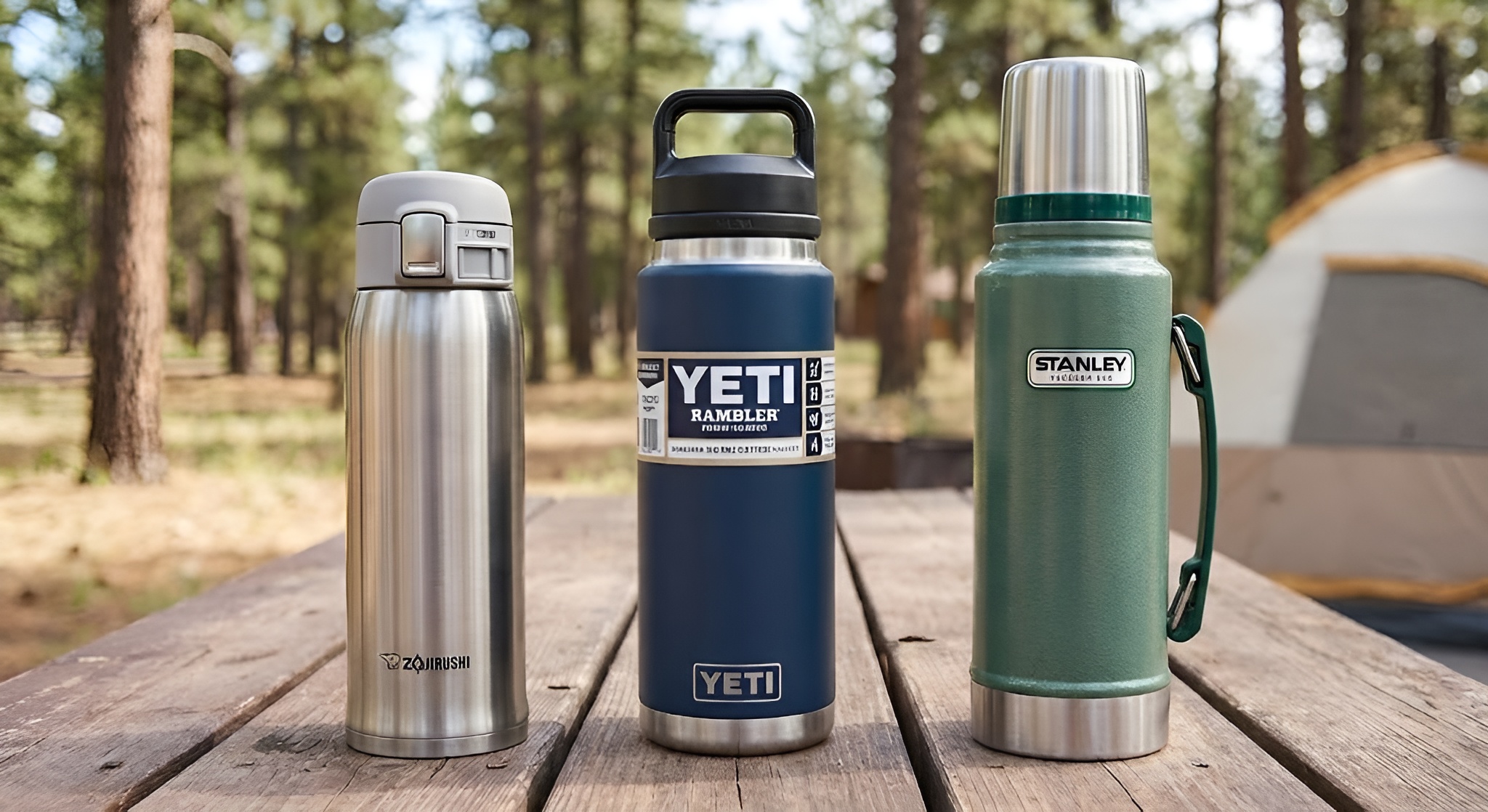
The technique has historical roots (grandpa-style brewing history) in 20th-century China, where lidded gaiwans or jam jars served as all-in-one brewing and drinking vessels. For outdoor use, the ideal grandpa vessel is wide-mouthed (so leaves settle and you can sip without inhaling them), double-walled or vacuum-insulated (to hold temperature), and transparent or semi-transparent (so you can see leaf expansion and liquor colour). The Hario 'Outdoor' Bottle (400 ml, borosilicate glass inner, silicone sleeve, £28, 280 g) and Kinto 'Travel Tumbler' (500 ml, stainless double-wall, screw lid, £32, 250 g) are both excellent; avoid narrow-neck Nalgene bottles, which trap leaves and make pouring impossible.
Grandpa-style has limits. Delicate, high-quality teas—competition-grade Japanese senchas, early-spring Silver Needle, high-mountain Taiwanese oolongs—lose nuance when brewed continuously and are better suited to gongfu. And if you're brewing for two or three people, a single grandpa mug doesn't scale; you'll want a small teapot or a gaiwan with a fairness pitcher to divide the liquor evenly. But for solo campers and wild swimmers who want a reliable, tasty brew without fuss, grandpa-style in an insulated bottle is the method we return to most often in the field.
8. Building Your Outdoor Tea Kit: Three Recommendations by Use Case
Wild swimmer / day hiker (weight-critical, speed-critical): Kelly Kettle Scout 1.2 L stainless (650 g, £85) or Ghillie Kettle aluminium 1.0 L (550 g, £68); double-walled titanium gaiwan 120 ml (55 g, £38); collapsible silicone fairness pitcher 180 ml (40 g, £15); two titanium tasting cups 60 ml each (50 g total, £16). Total weight: ~795–845 g, total cost: £154–172. Pack 20 g of dry birch bark and a handful of fatwood shavings as fire starter, plus a butane lighter in a waterproof case. This kit boils and brews a full gongfu session in under ten minutes from striking the fire, delivers proper leaf expression, and packs into a 2 L stuff sack. Backup: MSR PocketRocket 2 (73 g, £40) and a 110 g gas canister if fire restrictions apply.
Bikepacker / multi-day tourer (moderate weight, fuel flexibility): MSR PocketRocket 2 (73 g, £40) or Soto Windmaster (90 g, £55, better wind performance); 900 ml titanium pot with lid (150 g, £35–50); Hario Outdoor Bottle 400 ml for grandpa-style (280 g, £28); small zip-lock bags pre-portioned with 3 g leaf per bag (5 bags = ~15 g, negligible weight). Total weight: ~503–520 g plus one 230 g gas canister per week, total cost: £103–133. This setup prioritises simplicity and fuel availability; you brew grandpa-style in the bottle, which doubles as an insulated travel mug. If you want gongfu versatility, add a 120 ml titanium gaiwan and silicone pitcher (~95 g, £53) and brew in the pot lid or a lightweight bowl.
Campervan wild swimmer / car camper (weight irrelevant, comfort prioritised): Waeco 12 V travel kettle (850 g, £48) or traditional stove-top kettle (600–800 g, £20–40); small ceramic gongfu set in padded case (300 g, £35–60) or a 400 ml glazed Yixing-style teapot (250 g, £25–45); Anker 521 portable battery 100 Wh if relying on 12 V kettle (1,200 g, £90, gives 3–4 boils). Total weight: not a constraint, total cost: £90–195 depending on kettle choice. You can bring fragile ceramics, a proper tea tray, even a small brewing scale. Boil inside the van while changing out of a wetsuit, brew on a foldable camp table by the lochshore, and enjoy the ritual without compromise. For twig-kettle romantics, add a Kelly Kettle Base Camp 1.6 L aluminium (950 g, £78) for group brews and campfire ambience.
Always Carry a Backup Boil Method
Even if your primary kit is a Kelly Kettle, pack a lightweight butane stove and one canister (combined weight ~180 g, cost £45–55). Fire bans, wet kindling, and time pressure are realities; a backup ensures you never miss your brew.


Comments