1. What Defines a Proper Travel Tea Kit
A travel tea kit is any collection of portable equipment enabling you to brew, steep, and drink tea away from a fixed kitchen, evaluated by three hard constraints: weight, volume, and failure modes. It differs from a picnic set (which assumes car transport and tables) or office desktop gear (which assumes mains power and sinks). The minimum viable kit comprises a heat source or pre-heated water, an infusion vessel, a drinking vessel, and stored tea—but each component multiplies permutations. A backpacker flying Ryanair optimises for sub-500 g weight and carry-on compliance; a camper van touring Norway prioritises a 12 V kettle and ceramic teapot; a family beach holiday in Portugal needs child-safe, sand-resistant flasks and pre-portioned bags. No universal solution exists, and any retailer claiming otherwise is selling compromise.
The 'travel tea kit' category emerged commercially in the 2010s as speciality tea consumption grew among younger UK consumers, but the concept is ancient: Mongolian herders carried brick tea and iron pots; Victorian expeditions hauled tea chests and spirit stoves; 1970s hikers boiled Typhoo in billycans. Modern kits inherit this pragmatism but add performance materials—borosilicate glass that survives temperature shock, dual-wall vacuum stainless steel that holds 60°C for six hours, silicone infusers that fold to pocket size—and stricter safety compliance. Post-2006 airline liquid restrictions reshaped the category: you cannot carry brewed tea through security, so kits now emphasise dry storage and infusion downstream of the checkpoint. A well-designed 2026 travel kit acknowledges these constraints upfront rather than pretending they don't exist.
2. Leak-Proof Flasks and Bottles: What Actually Works
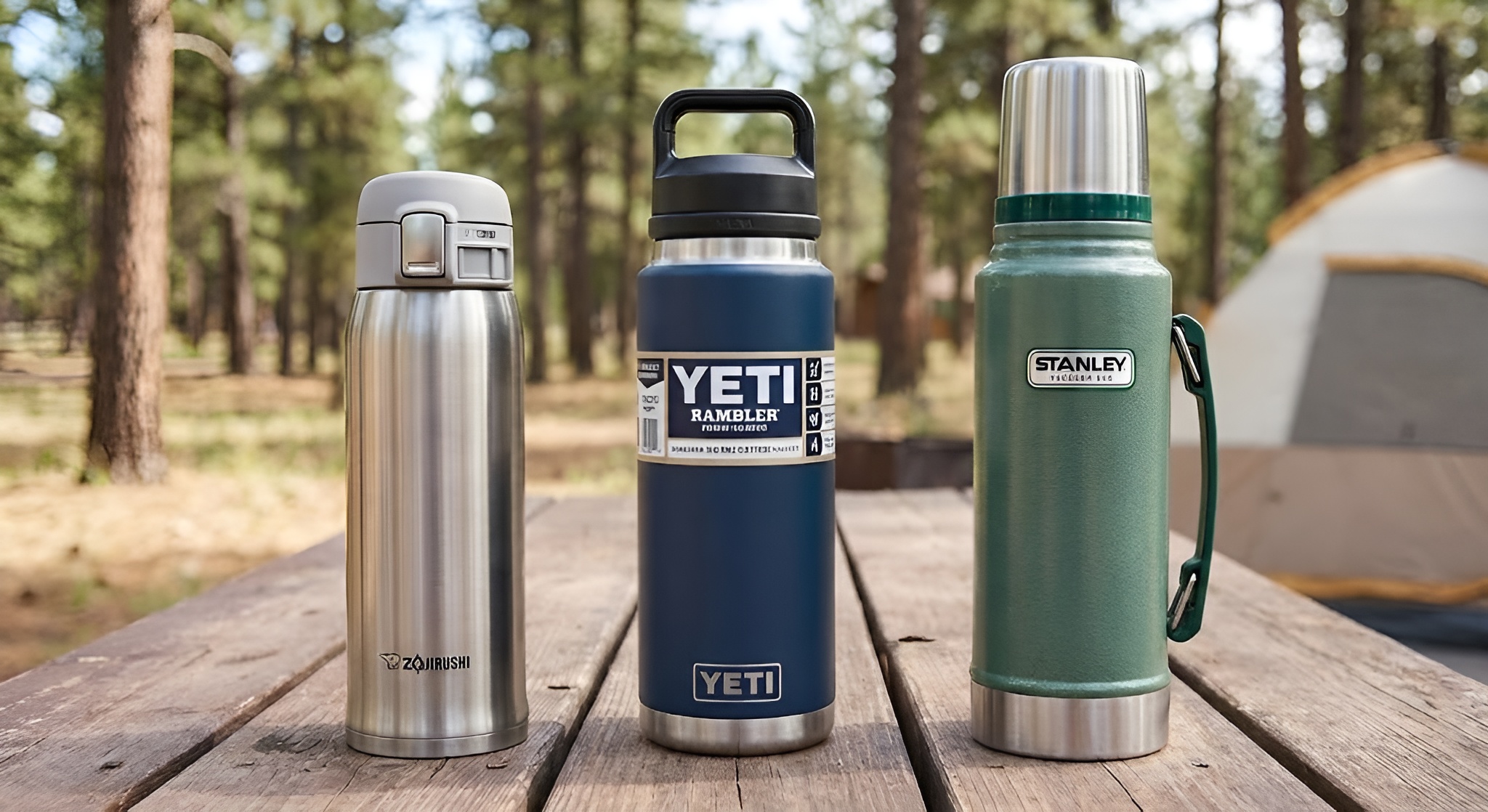
Leak-proof is a binary claim with analogue reality. A flask that doesn't drip when upright in a tote bag may haemorrhage when inverted in a rucksack; one that seals cold may vent steam or dribble when filled with 95°C water. True leak-proof design requires a threaded steel lid (not snap-on plastic), a food-grade silicone gasket renewed annually, and a pressure-equalising valve or button if the vessel is insulated. In 2026 the UK market leaders are Klean Kanteen TKWide 473 ml (£32, lifetime warranty, silicone gasket set £6), Zojirushi SM-SE48 (£45 on Amazon UK, Japanese import, holds 70°C for five hours), and Hydro Flask 16 oz Wide Mouth (£34, powder-coat finish resists scratches). All three pass the inverted overnight test in a hold bag; cheaper alternatives from supermarkets or AliExpress rarely do.
Glass-lined flasks (e.g. traditional Chinese double-wall models) offer superb flavour neutrality but shatter if dropped. Stainless steel imparts minimal taint if properly passivated; budget models sometimes leave a metallic edge on delicate whites. For cold-brew iced tea on a Mediterranean beach, the Fellow Carter Move Mug 473 ml (£28) includes a ceramic interior coating that eliminates metal contact and a True Taste ceramic-coated lid—worth the premium if you're packing Silver Needle or high-grade Japanese greens. Capacity sweet spot for solo travel is 350–500 ml (one generous mug or two small cups); couples should carry two 350 ml flasks rather than one large—redundancy if one lid fails, and you can brew two different teas.
Test Your Flask Upside-Down First
A truly leak-proof flask needs a threaded steel lid with a silicone gasket (replace yearly) and a pressure valve if insulated—test it inverted and hot before you travel, not in your luggage.
3. TSA and Airline-Compliant Tea Storage
UK hand luggage rules (mirroring EU regulations post-Brexit for most carriers) limit liquids to containers of 100 ml or less, all fitting in a single resealable 1-litre clear bag. Dry loose-leaf tea is not a liquid, but powdered matcha or finely milled rooibos can be queried by security; carry a printed label showing the product name and supplier. Metal tins under 100 g of total weight (tea plus container) pass X-ray without comment; larger tins (>200 g) should go in checked baggage to avoid manual inspection delays. TSA-compliant refers to the US Transport Security Administration's 3-1-1 rule (3.4 oz / 100 ml containers in 1 quart bag, 1 bag per passenger); the principle is identical to UK/EU practice, so gear marketed as TSA-safe works for flights from Heathrow or Gatwick.
Best cabin-friendly tins for 2026: Planetary Design Airscape 64 oz stainless steel is too large for hand luggage but ideal for checked bags and campsite base; for carry-on, use Blue Horse small round tins (available on Tea Suppliers UK, £4 each, 50 g capacity, airtight double lid) or Washi-wrapped aluminium caddies (import via Japan Centre London, £8–12, 40 g). Zip-seal Mylar bags (food-grade, opaque) are ultralight and X-ray-transparent; decant 10 g portions into 50×70 mm bags, label with masking tape, and pack flat in a document sleeve. Vacuum-seal larger batches (100–200 g) with a home sealer before departure to preserve volatile esters and monoterpenes—critical for floral summer teas whose aromatics degrade in warm luggage holds. Never pack tea in checked bags without double-bagging; burst shampoo bottles and crushed snacks are common, and tea absorbs every taint.
4. Compact Infusers and Portable Brewing Gear
A travel infuser must be small, easy to clean in a hostel sink or campsite tap, and compatible with various vessel shapes—hotel mugs, borrowed glasses, your own flask. Basket infusers (stainless-steel mesh, folding handles) are robust and give leaves room to unfurl; the OXO Brew Twisting Tea Ball (£10, dishwasher-safe, fine mesh) fits most mugs and flasks. Silicone infusers shaped like whales or submarines are charming but restrict leaf expansion and clog with fine dust—avoid for anything better than supermarket breakfast blends. Stick infusers (perforated steel tubes) work for large-leaf oolongs but trap broken leaves; clean them with a bottle brush nightly or they'll grow mould in humid climates.
For serious brewing on the move, the Hario ChaCha Kyusu Maru 700 ml teapot (£26, borosilicate glass, integrated steel mesh) packs well wrapped in a tea towel and brews multiple infusions of high-grade Chinese and Taiwanese teas—essential if you're spending a week in a gîte or Airbnb. The Finum Brewing Basket (£8, BPA-free plastic, fits most mugs) is lighter and cheaper; it won't shatter but will eventually stain and crack. One clever hybrid: the Libre Glass Tea Mug with Infuser (£18, 450 ml, double-wall glass, screw-in infuser lid) functions as both brewing and drinking vessel, eliminating the need for a separate cup—ideal for minimalist backpackers. Pair it with a neoprene sleeve (£5) for insulation and drop protection.
Basket Infusers Beat Novelty Shapes
Stainless-steel basket infusers with folding handles give leaves room to expand and clean easily at taps; avoid silicone novelty designs that restrict leaf movement and trap dust.
5. Portable Heating: Kettles, Stoves, and Safety
Boiling water is the gatekeeper to good tea, and travel heating is where kits most often fail. Electric travel kettles (0.5–0.8 L, 1,000 W, dual voltage 110–240 V) work across Europe and the UK but are bulky (15–20 cm tall) and slow (four minutes to boil 500 ml). The Russell Hobbs Travel Kettle 0.85 L (£18 on Argos, 1,000 W, plastic body) is cheap and widely stocked; the Gourmia GK320 0.5 L (£25, stainless interior, foldable handle) is more compact. Check voltage compatibility: a 110 V-only kettle from the US will overheat and fail on UK/EU 230 V mains, potentially starting a fire. Hotels and Airbnbs usually provide kettles, but quality varies—many cut out at 85–90°C, too cool for black teas or pu-erh.
For camping and outdoor trips, gas stoves (butane or propane cartridge, screw-thread or bayonet fit) are reliable; the MSR PocketRocket 2 (£40, 56 g, boils 1 L in 3.5 minutes) is industry standard for backpacking. Pair with a 0.6–1 L titanium or aluminium pot (£25–50). 12 V car kettles (plug into cigarette lighter) exist but are glacially slow (10–15 minutes for 500 ml) and drain batteries; use only with engine running. Immersion heaters (coil-type, 300–500 W) are banned in many European hostels due to fire risk and are too fragile for luggage. For short trips where you'll have intermittent access to boiling water (e.g. café stops, train station taps), pre-fill a vacuum flask with 95°C water in the morning; it will hold 80°C+ for six hours, adequate for greens and whites brewed at lower temperatures. Bring a small thermometer (clip-on dial type, £5) to check temperature before steeping.
6. Pre-Portioned Sachets and Packable Formats
Weighing loose leaf in a tent at dawn or a hotel room at midnight is tedious and messy; pre-portioning before departure saves time and waste. The simplest method: fill empty pyramid teabags (unbleached, heat-sealable, available from Sous Chef UK, £6 per 100) with 2.5–3 g of your chosen tea, seal with a domestic heat sealer or clothes iron (low heat, parchment paper buffer), and label with a permanent marker. Biodegradable PLA sachets compost in nine months but may split if roughly handled; paper-fibre sachets (e.g. T-Sac filters) are tougher and cheaper (£4 per 100) but have a faint wood-pulp taste with delicate teas—acceptable for robust blacks and BBQ-pairing smoked teas, less so for first-flush Darjeelings.
An alternative: zip-seal mini bags (40×60 mm, food-grade polyethylene, pack of 100 for £3 on Amazon UK). Decant 5 g portions, squeeze out air, label, and stack in a rigid tin or plastic case to prevent crushing. For a fortnight's trip, 200–300 g of tea (70–100 sachets at varied types) fits in a 500 ml container weighing under 400 g total—well within cabin baggage allowances. Include variety: a morning English Breakfast or Assam, a mid-afternoon oolong or white, an evening rooibos or chamomile. Tea cocktails are popular on European summer holidays; pack 20 g of a bold gunpowder green or Ceylon for cold-brewing with citrus and optional gin. Vacuum-sealing individual sachets is overkill unless you're travelling for a month or in extreme heat; a standard zip-seal in a tin preserves freshness for two weeks.
Pre-Fill Sachets Before You Leave
Fill unbleached pyramid bags or paper-fibre sachets with 2.5–3 g of tea at home, then seal and label them—no weighing in tents at dawn, no mess, no waste.
7. Beach, Camping, and Flight-Specific Kits
Beach kits prioritise sand and salt resistance, UV protection for stored tea, and cold-brew capability. Use a wide-mouth stainless flask (easier to rinse sand out), pack tea in opaque Mylar or metal tins (sunlight degrades catechins and chlorophyll within hours), and bring a collapsible silicone funnel (£4) for pouring without spills. Cold-brew iced tea made overnight in a 1 L bottle (6 g tea, refrigerator or cool box) is refreshing and requires no heat source. Add a reusable straw (stainless or glass, not paper—it disintegrates in iced tea) and a small bottle of honey or agave for sweetening. Avoid glass vessels on sandy beaches; a dropped teapot ruins the day.
Camping kits need durability and multi-day self-sufficiency. Pack a 1 L titanium pot (doubles as kettle and brew vessel), a folding steel infuser, a gas stove with two spare cartridges, and 200 g of loose leaf in waterproof bags. Include a microfibre tea towel for drying gear and a small brush for cleaning infusers. A gaiwan (lidded bowl, 100–150 ml, porcelain or stoneware, £8–15) weighs little and brews multiple short infusions—ideal for high-mountain oolongs or aged sheng pu-erh after a day's hiking. Wrap fragile items in clothing inside a stuff sack. Wild camping in Scotland or Norway means unpredictable weather; double-bag tea to keep it dry, and never leave a gas stove unattended in a tent.
Flight kits (carry-on only) are the most constrained. Pack 50–100 g of loose leaf in small tins (check they're under 100 g total), an OXO tea ball or Finum basket, and a collapsible silicone cup (200 ml, £6, folds flat). Request hot water after takeoff (cabin crew will provide a cup or small pot free of charge on most carriers); brew directly in the cup with your infuser. Avoid strong-smelling teas (lapsang souchong, heavily roasted oolongs) in confined spaces—fellow passengers may complain. For long-haul, bring two tins: a morning black and an evening herbal. Upon arrival, refill tins from your checked luggage stash if staying more than three days.
8. UK Stockists, Pricing, and What to Avoid in 2026
UK availability for quality travel tea gear has improved markedly since 2020, with outdoor retailers (Cotswold Outdoor, Go Outdoors), kitchen specialists (John Lewis, Lakeland), and online tea vendors (Tea Suppliers UK, Postcard Teas, Comins Tea) all stocking dedicated ranges. Expect to spend £60–100 for a complete modular kit (flask £30–45, infuser £8–15, tins £5–10, kettle £18–25, accessories £10). Budget alternatives exist—Wilko and Poundland sell basic stainless flasks for £8–12 and silicone infusers for £3—but longevity is poor; a £10 flask that leaks after two trips is costlier than a £35 Klean Kanteen that lasts five years. Buy once, cry once applies to travel tea gear.
Avoid pre-packaged 'travel tea sets' on Amazon under £25; they typically bundle a thin-walled flask, a plastic infuser that warps in hot water, and a nylon case that reeks of solvents. Avoid single-use teabags in foil sachets unless you're certain of the supply chain—many use plastic fusions that don't biodegrade. Avoid electric kettles without dual-voltage marking if you plan to travel outside the UK. Avoid infusers marketed as 'universal' that clip onto rims; they fall into mugs. Avoid tins with clear windows (light exposure) or plastic interiors that crack at temperature extremes. Test every component at home before departure: fill the flask with boiling water, invert it in a sink overnight, check for drips. Brew a pot of your favourite tea with the travel infuser; if it doesn't taste right, troubleshoot now, not in a Lisbon hotel room at 7 a.m. A properly assembled, tested travel tea kit transforms holiday tea from a compromise into a ritual—and for UK tea drinkers abroad in summer 2026, that's worth every gram of luggage weight.
Buy Once, Cry Once
A complete quality kit costs £60–100, but a £35 Klean Kanteen that lasts five years is cheaper than replacing a £10 budget flask that leaks after two trips.



Comments