1. What Are Carbon Isotope Ratios in Tea?
Carbon isotope ratios describe the relative abundance of the stable isotopes ¹³C and ¹²C in a sample of tea leaf. Both isotopes are non-radioactive forms of carbon; ¹²C accounts for roughly 98.9 per cent of natural carbon, while ¹³C makes up about 1.1 per cent. During photosynthesis, plants preferentially incorporate the lighter ¹²C over ¹³C, but the degree of this discrimination depends on the plant's biochemical pathway—C3, C4, or CAM. Camellia sinensis uses the C3 pathway, in which CO₂ is first fixed into a three-carbon molecule (3-phosphoglycerate) via the enzyme RuBisCO. This pathway discriminates strongly against ¹³C, yielding tissues that are relatively depleted in the heavier isotope.
Scientists express carbon isotope composition as δ¹³C, calculated by comparing the sample's ¹³C/¹²C ratio to that of a limestone standard (Vienna Pee Dee Belemnite, or VPDB) and reporting the difference in parts per thousand (‰). A δ¹³C value of −28‰, for example, means the sample contains 28 parts per thousand less ¹³C than the standard. Because C3 plants typically range from −32‰ to −24‰ and C4 plants from −16‰ to −10‰, the two groups occupy largely non-overlapping windows. This separation is the foundation of isotopic authentication: any significant shift toward less-negative (i.e. heavier) values in a purportedly pure tea suggests contamination or adulteration with C4 material.
Within the C3 range, finer variations arise from environmental factors. High-altitude gardens often show slightly more negative δ¹³C values because lower atmospheric pressure and cooler temperatures affect stomatal conductance and the efficiency of CO₂ diffusion. Water stress, by contrast, tends to push values less negative, as partially closed stomata concentrate ¹³C inside the leaf. Canopy shade, soil pH, and even the time of harvest can introduce further nuances, creating a multi-dimensional isotopic fingerprint that laboratories are beginning to decode for provenance verification.
δ¹³C Is Not Radiocarbon
Stable-isotope analysis measures the ratio of ¹³C to ¹²C—both non-radioactive—and has nothing to do with radioactive ¹⁴C used in radiocarbon dating. The two techniques serve different purposes: δ¹³C fingerprints metabolism and environment; ¹⁴C dates organic material.
2. How Carbon Isotope Ratios Reveal Adulteration
The most straightforward application of δ¹³C analysis is detecting the addition of C4-derived substances to tea. Common adulterants include maize starch (used to bulk lower-grade dust), cane or beet sugar (added to mask astringency or boost apparent sweetness), and synthetic colourants derived from C4 feedstocks. Because these materials carry δ¹³C values around −12‰ to −10‰, even a modest addition—say, 5 per cent by mass—will shift the bulk tea's signature measurably less negative. Laboratories can calculate the proportion of C4 material using a simple two-component mixing model, provided the end-member values are known.
In practice, the detection limit depends on analytical precision and the baseline δ¹³C of the pure tea. Modern isotope-ratio mass spectrometers (IRMS) achieve precision better than ±0.1‰, meaning additions as small as 2–3 per cent can be statistically significant if the adulterant and host tea are isotopically distinct. This sensitivity has proven especially valuable for high-value categories where profit margins incentivise fraud: single-estate Darjeelings, orthodox Assams, and aged pu-erhs have all been the subject of published authenticity studies using carbon isotopes.
It is important to note, however, that not all adulterants are C4. Rice starch, for instance, comes from a C3 plant and will have a δ¹³C similar to tea, rendering it invisible to this method alone. Likewise, certain synthetic flavourings or natural extracts may not shift the isotope ratio enough to trigger alarm. For this reason, carbon isotope analysis is typically deployed as part of a multi-technique screening protocol, alongside oxygen and hydrogen isotopes, trace-element profiling, and DNA barcoding.
3. Geographic Fingerprinting and Provenance Verification
Beyond detecting foreign substances, δ¹³C values can help verify—or challenge—a tea's claimed geographic origin. Because environmental conditions vary systematically with latitude, altitude, and local climate, teas from different regions often occupy subtly different positions along the C3 isotope continuum. High-elevation gardens in Darjeeling or Taiwan, for example, tend to show more negative δ¹³C values (around −30‰ to −32‰) than lowland plantations in Assam or Kenya (typically −26‰ to −28‰). Water stress in arid or seasonally dry regions can push values less negative still, sometimes approaching −24‰.
Several peer-reviewed studies have demonstrated that multi-isotope models—combining δ¹³C with δ¹⁸O (oxygen) and δ²H (deuterium)—can discriminate between major tea-producing countries with accuracies exceeding 85 per cent. Oxygen and hydrogen isotopes reflect local precipitation and evaporation patterns, while carbon captures altitude and water-use efficiency. Together, the three isotopes form a three-dimensional space in which different origins cluster, much like a chemical postcode. Laboratories build reference databases by analysing authenticated samples from known estates, then compare suspect teas against these benchmarks using multivariate statistics.
The method is not without limitations. Blending—common in everyday breakfast teas and even some premium oolongs—produces an averaged signature that obscures individual components. Blending ratios can shift the bulk δ¹³C unpredictably, and without prior knowledge of the blend composition, forensic interpretation becomes speculative. Moreover, within-region variability can be surprisingly large: two gardens separated by a single valley may differ by 1–2‰ if one is irrigated and the other rain-fed. For these reasons, isotope fingerprinting is most robust when applied to single-origin, single-flush teas and when the suspect sample falls well outside the expected range.
Altitude Is the Strongest Driver
Of all environmental factors, elevation above sea level exerts the most consistent influence on δ¹³C in tea. If a purportedly high-mountain oolong shows a lowland signature, that is often the first red flag in a lab report.
4. The Laboratory Process: From Leaf to δ¹³C Value
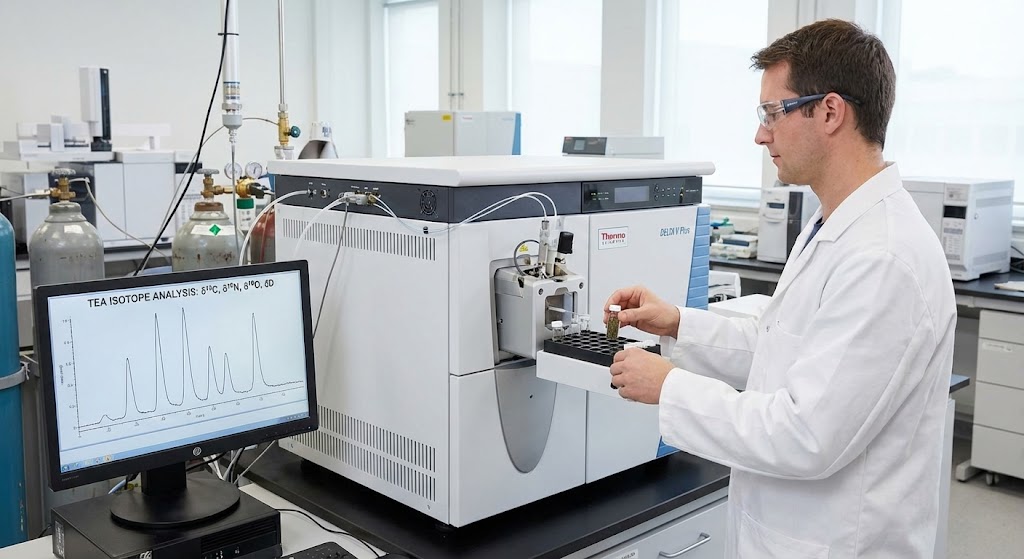
Measuring carbon isotope ratios requires isotope-ratio mass spectrometry (IRMS), a technique that combusts a small sample—typically 1–2 milligrams of dried tea leaf—in an oxygen-rich furnace at around 1,000 °C. The resulting CO₂ is purified, then introduced into the mass spectrometer, where ions are separated by mass-to-charge ratio and detected with high precision. The instrument compares the intensity of the mass-45 ion (¹³C¹⁶O¹⁶O) to mass-44 (¹²C¹⁶O¹⁶O) and calculates the δ¹³C value relative to the VPDB standard. Each analysis takes only a few minutes, but sample preparation—drying, grinding, weighing, and encapsulating in tin foil—adds time and requires meticulous attention to avoid contamination.
Quality control is paramount. Laboratories run certified reference materials (such as sucrose or cellulose standards with known δ¹³C values) alongside unknowns to monitor drift and accuracy. Duplicate measurements on the same sample should agree within ±0.2‰; larger scatter suggests inhomogeneity or instrumental problems. For tea, the choice of which part of the leaf to analyse can also matter: young buds and mature leaves may differ by up to 1‰ due to age-related changes in stomatal behaviour and carbon allocation. Reputable labs will specify whether they analysed whole leaf, infused residue, or ground composite, and will report results with appropriate uncertainty estimates.
In the UK, commercial IRMS services are offered by a handful of specialised laboratories, including university spin-outs and private analytical firms. Costs vary, but a single δ¹³C determination typically ranges from £30 to £60, excluding sample shipping and any consultancy interpretation. Multi-isotope panels (δ¹³C, δ¹⁸O, δ²H) or larger screening batches attract volume discounts. Turnaround is usually one to two weeks, though rush services may be available for customs or legal cases. For buyers of high-value teas, requesting a copy of the supplier's batch isotope certificate—if one exists—can be a useful due-diligence step, particularly when dealing with rare or geographically protected designations.
5. Interpreting Results: What the Numbers Actually Mean
A single δ¹³C value is not, by itself, proof of authenticity or fraud; interpretation requires context. The first step is to compare the measured value against the expected range for pure C3 tea (−32‰ to −24‰). A result of −28‰ sits comfortably in the middle and raises no immediate concerns. A value of −18‰, by contrast, is far too heavy for unadulterated Camellia sinensis and strongly suggests the presence of C4 material—either an intentional adulterant or a labelling error (for instance, a herbal infusion mislabelled as tea).
Within the C3 window, finer distinctions hinge on reference data. If a Darjeeling first flush claims to come from a high-altitude estate known to produce teas around −31‰, but the sample measures −26‰, that discrepancy warrants further investigation. Possible explanations include mislabelling, blending with lowland leaf, or even climatic anomalies during the growing season. Conversely, a δ¹³C of −30‰ in a lowland Assam would be unusual and might indicate either contamination or an error in the claimed origin. In either case, the isotope result serves as a flag, not a verdict; confirmatory evidence—sensory evaluation, packaging integrity, supplier audit trails—is essential before drawing conclusions.
For aged or fermented teas, interpretation becomes more complex. Post-harvest microbial activity, as seen in pu-erh or kombucha fermentation, can fractionate carbon isotopes slightly, though the shift is typically less than 1‰ and may not be distinguishable from natural variability. More significant is the potential for blending or re-moistening with sugars during storage, practices that can introduce C4 signals into what was originally a pure C3 product. Laboratories experienced in tea authentication will consider processing history and may request replicate samples or complementary tests—such as sugar profiling by liquid chromatography—to disentangle these effects.
One Data Point Is Not Enough
A δ¹³C value alone cannot prove a tea is genuine; it can only show whether the sample is consistent with the claim. Always combine isotope results with supplier reputation, sensory checks, and—where available—multi-isotope or trace-element data.
6. Limitations and Caveats of Carbon Isotope Analysis
While powerful, carbon isotope ratios are not a panacea. The most obvious limitation is the inability to detect C3 adulterants: rice starch, wheat flour, and many botanical extracts will have δ¹³C values indistinguishable from tea. Only when the adulterant is isotopically distinct—C4 sugars, maize derivatives—does the method shine. A second challenge is the natural variability within a single estate or even a single plucking round. Factors such as canopy position, leaf age, and diurnal weather fluctuations can introduce scatter of 1–2‰, which overlaps the signal from small amounts of blending or adulteration. Statistical confidence improves with replicate measurements and larger sample sizes, but that increases cost and time.
Blending, as noted earlier, is particularly problematic. A house blend of Assam and Ceylon will yield an intermediate δ¹³C that tells you little about the proportions or the authenticity of either component. If the blend recipe is known, forensic chemists can model the expected signature and check for deviations, but in the absence of declared ratios the isotope data become ambiguous. Similarly, flavoured teas—Earl Grey, jasmine, fruit-infused blends—often contain added oils, dried petals, or essences that contribute their own carbon, shifting the bulk δ¹³C unpredictably. For these products, the baseline 'pure tea' signature must first be established by analysing an unflavoured control from the same batch, which may not always be available.
Finally, carbon isotopes say nothing about pesticide residues, heavy metals, or microbial contamination—critical quality and safety parameters that require separate analytical methods. A tea with a perfect δ¹³C fingerprint could still fail on cadmium limits or harbour unsafe levels of pyrrolizidine alkaloids. For this reason, isotope analysis is best understood as one layer in a comprehensive quality-assurance programme, rather than a standalone certificate of purity or provenance.
7. Carbon Footprint Versus Carbon Isotopes: Clearing Up the Confusion
It is worth pausing to distinguish between carbon isotope ratios and the carbon footprint of tea, two entirely separate concepts that share only the element carbon. The carbon footprint measures the total greenhouse-gas emissions—expressed as kilograms of CO₂-equivalent—associated with growing, processing, packaging, and transporting tea. It is an environmental metric, calculated using life-cycle assessment and relevant to discussions of climate impact and sustainability. Carbon isotope ratios, by contrast, are a forensic tool: they reveal where and how the tea plant obtained its carbon during photosynthesis, with no direct bearing on emissions or environmental impact.
Confusion sometimes arises because both topics feature the word 'carbon' and both have gained prominence in the 2020s as consumers demand greater transparency. A low-carbon-footprint tea is not necessarily isotopically 'pure,' and a tea with an authentic δ¹³C signature may still have been shipped halfway around the world in energy-intensive packaging. The two metrics address different questions—'Is this tea what it claims to be?' versus 'What is this tea's climate cost?'—and both have a place in informed purchasing decisions, but they should not be conflated.
Different Tools, Different Questions
If you care about authenticity and origin, ask for isotope certificates. If you care about environmental impact, ask for life-cycle data or carbon-offset schemes. Both matter; neither replaces the other.
8. What UK Buyers Should Know: Accessing Isotope Data and Choosing Trustworthy Suppliers
For most everyday tea purchases—supermarket own-labels, standard breakfast blends—carbon isotope testing is overkill. The method comes into its own for high-value, single-origin, or Geographical Indication teas where provenance commands a premium: Darjeeling PDO, Japanese gyokuro, Taiwan high-mountain oolong, and aged pu-erh are prime candidates. If you are spending £30 or more per 100 grams, it is reasonable to expect the supplier to have conducted—or be willing to share—batch authentication data, including isotope results if the claim hinges on origin.
In practice, very few UK retailers proactively publish δ¹³C certificates, though some specialist importers and estate-direct brands maintain in-house or third-party testing programmes and will provide lab reports on request. When evaluating suppliers, look for transparency beyond marketing copy: detailed harvest dates, GPS coordinates or named gardens, traceability documentation, and memberships in certification schemes (Ethical Tea Partnership, Rainforest Alliance, or regional GI bodies). Suppliers serious about authenticity often mention laboratory partnerships or quality-control protocols in their 'About' or 'Quality' sections; those that do not may still test internally but choose not to advertise it, so a polite enquiry can be revealing.
If you wish to commission your own isotope analysis—for instance, to verify a suspected counterfeit or to satisfy due diligence for a commercial purchase—contact a UK-based IRMS laboratory or a food-authentication consultancy. Provide as much contextual information as possible: claimed origin, harvest date, purchase price, and any sensory or packaging anomalies. The lab will advise on sample size (usually 5–10 grams of dry leaf), testing scope (δ¹³C alone or multi-isotope), and expected turnaround. Keep in mind that a negative result (i.e. isotopes within the expected range) does not guarantee authenticity—it simply means the sample passed one test. Positive findings (isotopes well outside the range) are more definitive and can support a complaint, refund request, or, in commercial disputes, legal action.
For readers exploring related topics—such as selecting premium teas as gifts or understanding how blending affects composition—the principles of isotopic fingerprinting underscore a broader point: transparency and traceability are hallmarks of quality. Whether you are buying a single estate for personal enjoyment or curating matcha gift sets for clients, knowing that rigorous analytical tools exist—and that reputable suppliers use them—offers both peace of mind and a deeper appreciation for the craft and science behind every cup.
Ask Before You Buy Expensive Tea
For any tea over £25 per 100 g, enquire whether the supplier holds batch certificates of analysis—isotope, pesticide, or heavy-metal tests. Reputable vendors will either share them or explain their QC process; evasive answers are a warning sign.
Comments