1. What Tea Blending Actually Means (and What It Isn't)
Tea blending is the deliberate combination of two or more Camellia sinensis teas—or tea plus botanical additions—to achieve a flavour profile that no single component delivers alone. In professional contexts this may mean layering four Assam estates to smooth out crop-year variation, or marrying a bright Nilgiri with a malty Dian Hong to create a balanced breakfast tea. At home the principle is identical: you are composing a chord from individual notes, not simply mixing leftovers.
What blending is not: dumping stale tea into a jar with dried orange peel and calling it a 'custom blend.' Effective blending requires single-origin, known-grade components, each tasted individually so you understand its contribution. If you cannot describe what a given Keemun or Darjeeling brings to the cup—astringency, body, floral lift, cocoa finish—you are guessing, not blending. The goal is intentional, repeatable harmony, and that demands both a sensory baseline and a structured method.
Home blending sits somewhere between the creative freedom of the kitchen and the discipline of formulation chemistry. You are free to experiment, but every worthwhile blend obeys the same rules of proportion and balance that govern perfume, coffee roasting, and commercial tea blending. Respect those ratios, source with care, and you will produce house blends that rivals anything on a supermarket shelf—often at a fraction of the cost.
2. The Base/Accent/Note Framework: How Professional Blenders Structure Flavour
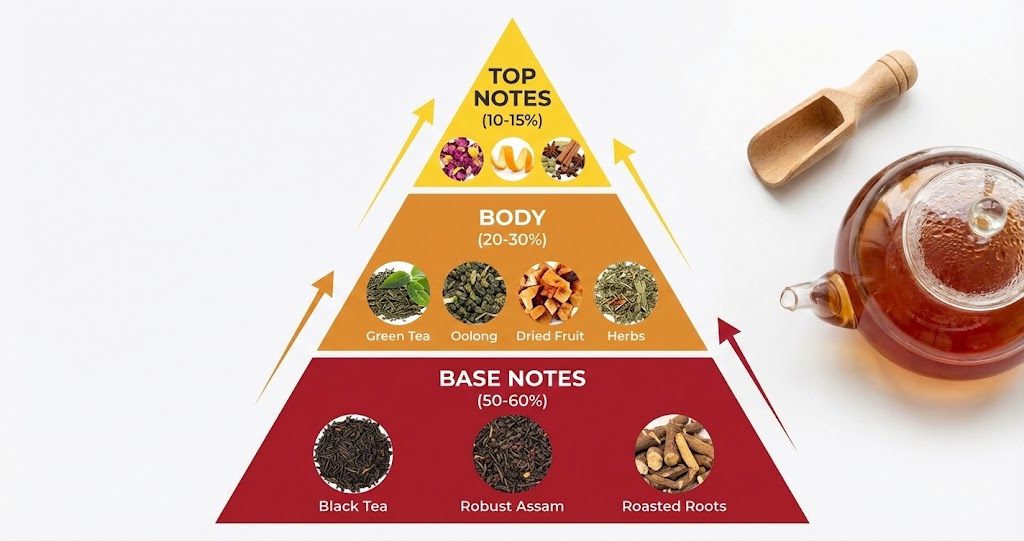
Every successful blend—from English Breakfast to a boutique afternoon Darjeeling-Nilgiri mix—follows a three-tier architecture: base (60–80 %), accent (15–30 %), and finishing note (2–10 %). The base provides body, structure, and drinkability; the accent adds character, complexity, or a signature flavour direction; the note contributes aroma, lift, or a memorable finish. This is not arbitrary—it mirrors the way our palate perceives layered flavours, with the dominant impression anchored by volume and the nuances carried by smaller, more volatile components.
Base teas are chosen for consistency, body, and a clean astringency that does not spike or collapse. Classic bases include Assam CTC or orthodox for malt and body, Ceylon OP for bright structure, or Keemun Mao Feng for a smooth, slightly sweet backbone. A good base should taste pleasant on its own but not so distinctive that it crowds out the accent. Think of it as the canvas: neutral enough to support, strong enough to anchor.
Accent teas provide the blend's personality. A first-flush Darjeeling brings muscatel and floral brightness; a Dian Hong adds honey and dried-fruit sweetness; a high-grown Nilgiri contributes citrus and a crisp, clean finish. You use less of an accent tea precisely because its character is more pronounced. If the base is the melody, the accent is the harmony that makes the tune memorable.
Finishing notes are the smallest component by weight but often the most noticeable aromatically. A pinch of jasmine pearls, a few leaves of Bai Mu Dan for peach-skin sweetness, or a gram of smoked Lapsang for a distant bonfire whisper—these are the elements that linger in the aftertaste or greet you in the dry-leaf aroma. In professional blending, finishing notes are sometimes called 'top notes' (borrowed from perfumery), and they are the reason a well-made blend smells more complex than it tastes at first sip.
Start 70/20/10 and Adjust
Your first trial blend should follow a 70 % base / 20 % accent / 10 % note split by weight. Brew it, log the result, then shift one variable—add 5 % more accent, halve the note—and compare. This bracketing approach isolates what each component contributes and builds your sensory vocabulary faster than random mixing.
3. Sourcing Single-Origin Components in the UK: Where to Buy and What to Look For
The quality ceiling of your blend is set by the quality of your components. Fortunately UK home blenders have access to an unusually strong network of independent tea importers, many of whom sell single-estate, single-flush teas in 50–100 g quantities—exactly the scale you need for trial blending. Avoid supermarket 'Assam' or 'Darjeeling' bags; these are almost always pre-blended from multiple estates and crop years, which means you have no baseline and no consistency batch to batch.
Where to source: Speciality online retailers such as What-Cha, Mei Leaf, Postcard Teas, Rare Tea Company, and Lalani & Co. offer transparent estate sourcing, harvest dates, and often detailed tasting notes. Many list the specific garden (e.g. Mangalam, Mim, Thurbo) and flush (first, second, autumn). For single-origin Assam orthodox, Ceylon OP grades, and Chinese blacks, these importers are your first stop. If you are blending greens or oolongs, the same suppliers stock single-cultivar Tie Guan Yin, Mao Feng, and high-mountain Taiwanese oolongs suitable for layering.
What to look for: Buy by estate and flush, not by generic region. 'Darjeeling FTGFOP1 Second Flush, Thurbo Estate, June 2026' tells you everything; 'Darjeeling Tea' tells you nothing. Ask for sample sizes if available—many retailers offer 25 g試taster packs. Pay attention to oxidation level (especially in oolongs), leaf grade (whole-leaf blends marry more predictably than dust), and harvest date (you want components from the same year for consistent ageing). For a starter blending pantry, budget £30–50 and buy four to six single-origin teas spanning different regions, oxidation levels, and flavour families.
If you are serious about blending and want to explore home roasting or home smoking as an additional variable, source a neutral base green (Mao Feng, Sencha) or lightly oxidised oolong and process it yourself. This gives you a component no commercial blender can offer and deepens your understanding of how heat, smoke, and oxidation shape the flavour you are trying to balance.
Buy in Parallel, Not in Sequence
Order all your components in one go, even if you have not finalised your blend idea. Single-estate teas sell out fast, especially first-flush Darjeelings and competition-grade oolongs. If you perfect a blend in August but the accent tea is gone by September, you cannot replicate it. Stock your pantry, then experiment.
4. Sensory Evaluation: Tasting Each Component Solo Before You Blend
Before you mix a single gram, brew and taste each candidate tea on its own, using the same water, temperature, vessel, and steep time you plan to use for the finished blend. This solo tasting builds your mental library: you learn that Estate A's Assam has a sharp, malty entry and a drying finish, while Estate B's is rounder, sweeter, and more forgiving with milk. Without this baseline you are guessing which tea does what in the blend, and iteration becomes frustratingly slow.
Use a simple sensory scorecard to log each tea's profile. Note: aroma (dry leaf and wet leaf), liquor colour, body (light/medium/full), astringency (low/medium/high, and where it peaks—entry, mid-palate, finish), sweetness, dominant flavour notes (malt, floral, fruit, vegetal, mineral), and aftertaste length. You do not need formal Q-grader training; you need consistent vocabulary and honest attention. If a Keemun tastes like cocoa and tobacco on Monday, it should taste that way on Wednesday, assuming water and steep time are constant.
Steep parameters: For black teas, use 2.5–3 g per 200 ml, 95–100 °C water, 3–4 minutes. For greens and whites, 2–2.5 g, 75–80 °C, 2–3 minutes. For oolongs, 3 g, 85–95 °C (depending on oxidation), 3 minutes. These are starting points; adjust to match how you intend to brew the final blend. The goal is to taste each component under identical conditions, so you can compare apples to apples and predict how they will behave when combined.
If you plan to serve your blend with milk, taste each component both black and with a splash of whole milk. Some teas (high-grown Nilgiris, delicate first-flush Darjeelings) lose structure with milk; others (Assam, strong Kenyan blacks) are built for it. Knowing this in advance lets you weight your base and accent appropriately. For more structured sensory practice, the same cupping and scoring techniques used in hosted tea tastings apply here—just with a tighter, blending-focused lens.
5. Building Your First Blend: Ratios, Mixing, and the Importance of Small Batches
Start with a 10–15 g total batch—just enough for three to five test cups. Weigh your components on a 0.1 g precision scale (kitchen scales are not accurate enough at this range). If you are following the 70/20/10 framework for a 12 g batch, that is 8.4 g base, 2.4 g accent, 1.2 g note. Round to the nearest tenth if needed, but record the exact weights in a notebook or spreadsheet. Without a log, you cannot replicate a successful blend or diagnose a failed one.
Mixing: Combine the weighed leaves in a small bowl or jar, then tumble gently to distribute. Avoid crushing or breaking leaves—you want the blend to marry naturally, not to pulverise into dust. If you are blending a CTC base with whole-leaf accent (not ideal, but sometimes necessary), be aware that particle size affects infusion rate; the CTC will extract faster, potentially overwhelming the whole leaf. Where possible, match leaf grades across components—OP with OP, TGFOP with TGFOP—to keep extraction even.
Brew your test blend using the same parameters you used for the solo tastings. Taste it black first, then (if appropriate) with milk. Ask: Is the base too dominant, or does the accent shine through? Is the finishing note perceptible in the aroma or aftertaste, or is it lost? Does the blend taste harmonious, or do the components sit separately in the cup? A successful blend should taste like a single, coherent tea, not a fruit salad of flavours. If you can identify every component distinctly, the proportions are likely off.
Iterate in one direction at a time. If the blend is too astringent, reduce the base or add more of a sweet accent (Dian Hong, Bai Mu Dan). If it is flat, increase the accent or add a brighter note (Nilgiri, jasmine). If the finishing note is invisible, double it—notes are often under-dosed by nervous beginners. Make one change, remix, rebrew, and compare. This disciplined approach builds your blending intuition far faster than scattergun experimentation, and it is how professional blenders dial in a new house tea.
Let It Rest Before You Judge
Once you have a candidate blend, store it in an airtight tin for at least 48 hours before final evaluation. Flavours marry and volatile compounds equilibrate; a blend that tastes disjointed fresh often smooths beautifully after a few days. Your 'final' judgement should come after this rest, not immediately after mixing.
6. Flavour Balancing and Troubleshooting Common Blend Failures
Even with careful component selection and ratio discipline, first blends often miss the mark. The most common failure modes are: astringency spikes (the tea turns harsh or mouth-drying mid-sip), muddy midpalate (all the flavours blur together with no clarity), hollow body (the tea tastes thin or watery despite adequate leaf), and phantom finishing note (you added 10 % jasmine or Lapsang but cannot taste or smell it).
Astringency spikes: Usually caused by too much high-tannin base (Assam, strong Ceylon) or a sharp accent (first-flush Darjeeling, high-grown oolong). Solution: reduce the offending component by 5–10 %, replace with a rounder base (Keemun, Dian Hong), or add a small percentage of a sweet, low-tannin tea (Bai Mu Dan, Taiwanese oolong). Alternatively, shorten your steep time by 30 seconds—extraction rate matters as much as ratio.
Muddy midpalate: Often the result of blending too many components or using teas with overlapping flavour profiles (e.g. three different malty Assams). Solution: simplify. Go back to base + accent + note. Make sure each component has a distinct role. If two teas taste similar solo, pick the better one and drop the other. Clarity in blending comes from contrast and structure, not from hedging your bets with five middling ingredients.
Hollow body: This happens when the base is too light or the accent is too delicate. Solution: increase the base percentage or swap to a fuller-bodied base (CTC Assam, strong Yunnan black). Alternatively, check your brewing—under-extraction (too little leaf, too short a steep) can make even a well-balanced blend taste thin. Body is a function of both formulation and preparation.
Phantom finishing note: If your note is invisible, you either did not use enough or you chose a note with poor carry in a strong base. Delicate florals (osmanthus, orchid oolong) often vanish in a bold Assam-forward blend. Solution: double the note percentage, or choose a more assertive note (jasmine pearls, Lapsang, rose petals). Remember that finishing notes are aromatic—if the dry-leaf smell does not hint at the note, you have not added enough. For more on precision ratios and how professionals dose botanicals or tea notes, see our dedicated blending ratios guide.
7. Scaling Up, Naming, and Storing Your House Blend
Once you have a winning formula—logged, tested, and rested—you can scale up to a working batch of 100–200 g. Multiply your trial weights proportionally, weigh carefully, and mix in a large jar or tin. Label everything: blend name, date mixed, component list with percentages, and recommended brewing parameters (leaf weight, temperature, time). A year from now you will not remember that 'Summer Blend 2026' was 65 % Mangalam Assam / 25 % Gielle second-flush / 10 % jasmine pearls, and without that record you cannot remake it.
Storage: Keep your finished blend in an opaque, airtight tin or Mylar pouch, away from light, heat, and moisture. For detailed guidance on containers, shelf life, and pantry placement, see our full tea storage guide. In general, well-stored blends hold their character for 6–12 months, though the more delicate finishing notes (white tea, jasmine) will fade first. If you are blending a large batch for gifts or for personal supply through the winter, consider vacuum-sealing 25 g portions to preserve freshness.
Naming: House blends deserve real names, not 'Mix 3' or 'Wednesday Experiment.' Choose something that reflects the flavour, the occasion, or the inspiration—'Morning Marmalade' for a bright Assam-Nilgiri-orange-peel breakfast blend, 'Smoke & Honey' for a Lapsang-Dian Hong evening tea. A good name makes the blend feel like a finished creation, not a work in progress, and it is easier to recommend to friends or include in tea gift sets.
If you enjoy the blending process and want to expand your skills, consider parallel experiments: a milk-friendly breakfast blend, a delicate afternoon Darjeeling-white tea blend, a smoky evening blend, or a floral summer iced-tea base. Each project deepens your understanding of how origin, oxidation, and ratio interact. Over time you will develop a personal blending style—a signature balance of body, brightness, and finish—and that intuition is worth far more than any recipe.
Version Your Blends Like Software
When you iterate a house blend, label it with a version number: 'Morning Marmalade v2,' 'Smoke & Honey v3.' This lets you track improvements, compare batches side by side, and revert if a change fails. It also builds a blending archive you can learn from—your v1 mistakes are as valuable as your v5 successes.
8. Beyond Black Tea: Blending Greens, Oolongs, and Mixed-Oxidation Blends
The base/accent/note framework applies equally to green, oolong, and white tea blends, but the execution differs. Green tea blends are more volatile and sensitive to storage; finishing notes (jasmine, osmanthus, mint) can dominate if over-dosed, and astringency spikes are common if you mix high-catechin Japanese greens (Sencha, Kabusecha) with Chinese pan-fired varieties. A balanced green blend might be 70 % Mao Feng (clean, slightly sweet base) + 20 % Gyokuro or Kabusecha (umami, depth) + 10 % jasmine pearls (floral lift). Brew cooler (75–80 °C) and shorter (2–3 minutes) to avoid bitterness.
Oolong blends offer enormous creative range because oolongs themselves span 10–80 % oxidation. A lightly oxidised Taiwanese high-mountain oolong (floral, creamy) can serve as an accent in a medium-roast Wuyi base (mineral, roasted grain), with a pinch of osmanthus or aged white tea as the note. Oolongs are also forgiving: their complex, layered flavour profiles mean small dosing errors are less catastrophic than in the starker world of black or green teas. If you are new to blending, starting with oolongs builds confidence.
Mixed-oxidation blends—combining black, oolong, green, and white teas in a single blend—are advanced territory but extraordinarily rewarding. A summer iced-tea blend might be 50 % Ceylon OP (structure, brightness) + 30 % Bai Mu Dan (peach, sweetness) + 20 % lightly oxidised oolong (floral, creamy). Brew it hot, chill it, and serve over ice with a squeeze of lemon. The challenge is matching steep times and temperatures; if you cold-brew the blend, this problem disappears, and the slower extraction rate often produces a smoother, more integrated flavour than hot brewing.
If you are experimenting with botanical additions—dried fruit, flowers, spices—treat them as finishing notes and dose conservatively. A few rose petals, a pinch of dried ginger, or a twist of dried citrus peel can lift a blend; a heavy hand turns it into potpourri. The goal is to enhance the tea, not to mask it. For related projects that explore flavour layering and fermentation, see our guide to kombucha second fermentation, which uses similar ratio thinking and sensory evaluation to balance fruit, spice, and tea in a fermented context.
Cold-Brew to Test Mixed-Oxidation Blends
When blending teas with different optimal brew temperatures (e.g. green + black), cold-brew your trial batch (12–18 hours, refrigerated) to equalise extraction. If the blend tastes balanced cold, you can then dial in a hot-brew compromise temperature (85 °C, 3 minutes) with confidence.



Comments