1. What Makes a Tea 'Flask-Friendly' for Outdoor Cinema
A flask-friendly tea is one that retains—or even improves—its flavour, aroma, and mouthfeel after one to three hours of contact with hot water in a sealed, insulated container. The defining challenge is sustained heat exposure without agitation or oxygen exchange. In an open teapot you can decant liquor from leaves at the ideal moment; in a thermos, leaves continue to release tannins, amino acids, and volatile oils until the water cools below extraction temperature (typically around 60 °C), a process that can take two hours or more depending on flask quality and ambient temperature.
Three chemical factors determine flask stability. Polyphenol oxidation: catechins and theaflavins react slowly with dissolved oxygen, shifting from bright astringency toward duller, sometimes metallic notes; darker teas (blacks, ripe pu-erh) have already undergone controlled oxidation during processing, so further change is less dramatic. Volatile-compound evaporation: linalool, geraniol, and other aromatic esters escape into the headspace of the flask; scented teas and high-fragrance oolongs suffer most. Tannin extraction kinetics: prolonged steeping extracts larger tannin polymers that bind proteins on the tongue, increasing astringency and potentially masking sweetness; lower brewing temperatures and shorter initial contact times slow this process. Practically, you want a tea whose flavour arc is either flat (no dramatic evolution over time) or gently downward-sloping, never one that peaks in the first ten minutes and declines sharply thereafter.
The Two-Hour Rule
If your screening runs longer than two hours, pack a second, smaller flask with fresh-brewed tea for the final act—most teas hit their flavour floor around 120 minutes in a sealed thermos, and a warm top-up transforms the viewing experience.
2. Why Lightly Oxidised Teas Struggle in a Thermos
Green and white teas are prized for delicate vegetal, floral, or marine notes that derive from minimally oxidised catechins and volatile aldehydes. In an open gaiwan, you control extraction by pouring off liquor within seconds to a minute; in a flask, those same leaves sit in near-boiling water for an hour or more, and the result is often a cooked spinach or seaweed aroma, elevated bitterness, and loss of the subtle sweetness that makes a good Longjing or Bai Mudan compelling. The mechanism is twofold: heat-labile amino acids (theanine, glutamate) degrade above 85 °C, reducing umami and perceived sweetness, while catechins—especially epigallocatechin gallate (EGCG)—continue to leach out, tipping the astringency balance.
Japanese steamed greens (sencha, gyokuro) fare worse than Chinese pan-fired varieties because steam-fixing preserves more chlorophyll and volatile compounds, both of which are vulnerable to prolonged heat. If you must pack a green tea, choose a hojicha (roasted green) or a robust Chinese green (Gunpowder, Chun Mee) with a toasted base that can anchor the cup even as top notes fade. Brew at 75–80 °C with a light leaf load (1.5–2 g per 500 ml), accept that it will be a muted version of the fresh cup, and pair it with something savoury—salted edamame or lightly buttered popcorn—to offset any residual bitterness. For most outdoor cinema purposes, lightly oxidised teas are better left at home or brewed fresh on-site if you have portable brewing kit access.
3. Darker Oolongs, Blacks, and Ripe Pu-erh: The Flask Champions
Heavily oxidised and roasted teas thrive—or at least survive—extended flask storage because their flavour compounds have already stabilised during processing. A Wuyi rock oolong (Da Hong Pao, Rou Gui) that has been charcoal-roasted twice will exhibit deep mineral, roasted-nut, and dark-fruit notes that hold for three hours; the roasting process drives off volatile aldehydes and polymerises catechins into larger, more stable tannins. Similarly, a well-made Dian Hong or Keemun black tea, with its malty, cocoa-like profile, mellows rather than sours in a thermos, as theaflavins and thearubigins—already the dominant polyphenols—undergo only minor further oxidation.
Ripe (shou) pu-erh is arguably the most flask-proof tea: its microbial fermentation creates stable, earthy, and woody flavour compounds (geosmin, various organic acids) that are largely immune to heat degradation, and its low residual catechin content means negligible bitterness creep. A 5–10-year-old shou pu-erh brewed at 95 °C with 3 g per 500 ml will taste almost identical at hour one and hour three, with a thick, soothing body that pairs beautifully with rich snacks. Traditional Assam CTC (crush-tear-curl) blacks, though often dismissed by speciality drinkers, also perform well in flasks—their uniform particle size ensures rapid, complete extraction in the first 20 minutes, after which little changes. For UK buyers, seek out orthodox Assam or garden-party-suitable blacks from estates like Manohari or Halmari, which offer complexity without fragility.
Roast Level as a Flask Predictor
If you can smell char or caramel when you open the packet, the tea will likely hold in a flask; if the dry leaf smells floral or grassy, it won't. Roast stabilises volatiles and locks in base flavour.
4. Scented and Flavoured Teas: When to Choose, When to Avoid
Scented teas—jasmine pearls, osmanthus oolong, rose congou—derive much of their appeal from volatile terpenes and esters that are either naturally present in the flowers or absorbed by the tea leaves during scenting. In a hot, sealed flask these compounds volatilise rapidly, concentrating in the headspace and dissipating each time you open the lid. After 60–90 minutes, what remains in the liquor is often a faint floral hint and the base tea's backbone, which may or may not be appealing on its own. Earl Grey, scented with bergamot oil, experiences a similar trajectory: the citrus top notes fade first, leaving the black-tea tannins more prominent, which can pair well with dark chocolate but clashes with milk chocolate or caramel popcorn.
If you love scented teas and insist on packing them, choose jasmine varieties made with a robust, slightly smoky base (Fujian Yin Hao rather than green Mao Feng), brew at a lower temperature (85 °C), and plan to drink within the first hour. Alternatively, opt for naturally sweet teas that require no added scent: a good Jin Xuan (Milk Oolong) from Taiwan offers creamy, buttery notes that persist in a flask because they originate from cultivar genetics and amino-acid composition, not volatile oils. Flavoured blends (vanilla rooibos, caramel black) are hit-or-miss—natural extracts can turn cloying or acrid with prolonged heat, while some artificial flavours remain stubbornly stable. If you're experimenting, brew a test flask at home and taste at 30-minute intervals to map the flavour trajectory before committing it to an outdoor screening.
5. Brewing Parameters for Two-to-Three-Hour Flask Stability
Standard gongfu or Western brewing parameters do not translate directly to thermos use. The goal is to front-load extraction slightly so that the initial cup is balanced, then accept a slow, gentle decline rather than a sharp drop-off. For most blacks and dark oolongs, start with 90–95 °C water (not a rolling boil), use 2.5–3 g of leaf per 500 ml (about half the density of a strong Western brew), and allow a 3–5-minute steep before sealing the flask. This pre-steep extracts the majority of soluble solids and gives you a chance to taste and adjust; if it's already astringent, dilute slightly with hot water before closing the lid.
For ripe pu-erh, you can be more aggressive: 95–100 °C, 3–4 g per 500 ml, and a 5-minute steep, because the tea is so forgiving. For hojicha or lightly roasted oolongs, drop to 85 °C and 2 g per 500 ml to preserve sweetness. Always preheat your flask by filling it with boiling water for two minutes and discarding; a cold stainless-steel interior can drop your brew temperature by 10 °C instantly, under-extracting the tea and leaving you with a thin, disappointing cup. If your screening is longer than two hours, consider a two-flask strategy: one with a robust, stable tea (pu-erh, Assam) for the first half, and a smaller flask with a fresher, more delicate brew (a second-flush Darjeeling or a Formosa oolong) for the interval or final act. Some UK enthusiasts now use vacuum-insulated French-press thermoses, which allow you to plunge the leaves after the desired steep time, halting extraction—these are worth exploring if you prioritise precision over simplicity.
The Cold-Brew Crossover
Teas marketed as 'cold-brew-friendly' (often found in iced-tea ranges) are also excellent flask candidates—they're selected for low astringency and stable flavour across long steep times, whether cold or hot.
6. Pairing Tea with Popcorn: Salt, Butter, and Caramel
Popcorn is the quintessential cinema snack, and its three dominant flavour vectors—salt, fat, and sweetness—each demand different tea responses. Classic salted or buttered popcorn leaves a fatty coating on the palate and a saline finish; a lightly astringent tea with moderate tannins will cleanse both, resetting your taste buds between handfuls. A Keemun or Nilgiri black works well here: enough structure to cut through butter, but not so much tannin that it clashes with salt. Avoid heavily malty Assams, which can taste almost sweet and amplify the butter rather than balance it. If you prefer an oolong, choose a tie guan yin (Iron Goddess) with a clean, mineral finish—though be aware that its delicate orchid notes will fade in a flask, leaving the mineral backbone, which is still effective as a palate cleanser.
Caramel or toffee popcorn introduces concentrated sweetness and caramelised-sugar bitterness. Here, you want a tea that echoes rather than contrasts: a malty Dian Hong, a roasted Dong Ding oolong, or a ripe pu-erh with cocoa and molasses notes. The principle is similar to tea and pastry pairing—match roast intensity and sweetness level to create a harmonious flavour envelope rather than a jarring juxtaposition. A lightly oxidised oolong or a bright Ceylon will taste thin and sour against caramel, highlighting the sugar's bitterness rather than complementing it. For cheese or herb-flavoured popcorn (increasingly popular at UK outdoor cinemas), treat it as you would a savoury cheese course: a robust black or a slightly astringent green (if you're brewing fresh) to balance umami and fat without overwhelming delicate herb flavours.
7. Pairing Tea with Chocolate, Crisps, and Other Cinema Snacks
Chocolate is the second-most-common cinema treat, and its pairing dynamics are well-documented in speciality tea circles. Dark chocolate (70 % cocoa and above) shares a tannin structure with tea, so you want a brew that complements rather than competes: Earl Grey (if you drink it early, before the bergamot fades), a Yunnan black, or a roasted oolong. Milk chocolate's creaminess and sweetness call for a malty or honeyed tea—Assam, Golden Yunnan, or a lightly oxidised Oriental Beauty oolong—that can bridge the gap between cocoa and milk-fat. White chocolate, being pure cocoa butter and sugar, pairs best with delicate, floral teas, but these are precisely the types that fail in a flask; if you're committed, brew a jasmine or white peony fresh and drink it within the first 30 minutes. For a deeper dive into chocolate-tea synergy, see our Earl Grey and chocolate pairing guide.
Crisps (potato chips) and other salty snacks benefit from the same cleansing astringency as buttered popcorn, but their vinegar or spice seasonings can clash with delicate teas. A robust Assam or a smoky Lapsang Souchong (if you enjoy it) stands up to salt-and-vinegar or barbecue flavours, while a lightly astringent Darjeeling or Formosa oolong complements sea-salt or lightly salted varieties. If you're packing a picnic-style spread—sandwiches, Scotch eggs, pork pies—refer to tea and sandwich pairing principles: black teas for meat and cheese, oolongs for vegetable or egg fillings, and avoid very hot water if you're also packing cold food (a lukewarm flask of strong black tea is still pleasant; a lukewarm green is not). Some UK outdoor-cinema operators now permit small camping stoves or portable kettles in designated areas; if yours does, consider a compact brewing kit and brew fresh at the interval for maximum flexibility.
Umami and Tannin Synergy
Savoury snacks high in umami (Marmite crisps, aged cheese, cured meat) bind with tea tannins to create a rounded, almost brothy mouthfeel—exploit this by choosing a high-tannin black or a ripe pu-erh. See tannin-umami pairing science for the full mechanism.
8. Buying Flask-Friendly Teas in the UK: What to Look For
UK independent tea merchants and speciality roasters have begun labelling certain teas as 'thermos-stable', 'flask-friendly', or 'cold-brew-compatible'—terms that signal low astringency creep and stable flavour profiles. Look for darker oolongs (Wuyi, Formosa Concubine), orthodox blacks (Assam, Yunnan, Nilgiri), and ripe pu-erh cakes or loose shou from suppliers such as Postcard Teas (London), Curious Tea (Ashford), or Canton Tea Co. (online, nationwide). Many of these merchants also stock iced and cold-brew selections that translate well to hot-flask use—check product descriptions for mention of 'low tannin', 'smooth', or 'forgiving brew window'.
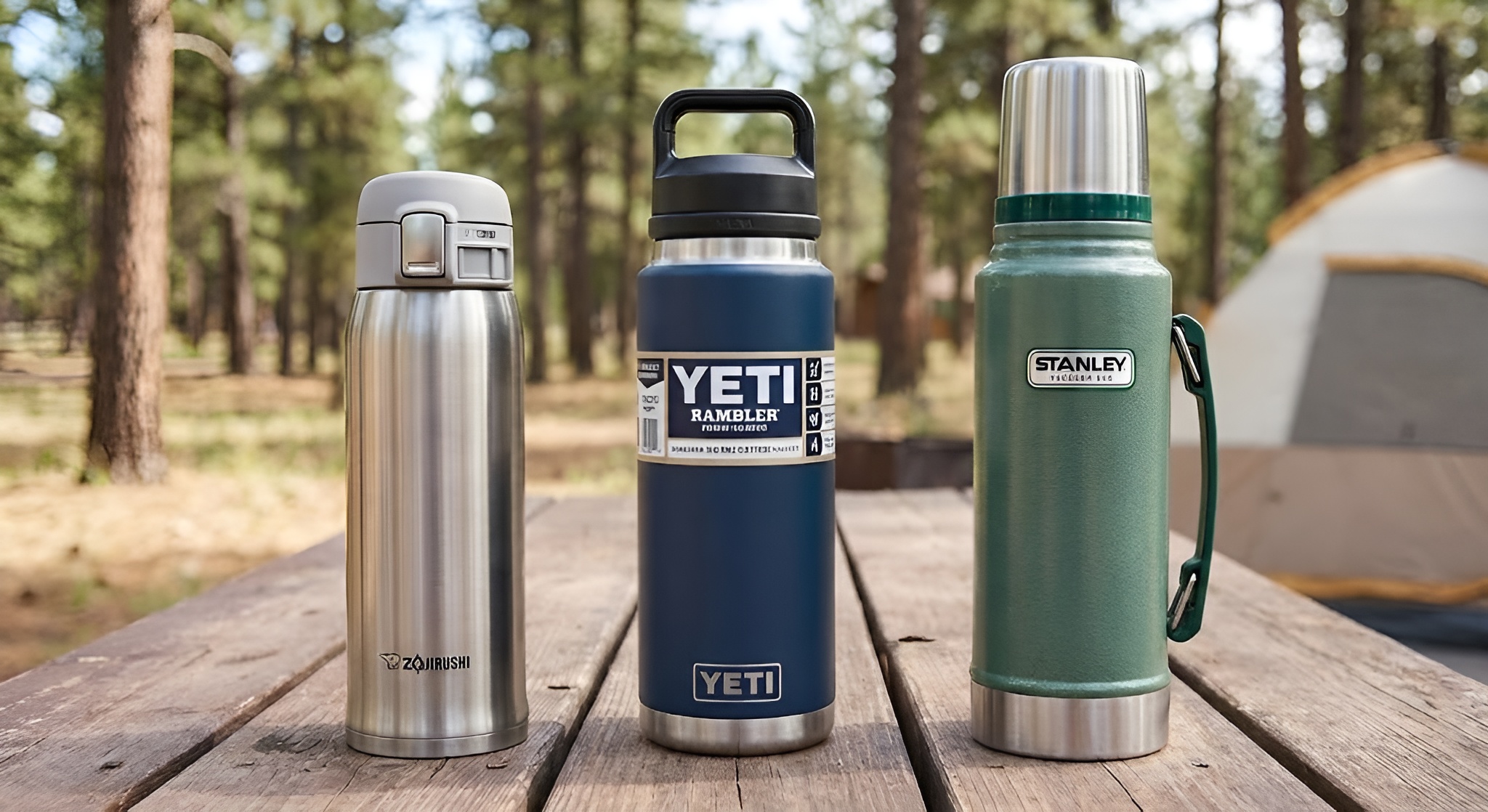
If you're new to flask brewing, consider purchasing a sample set or a mixed tea gift box that includes a range of oxidation levels and roast profiles, then conduct your own flask trials at home. Brew each tea at your intended parameters, pour into a thermos, and taste at 30, 60, 90, and 120 minutes; note which teas hold, which fade, and which turn unpleasant. This empirical approach is more reliable than relying on marketing copy alone. For rare or expensive teas (aged Wuyi oolongs, vintage pu-erh), reserve them for gongfu sessions at home rather than risking them in a flask; outdoor cinema is a context that rewards robustness and reliability over peak complexity. Finally, invest in a high-quality vacuum flask (Thermos, Stanley, or Zojirushi brands) with a wide mouth for easy cleaning and good thermal retention—a cheap flask that drops to 50 °C within an hour defeats the purpose of careful tea selection and will leave you disappointed well before the film's finale.
The Interval Top-Up Trick
Pack a small (250 ml) flask of plain boiling water alongside your tea flask. At the interval, top up your cup with hot water to dilute any creeping astringency and restore temperature—it's the simplest rescue for an over-steeped brew.


Comments