1. What Are MRLs and Why Three Different Standards?
A Maximum Residue Level (MRL) is the highest concentration of a pesticide legally permitted in or on food, expressed in milligrams per kilogram (mg/kg or parts per million, ppm). MRLs are not toxicity thresholds—they incorporate a safety margin, typically 100-fold, below the dose considered harmful in animal studies—but they do reflect how much residue remains after good agricultural practice. Because nations assess risk differently, prioritise different crops, and approve different active substances, the same chemical can carry an MRL of 0.05 mg/kg in the EU, 10 mg/kg in China, and 5 mg/kg in Japan.
For tea the divergence is stark. The European Union applies Regulation (EC) No 396/2005, which lists MRLs for approximately 500 active substances on tea (dried leaf); many older organophosphates and carbamates sit at the default 0.01 mg/kg because they were never supported by a dossier. China publishes GB 2763, updated most recently in 2021, with limits tailored to domestic cultivation: acetamiprid, for instance, stands at 10 mg/kg versus the EU's 0.1 mg/kg. Japan's Food Sanitation Act (enforced by MHLW) often splits the difference, setting limits informed by its own Acceptable Daily Intake calculations and the reality of importing large volumes from China, India and Sri Lanka. The result is a three-tier system in which a single sample can simultaneously pass Chinese domestic standards, fail Japanese import checks, and be detained at a UK port.
One Sample, Three Verdicts
A certificate showing 8 mg/kg acetamiprid is legal for sale in China, rejected in Japan (MRL 30 mg/kg but scrutinised), and non-compliant in the EU where 0.1 mg/kg is the ceiling. Always ask which standard the lab tested against.
2. Which Laboratories Test Tea and What Accreditations Matter
Pesticide residue analysis demands sophisticated equipment—liquid chromatography tandem mass spectrometry (LC-MS/MS) and gas chromatography tandem mass spectrometry (GC-MS/MS)—and rigorous quality control. Only laboratories accredited to ISO/IEC 17025 by a recognised national body can issue certificates with legal standing for customs clearance. In the UK, UKAS (United Kingdom Accreditation Service) is the national accreditor; on the Continent look for DAkkS (Germany), COFRAC (France) or equivalent. In China the CNAS (China National Accreditation Service for Conformity Assessment) mark is key, whilst Japan's FAMIC (Food and Agricultural Materials Inspection Center) performs official surveillance and many private Japanese labs carry JCLA accreditation.
Not all certificates are equal. An in-house report from an estate laboratory, however detailed, will not satisfy UK Border Force unless the lab holds recognised accreditation and participates in proficiency schemes. Major third-party testing houses—Eurofins, SGS, Intertek, ALS, AsureQuality—operate global networks of accredited sites and publish scope schedules listing exactly which pesticides and matrices they are accredited for. When reviewing a certificate, confirm the lab name and accreditation number appear on the UKAS or CNAS register; check the report references the analytical method (often QuEChERS extraction followed by LC-MS/MS); and verify that the limit of quantification (LOQ) for each analyte is at or below the relevant MRL. A LOQ of 0.05 mg/kg is useless if the MRL you care about is 0.01 mg/kg.
Some UK importers and specialty roasters commission testing on arrival, sending samples to UKAS labs such as Fera Science or Eurofins York. This adds cost—a full multi-residue screen for 450+ compounds runs £250–400 per sample in 2026—but provides an independent UK-accredited data point and can be faster than waiting for a Chinese CNAS certificate to be translated and apostilled. For high-value single-estate orders, dual testing (origin lab plus UK confirmation) is becoming standard practice.
3. Anatomy of a Pesticide Residue Certificate: What Each Section Means
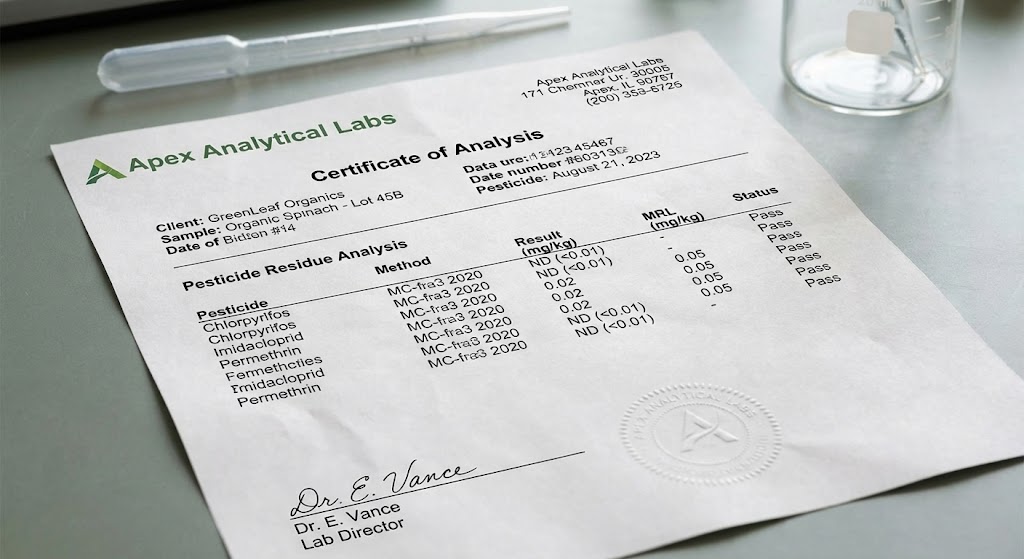
A typical multi-residue report runs two to four pages. The header identifies the laboratory, accreditation logo and number, report date, and a unique certificate number that can be verified on the lab's portal. The sample description records the tea type (Camellia sinensis, black/green/oolong), batch or lot code, sample weight, and date received; any mismatch between the supplier's shipping docs and this section is a red flag. The client and applicant fields show who commissioned the test—ideally the exporter or your own importer—and where results should be sent.
The heart of the certificate is the results table. Each row lists an active substance, the concentration found (often '<0.01' or 'ND' for non-detect), the LOQ, the MRL against which the lab compared the result, and a pass/fail or comply/exceed verdict. Crucially, the MRL column reflects the standard the lab was instructed to apply: if the client requested EU limits, that is what appears; if they asked for Chinese GB 2763, those higher thresholds will be printed, and the same residue may show as compliant. This is why the instruction to the lab—documented in the test request or purchase order—matters as much as the final number.
A second table or annex often lists analytes screened but not detected, demonstrating the breadth of the scan; a comprehensive screen in 2026 covers 400–600 substances, including legacy organochlorines (DDT, lindane), organophosphates (chlorpyrifos, profenofos), pyrethroids (bifenthrin, cypermethrin), neonicotinoids (imidacloprid, thiamethoxam), and fungicides (carbendazim, metalaxyl). Some certificates append a chromatogram—a spiked peak plot—for any detected residue, offering forensic proof of identity. Finally, the signatory block carries the lab manager's signature, date of issue, and a statement of compliance with ISO 17025 and the relevant standard. Without that signature and accreditation seal, the document is worthless at customs.
Check the MRL Column Every Time
A 'pass' verdict only means the lab applied the standard you requested. If the certificate lists GB 2763 limits but you need EU compliance, the pass is irrelevant—re-read every detected residue against Regulation 396/2005 yourself or ask the lab for a re-issue.
4. EU Regulation 396/2005 vs. GB 2763 vs. Japan MHLW: Key Differences in Practice
The European Union's MRL database (accessible at ec.europa.eu/food/plant/pesticides) is the gold standard for UK import. It sets limits compound-by-compound for tea, dried leaves (commodity code 0902), and applies a precautionary approach: unless a manufacturer submits a dossier proving safe use, the default MRL is 0.01 mg/kg—the limit of analytical determination rather than a toxicological threshold. This catches older actives (parathion, methamidophos) and newer substances not yet authorised in Europe. Certain pyrethroids (lambda-cyhalothrin at 1 mg/kg, deltamethrin at 5 mg/kg) and some fungicides (azoxystrobin at 30 mg/kg on fresh leaf, translating to roughly 70 mg/kg dried depending on processing factor) enjoy higher MRLs because dossiers were submitted, but the list is short compared to producing countries.
China's GB 2763-2021 reflects the agronomic reality of the world's largest tea producer. It permits acetamiprid at 10 mg/kg (100 times the EU limit), clothianidin at 2 mg/kg (versus 0.01 in Europe), and glyphosate at 1 mg/kg (versus 0.1 EU). The higher thresholds stem from different exposure assumptions—Chinese regulators model domestic consumption patterns, which include both green and fermented teas, and factor in processing loss—and from the fact that many of these compounds are registered for use on tea in China. GB 2763 is updated every few years; the 2021 edition expanded to over 560 pesticide-crop combinations, but the tea-specific list remains more permissive than Brussels will accept.
Japan's system, managed by the Ministry of Health, Labour and Welfare, occupies the middle ground. The country imports heavily from China, India and Vietnam, so outright alignment with EU strictness would choke supply; yet Japanese consumers expect high safety standards, so limits are generally tighter than GB 2763. For instance, Japan's MRL for imidacloprid on tea is 1 mg/kg (EU: 0.05, China: 0.5), and for cypermethrin 15 mg/kg (EU: 1, China: 20). Japan also operates a positive list: any pesticide not explicitly listed defaults to 0.01 mg/kg, mirroring the EU's philosophy but with a different enumeration. In practice, teas that pass Japanese testing often—but not always—clear EU hurdles; the reverse is almost always true.
For UK buyers, the strategic lesson is simple: only certificates tested against EU MRLs offer assurance of legal import. A Chinese lab certificate showing GB 2763 compliance may accompany the shipment, but UK Border Force and port health authorities apply retained EU law (as amended), so any exceedance of Regulation 396/2005 can trigger detention, sampling, and destruction. Even speciality tea categories—white, pu-erh, oolong—fall under the same commodity code and MRLs; there are no exemptions for artisan batches.
Demand EU-Standard Testing Before Shipment
Insist your supplier commissions a pre-export test against EU Regulation 396/2005 at a CNAS or ISO 17025 lab. Paying £300 for a certificate in Hangzhou is cheaper than a £5,000 detained-container bill in Felixstowe.
5. How to Spot Non-Compliances and Understand Detection Limits
A non-compliance occurs when any detected residue exceeds the applicable MRL. On the certificate this may be flagged with red text, an asterisk, or the word 'Exceed' in the status column. The magnitude matters: a reading of 0.02 mg/kg against an MRL of 0.01 mg/kg is a marginal overshoot—possibly from cross-contamination in processing—and some border posts may permit re-testing or blending, whilst 5 mg/kg clothianidin in a nominally organic sample points to deliberate use and invites a fraud investigation. Always compare the detected concentration to both the stated MRL and the limit you need; if the certificate applied Chinese limits, you must cross-reference every detected analyte against the EU database manually or ask the lab to re-issue under EU parameters.
Detection limits determine what the lab can see. The limit of detection (LOD) is the smallest amount the instrument can reliably distinguish from background noise, typically 0.001–0.005 mg/kg for modern LC-MS/MS. The limit of quantification (LOQ) is the lowest concentration the lab will report as a number, usually 0.01 mg/kg for most pesticides on tea. A result of '
Some certificates display a measurement uncertainty (e.g. ±20%), reflecting the precision of the method. If a residue is reported as 0.09 ±0.02 mg/kg and the MRL is 0.1, the sample is technically borderline; regulators may apply the upper bound (0.11 mg/kg) and call it a fail. Understanding uncertainty is critical when results sit near thresholds, and it is one reason why conservative importers prefer results well below the MRL—ideally less than 50% of the limit—to account for analytical variation and any enforcement discretion.
6. Organic Certification, Pesticide Drift, and What 'Pesticide-Free' Really Means
Organic certification—whether EU Organic (Reg. 2018/848), USDA NOP, or China Organic—prohibits synthetic pesticides, but it does not guarantee zero residues. Drift from neighbouring conventional fields, contaminated irrigation water, and legacy soil residues all contribute trace levels, and organic standards permit low-level contamination provided it is unintentional and below a fraction of the MRL (commonly 10% or 0.01 mg/kg, whichever is lower). An organic certificate therefore guarantees process—no intentional spraying—but the accompanying residue test may still show detectable pyrethroids or neonicotinoids from pesticide drift. This is lawful, yet it surprises consumers who equate 'organic' with 'residue-free'.
True pesticide-free tea is a higher bar: it requires not only organic farming but also isolation from contamination sources and testing that confirms all screened analytes are below LOQ. A handful of estates in high-altitude Darjeeling, Taiwanese alpine gardens, and some wild-grown forests in Yunnan achieve this naturally—elevation, biodiversity, and distance create a cordon sanitaire. When evaluating a 'pesticide-free' claim, ask for the certificate and check that 400+ compounds were screened (not just a cherry-picked subset) and that every line reads ' Pesticide solubility adds another dimension. Lipophilic (fat-soluble) residues largely remain in the dry leaf during infusion, so your cup may contain only 10–40% of the residue measured in the lab, whilst hydrophilic compounds such as glyphosate partition more readily into the liquor. A certificate showing 0.05 mg/kg of a water-soluble pesticide implies a higher intake per cup than the same concentration of a lipophilic pyrethroid. Some cautious drinkers filter this risk by choosing whole-leaf teas over dust grades—larger leaves expose less surface area to water—and by discarding the first rinse, which can carry a disproportionate share of surface residues. Testing services that analyse brewed liquor rather than dry leaf offer a more realistic exposure picture, though such tests remain rare in commercial practice. Ask whether the lab screened the full 400–600 compound panel or only the dozen required for organic compliance. A narrow screen that omits glyphosate, glufosinate and newer neonicotinoids is not a pesticide-free certificate—it is selective marketing. If safety is your priority, three sourcing strategies stand out. First, altitude: tea grown above 1,200 metres experiences lower pest pressure, cooler nights that slow insect metabolism, and greater distance from intensive agricultural valleys. Estates in Darjeeling's upper reaches, Taiwan's Alishan, and the Wuyi ranges of Fujian naturally require fewer interventions; when combined with organic practices, high-altitude gardens deliver some of the cleanest leaf profiles in global trade. Ask your supplier for garden elevation and check whether the estate is certified organic or in conversion—two data points that together predict low residues better than any single variable. Second, pre-shipment EU-standard testing: negotiate contract terms that require the seller to provide an EU-compliant certificate from an accredited lab before the container is loaded. This shifts the risk of non-compliance upstream and signals to the supplier that you understand the regulatory landscape. Reputable exporters in China, India and Sri Lanka already test to EU MRLs for European clients; extending that requirement to UK buyers is straightforward. If your volumes are small—less than 50 kg—consider pooling orders with other roasters or retailers to share testing costs, or source through UK-based importers such as Teatulia or Jing Tea who publish batch-level test results online. Third, estate reputation and transparency: some gardens have published residue certificates for every harvest for a decade; others treat testing as a regulatory burden and release data only under duress. Look for suppliers who list test results on their website, who can name the lab and provide certificate numbers on request, and who participate in multi-stakeholder initiatives such as Rainforest Alliance or Trustea, which mandate periodic residue surveillance. Single-origin specialist retailers in the UK—such as What Cha, Postcard Teas, or Rare Tea Company—often vet suppliers rigorously and will share certificates with trade customers or curious consumers. When choosing tea gifts or matcha for gifting, opting for brands with transparent testing not only protects your health but also rewards the supply-chain actors who invest in verification. Finally, maintain a pragmatic view of risk. Even a residue at 80% of the EU MRL translates to minuscule daily intake—micrograms rather than milligrams—and the safety margin built into MRLs means acute harm is vanishingly unlikely. The true value of reading certificates is not to eliminate phantom dangers but to choose thoughtfully: to support farms that prioritise sustainability, to avoid the highest-residue commodity grades, and to know that the care you take in brewing is matched by care in the field and the lab. When comparing suppliers, ask the altitude of the garden. Teas from above 1,200 m almost always test cleaner than lowland plantations, regardless of country, because pest ecology and farmer economics both shift in your favour at height. A non-compliant certificate—showing one or more residues above EU MRLs—does not automatically mean the tea is unsafe, but it does mean it cannot legally enter the UK market without remediation or exemption. Your first step is to verify the result: confirm the lab applied the correct MRL database (EU 396/2005, not GB 2763), check the analyte spelling and CAS number against the EC pesticide register, and ensure the LOQ was appropriate. Clerical errors—transposed digits, wrong MRL cited—are not uncommon, and a lab will re-issue a corrected certificate within days if you flag a mistake. If the exceedance is genuine, notify your supplier immediately and halt any further shipment from the same batch. Under UK retained law, you must not place non-compliant food on the market; doing so can trigger fines under the Food Safety Act 1990 and reputational damage. Some contracts include a clause allowing the buyer to reject the shipment and claim costs; others require the supplier to arrange re-testing or remediation (blending with a compliant lot to dilute the residue below the MRL, though this is contentious and often prohibited for organic). Document all communications and keep copies of the certificate, bill of lading, and any correspondence, as you may need to demonstrate due diligence to your local authority. In a few cases—where the residue is only marginally over (e.g. 0.012 mg/kg vs. 0.01 MRL), the supplier has a strong quality history, and you have a commercial imperative—you may commission a second opinion from a UK UKAS lab. Split-sample re-testing occasionally reveals a false positive or confirms the result lies within measurement uncertainty and is compliant when uncertainty is accounted for. If the re-test confirms non-compliance, your options narrow to disposal (costly), return to origin (if the exporter agrees), or—very rarely—applying to the relevant authority for an emergency MRL derogation, a process reserved for cases of supply-chain disruption and almost never granted for tea. The best remedy is prevention: write testing requirements into every purchase order, build relationships with suppliers who understand EU MRLs, and consider investing in quality infusers and brewing methods that maximise the pleasure of the clean, compliant teas you do source. A single non-compliant batch is a learning moment; a pattern of non-compliance is a signal to change supplier.Verify the Scope of 'Pesticide-Free' Claims
7. Sourcing Strategies for UK Buyers: Altitude, Pre-Shipment Testing, and Trusted Estates
Elevation Is Your First Filter
8. What to Do If You Receive a Non-Compliant Certificate
Continue Your Journey



Comments