1. What Counts As Stale—and What Can Be Saved
Staleness in tea is primarily the result of oxidative degradation and moisture absorption. The volatile compounds responsible for aroma—aldehydes, esters, alcohols—react with oxygen in the air or break down over time, especially in the presence of light and heat. Concurrently, dry tea is hygroscopic: it pulls water vapour from the atmosphere, which softens the leaf structure, dilutes flavour precursors, and can eventually support microbial growth. A stale tea smells flat, musty, or grassy where it once smelled floral, fruity, or roasted; the liquor is thin, astringent without complexity, or oddly vegetal.
Re-roasting can reverse or mask many of these changes if the damage is chemical rather than biological. Leaves that have absorbed humidity, lost volatile top-notes, or developed a cardboard-like flatness are good candidates. Leaves that show visible mould (white, green, or black patches), smell of ammonia or rot, or have been invaded by pantry moths or weevils must be discarded—heat will kill surface microbes but cannot remove mycotoxins or insect debris. Similarly, flavoured teas (Earl Grey, jasmine blends with added oils) rarely benefit because the artificial or natural flavourings degrade independently of the leaf, and re-roasting cannot restore a vanished bergamot note.
The best candidates for revival are minimally processed or traditionally roasted teas: Tieguanyin and other rolled oolongs, Wuyi rock teas, aged sheng and shu pu-erh, and robust black teas such as Keemun or Yunnan gold. Conversely, Japanese steamed greens (sencha, gyokuro) and Chinese pan-fired greens (Longjing, Biluochun) are fragile; re-roasting often accelerates the conversion of chlorophyll to pheophytin, turning the liquor brown and bitter. White teas—Silver Needle, White Peony—lose their delicate floral volatiles under heat and are generally not worth the attempt unless they are several years old and already undergoing intentional aging.
Smell Before You Roast
If the dry leaf smells of nothing, re-roasting may help. If it smells actively unpleasant—sour, ammoniated, or musty in a dank way—no amount of heat will improve it. Trust your nose.
2. The Chemistry of Re-Roasting: What Heat Actually Does
Re-roasting applies dry heat to drive off absorbed moisture and trigger mild Maillard reactions and caramelisation in residual sugars and amino acids. The process is closely related to the final firing or baking (hong bei) step used in traditional oolong and rock-tea production, where leaves are held at 80–120 °C to stabilise flavour, deepen colour, and extend shelf life. In a stale leaf, gentle heat volatilises the water that has softened cell walls, evaporates some of the more oxidised or off-flavour compounds, and encourages the formation of new aromatic molecules—roasted, nutty, or toasty notes—that can mask residual flatness.
However, the same heat that revives can also destroy. Temperatures above 120 °C begin to scorch delicate tips and break down catechins and polyphenols into bitter, astringent tannins. The balance between revival and ruin depends on temperature, time, and airflow. A slow, even roast at 80–100 °C allows moisture to escape without charring the leaf surface; rapid, high heat (as in a very hot pan) can produce an attractive toasted aroma on the outside while leaving the interior damp and stale. This is why single-layer spreading and periodic stirring or shaking are critical, regardless of method.
It is also worth noting that re-roasting does not reverse oxidation in the strict chemical sense—once a catechin has oxidised to a theaflavin, no amount of heat will turn it back. What re-roasting can do is drive off volatile oxidation by-products (aldehydes that smell stale or cardboardy) and create new flavour compounds that are more pleasant. The result is not a restoration of the original flavour profile but a transformation into something different and, ideally, still enjoyable.
3. Oven Re-Roasting: The Most Controlled Method
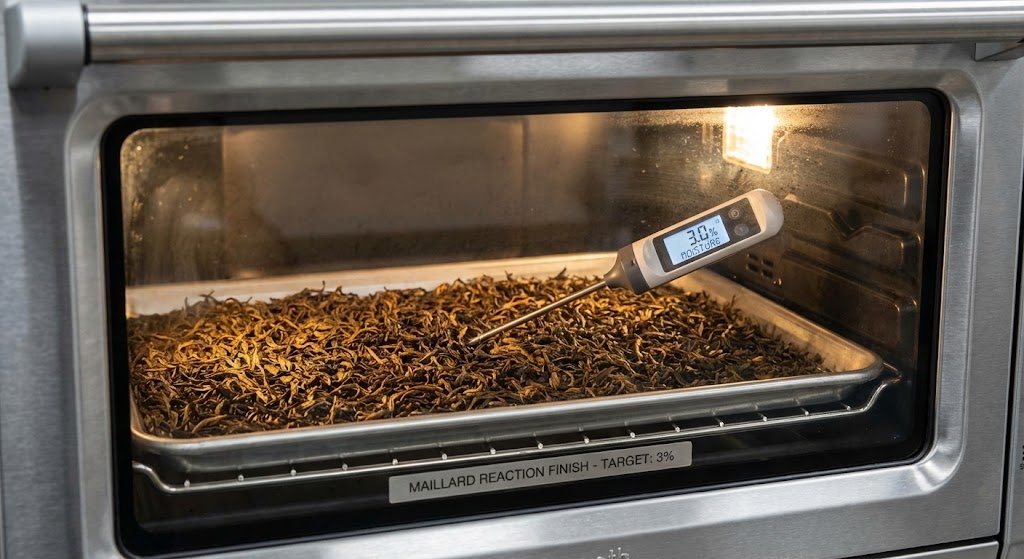
For most home users, a conventional oven offers the best combination of control, capacity, and even heat distribution. Preheat your oven to 80–100 °C (fan or conventional; fan is slightly better for moisture evacuation). Spread the stale leaves in a single, loose layer on a clean baking tray lined with baking parchment—do not pile them or they will roast unevenly. Slide the tray onto the middle rack and set a timer for 10 minutes.
After 10 minutes, open the oven and gently stir or shake the tray to redistribute the leaves. Check the aroma: you should begin to smell a toasted, warm fragrance rather than the previous staleness. If the leaves still feel slightly soft or damp, return them for another 5–10 minutes. The total roasting time is typically 15–20 minutes for oolongs and blacks, 10–15 minutes for lighter teas. Remove the tray as soon as the leaves are crisp and fragrant; overdo it and they will turn brittle and bitter.
Let the leaves cool completely on the tray—do not transfer them to a sealed container while hot, as residual steam will re-introduce moisture. Once cool, transfer to an airtight tin or jar and store in a dark, cool cupboard. Oven re-roasting is particularly effective for larger batches (50–200 g) and for teas that were originally roasted, such as Tieguanyin, Da Hong Pao, or Himalayan black teas. The method is forgiving, repeatable, and requires no special skill beyond patience and a willingness to check progress.
Watch the Colour, Not the Clock
Leaf size, moisture content, and oven calibration vary. Check every 5 minutes after the first 10, and pull the tray when the leaves smell right and feel crisp—colour should deepen slightly but not turn black.
4. Pan and Wok Techniques: Speed and Tradition
Pan-firing or wok-roasting is the method used by tea artisans in China and Taiwan, and it can be highly effective—if you are comfortable working over moderate heat and stirring constantly. Preheat a clean, dry wok or heavy-bottomed frying pan (cast iron or carbon steel preferred) over low to medium-low heat. Add a small handful of stale leaves—no more than 20–30 g at a time—and use a wooden or bamboo spatula to keep them moving in a gentle, continuous motion.
The goal is to toast, not fry. The leaves should never sit still long enough to scorch; instead, they tumble and flip, releasing moisture as steam and gradually darkening and crisping. This process takes 3–6 minutes depending on heat and leaf type. You will smell the shift from stale to roasted quite clearly; the moment the aroma turns pleasantly nutty or toasty, tip the leaves out onto a cool plate to arrest further cooking.
Pan methods are fast and produce excellent results for rolled oolongs and rock teas, but they demand attention and a degree of intuition. Uneven heat, a moment's distraction, or too-high temperature will burn delicate tips or create bitter, acrid notes. For beginners, the oven is safer; for those familiar with wok cooking or home roasting techniques, the pan offers speed and a hands-on, craft feel. One practical tip: slightly dampen your hand and flick a few drops of water into the empty, preheated pan; if they bead and roll, the temperature is about right. If they instantly vaporise or the pan smokes, it is too hot.
5. Microwave Re-Roasting: Viable for Very Small Batches
Microwave re-roasting is controversial, but it can work for very small volumes—10–20 g—when time or equipment is limited. The principle is the same: apply heat to drive off moisture. The challenge is that microwaves heat unevenly, and the margin between 'just right' and 'scorched' is narrow. Spread the leaves in a single layer on a microwave-safe plate lined with kitchen paper (to absorb released moisture). Microwave on medium-low power (30–40 %) for 30 seconds, then remove, stir, and check.
Repeat in 20–30 second bursts, stirring between each, until the leaves feel dry and smell toasted. Total time is usually 90 seconds to 2 minutes, but this varies wildly by microwave wattage and leaf moisture content. The risk is localised scorching—individual leaves can char while others remain damp—so this method is best reserved for emergencies or when you want to test a very small sample before committing a larger batch to the oven or pan.
In practice, oven drying is more predictable and forgiving. Microwave re-roasting is mentioned here for completeness and because some readers will try it regardless; if you do, use the lowest practical power setting, work in very short intervals, and accept that results will be inconsistent. For most teas and most purposes, the oven or pan will serve you better.
Test First, Scale Later
Before committing 100 g of precious oolong, re-roast 10 g as a trial. If the aroma and flavour improve, proceed with the rest. If not, you've lost only a small sample.
6. Success Rates by Tea Type: Realistic Expectations
Oolongs (Tieguanyin, Da Hong Pao, Dong Ding, Phoenix Dan Cong) are the easiest and most rewarding candidates. Their rolled or twisted structure holds moisture pockets that respond well to heat, and many were traditionally roasted as part of processing. Success rate: 80–90 % for moderately stale leaves. Aged and raw pu-erh also respond well, particularly if they have absorbed ambient humidity; a light roast can dry them out and sharpen the profile. Success rate: 70–80 %.
Black teas (Yunnan gold, Keemun, Assam, Scottish breakfast blends) can be revived if they have gone flat or slightly musty, though the improvement is less dramatic than with oolongs. The existing oxidation means there are fewer delicate volatiles to preserve, and re-roasting mostly adds a toasted, malty note. Success rate: 60–70 %. Green teas are much harder. Pan-fired Chinese greens (Longjing, Gunpowder) tolerate gentle re-roasting better than steamed Japanese greens, but both risk turning bitter and brown. Success rate: 30–50 %, and often not worth the effort unless the tea was expensive and only mildly stale.
White teas and yellow teas are generally not suitable. Their appeal lies in delicate floral and grassy notes that are easily destroyed by heat; re-roasting will darken the liquor and flatten the profile further. If a white tea has aged intentionally over several years and developed richer, honeyed notes, a very gentle, very brief roast (5–8 minutes at 80 °C) might be worthwhile, but expect mixed results. Flavoured teas (Earl Grey, jasmine, fruit blends) should not be re-roasted; the added oils or flowers will not revive, and you risk baking off what remains of the flavouring while doing little for the base leaf.
7. When Not to Bother: Recognising Lost Causes
Re-roasting takes time and care, and not every stale tea is worth the effort. If the leaves were inexpensive commodity-grade to begin with—supermarket own-brand teabags, for example—the improvement will be marginal at best, and you are better off composting them and buying fresh. Similarly, if the tea has been open and exposed to air for more than a year, or stored in a warm, bright kitchen, the degradation is likely too advanced for revival to be meaningful.
Visible mould, off-odours (sour, ammoniated, putrid), or insect contamination are absolute deal-breakers. No amount of heat will remove mycotoxins, and attempting to roast mouldy tea will spread spores in your kitchen. Discard any tea that shows these signs. Likewise, if you have already tried re-roasting once and the results were poor—bitter, astringent, or still flat—do not repeat the process. Each successive roast degrades the remaining polyphenols and volatiles further; you are chasing diminishing returns.
Finally, consider opportunity cost. If you have 50 g of stale mid-tier oolong and the same quantity of fresh, high-quality leaf waiting to be enjoyed, it may be more sensible to compost the stale batch and move on. Re-roasting is a useful skill and a satisfying exercise in resourcefulness, but it is not a substitute for proper storage practices or regular rotation of your tea stock. Prevention—airtight tins, cool dark cupboards, prompt consumption—remains the best strategy.
Know When to Let Go
If the cost of your time and energy exceeds the replacement cost of the tea, compost it. Re-roasting is for rescuing good tea that went stale, not for salvaging mediocre tea that was never worth keeping.
8. Storing Revived Tea and Preventing Re-Staleness
Once you have successfully re-roasted a batch of tea, it is no more stable than freshly processed leaf—possibly less so, since the roasting process has driven off protective moisture and exposed new surface area to oxidation. Transfer the cooled leaves immediately to an airtight container: a metal tin with a tight-fitting lid, a glass jar with a rubber seal, or a vacuum-sealed pouch. Store in a cool, dark cupboard away from spices, coffee, or other strong-smelling ingredients.
Revived tea will typically remain at its peak for 4–8 weeks, after which the same oxidative processes will resume. For this reason, it is wise to re-roast only what you will drink in the near term, rather than reviving an entire 200 g canister at once. If you must store larger quantities, consider portioning into smaller tins to minimise repeated opening and air exposure. Some enthusiasts go further and use oxygen absorbers or nitrogen-flush bags, but for most home drinkers, a good tin and prompt consumption will suffice.
Finally, reflect on what caused the staleness in the first place. Was the original packaging inadequate? Was the tea stored too close to a window or radiator? Did you leave the lid off between sessions? Freezing is one option for very long-term storage of high-value teas, though it introduces its own risks of condensation and freezer odours. In general, buying smaller quantities more frequently, storing with care, and rotating stock are more practical strategies than relying on re-roasting as a regular fix. Think of revival techniques as a rescue tool, not a maintenance routine.
Label and Date Revived Batches
Mark your tin with the date of re-roasting. This reminds you to prioritise it in your rotation and prevents the same leaves languishing for another six months until they need rescuing again.


Comments