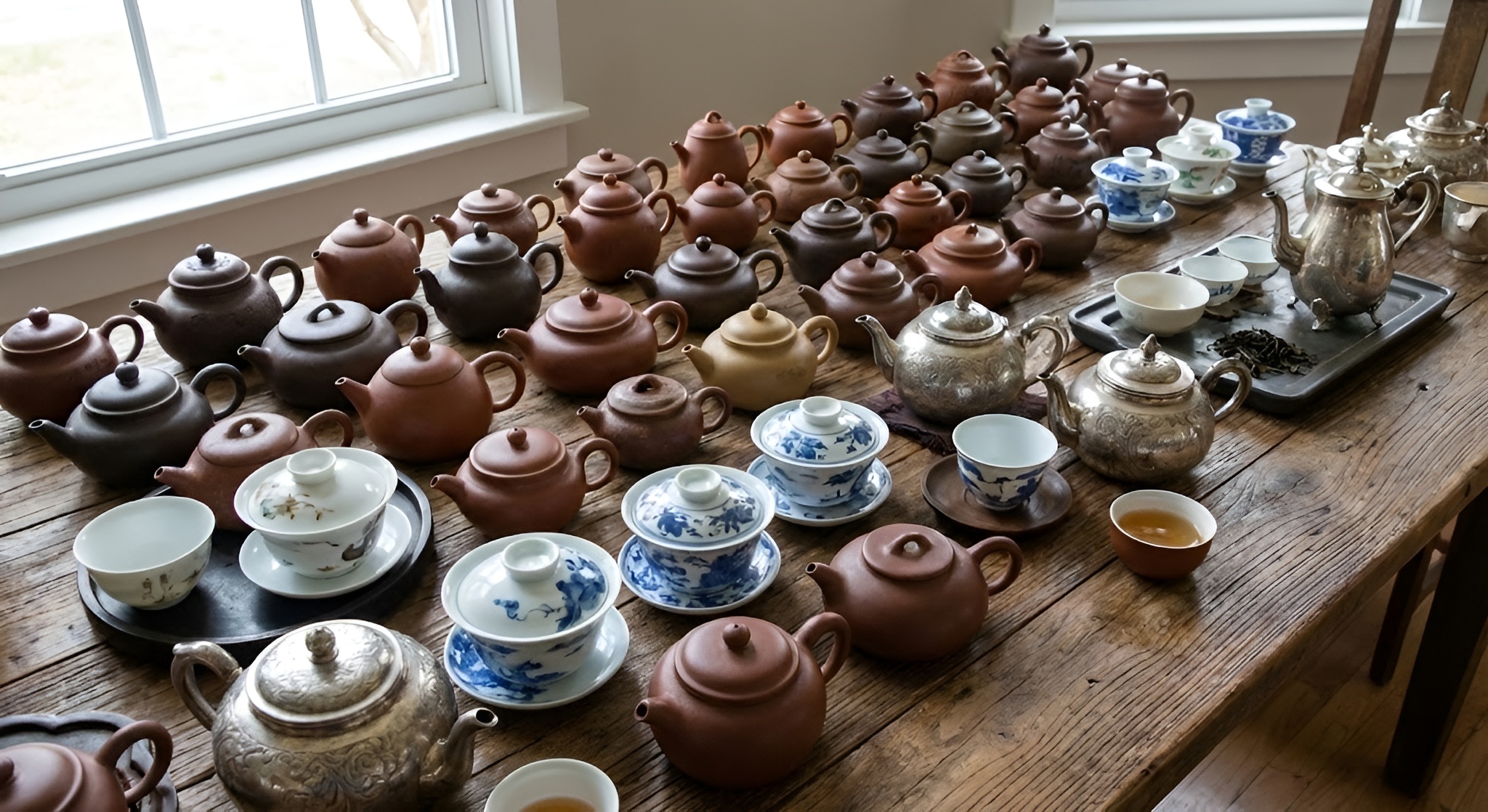
1. What Distinguishes Gaiwan and Teapot as Extraction Vessels
A gaiwan is a lidded, handle-free bowl—typically 100–150 ml—comprising three parts: bowl, lid, and saucer. Originating in Ming-dynasty China, it doubles as both brewing chamber and drinking vessel in traditional settings, though most modern users decant into a separate pitcher or cup. The defining feature is the wide, open mouth and shallow profile: leaf sits in a broad, thin layer, maximising surface exposure to water. Pour-out happens by tilting the bowl and using the lid as a strainer, a motion that takes one to three seconds and involves minimal restriction.
A teapot—whether ceramic, cast-iron, glass, or unglazed clay—encloses leaves in a taller, more vertical chamber and channels liquid through an internal strainer or perforated basket and out via a spout. Teapot geometry varies widely, but most designs present a narrower diameter and greater height than a gaiwan of equivalent volume. The spout introduces a choke point that slows decanting to five to fifteen seconds, and the lid seals more tightly, reducing gas exchange. Together, these features create a more stable, enclosed thermal and hydrodynamic environment compared with the gaiwan's open, agile format.
Both vessels share the same core inputs—leaf mass, water temperature, contact time—but their physical architecture reshapes how those inputs translate into dissolved solids, volatile aromatics, and astringent polyphenols in the cup. Recognising these structural differences is the first step toward intentional, predictable brewing.
2. Vessel Geometry and Extraction Surface Area
Extraction rate is proportional to the wetted surface area of the leaf and the concentration gradient between leaf interior and surrounding liquor. In a gaiwan's shallow bowl, dry leaf spreads horizontally, unfurling into a loose mat one or two leaves deep. Water floods the entire bed almost instantly, and each particle enjoys direct contact with turbulent flow. Measured surface-area-to-volume ratios in a 120 ml gaiwan can exceed those in a 120 ml spherical teapot by 30–40 per cent, meaning more leaf surface is available for diffusion per millilitre of water.
A taller teapot, by contrast, encourages a deeper leaf column. The same five grams of rolled oolong that forms a single layer in a gaiwan may stack three or four leaves high inside a narrow pot. Lower leaves experience reduced flow velocity and partial shading from upper layers, slowing their hydration and limiting early solute release. This effect is especially pronounced in tightly rolled or compressed teas—Dan Cong, Tie Guan Yin, pu'erh cakes—that require time and agitation to fully open. The result is a shallower initial extraction curve in the teapot, with more material reserved for subsequent infusions.
Published computational fluid dynamics (CFD) models of teapot and bowl geometries confirm that horizontal, open vessels generate higher average shear rates at the leaf surface during the pour and early steep, accelerating the convective transport of dissolved polyphenols, caffeine, and amino acids into the bulk liquid. This geometric advantage explains why gaiwan protocols often specify ultra-short contact times—ten to twenty seconds—to avoid over-extraction, whereas the same tea in a teapot may require thirty to sixty seconds to achieve equivalent concentration.
Match Leaf Density to Vessel Depth
For tightly rolled oolongs or compressed pu'erh, a gaiwan's shallow bed ensures every leaf unfurls freely; stacking them in a tall, narrow pot delays full hydration and mutes early aromatics.
3. Turbulence, Convection, and Pour Dynamics
Turbulence is the chaotic, swirling motion that lifts particles, disrupts boundary layers, and refreshes the water film around each leaf fragment. When you pour boiling water into a gaiwan's wide bowl from a height, the jet strikes the leaf bed and radiates outward, creating eddies and vortices that tumble leaves and strip dissolved compounds into the liquor. The open geometry offers little resistance, so kinetic energy dissipates as mixing rather than heat. Turbulence intensity—quantified by Reynolds number—remains high throughout the pour and initial seconds of the steep.
In a teapot, the same pour enters through a smaller lid aperture or via a side-mounted spout inlet, and the liquid must navigate the chamber's taller walls and any internal basket or strainer. These geometric obstructions dampen large-scale turbulence, converting kinetic energy into smaller, slower convective currents. Fluid-dynamics analyses show that spherical and bulbous teapot shapes promote gentle, rolling convection—warm liquid rises along the walls, cools slightly near the lid, and sinks back through the leaf bed—but peak velocities remain lower than in a gaiwan's initial turbulent burst.
The practical consequence is that gaiwan extraction front-loads solute release: polyphenols, caffeine, and volatile esters leave the leaf rapidly in the first ten to fifteen seconds, then the rate plateaus. A teapot's steadier, slower convection spreads extraction more evenly across the contact period, which can smooth out astringency peaks and enhance perception of body and sweetness. For high-aroma greens and lightly oxidised oolongs, the gaiwan's turbulence captures delicate florals before they volatilise; for robust blacks and aged pu'erh, a teapot's gentler flow may better integrate tannins and reduce harshness.
4. Pour Speed, Spout Restriction, and Contact-Time Extension
Once leaves have steeped, the speed of decanting determines final contact time and, by extension, total dissolved solids. A gaiwan pours in one to three seconds: you tilt the bowl, crack the lid to create a narrow slot, and liquid streams out under gravity with minimal resistance. Achieving a clean, fast pour requires practice—correct thumb, index, and middle-finger placement—but the physics are simple: wide exit, short path, high flow rate.
A teapot's spout introduces a hydraulic choke. Liquid must travel from the chamber base, through an internal filter or basket holes (typical diameter 1–2 mm), along a curved or angled spout channel (often 4–6 mm at the outlet), and finally exit against atmospheric pressure. Spout geometry—length, taper, interior smoothness—governs flow rate, but even a well-designed spout rarely empties a 150 ml pot in fewer than five seconds, and many take ten or more. During that interval, leaves remain submerged and extraction continues, adding an unplanned five-to-ten-second tail to your nominal steep time.
This tail effect accumulates across multiple infusions. If you intend a twenty-second gongfu steep but decanting takes eight seconds, actual contact time is twenty-eight seconds—a 40 per cent overrun. Sensitive teas—Japanese greens, high-mountain oolongs—can tip from balanced to astringent. The gaiwan's near-instantaneous pour keeps extraction percentages tightly controlled, which is why competitive tea tasters and quality-control labs often prefer gaiwans for reproducibility. Teapots, meanwhile, benefit brewers who value forgiveness and fuller body over precision, since the extended contact naturally boosts sweetness and mouthfeel.
Time the Full Pour, Not Just the Steep
Start your timer when water hits the leaf and stop it when the last drop leaves the spout or gaiwan. Ignoring decant time in teapot brewing can add 20–50 per cent to actual extraction, skewing results.
5. Lid Design, Volatile Retention, and Aroma Management
Tea aroma comprises dozens of volatile esters, aldehydes, alcohols, and terpenes—many with boiling points below 100 °C—that partition between the liquid phase and the steam above it. A gaiwan lid sits loosely on the bowl's rim, leaving a visible gap when tilted for pouring. During the steep, steam vents freely, carrying high-volatility compounds (linalool, geraniol, cis-jasmone) into the air. This rapid degassing preserves a clean, bright aroma profile in the liquor but means some of the most delicate florals never make it to the cup—they dissipate into the room or cling to the underside of the lid, which experienced tasters sniff between infusions to capture those transient notes.
A teapot lid, especially on Yixing, Banko, or glazed ceramic designs, forms a tighter seal. The small vent hole (if present) or the narrow gap around the lid's flange restricts vapour escape, maintaining higher partial pressures of volatile organics in the headspace. Those volatiles re-condense on the lid interior and drip back into the liquor or remain dissolved at higher concentrations. The result is a richer, more persistent aroma in the brewed tea, with mid- and low-volatility compounds (nerolidol, indole, certain lactones) more evident. However, trapping steam also traps heat and moisture, which can push extraction of astringent catechins and gallic-acid derivatives beyond the desired window if the pot sits too long.
For aroma-forward teas—Phoenix Dan Cong, Baozhong, Darjeeling first flush—many brewers prefer the gaiwan's open venting to showcase ephemeral high notes without risking a heavy, tannic finish. For aged or roasted teas—Liu Bao, Wuyi rock oolongs, Yunnan blacks—a sealed teapot concentrates deeper, earthy, or caramelised aromatics that benefit from containment. Switching vessels can therefore reveal different facets of the same leaf, much like decanting wine into different glass shapes.
6. Thermal Dynamics: Heat Retention and Temperature Stability
Extraction kinetics double roughly every 10 °C rise in water temperature, so even small thermal differences between vessels matter. A thin-walled porcelain gaiwan (wall thickness ~2 mm) has low thermal mass and high emissivity: it heats quickly when filled, then sheds warmth rapidly to the surrounding air. Measured temperature loss in a 120 ml porcelain gaiwan can reach 8–12 °C in the first thirty seconds, especially in cool rooms or when wet hands conduct heat away from the bowl's exterior. This cooling effect acts as a built-in brake on extraction, preventing runaway astringency and making gaiwans relatively forgiving for delicate greens and whites.
Teapots, by contrast, vary enormously in heat retention depending on material and wall thickness. A thick unglazed Yixing clay pot (5–8 mm walls) or a cast-iron tetsubin with enamel lining can lose as little as 3–5 °C over sixty seconds, maintaining a more stable, elevated temperature throughout the steep. Tokoname and Chaozhou clays fall between these extremes, while double-walled glass and vacuum-insulated designs push retention even higher. The consequence is that a teapot keeps extraction running hotter for longer, boosting caffeine release, accelerating tannin dissolution, and intensifying body.
In gongfu sequences of five to ten short infusions, heat retention compounds across steeps. A gaiwan cools between pours, resetting the thermal baseline each time and preserving the tea's evolution in neat steps. A well-insulated teapot carries residual heat forward, so infusion three may start at 92 °C even if infusion one began at 95 °C, subtly altering the flavour trajectory. Brewers who prize clarity and definition favour the gaiwan's thermal reset; those seeking cumulative depth and warmth lean toward heat-retentive teapots. Pre-warming either vessel narrows the gap but does not eliminate the material's intrinsic thermal inertia.
Pre-Warm to Equalise Starting Temperature
Rinse both gaiwan and teapot with boiling water for ten seconds before brewing. This simple step reduces initial heat sink, bringing thin porcelain closer to thick clay's thermal baseline and improving repeatability.
7. Material Surface Chemistry and Flavour Interaction
Beyond geometry and heat, the chemical nature of the vessel's inner surface can modify extraction by adsorbing, catalysing, or releasing compounds. Glazed porcelain and borosilicate glass are effectively inert: they present a smooth, non-porous silica or alumino-silicate surface that neither absorbs tannins nor leaches ions. This inertness makes glazed gaiwans the reference standard for comparative tasting—any flavour change stems purely from time, temperature, and turbulence, not material interaction.
Unglazed stoneware—Yixing zisha, Jianshui, Chaozhou zhuni—is micro-porous, with interconnected pores (0.1–10 µm) that trap oils, polyphenols, and volatile esters during use. Over dozens of sessions with the same tea type, these clays build a seasoning layer that subtly rounds astringency and adds a perceived smoothness. Laboratory infrared spectroscopy confirms that used Yixing clay retains adsorbed catechins and theanine, which may slowly release or react with fresh brew. Some brewers regard this as desirable patina; others view it as cross-contamination that blurs the true character of each tea. Glazed stoneware splits the difference, offering durability and easy cleaning while blocking micro-porous effects.
Cast-iron teapots with enamel interiors behave like glazed ceramic—inert and cleanable—but bare iron (rare in modern tetsubin) can release ferrous ions that darken liquor and impart metallic notes. Silver teapots are inert and prized for their antimicrobial surface, though their high thermal conductivity makes them poor heat retainers unless thick-walled. For controlled, repeatable extraction, a glazed-porcelain gaiwan remains unmatched; for exploring how clay seasoning reshapes a familiar tea, an unglazed Yixing pot offers a unique, evolving variable.
8. Choosing Gaiwan or Teapot by Tea Type and Brewing Goal
High-aroma oolongs and green teas—Tie Guan Yin, Baozhong, Bi Luo Chun, Japanese sencha—benefit from the gaiwan's rapid heat loss, vigorous turbulence, and open venting. These teas contain abundant volatile esters and low levels of oxidised tannins, so a fast, cool extraction captures floral and grassy notes without bitterness. The gaiwan's instant pour also suits the ultra-short contact times (10–20 seconds) typical of competitive gongfu, where each infusion highlights a distinct layer—sweetness, then florals, then mineral finish—in clear sequence.
Aged and fermented teas—shou pu'erh, Liu An, Fu Zhuan—often present earthy, woody, or mushroom notes that emerge slowly and deepen with heat. A thick-walled Yixing or Chaozhou teapot holds temperature steady, allowing complex microbial metabolites (pyrazines, methoxyphenols) to dissolve fully and integrate. The slower pour and tighter lid prevent volatile mustiness from escaping too quickly, yielding a rounder, sweeter cup. Many pu'erh enthusiasts dedicate one clay pot per tea region to build complementary seasoning.
Robust black teas—Assam, Yunnan Dian Hong, Ceylon—tolerate or even thrive under the teapot's extended contact and stable heat, which boost caffeine yield and malty, caramelised flavour compounds. A porcelain or cast-iron teapot provides the thermal mass these teas need without the clay's tannin adsorption, preserving full-bodied astringency. Conversely, brewing a bold black in a gaiwan with rapid decanting can produce a lighter, more tea-forward profile, useful when serving the same leaf across many short infusions.
For exploration and learning, owning both formats is ideal. Brew the same tea side by side—identical dose, time, and temperature—and compare aroma, body, astringency, and sweetness. The differences clarify how much vessel geometry, rather than leaf quality alone, shapes your sensory experience. UK buyers will find quality gaiwan sets from specialist importers and online tea retailers; well-made teapots in Yixing, Tokoname, and glazed porcelain are widely available, though provenance and clay authenticity vary. Prioritise verified materials, clear return policies, and user reviews that discuss heat retention and pour behaviour. If you are assembling a gift for a tea enthusiast, pairing a high-quality gaiwan with a selection of oolongs—or a seasoned Yixing pot with aged pu'erh—demonstrates understanding of how vessel and leaf interact, elevating the gesture beyond generic kitchenware.
Side-by-Side Trials Reveal True Differences
Brew the same oolong in both a gaiwan and a teapot using identical parameters. Taste each infusion in sequence to isolate the vessel's effect—clarity versus body, bright florals versus integrated sweetness—without leaf variability.
Comments