1. What a Gaiwan Is—and Isn't
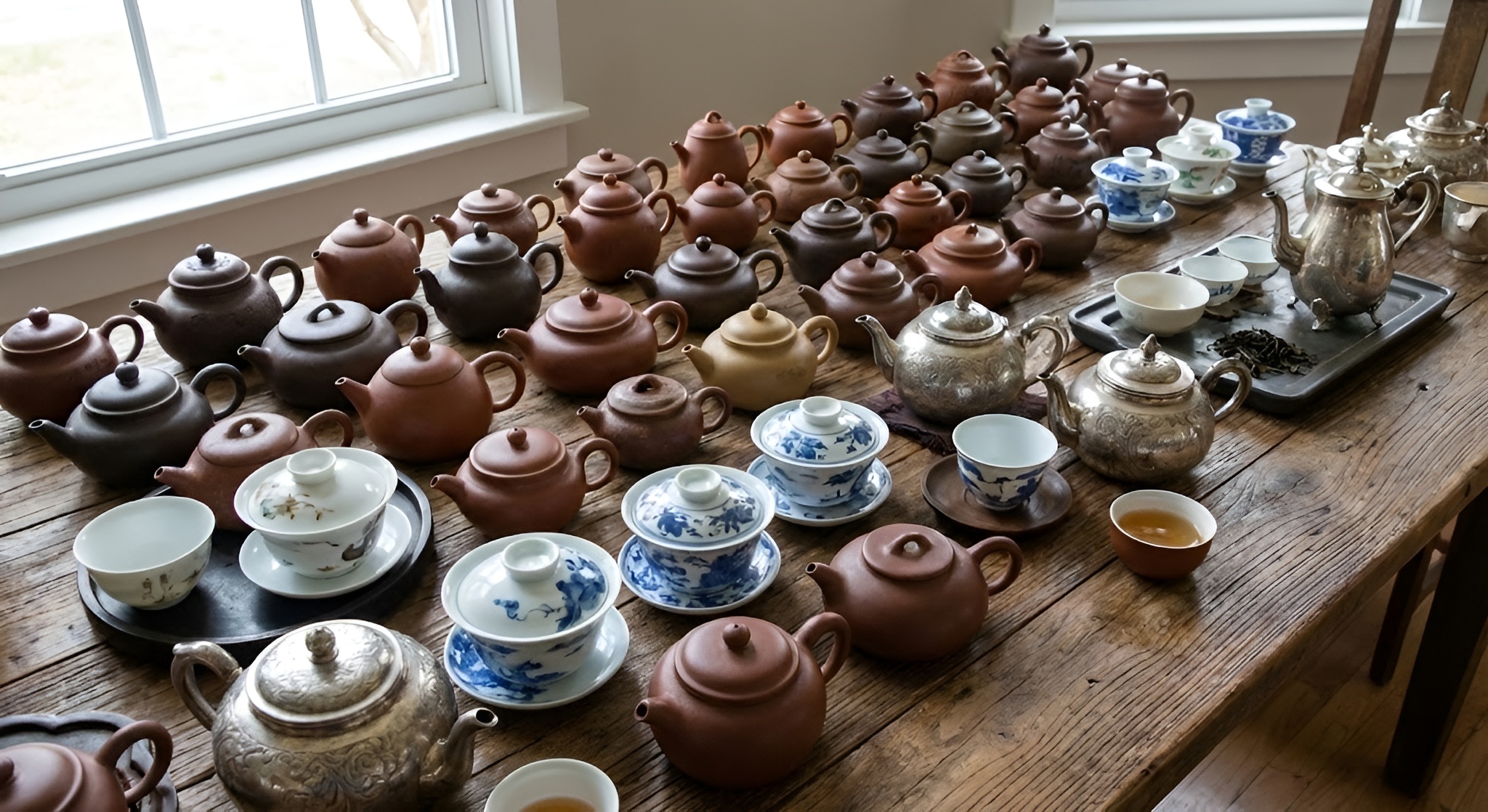
A gaiwan (蓋碗, literally 'lidded bowl') comprises three parts: a flared bowl, a domed lid with a central knob, and—in formal sets—a matching saucer. The bowl holds 100–200 ml when filled to the brim; practical brewing volume is closer to 110–150 ml once you account for leaf displacement. Unlike a teapot, there is no built-in strainer, no handle, and no spout; liquid exits wherever you tilt the rim, controlled only by how far you slide the lid to create a gap. This apparent simplicity is deceptive: every millimetre of lid position, every degree of tilt, and every second of contact time is under the drinker's direct control, which makes the gaiwan both liberating and intimidating.
Gaiwans are not teacups in the Western sense, though they can be drunk from directly in casual settings. In classical gongfu cha practice, the gaiwan functions as the brewing chamber: liquid is decanted into a pitcher (gongdaobei) after each steep, then distributed to small tasting cups. This separation allows multiple infusions of the same leaves—often six to twelve rounds—with evolving flavour profiles that would be lost in a single long steep. The gaiwan's wide mouth and minimal wall thickness mean heat dissipates quickly, so the tea cools faster than in a closed pot, forcing the brewer to work with intention and rhythm rather than leaving leaves to stew.
Gaiwan vs. Teapot in One Sentence
A teapot holds heat and guides the pour; a gaiwan sheds heat and demands you control the pour—choose the former for forgiving blacks, the latter for precision oolongs.
2. Historical Roots and Regional Variations
The lidded bowl form appears in Chinese ceramics as early as the Ming dynasty (1368–1644), though the gaiwan as a dedicated tea vessel became widespread during the Qing. By the 18th century, porcelain gaiwans were standard equipment in Fujian and Guangdong teahouses, prized for their ability to showcase the colour and clarity of fine Wuyi oolongs and Phoenix dancongs. The absence of a handle was not an oversight but a feature: holding the rim forced the drinker to pay attention to temperature, discouraging careless over-steeping and reinforcing the meditative cadence of gongfu brewing.
Regional styles diverge in capacity and decoration. Chaozhou gaiwans—favoured for dancong oolong—tend to run small (80–120 ml) with delicate hand-painted motifs, while Yunnanese pu-erh drinkers often prefer slightly larger, plainer vessels (130–180 ml) that accommodate chunky compressed leaf. In Taiwan, you will find ultra-thin porcelain competition gaiwans designed for professional tasting, where wall thickness below 1 mm ensures the vessel itself contributes no thermal inertia. Celadon-glazed gaiwans from Longquan remain popular among collectors, though their thicker walls make them less suitable for temperature-sensitive greens. Modern glass gaiwans appeared in the 1990s, traded thermal efficiency for visual theatre; they run hotter to the touch and are best reserved for display or for brewing whites and lightly oxidised oolongs where watching the leaf unfurl is half the pleasure.
3. Why High-Fire Oolong and Pu-erh Favour the Gaiwan
Heavily roasted oolongs—Wuyi yancha, aged Tieguanyin, Milan dancong—and raw or ripe pu-erh share a common trait: they demand near-boiling water and benefit from multiple short infusions that tease out layered aromatics. A gaiwan's wide mouth exposes the maximum leaf surface area to water, accelerating extraction in the first 10–15 seconds, then allows rapid decanting before astringency builds. Because the vessel loses heat quickly, you can pour boiling water directly onto the leaves without the prolonged high-temperature contact that would occur in a preheated Yixing pot, making it easier to avoid bitterness in teas with high polyphenol or caffeine content.
The visual feedback is equally important. Compressed pu-erh cakes and tightly rolled tieguanyin pearls need space to expand; in a narrow-necked teapot you cannot see whether the leaves have fully opened or remain clumped. The gaiwan's open bowl lets you monitor unfurling in real time and adjust subsequent steeps accordingly—adding five seconds if the leaves are still tight, shortening to eight seconds once they relax. This iterative tuning is central to gongfu method and nearly impossible in a closed vessel. For teas with volatile top notes—orchid, honey, roasted grain—the gaiwan's lack of a spout means aromas are not trapped and redirected; they rise straight to your nose as you lift the lid, preserving the olfactory dimension that can be muted in a teapot.
By contrast, delicate greens and whites can be brewed in a gaiwan, but the technique requires lower temperatures (70–85 °C) and a gentler hand; many drinkers find a Japanese kyusu or small porcelain pot more forgiving for these categories. The gaiwan's speed and transparency are assets only when the tea itself benefits from rapid, high-heat extraction and iterative tasting.
The Five-Second Rule for Roasted Oolong
First infusion of a charcoal-roasted yancha? Pour at 95–100 °C, decant after 5–8 seconds, and expect muted flavour—it is a rinse as much as a steep. The second pour is where the roast lifts and the minerality emerges.
4. The Three-Finger Grip and Burn Prevention
The canonical hold: place your thumb on one side of the rim (at roughly two o'clock if the spout gap is twelve), your middle finger on the opposite side (eight o'clock), and rest your index finger lightly on the lid knob to stabilise it during the pour. Your palm never touches the bowl; all contact is at the coolest points—rim and knob. This tripod grip works because porcelain conducts heat poorly in thin cross-sections, so the rim, though warm, remains 15–20 °C cooler than the body. The lid knob, being solid and elevated, stays coolest of all. The first dozen attempts will feel precarious; your fingers will tense, the gaiwan will wobble, and you may splash. Repetition is the only cure.
Common mistakes: gripping too tightly (which conducts more heat and fatigues the hand), holding the bowl too low (where the walls are hottest), or using only thumb and index finger in a pincer grip (unstable and prone to tipping). Some teachers advocate a two-finger hold—thumb and middle finger only, no index on the lid—but this demands a heavier, more secure lid fit and is less forgiving for beginners. If you are genuinely burning yourself, the water is likely above 95 °C and you are holding the body rather than the rim; try preheating the gaiwan with a quick rinse, which brings the porcelain closer to water temperature and reduces the thermal shock to your skin.
For UK drinkers accustomed to mug handles and Brown Betty knobs, the gaiwan grip feels alien. Practice with room-temperature water and a timer: fill, lid, grip, pour into a jug, repeat twenty times. Muscle memory develops faster than confidence. Once your fingers know where to sit without conscious thought, introduce hot water in 10 °C increments until you are comfortable at the 90–95 °C range most oolongs demand. Accept that occasional splashes and minor discomfort are part of the learning curve; no one masters the gaiwan in a single session.
Pre-Warm to Protect Your Fingers
Fill the gaiwan with boiling water, let it sit 20 seconds, then discard. The porcelain is now at ~85 °C, so the differential when you add fresh brew water is smaller, and the rim stays just below the pain threshold.
5. Pour Angle, Lid Gap, and Flow Control
Slide the lid so its edge sits 3–5 mm inside the rim of the bowl, creating a crescent-shaped gap. Tilt the gaiwan to 45–60° over your pitcher; liquid will flow through the gap while the lid acts as a baffle, holding back the spent leaves. Pour in a single smooth motion—jerky movements cause the lid to shift and leaves to escape. The key variable is the size of the gap: too narrow (1–2 mm) and surface tension slows the flow, trapping leaf fragments and dripping onto the table; too wide (8–10 mm) and whole leaves tumble out, clogging the pitcher and wasting your infusion. The ideal gap accommodates liquid and steam but not leaf, which means it scales with leaf size: a 3 mm gap works for tightly rolled oolong, while flaky pu-erh or large white-tea buds may need 5–6 mm.
The pour angle also matters. At 30° the gaiwan dribbles; at 70° it gushes and risks displacing the lid. A 50–55° tilt gives a steady stream that fills a 150 ml pitcher in 4–6 seconds without splashing. If you hear air gulping back into the gaiwan mid-pour, the gap is too small or the lid has slipped; pause, reset the lid position, and resume. Some brewers tap the lid knob gently with an index finger during the pour to prevent it shifting; others rely on a firm initial placement and trust physics. Both approaches work; choose the one that feels secure.
After decanting, lift the lid fully to let the leaves breathe and cool. Leaving the lid on between infusions traps heat and moisture, continuing extraction and turning your next steep sour or flat. This is especially critical for high-fire oolongs and ripe pu-erh, where residual heat can over-develop tannins in seconds. The gaiwan is not a passive vessel; it requires active management of temperature, contact time, and airflow across every stage of the session.
6. Water Quality, Temperature, and Timing
Because gaiwan infusions are short—often under 15 seconds—any off-flavour in your water is magnified. Chlorine, chloramine, and excess calcium do not have time to dissipate or be masked by prolonged extraction; they hit the palate immediately. If you are brewing in a hard-water region—London, Birmingham, Cambridge—either use a carbon-block filter or switch to bottled spring water with balanced mineral content (40–80 mg/l calcium, 10–30 mg/l magnesium). The difference in clarity and sweetness is not subtle.
Temperature precision is non-negotiable. A variable-temperature kettle set to 95 °C is the baseline for most oolongs and ripe pu-erh; raw pu-erh and heavily roasted yancha can take full boiling. Whites and greens in a gaiwan want 75–85 °C, but be aware that the thin porcelain sheds 3–5 °C within the first ten seconds, so you may need to pour slightly hotter than you would into a preheated Yixing. A probe thermometer is useful during the first month of practice; once you know your kettle's cool-down curve, you can dispense with it.
Steep times start at 5–10 seconds for the first infusion (often a rinse, discarded or drunk), then lengthen incrementally: 8, 12, 15, 20, 30 seconds and so on. The gaiwan's rapid heat loss means you cannot simply set a timer and walk away; you must pour the moment the time elapses, or the tea cools below extraction threshold and the profile stalls. This immediacy is why gongfu sessions feel ritualistic—they demand presence and rhythm in a way a five-minute mug steep does not.
Decant Completely, Every Time
Even 5 ml of liquid left in the gaiwan will continue extracting between pours, throwing off your timing. Tilt until the last drops fall, then lift the lid to stop the clock.
7. Choosing and Caring for a Gaiwan in the UK
Porcelain remains the gold standard: thin-walled (1–1.5 mm), white or off-white glaze, 110–150 ml capacity, weight under 80 g when empty. Avoid thick hotel-ware gaiwans sold in generic Chinese supermarkets; they retain too much heat, slow your pour, and dull the tea's aromatics. Specialist UK retailers and curated gongfu sets offer Jingdezhen porcelain gaiwans with hand-painted blue-and-white or celadon glaze; expect to pay £12–30 for a quality piece. Competition-grade ultra-thin versions (sub-1 mm walls) are available but fragile; they chip if knocked and are best reserved for advanced brewers who have mastered the grip.
Glass gaiwans look dramatic and let you watch the leaf dance, but they conduct heat faster than porcelain, making the grip hotter and less forgiving. They suit whites and lightly oxidised oolongs brewed at lower temperatures; for high-fire teas, stick with porcelain. Celadon and ru-ware gaiwans are beautiful but typically thicker-walled, which buffers temperature swings—useful for forgiving blacks and ripe pu-erh, less so for precision work. If you are building a complete gongfu kit, prioritise a single good porcelain gaiwan over multiple decorative variants; you can expand the collection once the technique is solid.
Care is minimal: rinse with hot water immediately after the session to prevent tannin staining, and let air-dry upside down. Do not use detergent—residual surfactant flavours will taint delicate teas. Porcelain is dishwasher-safe in theory, but the thermal shock and jostling risk chipping the rim, which ruins the pour seal. Store gaiwans nested loosely or on a padded shelf; a chipped rim or cracked lid renders the vessel unusable. Over months of use, fine crazing may appear in the glaze—this is cosmetic and does not affect performance, though some purists prefer to retire heavily crazed pieces and start fresh.
Start with 120 ml, Not 150 ml
A smaller gaiwan is lighter, easier to grip, and forces you to brew only what you will drink immediately. Once confident, scale up to 150 ml for sharing or longer sessions.
8. Troubleshooting Common Gaiwan Problems
Burnt fingers: You are gripping the body instead of the rim, or your water is above 95 °C and the porcelain is transferring heat faster than your skin can tolerate. Preheat the gaiwan, lower the water temperature by 5 °C, and confirm your thumb and middle finger rest on the rim's top edge, not the curved wall below. If pain persists, try a thicker-walled gaiwan (1.5–2 mm) as a training vessel before returning to competition-thin porcelain.
Leaves in the pitcher: Your lid gap is too wide, or you are tilting past 60° and the surge is dislodging the baffle. Reduce the gap to 3 mm, slow the tilt, and ensure the lid sits snugly—some cheaper gaiwans have poorly fitted lids that rattle and shift. A tiny gap is better than a large one; you can always pour more slowly. If large-leaf whites or pu-erh consistently escape, consider a gaiwan with a tighter lid tolerance or switch to a small gongfu pot for those teas.
Weak or astringent infusions: Weak suggests under-extraction—either your water has cooled too much (check temperature at pour, not at kettle), your steep time is too short, or your leaf-to-water ratio is off (aim for 5–7 g per 110 ml). Astringency points to over-extraction: reduce steep time by 2–3 seconds, lower temperature by 3–5 °C, or confirm you are lifting the lid between infusions to halt residual contact. The general brewing principles apply, but the gaiwan's speed amplifies every variable, so small adjustments have outsize effects.
Dribbling or slow pour: Gap too narrow, or the lid has slipped inward and is blocking flow. Reset the lid, increase the gap to 4–5 mm, and tilt decisively to 50°. Surface tension can also cause dribbling if the rim is wet or oily; wipe it dry between infusions. Some gaiwans have a rolled or thickened rim that disrupts laminar flow; if dribbling persists across multiple sessions, the vessel geometry may be at fault—consider replacing it with a thinner-rimmed model.



Comments