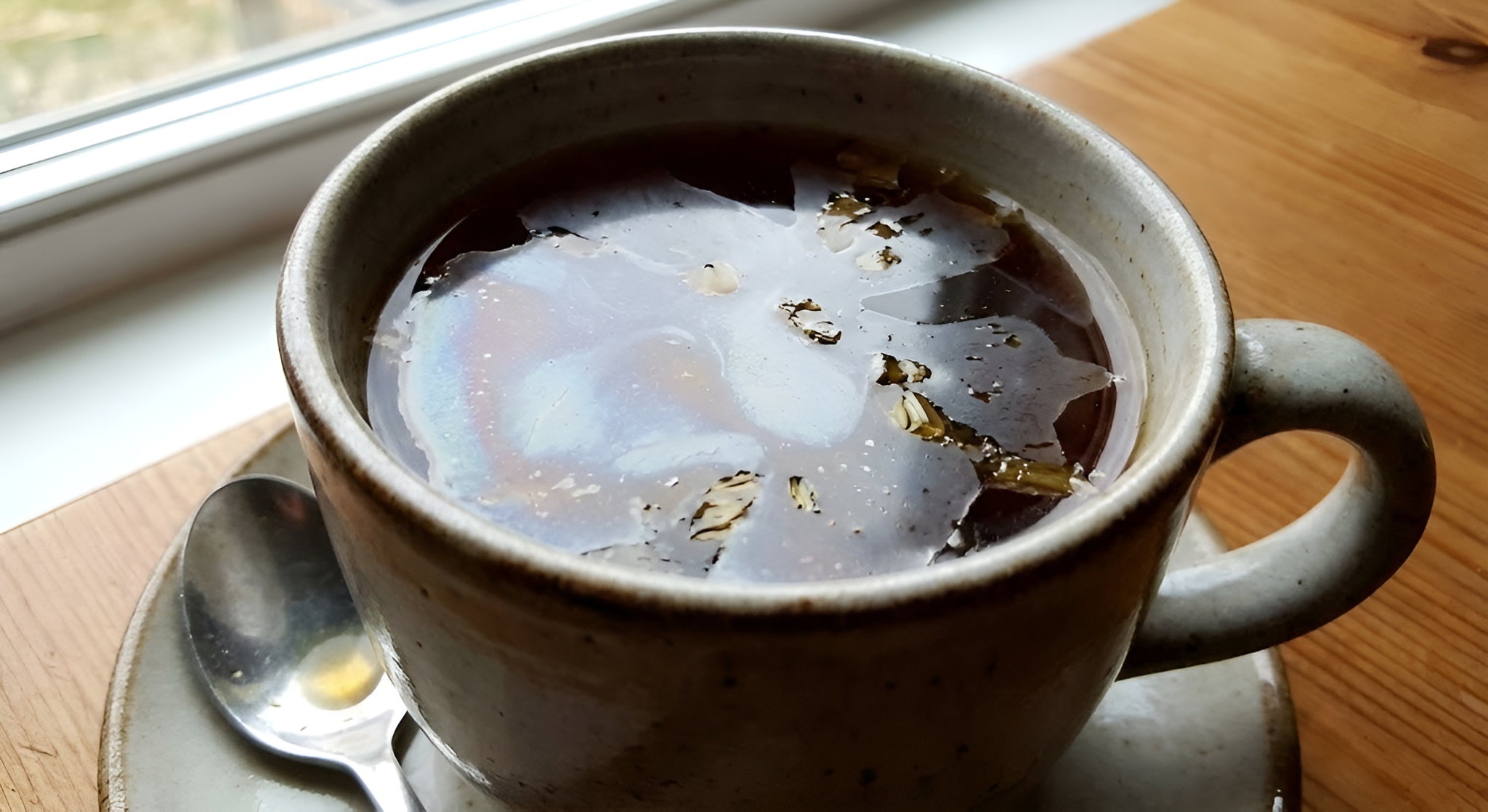
1. What Is Tea Scum and Why Does It Form?
Tea scum is the thin, often iridescent film that appears on the surface of brewed tea, particularly in areas with hard water. It consists of calcium carbonate (CaCO₃) crystals and polyphenol-mineral complexes—insoluble aggregates formed when tea's phenolic compounds bind to dissolved calcium and magnesium ions. The film may shimmer with interference colours (due to variable thickness at the nanometre scale) or appear as a dull, chalky residue that clings to the side of the mug as the liquid level drops.
Formation begins the moment boiling water is poured. Heating drives dissolved carbon dioxide out of solution, which shifts the equilibrium of the bicarbonate buffer system: Ca(HCO₃)₂ → CaCO₃ ↓ + H₂O + CO₂ ↑. The resulting calcium carbonate is only sparingly soluble and precipitates as microscopic crystals. Simultaneously, polyphenols—especially the larger, oxidised molecules found in black and oolong teas—chelate free calcium and magnesium, forming brownish complexes that aggregate and float. The interplay of these two processes produces the characteristic scum layer.
The phenomenon is amplified in the UK because much of the drinking water, particularly in London, the South East, and East Anglia, is drawn from chalk aquifers rich in calcium bicarbonate. Water hardness routinely exceeds 200–300 mg/L as CaCO₃ equivalent, providing abundant substrate for both precipitation pathways. By contrast, soft-water regions—Scotland, Wales, the South West—experience far less scum even when brewing identical teas under the same conditions.
The Iridescence Tells the Story
Thin-film interference—the rainbow shimmer on scum—indicates layers just hundreds of nanometres thick. If your film is colourless or chalky, calcium carbonate dominates; if brown and oily, polyphenol complexes are the main culprit.
2. The Chemistry of Calcium Carbonate Precipitation
Water suppliers typically maintain a bicarbonate buffer to prevent pipe corrosion: calcium exists as soluble Ca(HCO₃)₂. When you boil the kettle, heat and agitation expel CO₂, shifting the equilibrium toward insoluble CaCO₃. This process, known as temporary hardness removal, is the same mechanism that creates limescale inside kettles and pipes. The calcium carbonate crystals are tiny—often sub-micron—but their low density causes them to float, forming a surface raft that traps other particles and organic matter.
The pH of the brew also matters. Black tea typically has a pH of 4.9–5.5; adding hard water raises it slightly. As pH climbs above 5.5, carbonate ion concentration increases, favouring precipitation. Conversely, very acidic infusions (for instance, fruit-heavy blends or teas stored alongside dried fruit) can hold more calcium in solution, reducing visible scum but potentially increasing sediment once the tea cools.
Temperature dependence is non-linear. Solubility of calcium carbonate decreases with rising temperature up to about 80 °C, then levels off. This means the scum you see when pouring boiling water will be nearly as pronounced if you brew at 85 °C, but noticeably less if you cold-brew, where bicarbonate remains stable and CO₂ loss is minimal.
3. Polyphenol-Mineral Complexes: Why Black Tea Produces More Scum
While calcium carbonate accounts for the white, chalky component of scum, the brownish, sometimes sticky film is largely polyphenol-mineral complexes. Tea polyphenols—catechins in green tea, and theaflavins and thearubigins in black—contain multiple hydroxyl groups capable of chelating divalent cations like Ca²⁺ and Mg²⁺. When these ions bind, the resulting complex is less polar and less soluble than the free polyphenol, causing it to aggregate and precipitate.
Oxidation level is the decisive factor. During black-tea processing, catechins are enzymatically oxidised into theaflavins (responsible for brightness and astringency) and thearubigins (contributing body and colour). These larger, more complex molecules have greater affinity for metal ions and form bulkier, less soluble aggregates. Green teas, which undergo minimal oxidation, retain simpler catechins (EGCG, ECG, EGC, EC) that bind minerals less avidly, yielding clearer brews with less scum even in hard water.
Oolong teas occupy the middle ground: lightly oxidised oolongs (10–30%) behave more like greens, while heavily roasted, dark oolongs (60–70%) can produce scum approaching that of black tea. The relationship is not perfectly linear—roasting and firing also denature some polyphenols and may introduce Maillard products that alter binding—but as a rule, higher oxidation equals more scum in hard water.
Match Your Tea to Your Water
If you live in a hard-water area and dislike scum, prioritise Japanese greens, white teas, or lightly oxidised oolongs. Save robust Assam and Ceylon blacks for soft-water holidays or filtered brewing.
4. The Milk Effect: Why Adding Dairy Reduces Scum
One of the most reliable ways to reduce visible tea scum is to add milk. The effect is immediate and dramatic: a black tea that produces a heavy film when drunk plain will show almost no surface scum when a splash of milk is stirred in. The mechanism is twofold. First, casein micelles—the colloidal protein structures in milk—bind calcium ions, effectively sequestering them and preventing both carbonate precipitation and polyphenol chelation. Second, milk proteins can coat polyphenol molecules, increasing their hydrophilicity and keeping them in suspension rather than aggregating at the surface.
The milk-first versus milk-after debate has a scum dimension: adding milk to the cup before pouring hot tea allows casein to bind calcium incrementally as each drop mixes, potentially reducing peak local concentrations and minimising film formation. Pouring milk into already-brewed tea still works, but may leave a transient scum layer until stirring disperses the proteins. In practice, both methods drastically cut scum compared to black tea alone.
Plant-based alternatives vary. Soy and oat milks contain proteins and emulsifiers that can sequester some calcium, though casein remains the most effective binder. Almond and rice milks, lower in protein, offer less scum reduction. Regardless of milk type, the addition typically lowers the tea's effective pH slightly and increases turbidity, masking any residual fine particles.
5. Water Hardness Across the UK: Regional Variation and Testing
The UK exhibits striking regional gradients in water hardness, driven by underlying geology. Southern and eastern England—London, Essex, Kent, Sussex, parts of the Midlands—overlie chalk and limestone aquifers, yielding water that routinely exceeds 250 mg/L CaCO₃ equivalent and can reach 350 mg/L in some Thames Water supply zones. By contrast, much of Scotland, Wales, the Lake District, and Cornwall draws from igneous or low-carbonate rock, producing soft water below 50 mg/L.
You can verify your local hardness via your water company's annual report or by requesting a free test kit. Hardness is reported in mg/L as CaCO₃, in degrees Clark (°Clark), or in parts per million (ppm); approximate conversions are 1 °Clark ≈ 14.3 mg/L. Above 200 mg/L, scum becomes conspicuous in most black teas; below 100 mg/L, it is rare. Between 100 and 200 mg/L, scum formation depends heavily on tea type, brewing temperature, and standing time.
Home water filters—jugs with ion-exchange resins—can reduce hardness by 50–80 per cent, though their effectiveness declines as the resin saturates. Whole-house softeners (regenerating salt-based systems) eliminate temporary hardness almost entirely but add sodium, which some drinkers find alters flavour. For tea purists, filtering or using bottled spring water from soft-water sources (check the label for <100 mg/L total dissolved solids) offers a middle path that preserves mineral character without excessive scum.
Quick Hardness Test at Home
Brew identical black tea in tap water and bottled spring water side by side. A dramatic difference in scum confirms your tap is the variable. Filtering is then worth the effort.
6. Brewing Techniques to Minimise Scum Formation
Beyond water treatment, several brewing adjustments can cut scum without requiring new equipment. Lower brewing temperatures—85 °C instead of a rolling boil—reduce CO₂ loss and carbonate precipitation. Many fine green and white teas are optimally brewed at 70–80 °C anyway, so the practice aligns with flavour goals. For black tea, a modest drop to 90–95 °C still extracts full character while noticeably reducing surface film, especially if you allow the kettle to stand 30 seconds after boiling.
Cold brewing virtually eliminates scum. At refrigerator temperatures (4–10 °C), calcium bicarbonate remains stable, CO₂ stays dissolved, and polyphenol-mineral complexes form very slowly, if at all. Cold-brewed black, oolong, and green teas yield clear, sediment-free infusions even in extremely hard water. The trade-off is time—typically 8–12 hours—and a different flavour profile, often lighter and sweeter, with reduced astringency. For summer iced tea or overnight prep, cold brewing is both convenient and scum-proof.
Avoiding prolonged standing also helps. Scum accumulates as the tea cools and CO₂ continues to escape; drinking your tea while still hot minimises visible film. If you must leave a mug for later, covering it (a saucer works) slows evaporation and CO₂ loss, though it cannot prevent all precipitation. Finally, stirring before drinking re-suspends light scum particles, distributing them through the liquid rather than concentrating them at the surface—a cosmetic fix, but effective.
7. Health Implications: Is Tea Scum Harmful?
The short answer is no, tea scum is not harmful in the quantities encountered in normal consumption. Calcium carbonate is the same compound used in antacid tablets and dietary supplements; ingesting a few milligrams per cup poses no risk and may even contribute a trivial amount to daily calcium intake. Polyphenol-mineral complexes are likewise inert in the digestive tract—most pass through undigested, and the small fraction that dissociates releases polyphenols and minerals already present in tea and water.
One caveat concerns microbial growth. A persistent scum layer on an unwashed mug can provide a surface for bacteria and mould, especially in damp environments. Residual tea, sugar, and organic matter trapped in the film offer nutrients; over days or weeks, this can lead to visible biofilms or off-odours. Thorough washing with detergent after each use prevents colonisation. Mugs left overnight with cold, scummy tea are best emptied and rinsed promptly.
Some studies have explored whether scum formation reduces the bioavailability of tea polyphenols—the beneficial catechins and flavonoids associated with antioxidant activity. Early research suggested that complexing with metal ions might lower the fraction absorbed in the gut, but subsequent work found the effect modest and variable, depending on dietary context (presence of ascorbic acid, proteins, other chelators). In practice, if you add milk—which both cuts scum and binds polyphenols—you are already accepting a trade-off. The consensus is that scum's impact on health, positive or negative, is minimal compared to the overall polyphenol load and the benefits of regular tea consumption.
Don't Stress the Scum
If it bothers you aesthetically, filter your water or switch teas. If it doesn't, drink on—there's no evidence of harm, and worrying about a few mineral specks misses the bigger picture of tea's benefits.
8. Cleaning and Prevention: Practical Tips for the UK Kitchen
Preventing scum build-up in kettles and mugs starts with regular descaling. Limescale (calcium carbonate) inside the kettle provides nucleation sites for further precipitation, amplifying scum in every subsequent brew. Descale every 4–8 weeks using citric acid (1–2 tablespoons in a full kettle, boiled and left to stand) or white vinegar (equal parts vinegar and water, boiled briefly, then rinsed thoroughly). Both dissolve carbonate deposits without harsh chemicals.
For mugs and teapots, a soft brush or sponge with washing-up liquid usually suffices if used daily. Stubborn brown stains—polyphenol tannins that have bonded to ceramic—can be lifted with a paste of bicarbonate of soda and water, or a brief soak in dilute bleach solution (rinse exhaustively afterward). Avoid abrasive scourers on fine porcelain, as they scratch the glaze and create texture that traps future scum. Stainless-steel infusers benefit from occasional soaking in citric acid to remove mineral films inside the mesh.
For those who entertain or gift tea, scum-free presentation matters. If you're preparing tea for guests in a hard-water area, consider using filtered water, offering milk, or brewing a Japanese green tea that naturally resists scum. When gifting tea, including a simple jug filter or a note about water quality shows thoughtfulness and can elevate the recipient's experience. Similarly, matcha gift sets—where water quality profoundly affects texture—often pair well with a reminder about soft or filtered water for the best results.
Citric Acid Is Your Friend
Keep a tub of food-grade citric acid (available in supermarkets, often near home-brewing supplies). It descales kettles, mugs, and infusers safely, rinses clean, and costs pennies per use. Far superior to proprietary descalers.


Comments