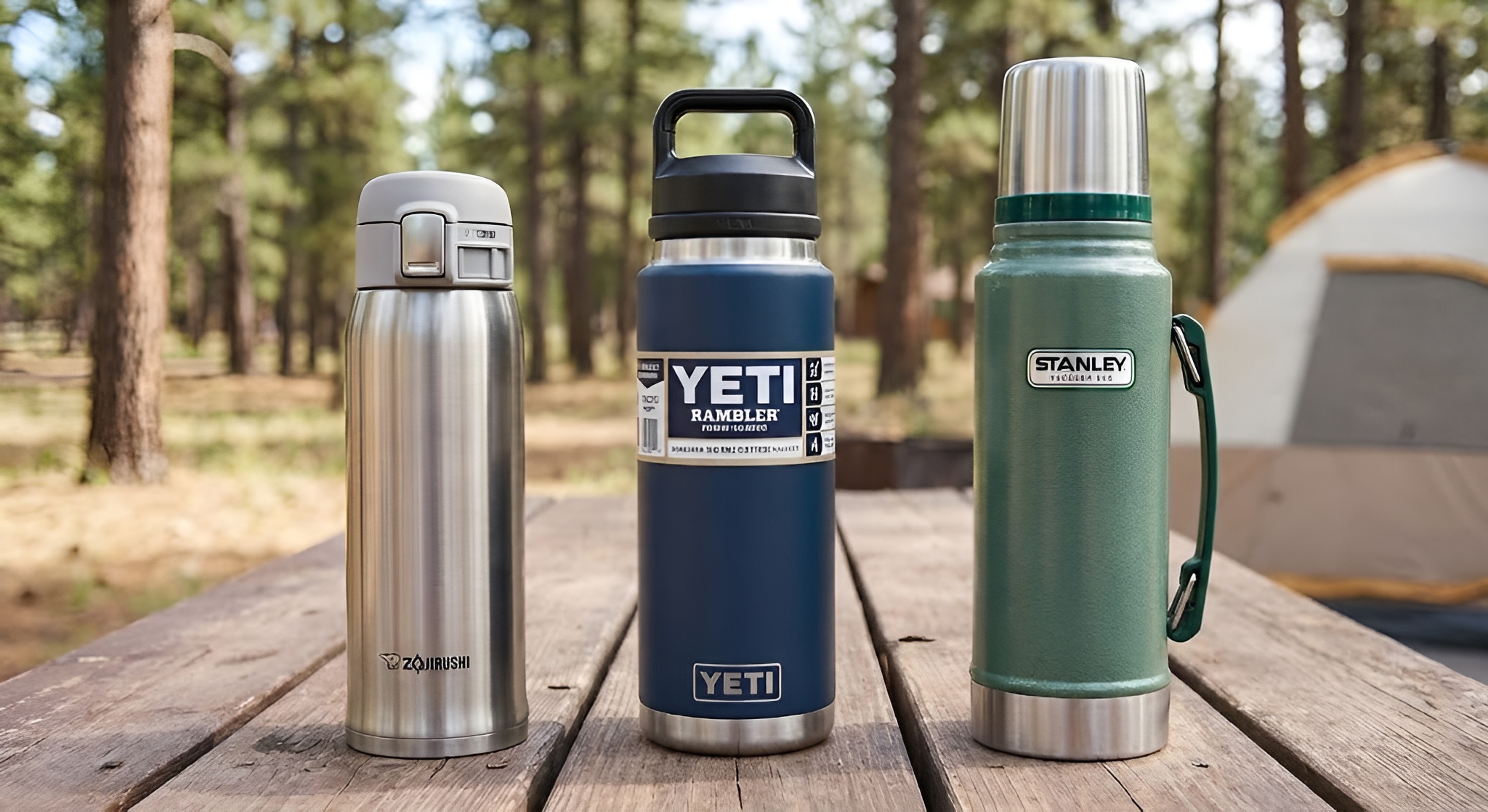
1. Why Rail Commutes Demand Different Hardware and Tea
A commuter flask must meet three simultaneous requirements: it must survive being knocked against turnstiles and seat-back tables; it must open and close reliably with one hand while you stand in a crowded vestibule; and it must retain heat for the duration of your journey without continuing to steep the tea into bitterness. These constraints eliminate many designs that work well for picnics or car travel. A traditional vacuum flask with a screw cap and separate cup is too slow to open when the train lurches, whilst a ceramic infuser mug without a sealed lid will spill the moment you set it down on a tilting table.
The tea itself must tolerate conditions you cannot control. If you brew at home and the train is delayed, the leaves may sit in hot water for an extra twenty minutes; if you brew on the platform and board immediately, the flask seals the headspace and traps volatile aromatics that can turn sour. Teas high in certain catechins—particularly epigallocatechin gallate (EGCG)—develop astringency faster in a closed environment, whilst fully oxidised teas and those with Maillard-reaction compounds (roasted oolongs, ripe pu-erh) remain stable. Understanding these mechanisms lets you match tea to vessel and schedule, rather than discovering halfway to Birmingham that your Darjeeling has turned metallic.
2. One-Handed Lids: Push-Button, Flip and Slide Mechanisms Compared
The most reliable one-handed lid designs use a push-button release that slides open a drinking spout and closes it again with a second press. The button should be large enough to operate with a gloved thumb in winter and require firm pressure—hair-trigger mechanisms open in your bag. A good push-button lid incorporates a secondary lock (usually a rotating collar or slider) to prevent accidental opening; check that this lock can also be engaged one-handed, or you will need to set the mug down to secure it after drinking.
Flip lids—which hinge open when you press a lever—are faster but more prone to mechanical failure. The hinge pin and spring are common failure points after six months of daily use, and many flip designs do not seal as tightly as button spouts because the gasket must accommodate the moving hinge. Slide lids, where you push a panel sideways to reveal a drinking hole, offer a middle ground: fewer moving parts than a flip, easier to clean than a button mechanism, but they can jam if tea residue dries in the slide channel. Whichever you choose, ensure the drinking aperture is large enough for a comfortable flow but not so wide that hot tea slops out when the train brakes.
Avoid twist-to-open lids for commuter use. They require two hands (one to hold the mug, one to twist) and are slower in an emergency stop. Screw caps with a separate sipper plug are similarly impractical; by the time you have unscrewed, sipped and re-sealed, you have missed your station.
Test the Lock at Speed
Before trusting a new lid on a packed morning service, simulate train movement at home: fill the mug, close it, then walk briskly around your kitchen whilst opening and closing the lid one-handed. If you cannot operate it smoothly whilst moving, you will struggle on the 08:15 to Euston.
3. Infuser Size, Mesh Gauge and the Problem of Cramped Baskets
Many travel infusers are too small. A typical commuter mug holds 350–500 ml, but the removable infuser basket often occupies less than half that volume, leaving perhaps 150 ml for dry leaf. Whole-leaf teas—particularly large-format oolongs, white peony and twisted Yunnan blacks—expand to three or four times their dry volume when steeped; in a cramped basket they cannot unfurl fully, yielding a weak, one-dimensional brew even after ten minutes. If you drink whole-leaf tea daily, look for a basket that extends at least two-thirds of the mug's height and has an internal diameter within a centimetre of the mug body.
Mesh gauge is less critical than volume, but it matters for fine teas. Stainless-steel mesh is usually specified in microns or as a 'grade'; 200-micron openings (roughly 70 mesh) will retain most whole-leaf and broken teas but may let through the finest dust from CTC breakfast blends. Finer mesh (100 micron / 140 grade) prevents sediment but clogs faster and requires more frequent cleaning. Nylon and silicone mesh infusers are lighter and less prone to denting, but they absorb tannins over time and can impart a faint plastic note to delicate greens or whites; reserve them for robust blacks and oolongs.
The basket's base perforation pattern also affects extraction. A flat base with small holes drilled in concentric rings can trap leaf fragments and restrict water circulation; a conical or domed base with larger slots encourages convection and more even steeping. If you buy online and cannot inspect the basket, check user photos for the hole size and distribution—manufacturer illustrations often show idealised geometry that does not match production units.
4. Brewing at the Station Versus Brewing at Home
Brewing at the station—rather than in your kitchen—gives you control over steeping time and ensures the infuser is removed before you board. Most station concourses and many platforms now have hot-water taps (often installed for instant noodles and coffee); these typically dispense at 85–95 °C, which is adequate for black teas and most oolongs and avoids the wait for a kettle to boil. Measure your leaf into the infuser basket at home, carry it dry in the mug, then add water and start a timer on your phone whilst you wait for the train. When the steep finishes—typically three to five minutes, depending on tea type—lift out the basket, stow it in a small zip-lock bag (to contain drips), and board with a ready-to-drink brew that will not continue extracting.
Brewing at home is faster if you are rushed, but it requires accurate timing and immediate basket removal. If you brew, seal the mug and then encounter a delay—road works, a missing umbrella, a conversation at the front door—the tea continues steeping in residual heat, often turning bitter by the time you open it on the train. One mitigation is to steep for only half the usual time at home, anticipating that the sealed environment will continue extraction; this is tricky to calibrate and varies with tea type and mug insulation. A simpler approach is to pour the finished brew into a preheated mug without an infuser, leaving the spent leaves behind in a teapot or gaiwan, but this adds a vessel to wash and defeats the purpose of an all-in-one commuter flask.
A third option—cold-brewing overnight in the fridge—produces a concentrate you can dilute with hot water at the station or drink cold. This suits high-catechin greens and certain oolongs that turn astringent when hot-steeped in a sealed mug, but it requires planning and a second container. For daily commuter use, platform brewing remains the most reliable method: you control timing, avoid over-extraction and arrive at your desk with tea at drinking temperature rather than scalding.
The Five-Minute Platform Rule
Aim to arrive at the station five minutes before your usual train. That window lets you brew without rushing, remove the infuser calmly and still have a buffer if the service is early. Missed trains cost more time than an earlier alarm.
5. Which Teas Tolerate Sealed Vessels and Long Commutes
Once sealed, a travel mug traps steam, volatile aldehydes and phenolic compounds in the headspace above the liquid. Teas rich in linalool, geraniol and other monoterpene alcohols—particularly lightly oxidised oolongs (Tieguanyin, high-mountain Taiwanese), Darjeeling first-flush and Bai Mudan white—can develop a sour or 'cooked vegetable' note within thirty minutes as these aromatics concentrate and interact with residual heat. The effect is more pronounced in well-insulated mugs that hold temperature above 70 °C for an hour or more.
Fully oxidised black teas—Assam, Ceylon, Yunnan dianhong, English Breakfast blends—are far more stable. Oxidation converts catechins into theaflavins and thearubigens, which are less reactive and less prone to off-flavours in a closed environment. Roasted oolongs (Da Hong Pao, Wuyi yancha, heavily roasted Dong Ding) benefit from Maillard-reaction compounds—pyrazines, furans, melanoidins—that actually mellow further when held at moderate temperature; a sealed mug can even improve the roundness of a roasted oolong over the first hour. Ripe (shou) pu-erh is similarly forgiving, thanks to microbial transformation during pile fermentation that produces stable, earthy compounds (geosmin, various quinones) unaffected by headspace chemistry.
If you love delicate teas, consider switching to a mug without an infuser and brewing a robust black or ripe pu-erh for the commute, saving your first-flush Darjeeling or competition-grade oolong for a proper gongfu session at home. Alternatively, choose a poorly insulated mug that lets the tea cool rapidly below 60 °C; this reduces headspace reactivity but defeats the purpose of a travel flask on a cold morning. The most practical compromise is to match tea to journey length: greens and light oolongs for sub-30-minute trips where the mug stays open, blacks and roasted teas for anything longer.
6. Material Durability: Stainless Steel, Ceramic Linings and Lid-Seal Longevity
The standard commuter flask uses double-wall stainless steel (typically 18/8 or 18/10 austenitic grade) with a vacuum gap for insulation. This construction is light, dent-resistant and retains heat well; a good vacuum seal will keep tea above 60 °C for four to six hours, far longer than most commutes. Cheaper single-wall steel mugs are prone to exterior condensation and burn your hand when filled with boiling water; avoid them unless you only ever brew warm tea. Some flasks add a ceramic or glass liner inside the steel shell, marketed as 'preserving flavour'; in practice, ceramic linings are fragile and can crack if the mug is dropped onto a station platform, and they add weight. Unless you are particularly sensitive to metallic notes (rare with modern stainless steel), a plain double-wall steel interior is more durable.
Lid seals are the weakest link. Most use silicone gaskets, which are easy to mould and initially seal well, but silicone degrades under repeated thermal cycling and exposure to tannins. Expect a silicone seal to lose grip after twelve to eighteen months of daily use, at which point the mug will weep slowly or fail to hold pressure. Higher-end flasks use EPDM (ethylene propylene diene monomer) or nitrile rubber seals, which tolerate temperature swings and chemical exposure better; these can last three years or more but are harder to find as spare parts. When buying, check whether replacement seals are sold separately and what they cost—if a £25 mug requires a £6 seal every year, the lifetime cost rivals a £45 flask with EPDM seals that last three years.
The mug body's exterior coating—powder coat, anodising or plain brushed steel—affects grip and longevity. Powder coat (baked enamel) can chip if struck, exposing bare steel that may corrode; once chipping starts, it accelerates. Anodised finishes are harder but can wear through at high-friction points (the base, the lip). Plain brushed or bead-blasted steel shows scratches but does not degrade functionally. For daily commuter abuse, prioritise a finish you can live with when scuffed, rather than one that looks pristine in the product photo.
Buy Two Mugs, Rotate Daily
Letting a mug dry fully between uses extends seal life and prevents mould in the lid mechanism. Two identical mugs in rotation—one in use, one drying—will outlast a single mug used every day, and you have a backup if one fails mid-commute.
7. Sizing, Cup-Holder Fit and Rucksack Stowage
Commuter mugs range from 300 ml (enough for a single strong brew) to 600 ml (two moderate cups or one long sipping session). A 400–450 ml capacity suits most rail journeys: it fits into standard train cup holders (which typically have a 75–85 mm internal diameter) and is not so tall that it tips when the carriage tilts. Measure the diameter of your mug at its widest point (usually the lid or the base); anything over 90 mm will not fit securely in a holder and must be nursed in your lap or wedged between bags. Height matters less, but very tall mugs (above 220 mm) can topple in shallow holders or protrude awkwardly from a rucksack side pocket.
If you carry the mug in a bag rather than drinking immediately, ensure it has a positive seal even when inverted. Fill it with water, close the lid, turn it upside down and shake it for ten seconds over a sink. Any drips indicate a poor seal or misaligned gasket; some mugs seal well when upright but leak under pressure when tilted. Check again after a month of use, as seals can shift or degrade. For rucksack stowage, an external elastic side pocket works well if the mug is sealed, but avoid putting a hot, freshly filled mug into a closed main compartment with electronics or books—condensation and the small risk of catastrophic seal failure are not worth the soggy laptop.
Weight is less of an issue for rail commuters than for hikers, but a 500 g empty mug becomes 900 g when full; if you also carry a laptop and lunch, every hundred grams counts. Titanium flasks are lighter (often 40% less than steel) but significantly more expensive and offer similar insulation. For most users, a well-designed 300–350 g stainless flask is the sweet spot between weight and cost.
8. Buying Advice: What to Check Before You Commit
Before buying, read user reviews for long-term feedback, not first-week impressions. Look for comments on seal longevity ('still leak-free after a year'), ease of cleaning ('the lid has six parts and they all trap tea') and customer-service responsiveness if a seal fails. Be wary of 'spill-proof' marketing claims unless reviews confirm them under real jostling. Many manufacturers define 'spill-proof' as 'resistant to minor tilting', which is not the same as 'survives being dropped into a tote bag on the Northern Line'.
Check whether the mug and all its components are dishwasher-safe. Stainless-steel bodies usually are, but lids with electronic temperature displays, glued-on logos or multi-part slider mechanisms often are not, and hand-washing a fiddly lid every evening is a disincentive to daily use. If you plan to clean by hand, look for designs with fewer crevices; a single-piece silicone gasket is easier to scrub than a three-part valve assembly. For persistent tannin staining on steel interiors, a monthly soak in dilute citric acid or a proper mug-cleaning powder (see our mug-cleaner guide) will restore the surface without scratching.
Finally, consider where you will buy. High-street outdoor retailers (Blacks, Cotswold Outdoor, Go Outdoors) stock commuter flasks year-round and accept returns if the seal leaks; online marketplaces offer wider choice but variable quality control, and knock-off 'vacuum flasks' often lack a true vacuum. If you order online, test the seal immediately on arrival and return the mug if it fails—waiting until your first commute to discover a leak is too late for most return windows. For a curated list of flasks that meet commuter-specific criteria, see our portable infuser-flask buyers' guide and our thermos-flask recommendations, both of which compare models available in the UK in 2026.
Spare Seals Are Worth Buying Upfront
If your chosen mug sells replacement gaskets separately, order one or two when you buy the flask. Seals go out of stock or get discontinued, and having a spare means a split gasket does not end your commute-tea habit while you wait for shipping.



Comments