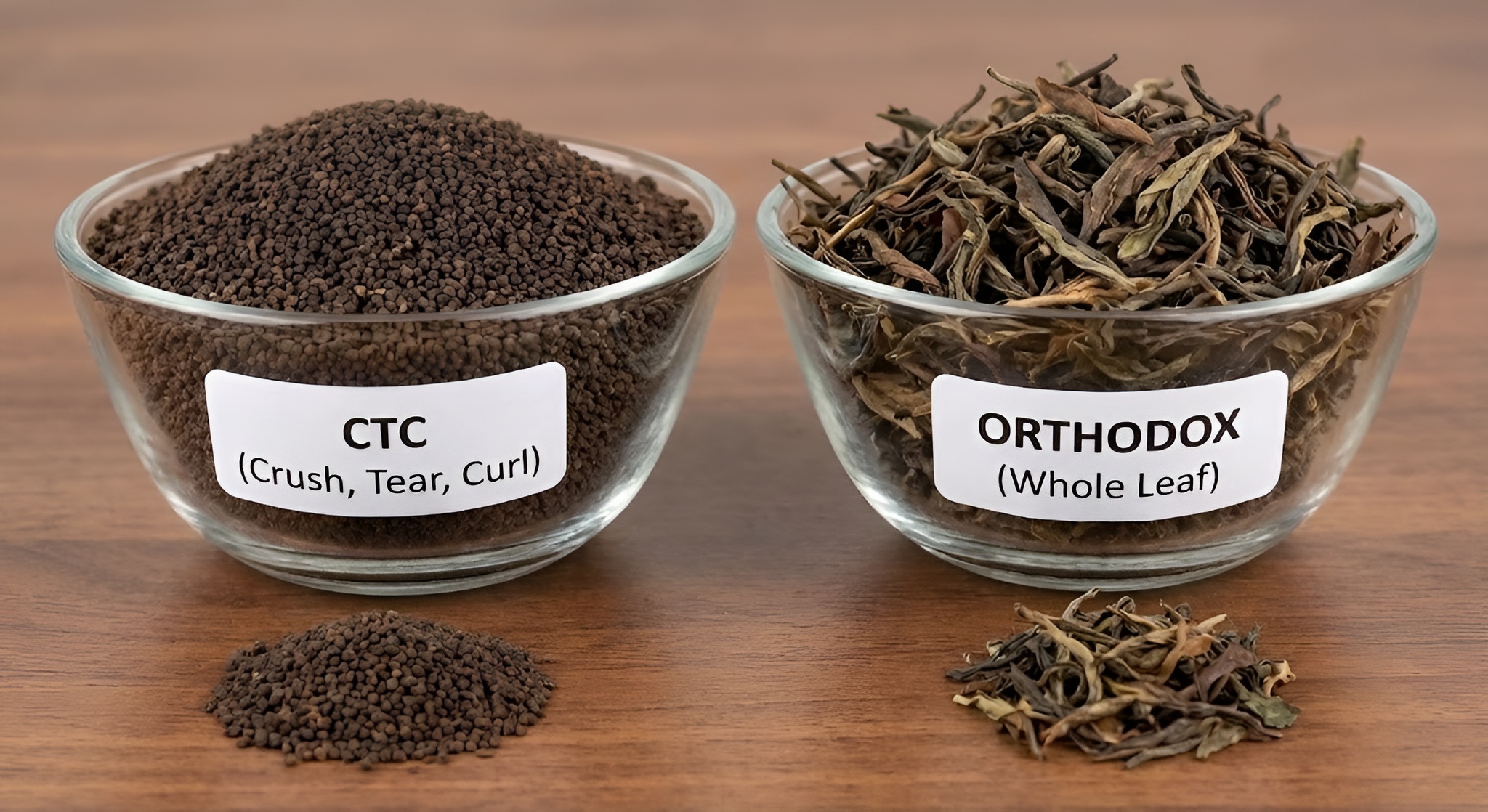
1. What Orthodox and CTC Processing Mean
Orthodox processing is the traditional, centuries-old method for making tea. After plucking, the leaf is withered to reduce moisture, then rolled—originally by hand, now usually by machine—to rupture the cell walls and initiate oxidation. The rolled leaf is spread in thin layers, allowed to oxidise in controlled humidity and temperature, then fired (dried) to halt enzymatic activity. The result is a leaf that retains much of its original shape—twisted, wiry, sometimes whole—and a liquor that reflects the terroir, cultivar and skill of the maker. Orthodox manufacture is used for all tea types, but when we compare it to CTC we are typically discussing black tea, where oxidation is taken to completion.
CTC processing was invented in the 1930s by William McKercher in Assam to meet the demand for strong, quick-brewing tea suited to mechanised tea-bag filling. The withered leaf is passed through a series of cylindrical rollers fitted with hundreds of small teeth; these rollers cut, tear and curl the leaf into tiny, hard pellets roughly the size of a peppercorn. The macerated leaf oxidises very rapidly because of the vastly increased surface area, and the resulting granules are uniform in size, which ensures consistent extraction during brewing. CTC accounts for the majority of black tea produced globally and dominates the commodity tea market, particularly in India, Kenya, Sri Lanka and Indonesia.
The key distinction is mechanical violence: orthodox rolling bruises and shapes; CTC rollers pulverise. That difference in leaf structure cascades through grading, flavour, brewing behaviour and price.
The McKercher Legacy
CTC was born not to make bad tea but to make efficient tea: faster oxidation, uniform granules, and a robust cup that holds up to milk and sugar. For that purpose, it remains unmatched.
2. How Orthodox Leaf Grades Work: OP, FOP, TGFOP and Beyond
Orthodox black tea is graded after manufacture by sieving the dried leaf through a series of mesh screens. The resulting categories describe particle size and, to a lesser extent, the presence of tips (the unopened bud, covered in fine white or golden down). The most common orthodox grades you will encounter in the UK are:
OP (Orange Pekoe): long, wiry leaves without tip. Despite the name, nothing to do with oranges; 'orange' likely derives from the Dutch royal House of Orange or a transliteration of a Chinese term. FOP (Flowery Orange Pekoe): as OP, but with some tip content. GFOP (Golden Flowery Orange Pekoe): more golden tips. TGFOP (Tippy Golden Flowery Orange Pekoe): abundant tips, often from higher-elevation gardens. FTGFOP, SFTGFOP: 'Finest' and 'Special Finest'; marketing superlatives that indicate a very high tip content and careful plucking, but no legally binding standard. BOP (Broken Orange Pekoe): smaller pieces, faster extraction, darker liquor. BOPF (Broken Orange Pekoe Fannings): even smaller. Dust: the finest particles, used in tea bags.
These grades tell you leaf size and tip content, not absolute quality. A well-made BOP from a first-flush Darjeeling estate can be more complex and expensive than a poorly handled SFTGFOP from a lowland garden. The grading system is a morphological shorthand, not a flavour guarantee. In the UK, serious loose-leaf merchants will list the grade alongside the estate name, flush and year, because all four pieces of information together tell the story. For more on how tea grades translate to the cup, see our dedicated explainer.
3. How CTC Leaf Grades Work: PF, PD and Dust
CTC tea is also graded by particle size, but the lexicon is simpler because there are no whole leaves and no tips to count. After the CTC rollers have done their work, the oxidised and dried granules are passed through sieves, yielding three principal categories:
BP or PF (Pekoe Fannings): the largest CTC particles, roughly 1–2 mm, sometimes called 'primary grade.' Brews quickly but retains a little more body than smaller grades. PD (Pekoe Dust): smaller still, under 1 mm. D or Dust: the finest fraction, almost powder. Dust grades brew the fastest and darkest, delivering maximum strength in minimal time, and they are the workhorse of the global tea-bag industry. Some processors further subdivide—D1, D2, Fine Dust—but for the UK consumer the salient point is that all CTC grades are small, all brew fast, and all produce a strong, astringent, malty liquor.
CTC grading is functional, not romantic. You will never see a CTC packet labelled 'Golden Tippy'; there are no tips left after the rollers. The grade communicates mesh size and therefore brewing speed. In practice, most UK tea bags contain a blend of PD and Dust from multiple origins—Kenya for brightness, Assam for body—formulated to deliver a consistent cup regardless of water hardness or steeping time. For readers interested in the best Assam CTC teas available in the UK, we maintain a regularly updated shopping guide.
Why Dust Isn't Inferior
In CTC manufacture, Dust is not waste—it is the intentional product of sieving. For a strong, three-minute brew with milk, Dust delivers exactly what is needed: rapid extraction and robust tannins.
4. The Chemistry and Flavour Differences
The flavour difference between orthodox and CTC tea is a direct consequence of oxidation kinetics and extraction surface area. In orthodox manufacture, oxidation proceeds over one to three hours in a thin layer; enzymes—principally polyphenol oxidase and peroxidase—polymerise catechins into theaflavins (bright, brisk astringency) and thearubigins (depth, colour, body). Because the leaf remains largely intact, aromatic volatiles—geraniol, linalool, methyl salicylate—survive firing and contribute to the tea's complexity and fragrance. The liquor is typically amber to copper, the mouthfeel can be silky or brisk, and the finish often carries floral, fruity or honey notes depending on terroir and cultivar.
In CTC manufacture, the leaf is macerated into granules with vastly increased surface area, so oxidation completes in minutes rather than hours. The rapid, vigorous reaction favours the formation of thearubigins over theaflavins, yielding a darker, redder liquor with less brightness and more body. Volatile aromatics are largely lost; the cup is characterised by malt, toast, astringency and strength. CTC teas are forgiving—they tolerate hard water, high temperatures and long steeping without becoming undrinkably bitter—which is why they dominate the UK breakfast table. Orthodox teas are more delicate and reward careful attention to water temperature, steeping time and leaf-to-water ratio.
Neither profile is superior in the abstract. If you want a tea that can stand up to a splash of milk, a spoonful of sugar and a hurried three-minute brew, CTC wins. If you want to taste the difference between a Darjeeling first flush and a Yunnan Dian Hong, or if you enjoy the ritual of a teapot and multiple infusions, orthodox is the only option. Many UK drinkers enjoy both, switching between a morning CTC builder's brew and an afternoon gongfu session with a Keemun or Lapsang Souchong.
The Astringency Spectrum
CTC's rapid oxidation produces more thearubigins, which bind proteins and give that drying, tannic grip. Orthodox teas with high theaflavin content taste brisk and bright without the same heavy astringency—key for black teas drunk without milk.
5. Which Processing Method Suits Which Use
CTC is ideal for: tea bags; breakfast blends; iced tea (especially in commercial settings); any context where you need speed, strength and consistency; milk tea, chai and masala chai (the robust tannins cut through spices and dairy); catering and hospitality, where staff training is minimal and volume is high. CTC also excels in hard water areas—common across much of England—because the strong extraction masks the dulling effect of calcium and magnesium. If you are buying tea as an everyday staple and value cost per cup, CTC delivers unmatched economy.
Orthodox is ideal for: loose-leaf teapot service; tasting flights and single-estate teas, where terroir and processing nuance matter; black teas drunk without milk, where brightness and aroma are prized; multiple infusions (many orthodox teas, especially from China, reward two or three steeps); gifting—orthodox teas have the visual appeal and narrative romance that make them suitable for tea gifts and presentation tins. Orthodox also suits cupping and evaluation, because the slower extraction gives you time to assess aroma, flavour and finish separately.
In practice, many UK households keep both: a CTC breakfast blend in bags for the morning rush, and a tin of orthodox Darjeeling or Assam TGFOP for weekend afternoons. The two methods are complementary, not mutually exclusive, and understanding the strengths of each helps you match the tea to the moment.
6. Price, Availability and the UK Market in 2026
In 2026, commodity CTC black tea from Kenya and Assam trades at auction for roughly £2–4 per kilogram in bulk; by the time it reaches the consumer in a supermarket tea-bag box, you are paying around £8–15 per kilo equivalent. Orthodox black tea spans a vastly wider price range: a decent Assam orthodox might cost £15–25 per kilo at retail, a first-flush Darjeeling FTGFOP £50–80, and a competition-grade hand-rolled Keemun or Yunnan can exceed £200 per kilo. The price difference reflects labour (orthodox plucking and rolling is more skilled and slower), yield (CTC extracts more sellable product per kilogram of green leaf), and market positioning (orthodox teas are sold on terroir and story; CTC is sold on consistency and strength).
UK availability mirrors this divide. CTC dominates supermarkets—Yorkshire Tea, PG Tips, Twinings Everyday, Typhoo, and own-label blends are all CTC-based. You can also find premium CTC loose-leaf in specialist shops, particularly strong Assam blends favoured by milk-tea drinkers. Orthodox teas are stocked by online specialists (Postcard Teas, Jing Tea, Rare Tea Company, The Tea Makers of London, What-Cha), independent tea rooms, and the occasional enlightened supermarket loose-leaf range (Waitrose, Sainsbury's Taste the Difference). Farmers' markets and subscription boxes increasingly feature single-estate orthodox teas, and the market for tea advent calendars in 2026 leans heavily orthodox, with each day revealing a different estate or cultivar.
If you are new to orthodox tea, start with a sampler set from a reputable merchant; many offer 10g pouches of four or five single-estate blacks so you can compare Darjeeling, Assam, Ceylon and Keemun side by side. For CTC, seek out a good loose-leaf Assam CTC rather than defaulting to bags—you will get a cleaner, maltier cup and the satisfaction of controlling your own brew strength. For broader guidance on choosing tea across categories, see our tea buyer's guide.
Cost per Cup, Not per Kilo
A £60/kg orthodox tea that rewards three infusions costs you roughly 60p per session (for 3 g leaf); a £12/kg CTC used once costs 4p per cup. Both have a place; know what you are optimising for.
7. Recognising Quality Within Each Processing Method
Because orthodox and CTC serve different purposes, quality markers differ. For orthodox black tea, look for: even leaf size and colour within the grade (no excessive dust or stems); visible tips if the grade promises them (golden or silver, not brown); a clean, fresh aroma from the dry leaf (malt, honey, dried fruit, floral notes—no mustiness or smoke unless intentional, as in Lapsang); a bright, clear liquor after steeping (cloudiness suggests poor firing or old leaf); and a complex flavour that evolves across the sip and supports a pleasant finish. High-quality orthodox tea should also be re-steepable: a second infusion at slightly higher temperature or longer time should yield a different but still enjoyable cup.
For CTC tea, quality is less about complexity and more about consistency and cleanliness. Look for: uniform granule size (minimal powder, unless it is deliberately a Dust grade); a rich, malty aroma from the dry leaf; a deep red-brown liquor that is clear, not murky; and a robust, astringent mouthfeel without harsh bitterness. A good CTC should taste full-bodied with milk and hold its character even if slightly over-steeped. Avoid CTC that smells flat, stale or dusty, or that brews a thin, sour cup—these are signs of poor storage or low-grade blending.
In both cases, freshness matters. Black tea does not spoil quickly, but it does lose volatile aromatics over time. Buy from merchants with high turnover, store your tea in an airtight tin away from light and moisture, and aim to consume within six months of opening. The health benefits of tea—antioxidant polyphenols, L-theanine, moderate caffeine—are present in both orthodox and CTC blacks, though orthodox teas with higher theaflavin content may offer a slightly different polyphenol profile.
The Re-Steep Test
If an orthodox tea tastes hollow or bitter on the second infusion, it was likely over-processed or poorly stored. A well-made orthodox black should reward patience and give you at least two good cups.
8. Practical Buying Advice for the UK Market
When shopping for tea in 2026, your first question should be: what do I want from this cup? If the answer is speed, strength and value—your everyday morning brew, a tea that works with milk, something reliable and fuss-free—choose CTC. Look for loose-leaf Assam CTC from a reputable blender, or a well-reviewed supermarket own-label blend. Avoid the cheapest commodity bags; an extra pound or two per box usually means better-quality leaf and a cleaner cup. If you prefer tea bags for convenience, seek out pyramid bags with whole CTC granules rather than fannings and dust; brands such as Clipper, Taylors of Harrogate and Twinings Superblends offer a step up in quality without breaking the bank.
If you want complexity, aroma and the pleasure of a ritual—a tea to sit with, to taste mindfully, to explore—choose orthodox. Start with a single-estate Assam or Ceylon orthodox (both are robust enough to be forgiving) before moving to more delicate first-flush Darjeelings or Chinese blacks. Buy in small quantities (25–50 g) until you know your preferences, and invest in a teapot or gaiwan to make the most of multiple infusions. If you are buying as a gift, orthodox teas in attractive tins or sample sets make an excellent choice; see our guide to the best tea gifts for curated recommendations.
Finally, support transparent sourcing where you can. Many UK speciality merchants now list the estate, elevation, harvest date and maker's name for orthodox teas; some even publish farm-gate prices. For CTC, transparency is rarer—most supermarket blends source from multiple estates and countries—but a few brands (Clipper, Hampstead Tea) emphasise direct trade and organic certification. Both processing methods can be produced sustainably and fairly, but it is easier to trace provenance and support smallholders when you buy single-estate orthodox leaf. For a deeper dive into tea grading across orthodox and CTC, consult our dedicated comparison.



Comments