
1. What Cold Brewing Does to White Tea Extraction
Cold brewing relies on time rather than heat to drive extraction. In hot water (70–85 °C), the kinetic energy accelerates the dissolution of catechins, amino acids, caffeine and other soluble compounds; in cold or refrigerated water (2–15 °C), that kinetic energy is drastically lower, so only the most soluble molecules—principally amino acids such as L-theanine, some simple sugars and a subset of polyphenols—move into solution at an appreciable rate. White tea, which undergoes minimal oxidation and retains high levels of free amino acids, is well suited to this selective extraction: the compounds that contribute sweetness, umami and floral notes dissolve readily, while many of the catechins responsible for astringency remain largely in the leaf.
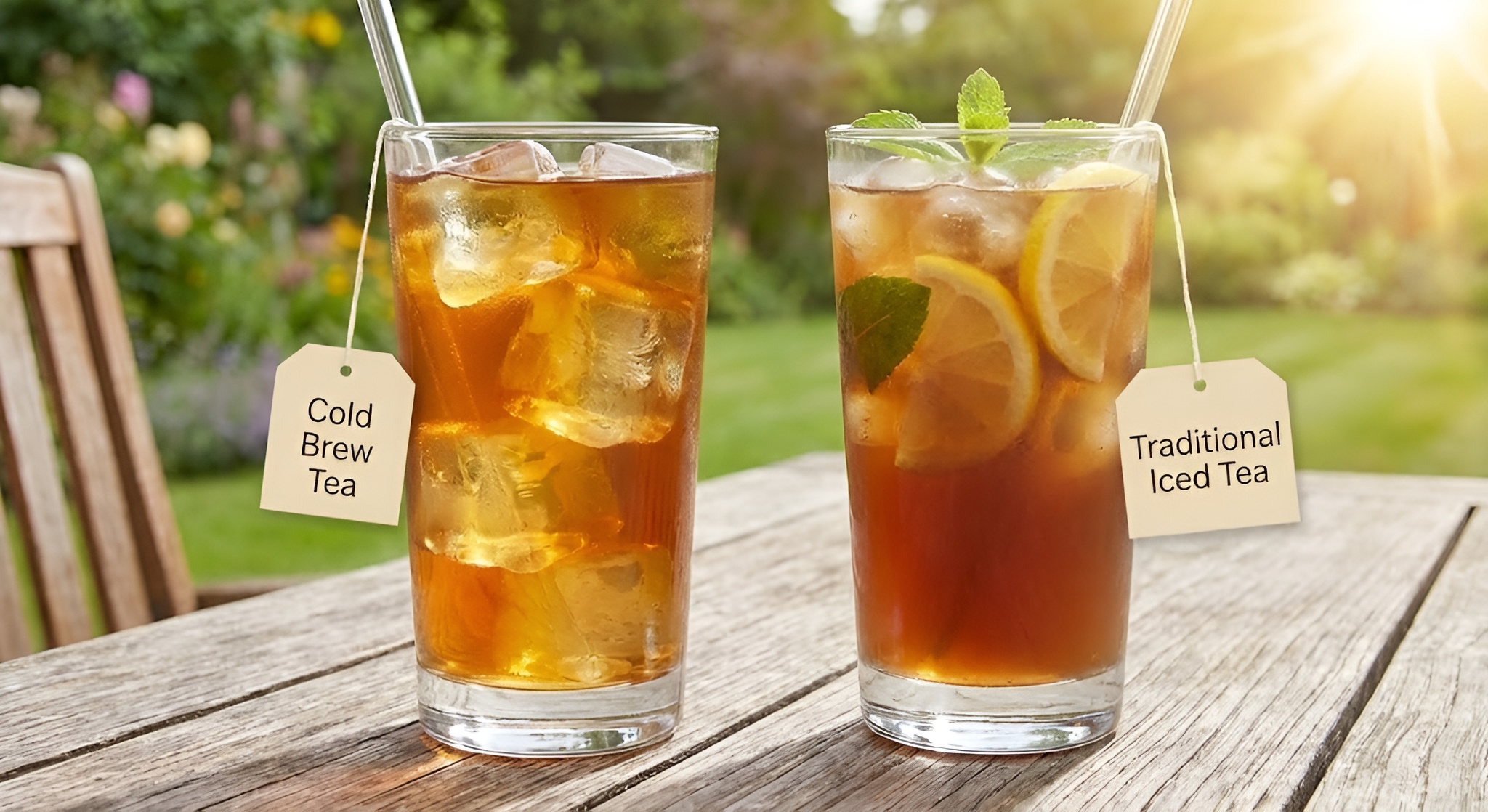
The result is a liquor that tastes smoother and sweeter than a hot infusion of the same tea, with less perceived bitterness and a lighter body. Because extraction is slow, steeping times typically range from 6 to 12 hours—longer if the water is very cold, shorter if the ambient temperature is higher or the leaf is finely broken. The science of cold brewing shows that total dissolved solids plateau after a certain time; beyond that, you gain little additional flavour and may extract unwanted tannins or develop off-notes if the tea oxidises in contact with air. For white tea, 8–10 hours in a refrigerator is a good starting point, but you can taste periodically and stop when the balance suits your palate.
It is worth noting that cold brewing does not extract zero catechins—merely fewer of them. If you use too much leaf, steep too long or choose a cultivar naturally high in catechins, the tea can still turn astringent. Conversely, if you use too little leaf or steep too briefly, the infusion may taste flat or watery. The key is to find the right ratio of leaf to water and the right duration for your chosen tea, then adjust the variables—temperature, time, leaf size—to hit your target strength and sweetness. Simple home checks, such as tasting every two hours after the six-hour mark, will tell you when the extraction is complete.
Taste Every Two Hours After Hour Six
Cold extraction plateaus at different times depending on leaf size and water temperature. Sample your brew from six hours onward to catch the sweet spot before astringency creeps in.
2. Silver Needle: Bud-Only Structure and Flavour Trade-Offs
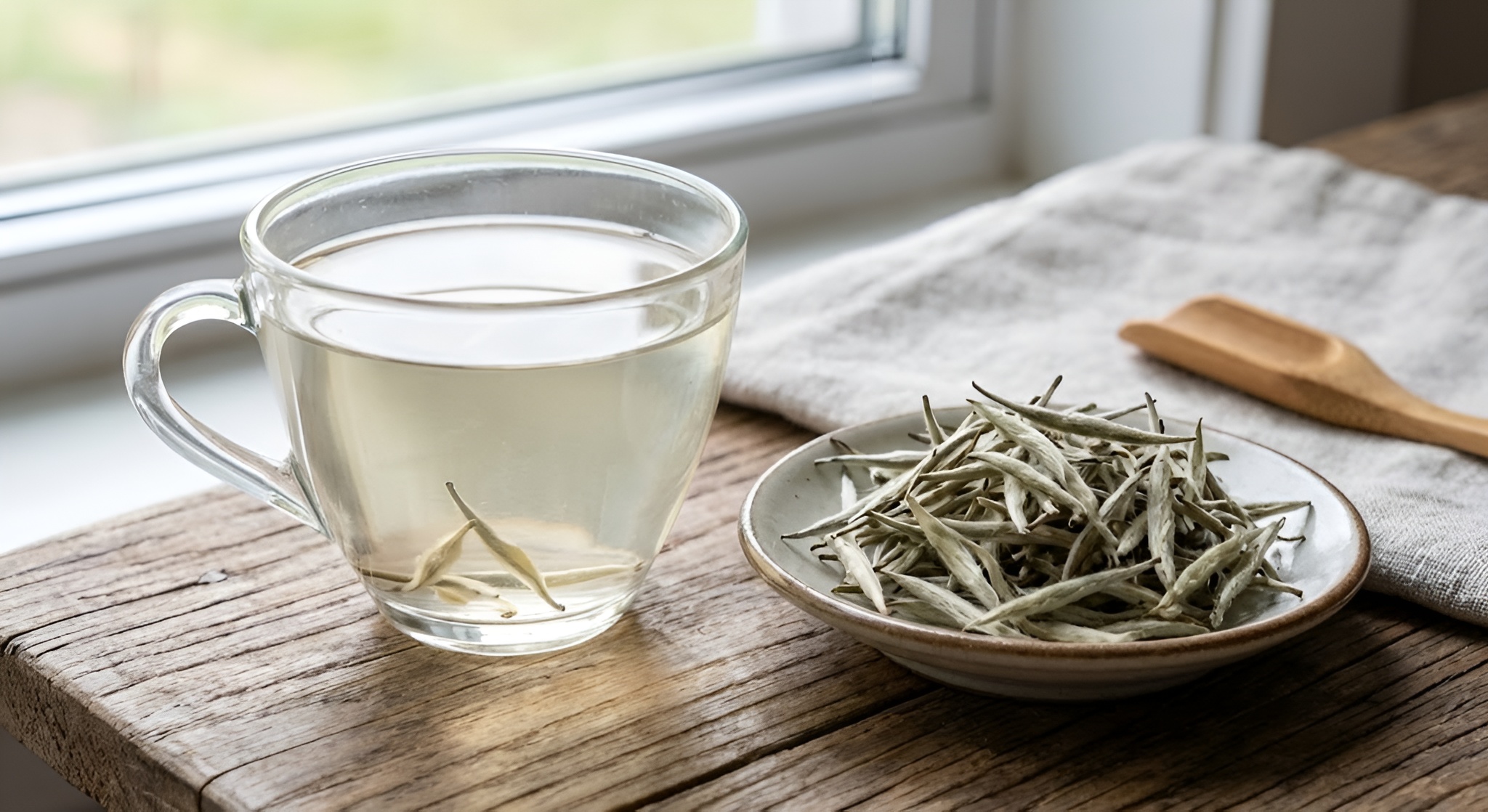
Silver Needle (Bai Hao Yin Zhen) is the most prized white tea, composed entirely of unopened buds covered in fine white down. Its minimal processing—withering and gentle drying—preserves a high concentration of amino acids, giving hot infusions a sweet, delicate character with notes of melon, hay and sometimes honey. When cold brewed, Silver Needle yields an exceptionally smooth, subtle liquor: the low temperature suppresses catechin extraction almost entirely, and the liquor tastes clean, sweet and floral. For drinkers who prize elegance and low astringency, cold-brewed Silver Needle can be a revelation.
The trade-off is intensity. Because buds have a smaller surface area than leaves and a denser internal structure, they release flavour more slowly. Even after 10–12 hours in the refrigerator, a cold-brewed Silver Needle may taste lighter and more transparent than a hot infusion of the same tea. Some drinkers appreciate this ethereal quality; others find it lacks body. If you want a more robust cold brew, you have two options: increase the leaf-to-water ratio (which raises the cost per serve) or switch to a tea with a higher proportion of leaves, such as White Peony.
From a cost perspective, Silver Needle is the most expensive white tea by weight, often £20–£40 per 50 g for high-grade Fuding or Zhenghe leaf. Cold brewing typically requires 5–8 g per litre to achieve noticeable flavour, so a single litre of cold-brewed Silver Needle can cost £2–£6 in leaf alone—more if you increase the ratio for extra body. If you are brewing daily iced tea for a household, that expense adds up quickly. For special occasions or when you want the purest expression of white tea, cold-brewed Silver Needle is worth it; for everyday drinking, consider a less expensive option or reserve your best buds for hot infusions where their complexity shines.
3. White Peony: Leaves, Body and Complexity
White Peony (Bai Mudan) consists of one or two buds plus two young leaves, giving it a larger surface area and a more varied chemical profile than Silver Needle. The leaves contribute additional polyphenols, sugars and aromatic compounds, so White Peony typically tastes fuller and more complex than bud-only teas, even when brewed hot. When cold brewed, White Peony strikes an excellent balance: the leaves release enough body and flavour to create a satisfying iced tea, while the buds add sweetness and the overall low temperature keeps astringency in check.
Extraction is faster and more pronounced with White Peony than with Silver Needle, thanks to the larger, thinner leaves. A typical cold brew—6–8 hours in the refrigerator, 4–6 g per litre—will yield a pale straw-coloured liquor with floral and honeyed notes, a touch of hay and a soft, rounded mouthfeel. If you prefer more intensity, you can push the ratio to 7–8 g per litre or extend the steep to 10–12 hours, tasting along the way to ensure the tea does not turn bitter. Because White Peony is more forgiving than delicate bud teas, it is a good choice for cold-brew beginners or for anyone who wants a reliable, everyday iced white tea without constant monitoring.
Economically, White Peony offers better value: expect to pay £8–£20 per 50 g for quality Fujian leaf, roughly half to one-third the price of Silver Needle. At 5–6 g per litre, a litre of cold-brewed White Peony costs 80p–£2.40 in leaf, making it feasible for daily consumption. For UK households looking to replace shop-bought iced tea or cold soft drinks, White Peony is often the sweet spot: good flavour, reasonable cost and forgiving extraction. If you want to explore cold-brewed white tea without committing to premium Silver Needle, start here and adjust your ratio and steep time to taste.
White Peony Is the Everyday Choice
Its leaves deliver body and forgiveness at half the cost of Silver Needle. Use 5–6 g per litre, steep 6–8 hours, and you have a reliable, sweet iced tea for pennies per serve.
4. Blended and Lower-Grade White Teas: Shou Mei, Gong Mei and Value Options
Not all white tea is precious buds. Shou Mei and Gong Mei are lower-grade white teas made from larger, more mature leaves plucked later in the season. They undergo the same withering and drying process as Silver Needle and White Peony, but their leaves are coarser, darker and carry more robust, sometimes slightly vegetal or woody flavours. In hot infusions, Shou Mei can taste earthy, honeyed and full-bodied, with a touch of astringency if over-brewed. When cold brewed, these teas come into their own: the low temperature tames any rough edges, the larger leaves release plenty of flavour over a long steep, and the result is a smooth, satisfying iced tea at a fraction of the cost of premium grades.
Blended white teas—often a mix of bud, leaf and stem sold as 'White Tea' without a specific grade—are also excellent candidates for cold brewing. These blends are typically more affordable (£4–£10 per 50 g) and can include leaf from multiple harvests or regions. Because they are designed for accessibility rather than prestige, they tolerate a wide range of brewing parameters and deliver consistent, pleasant flavour without the need for precise ratios or timing. If you are new to white tea or simply want a workhorse iced tea for summer, a good blended white or a Shou Mei will serve you well.
From a cost-per-serve perspective, Shou Mei and blends are unbeatable. At 5–6 g per litre, a litre of cold-brewed Shou Mei costs 40p–£1.20 in leaf—competitive with supermarket iced tea but vastly superior in flavour and free from added sugars or preservatives. For households that drink iced tea by the jug, or for anyone on a tight budget, these lower-grade white teas offer the best value. They also work well in large-batch brewing: fill a cold brew pitcher with 2–3 litres of water, add 12–15 g of Shou Mei, refrigerate overnight, and you have enough iced tea for several days. The flavour may not have the ethereal complexity of Silver Needle, but it will be smooth, naturally sweet and refreshing—exactly what you want from a summer drink.
5. Practical Method: Ratios, Timing and Water Quality
To cold brew white tea, you need loose leaf (or sachets designed for cold brewing), a vessel with a lid or cover, and cold or refrigerated water. Leaf-to-water ratio is the most important variable: start with 5–6 g of leaf per litre of water for White Peony or blended white tea, or 6–8 g per litre for Silver Needle if you want noticeable body. Weigh your leaf if possible—volume measurements are unreliable because white tea is bulky and varies widely in density. Place the leaf in a jug, carafe or dedicated cold brew maker, add cold water, cover and refrigerate.
Steeping time depends on water temperature and leaf size. In a refrigerator at 2–5 °C, plan for 8–10 hours; at ambient cool temperatures (10–15 °C), extraction will be faster, so check after 6 hours. Larger leaves (Shou Mei, White Peony) release flavour more quickly than buds (Silver Needle), so you may be able to shorten the steep or reduce the leaf ratio slightly. Taste periodically: if the liquor is too light, add more leaf next time or extend the steep; if it tastes astringent or flat, reduce the leaf or stop the steep earlier. There is no single 'correct' duration—your palate is the final arbiter.
Water quality matters as much in cold brewing as in hot. Filtered or bottled water with moderate mineral content (50–150 mg/L total dissolved solids) will yield a cleaner, sweeter infusion than heavily chlorinated tap water. Very soft water, common in parts of Glasgow and Manchester, can produce a flat-tasting brew; if your tap water is very soft, consider blending it with a small amount of bottled spring water to add mineral complexity. Conversely, hard water (above 200 mg/L) may form a slight haze or suppress delicate flavours, though white tea is generally less sensitive to water hardness than green or oolong.
Once the steep is complete, strain the leaf or remove the infuser and refrigerate the finished tea in a sealed container. Cold-brewed white tea will keep for 2–3 days in the refrigerator, though flavour is best within the first 24 hours. Serve over ice if you wish, but note that dilution from melting ice will weaken the brew; if you want to avoid that, consider flash-chilling a hot infusion or brewing a stronger concentrate and cutting it with ice. For everyday iced white tea, however, a simple refrigerator cold brew is hard to beat for convenience and flavour.
Weigh Your Leaf, Don't Guess
White tea is bulky and varies in density. Five grams of Silver Needle looks very different from five grams of Shou Mei. Use a scale to hit consistent ratios and reproducible results.
6. Cost Per Serve and Value Reasoning for UK Households
Cold brewing white tea can be more expensive per serve than hot brewing the same tea, for two reasons: you often need more leaf to achieve equivalent strength, and the long steep ties up your leaf for hours, preventing re-steeping. A typical hot infusion of White Peony might use 3 g of leaf in 200 mL of water, yielding two or three infusions for a total cost of perhaps 50–80p. A cold brew of the same tea at 5 g per litre (5 × 200 mL = 1 g per 200 mL, plus the inability to re-steep) will cost roughly the same per unit volume, but because cold-brewed tea is usually consumed in larger quantities—a full litre rather than a teacup—the total leaf cost per session is higher.
For Silver Needle, the economics are less favourable. At 7 g per litre and £30 per 50 g, a litre of cold-brewed Silver Needle costs £4.20 in leaf alone. That is a premium price for an iced beverage, and it may not be justifiable for everyday drinking unless you place exceptional value on the delicate, bud-only character. For White Peony, the cost is more manageable: 5 g per litre at £12 per 50 g works out to £1.20 per litre, which is reasonable for a high-quality, naturally sweetened iced tea with no additives. For Shou Mei or blends, the cost drops to 40p–£1 per litre, making cold-brewed white tea cheaper than many supermarket iced drinks and vastly healthier.
When deciding whether cold brew is worth it, consider opportunity cost: could you hot-brew the same tea, re-steep it twice, and get more total liquid for the same leaf? Often, yes—but the flavour profile will be different, and hot tea requires immediate attention, whereas cold brew is set-and-forget. If you value convenience, smoothness and the ability to make a large batch overnight, cold brewing pays dividends. If you are on a tight budget or want to maximise extraction efficiency, hot brewing with multiple infusions is more economical. There is no universal answer; it depends on your household's budget, consumption patterns and taste preferences. For a UK summer when you want iced tea on tap, a weekly batch of cold-brewed White Peony or Shou Mei is a sound investment.
Reserve Silver Needle for Hot Infusions
At £4+ per litre cold brewed, Silver Needle's delicate complexity is often lost in the chill. Save your best buds for hot tea and use White Peony or Shou Mei for iced.
7. Which Styles of White Tea Suit Cold Brew—and Which Don't
Almost any white tea can be cold brewed, but not all benefit equally from the method. Silver Needle works if you want an ultra-smooth, ethereal infusion and are prepared to pay for it; White Peony is the all-rounder, delivering good body, flavour and value; Shou Mei and Gong Mei are excellent for everyday iced tea, with robust flavour and low cost. Aged white tea—leaf that has been stored for several years and developed darker, earthier notes—can also be cold brewed, though the long steep may extract woody or medicinal flavours that some drinkers find overpowering in a chilled drink. If you are curious, try a short steep (4–6 hours) and taste; aged white is often better appreciated hot, where its complexity unfolds gradually.
Blended white teas that include Anji Bai Cha (a green tea despite the name) or other non-traditional cultivars can work well, especially if the blend is designed for iced tea or marketed as naturally sweet. Check the manufacturer's guidance: some producers now label teas as 'cold brew friendly' and adjust the leaf size or processing to suit. Conversely, very old, stale or poorly stored white tea will not improve with cold brewing; the method amplifies sweetness and reduces bitterness, but it cannot rescue flat, musty or oxidised leaf. Always start with fresh tea stored in a cool, dark, airtight container, and check that the leaf still smells fragrant and clean before committing it to a long steep.
If you are experimenting, keep notes: record the tea name, leaf weight, water volume, steep time and temperature, and your impressions of the finished liquor. Over a few batches, you will develop a feel for which teas and ratios suit your palate. Cold brewing is forgiving—there are few catastrophic failures—but small adjustments in leaf quantity or steep duration can make the difference between a good iced tea and a great one. For more background on how white tea is processed and why its chemistry suits cold extraction, see our guide to Fujian white tea and the role of withering and enzymes.
8. Verdict: Does Cold Brew White Tea Work, and Is It Worth It?
Yes, cold brew white tea works—and for certain styles and occasions, it works exceptionally well. The method leverages white tea's high amino acid content and minimal oxidation to produce a smooth, naturally sweet infusion with low astringency and a delicate flavour profile. White Peony and Shou Mei are particularly well suited: they deliver good body, tolerate long steeps and offer excellent value for money. Silver Needle can be cold brewed successfully, but its ethereal character and high cost mean it is often better appreciated hot, where multiple infusions reveal its full complexity.
From a practical standpoint, cold brewing is convenient: you can prepare a large batch overnight, refrigerate it and have iced tea ready for several days with no further effort. The cost per serve is higher than hot brewing with re-steeps, but for UK households that consume iced tea regularly in summer, the convenience and flavour quality justify the extra leaf. A litre of cold-brewed White Peony costs roughly £1–£1.50 in leaf—more than a hot pot of the same tea, but far less than shop-bought iced drinks and with none of the added sugars, artificial flavours or packaging waste.
The key to success is matching the tea to the method. Use White Peony or a good blended white for everyday iced tea, reserving premium Silver Needle for hot infusions or special cold brews. Weigh your leaf, start with a 5–6 g per litre ratio, steep for 8–10 hours in the refrigerator, and taste periodically until you find your ideal balance. Invest in a cold brew pitcher with a removable infuser if you plan to brew regularly, and always use fresh, well-stored leaf and clean, filtered water. If you follow those guidelines, cold-brewed white tea is not just viable—it is one of the most rewarding ways to enjoy tea in warm weather, offering clarity, sweetness and a genuine sense of craft in every chilled glass.
Match the Tea to the Method
White Peony and Shou Mei thrive cold brewed; Silver Needle shines hot. Choose your leaf based on how you plan to drink it, and you will get better flavour and value from every gram.



Comments