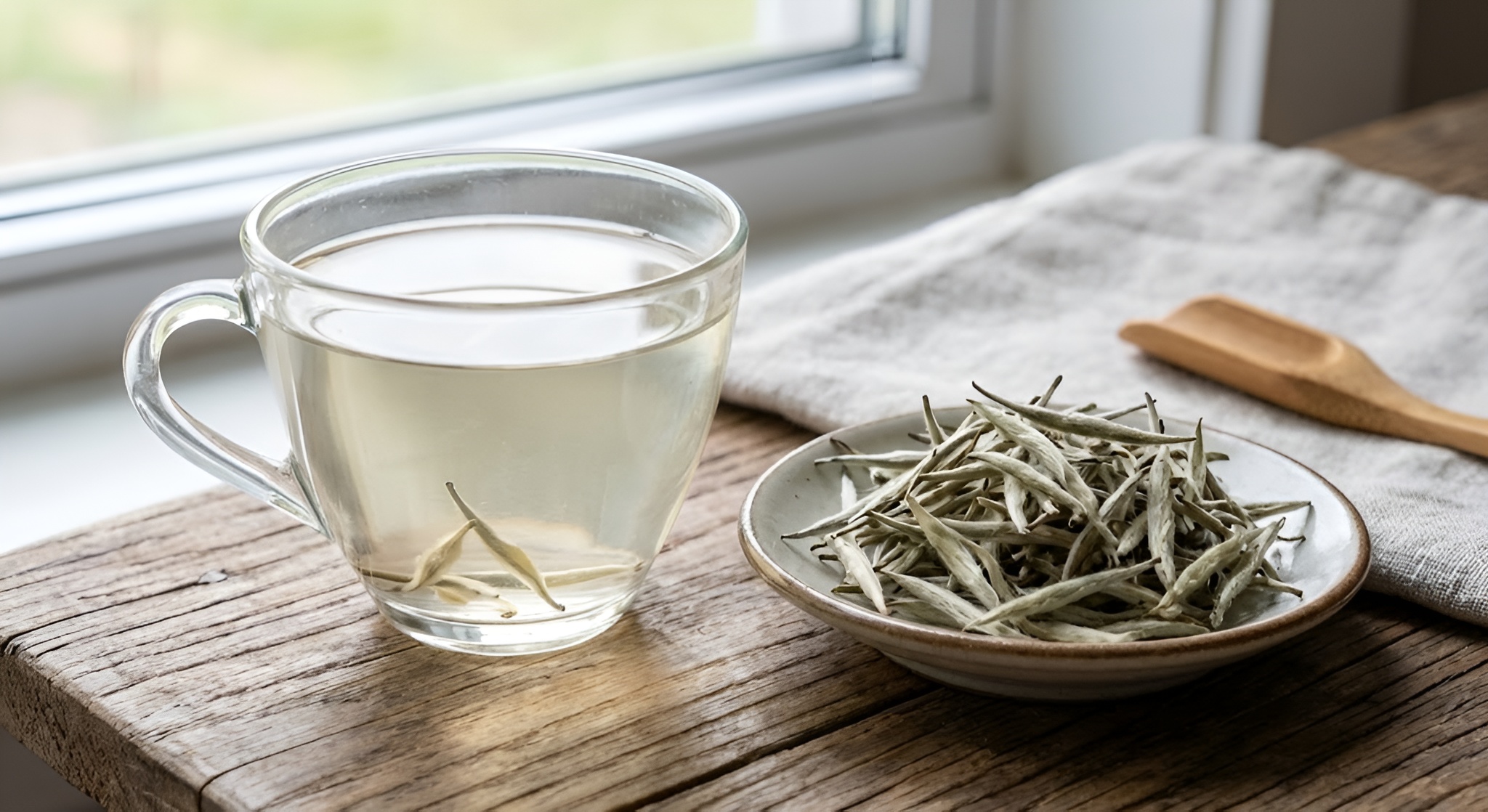
1. What Is Aged White Tea and Why the UK Climate Suits It
Aged white tea—sometimes called lao bai cha (老白茶) in Mandarin—refers to white tea stored intentionally for months or years to allow slow post-production changes. Unlike green tea, which is typically enjoyed fresh, or pu-erh, which is fermented or designed to age, white tea occupies a middle ground: it undergoes minimal processing (withering and drying, no pan-firing or rolling), so polyphenol oxidase enzymes remain active in the dried leaf. Over time, residual moisture, ambient oxygen, and ambient microbes drive gentle oxidation and esterification, darkening the liquor, mellowing astringency, and generating new aromatics—honey, dried apricot, woody spice—while the original floral or grassy top-notes recede.
The UK's temperate maritime climate offers a natural advantage for dry storage of white tea. Our average indoor temperatures in unheated cupboards or spare rooms sit between 14 and 18 °C year-round—cool enough to slow oxidation and prevent runaway fermentation, yet warm enough to sustain enzymatic activity. Contrast this with tropical 'wet storage' (Hong Kong, Guangzhou) where 25–30 °C and 70–80 % relative humidity accelerate ageing but risk mould, or arid climates (high-altitude Colorado, desert Spain) where sub-10 % RH can desiccate leaves and stall transformation. British homes naturally hover near 50–60 % RH in summer and can spike to 70 % in winter without dehumidification, so the challenge is managing those seasonal swings rather than fighting an inherently hostile environment.
Not every white tea benefits from age. Delicate, high-bud-content grades—especially loose silver needle (bai hao yin zhen)—are prized for ephemeral sweetness and downy texture that peak within the first year and fade thereafter. By contrast, coarser grades with mature leaves and stems—gong mei (贡眉), shou mei (寿眉), and compressed bai mudan cakes—contain more polyphenols, cellulose, and lignin, which provide the structural backbone for long-term transformation. Fujian producers have recognised this for decades, pressing shou mei into 200 g or 357 g cakes specifically for ageing, and the market now distinguishes 'new' white tea (within one year) from three-year, five-year, and ten-year vintages, each commanding higher prices if provenance and storage are documented.
Cool Beats Hot for Longevity
If you have a choice between a 16 °C north-facing cupboard and a 20 °C south-facing shelf, pick the cooler spot—you'll add years to the viable ageing window and preserve more nuance in the final cup.
2. Which White Tea Grades and Origins Actually Age Well
Success in ageing hinges on raw material. Gong mei and shou mei—the third and fourth traditional Fujian grades, made from larger leaves and shoots harvested later in the season—are the workhorses of the aged white tea world. Their higher cellulose and polyphenol content sustains oxidative and microbial activity over years, and their lower unit cost (typically £8–£15 per 100 g for decent loose shou mei, £20–£40 for a 200 g cake) makes experimentation affordable. Look for cakes from Fuding or Zhenghe county, ideally spring or early-summer harvests (March–May), which retain enough amino acids and sugars to develop sweetness as astringency fades.
Compressed bai mudan (white peony) cakes occupy a middle tier: more bud content than shou mei, so initial floral character is brighter, but still enough leaf mass to age gracefully. Expect to pay £25–£50 per 200 g cake for reputable brands. Loose bai mudan, however, often loses its best qualities within 18 months unless stored in very stable conditions; the increased surface area accelerates volatile loss and the delicate balance between bud sweetness and leaf body tips toward flatness rather than complexity.
Silver needle is the outlier. Its pure-bud composition and premium price (£40–£80 per 100 g for top Fuding or Zhenghe silver needle) are predicated on fresh, downy sweetness and a pale, champagne-hued liquor. Some collectors age it, and there is a niche market for three- to five-year silver needle with honeyed depth, but the transformation is subtle and the risk of losing the tea's defining characteristics is high. Unless you already own more silver needle than you can drink fresh, it's wiser to store gong mei or shou mei and enjoy silver needle within the first year.
Provenance matters as much as grade. Fuding county in northeastern Fujian is the historical heartland; its da bai hao cultivar and cool, misty growing conditions yield white tea with robust polyphenol structure and balanced sweetness. Zhenghe county, slightly inland, produces a slightly earthier, more mineral profile. Both age well. Be cautious with white tea labelled only 'Fujian' or 'China'—it may be blended from multiple origins or lower-grade leaf, and the ageing trajectory will be less predictable. If you're investing time and cupboard space, spend a bit more upfront for documented single-origin material.
Buy Cakes, Not Loose, for Long Ageing
Compressed cakes expose less surface area to air and humidity swings, slow volatile loss, and are easier to store in quantity. If you plan to age beyond two years, prioritise 200 g or 357 g cakes over loose leaf.
3. Setting Up Your UK Home Storage Environment: Humidity, Temperature, and Airflow
The gold-standard environment for ageing white tea is stable, breathable, and monitored. Temperature: aim for 14–18 °C, typical of a cool cupboard, spare bedroom, or insulated garage in the UK. Avoid attics (summer heat spikes to 25+ °C) and unheated sheds (winter drops below 5 °C can halt activity and cause condensation when ambient temps rise). A north-facing room or interior cupboard away from radiators is ideal. Relative humidity: target 50–65 % RH. Below 45 %, oxidation slows to a crawl and leaves can become brittle; above 70 %, mould risk escalates sharply, especially in poorly ventilated spaces. Invest in a digital hygrometer (£10–£20) and check readings monthly. In damp British autumns and winters, a small electric dehumidifier or silica-gel packs in the storage area can prevent the 75–80 % spikes that spell disaster.
Airflow and light: white tea benefits from gentle air exchange—this is why traditional Fujian storage uses kraft-paper-lined cardboard cartons rather than vacuum-sealed bags. Fresh oxygen feeds slow oxidation; stagnant, sealed environments can develop off-notes. At the same time, avoid direct draughts (open windows, air-con vents) that cause rapid humidity fluctuations. Store in a dark cupboard or wrap cartons in brown paper; UV light degrades chlorophyll and polyphenols, bleaching flavour. Never use clear glass jars or leave cakes on open shelves near windows.
Vessel choice: for cakes, the classic method is to leave them in their original kraft or rice paper wrapping, then place 3–5 cakes in a clean cardboard box (the sort online retailers use for shipping works well). For loose shou mei or gong mei, decant into food-grade kraft-paper bags (fold-top or sewn-seam), then group those bags in a lidded cardboard carton. Some UK enthusiasts use Mylar-lined resealable pouches for tighter humidity control, especially if ambient RH swings wildly; this is a hybrid approach—less breathable than paper, more breathable than metal tins. Never use plastic zip-lock bags (they trap moisture and impart plasticky off-flavours) or fully airtight stainless-steel canisters (no air exchange means stalled ageing). For a deeper dive on general tea storage principles, see our guide on how to store tea properly at home.
Label everything: date of purchase, origin, grade, and storage start date. Aged white tea looks similar across vintages once the leaves darken, and you will forget which box holds 2024 shou mei and which holds 2021 gong mei. A simple sticky label or permanent marker on the carton saves confusion and lets you track transformation accurately.
4. The Transformation Timeline: What to Expect at 1, 3, 5, and 10 Years
0–6 months: the 'settling' phase. Freshly pressed cakes or newly purchased loose white tea often carry a faint vegetal or grassy edge—reminiscent of fresh hay or steamed greens—and may show some astringency in the finish. By month three, these notes begin to soften; by six months, the liquor colour deepens slightly from pale straw to light gold, and a honeyed sweetness emerges in the aftertaste. This is the minimum resting period before you can meaningfully compare aged character to fresh.
1–2 years: the 'early mellowing' window. Astringency recedes noticeably; the mouthfeel becomes rounder, almost creamy. Floral top-notes (jasmine, orchid) fade, replaced by ripe stone fruit—apricot, peach skin—and a gentle maltiness. The liquor deepens to amber-gold. At this stage, many drinkers find the tea more approachable than fresh, though true aged complexity has not yet developed. If you're ageing bai mudan, this may be the sweet spot before delicate bud character disappears entirely; for shou mei, it's just the beginning.
3–5 years: the 'classic aged white' phase. The liquor turns deep amber to light mahogany. Dominant flavours shift to dried fruit (fig, date, raisin), honeyed sweetness, and woody or herbal notes—sandalwood, aged chenpi (dried tangerine peel), sometimes a faint medicinal edge similar to aged sheng pu-erh. Astringency is minimal; the tea feels smooth, warming, and subtly sweet without added sugar. Aroma becomes fuller, with hints of caramel or toasted grain. This is the stage at which Fujian producers and Hong Kong tea merchants begin to market white tea as 'aged' and price it accordingly—expect to pay 50–100 % more than fresh equivalents.
10+ years: the 'mature aged white' realm, comparable in complexity to ripe pu-erh or well-aged oolong. The liquor is deep reddish-brown; flavour is profoundly mellow, with layers of dried longan, dark honey, aged wood, and earthy undertones. Bitterness and astringency are absent; the sensation is almost meditative—smooth, slightly thick, with a long, sweet aftertaste that lingers for minutes. Aroma may include hints of tobacco leaf, aged leather, or damp forest floor (in a pleasant, not musty, way). Truly excellent ten-year white tea is rare in the UK market; if you find a verified example, expect to pay £60–£100 per 100 g or more. Most of what you'll drink at this age will be tea you stored yourself, which is part of the appeal.
Taste Every Six Months
Brew a small sample every six months and take tasting notes. You'll learn your storage micro-climate, catch problems early, and enjoy watching the tea's personality unfold—ageing is as much about the journey as the destination.
5. Monitoring and Troubleshooting: Recognising Mould, Mustiness, and When to Intervene
Even in well-managed UK storage, problems can arise. The most serious is mould—white, grey, or greenish fuzz on the leaf surface, often accompanied by a musty or sour smell. Mould thrives above 70 % RH and in stagnant air. If you spot it, discard the affected tea immediately; do not attempt to 'air it out' or brush it off, as mould spores can produce mycotoxins. Prevent mould by checking your hygrometer monthly, especially October–March when British homes are prone to condensation, and ensure your storage area has at least passive ventilation (a cupboard door opened briefly each week suffices).
Mustiness without visible mould suggests the tea has absorbed off-odours—perhaps from damp cardboard, nearby spices, or cleaning products. White tea is highly absorbent. If the musty note is faint, try airing the tea: unwrap cakes or open bags, spread leaves on a clean tray in a dry, well-ventilated room (not in direct sun) for 2–4 hours, then re-wrap and return to storage. If mustiness persists or intensifies, the tea is likely compromised. This underscores the importance of odour-free storage: never keep white tea in the same cupboard as ground coffee, dried chillies, or strong-smelling cleaning supplies.
Flat or sour flavour can indicate over-humidity or, conversely, excessive dryness. If your hygrometer reads below 45 % RH for months on end, oxidation stalls and the tea may taste lifeless—pale, thin, and uninteresting. A brief 'rehydration' by introducing a small bowl of water into the storage cupboard for a few days (monitored carefully to avoid spiking above 65 %) can kickstart activity, though results are mixed. Conversely, if RH has been too high (65–75 % range) for extended periods, you may get a sour, over-fermented character; there's no fix—prevention is key.
For guidance on managing the tricky transition periods when UK humidity swings most, see our seasonal guide on transitioning tea storage from summer to autumn. Regular inspection is your best insurance: every three to six months, open your storage boxes, sniff the tea, check for discolouration or fuzz, and brew a small sample. Catching a problem at month six is inconvenient; catching it at year three is heartbreaking.
The Sniff Test Never Lies
Before you brew, sniff the dry leaf. It should smell clean—fruity, honeyed, woody—not musty, sour, or flat. If your nose says something's off, trust it and investigate before the whole batch spoils.
6. Brewing Aged White Tea: Adjustments for Mature Leaf and Comparing Fresh vs. Aged
Aged white tea calls for different brewing parameters than fresh. Leaf ratio: use 4–5 g per 150 ml gaiwan or teapot, slightly more generous than fresh white tea, because aged leaves are often more compact and slower to unfurl. Water temperature: 95–100 °C, near-boiling or fully boiling. Fresh white tea's delicate buds can turn astringent above 85 °C, but aged shou mei or gong mei has lost most of its astringency and benefits from the higher heat to coax out deep, honeyed flavours and open tightly compressed leaves. Infusion times: start with 20–30 seconds for the first steep, then 30, 45, 60 seconds and so on, extending gradually. Well-aged white tea can yield 6–8 flavourful infusions, with later steeps revealing woody, herbal, or sweet grain notes that the first steep only hints at.
If your tap water is hard (London, Birmingham, much of the Southeast), consider filtering or using bottled spring water; aged white tea's subtle, layered flavours can be masked by high mineral content. A glass gaiwan is ideal for showcasing the colour transformation and watching the leaves slowly unfurl—half the pleasure of aged white tea is visual.
Fresh vs. aged comparison: if you have both a fresh 2026 shou mei and a three-year 2023 shou mei from the same origin, brew them side by side. The fresh will be brighter, grassier, more astringent, with a pale yellow-green liquor; the aged will be mellower, honeyed, with amber liquor and a rounder mouthfeel. Neither is objectively 'better'—it's a matter of preference. Some drinkers love the brisk, clean character of fresh white tea; others find aged white tea more soothing and complex. The comparison also teaches you what to expect as your own stored tea evolves.
7. The Investment Case: Price Appreciation, Provenance, and UK Market Realities
Aged white tea from established Fujian producers can appreciate significantly. A 200 g cake of Fuding shou mei that retailed for £18 in 2016 may fetch £45–£60 in 2026 if it has been stored well and can be verified as genuine. The driver is scarcity: well-aged stock is finite, and demand in China, Hong Kong, and among international collectors has grown. However, the UK secondary market for aged tea is thin compared to China or even the United States. You're unlikely to flip a three-year gong mei cake for profit on eBay or at a local tearoom unless you've built a reputation as a knowledgeable collector.
The real investment value is personal: you're locking in today's prices (before further appreciation) and ensuring known provenance and storage conditions. Buying ten-year aged white tea on the open market in 2026 means trusting the seller's storage claims, which are difficult to verify and often inflated. When you age it yourself, you know the humidity log, the temperature range, and that the tea has never been exposed to mould or off-odours. That certainty has value, especially if you're spending serious money on premium tea.
Beware of faked aged tea: unscrupulous vendors artificially accelerate ageing by exposing tea to high heat and humidity for weeks, or blend young and old leaf to mimic colour and aroma. Telltale signs include suspiciously cheap pricing (genuine five-year Fuding white tea will not sell for £15 per 200 g cake), inconsistent leaf appearance (mix of very dark and pale leaves in a single cake), or an overly smooth, flat flavour with no complexity. Buy from reputable UK importers or direct from known Fujian producers, and if a deal seems too good to be true, it almost certainly is.
Document Everything
Keep purchase receipts, producer info, and storage logs (even a simple spreadsheet with monthly RH readings). If you ever sell or gift aged tea, this documentation proves provenance and justifies the asking price—or simply enriches your own tasting records.
8. Where to Source White Tea for Ageing in the UK and How Much to Store
For ageing experiments, prioritise quality over quantity at the outset. Start with 400–600 g total—perhaps two or three different 200 g cakes (one shou mei, one gong mei, one compressed bai mudan) from different producers or years. This gives you enough material to taste every six months without depleting your stock, and lets you compare how different teas evolve under identical storage conditions. Once you've confirmed your storage setup works and you enjoy the trajectory, scale up.
UK-based specialists that stock compressed white tea suitable for ageing include What-Cha (wide range of Fujian whites, including affordable shou mei cakes), Mei Leaf (focuses on premium grades, often with detailed provenance), and Yunnan Sourcing UK (primarily pu-erh, but carries some Fuding white cakes). For a curated selection of high-quality loose and compressed whites, consult our best white tea review. If you prefer to buy directly from China, Bai Lin Gong Fu Tea and Te Ji are reputable Fuding-based vendors that ship internationally, though you'll pay customs duty and VAT on imports over £135.
Avoid supermarket or generic 'white tea' teabags, which are typically dust-grade or blended material with no ageing potential. Similarly, flavoured white teas (jasmine white, peach white) will not age well—the added aromatics degrade unpredictably and can turn rancid. Stick to pure, unflavoured, whole-leaf or compressed white tea from a documented harvest and region.
Finally, consider joining a UK tea community—online forums, regional tasting groups, or the UK Puer & Dark Tea Club—where enthusiasts share storage tips, trade samples, and collectively taste aged teas. Ageing tea is a long game, and having a peer group to compare notes with makes the journey more rewarding and less solitary. For broader advice on hosting structured tastings, see our guide on how to host a tea tasting party at home.


Comments