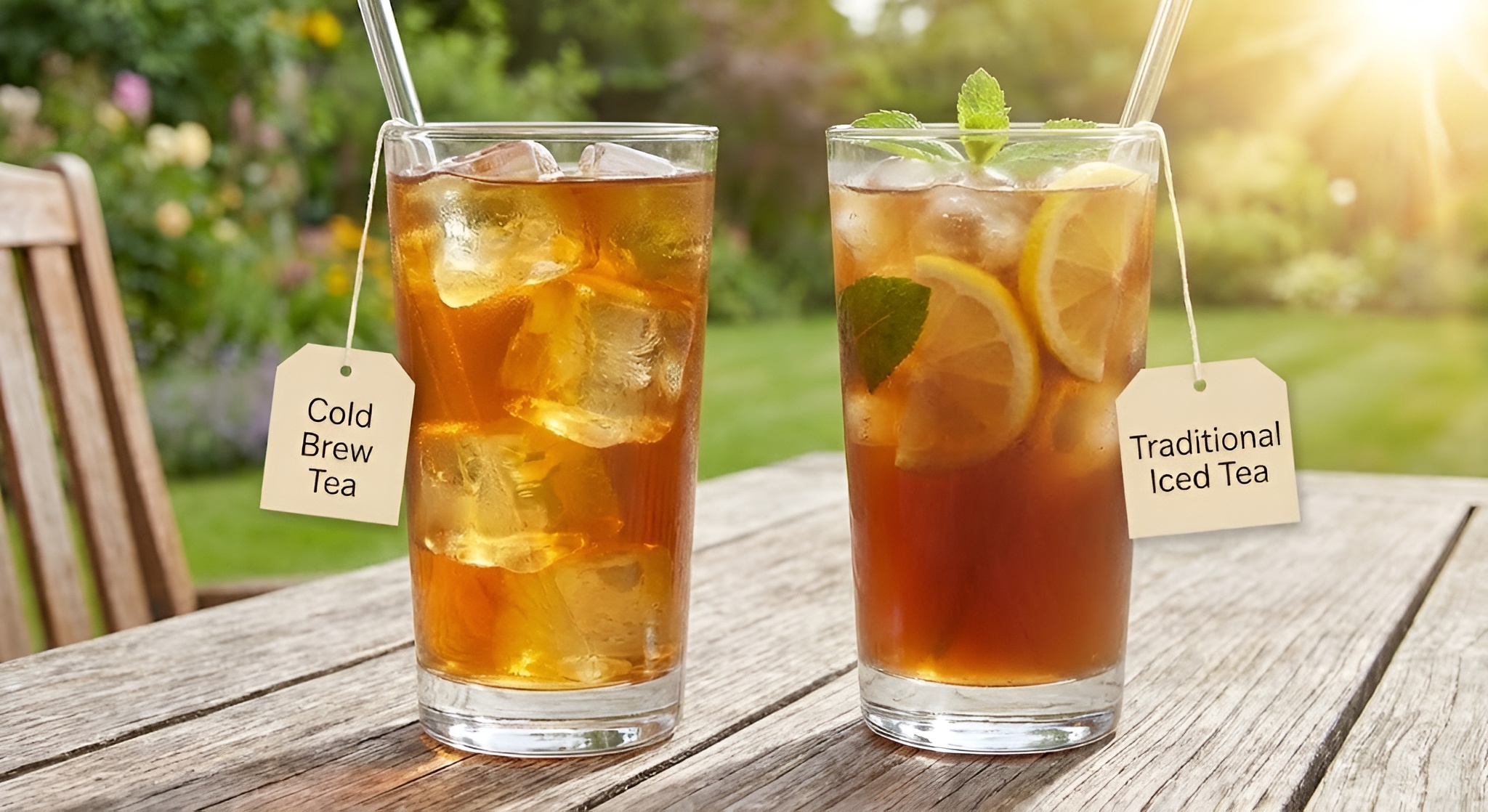
1. Why Standard Ice Dilutes Iced Tea (and How Much Water You're Really Adding)
When you drop regular ice cubes into hot or warm tea, two things happen simultaneously: the tea transfers heat to the ice, and the ice melts into liquid water, increasing the total volume of your drink. A standard UK ice-cube tray compartment holds roughly 30 ml; if you use four cubes to chill 250 ml of tea, you're adding up to 120 ml of water as those cubes melt—a dilution factor approaching 50 per cent. The exact amount depends on starting tea temperature, ice temperature (most home freezers run at around −18 °C), and ambient conditions, but the principle is constant: ice is frozen water, and it will become liquid water in your glass.
The physics are straightforward. It takes approximately 334 joules to melt one gram of ice at 0 °C into water at 0 °C (the latent heat of fusion), plus further energy to warm that melt-water to the final drink temperature. Hot tea at 80 °C carries enough thermal energy to melt a significant mass of ice before equilibrium is reached. If you pour boiling-hot tea over ice and want a final temperature around 4 °C (refrigerator cold), you'll melt roughly one gram of ice for every 1.16 grams of tea, assuming no heat loss to the glass or air—close to a 1:1 mass ratio. That's why a cuppa brewed at normal strength tastes insipid once chilled: you've effectively added an equal volume of plain water.
Most casual recipes ignore this dilution, instructing you to 'brew as usual, then pour over ice.' The result is predictably weak. Professional iced-tea service—and increasingly ready-to-drink bottled products—compensate by brewing concentrate, using tea ice, or employing flash-chill with a pre-calculated ice load. Home brewers can do exactly the same, once they understand the maths.
2. Double-Strength Concentrate Brewing: Ratios, Timing, and Temperature for Every Tea Type
The simplest anti-dilution strategy is to brew your tea at twice the normal strength, so that when ice melts and adds ~50 per cent water, you end up at the intended concentration. In practice this means doubling your leaf dose while keeping water volume and steep time constant, or halving your water volume for the same amount of leaf. For black tea, a typical hot-brew ratio is 2–3 g per 200 ml; for iced concentrate, use 4–6 g per 200 ml (or 2–3 g per 100 ml). For green tea, increase from ~2 g per 150 ml to 4 g per 150 ml. The steep time remains the same—3–5 minutes for black, 2–3 minutes for green, 5–7 minutes for oolong—because you're targeting higher solids extraction, not longer extraction.
Temperature matters. Many guides suggest brewing concentrate at lower temperatures to avoid bitterness, but in reality hotter water extracts more efficiently, which is exactly what you want when you need double the dissolved solids. For black tea concentrate, use water at 95–100 °C; for green, 75–80 °C; for white, 80–85 °C. If the result tastes astringent when hot, it will mellow considerably once chilled and diluted by ice. The key is to taste your concentrate before chilling—it should seem almost too strong, verging on syrupy, because you know half its potency will vanish into melt-water.
Once brewed, let your concentrate cool to room temperature (or refrigerate for 30–60 minutes) before pouring over ice. Pouring boiling concentrate directly onto ice works for flash-chill methods (see section 4), but if you're simply filling a glass, starting from warm rather than scalding reduces the total ice melt and gives you finer control over final dilution. Store any unused concentrate in the refrigerator for up to three days; it will continue to develop flavour and can be diluted to taste with cold water or ice as needed. This method is the backbone of batch iced-tea service for events, and it scales beautifully—brew a one-litre concentrate in the morning, decant into a jug, and you have the foundation for a dozen glasses through the afternoon.
Taste Your Concentrate Hot
Before you chill, sip the hot concentrate. It should taste almost uncomfortably strong—darker, more astringent, more aromatic than you'd drink straight. If it tastes 'just right' hot, it will taste watery once diluted by ice.
3. Tea Ice Cubes: Timing, Tray Types, and Flavour-Matching Strategy
The zero-dilution solution: freeze your tea into ice cubes, then use those cubes to chill fresh tea of the same type (or a complementary one). When the cubes melt, they release concentrated tea rather than plain water, so your drink strengthens or stays constant instead of weakening. The method is elegant, requires no special equipment beyond an ice-cube tray, and works for every tea category. The downside is advance planning—most UK freezers take 4–6 hours to freeze a standard tray, so you need to think one day ahead.
Best practice: brew a strong pot of your chosen tea (slightly stronger than drinking strength, because freezing can mute delicate aromatics), let it cool, then pour into silicone or plastic ice-cube trays. Avoid metal trays, which can impart off-flavours. Cover the trays with cling film or a lid to prevent freezer odours (frozen tea will cheerfully absorb the scent of last week's curry). Once solid, pop the cubes into a labelled freezer bag—'Darjeeling cubes,' 'Sencha cubes'—and repeat. You can keep a rotating stock of two or three tea types, matching cubes to the tea you're serving that day.
Flavour matching matters more than you might think. Earl Grey cubes in a glass of Assam will add bergamot; jasmine-green cubes in a white tea will overlay floral notes. Sometimes that's delightful, sometimes it muddies the profile. For precision, match cube and brew exactly; for creative blending, experiment with complementary pairs—lapsang ice in a smoky black iced tea, mint-infused cubes in Moroccan-style green, or chamomile cubes in a hay-fever relief herbal blend. Full details, including flavoured-cube recipes and cocktail applications, are covered in our dedicated tea ice cubes guide.
Double-Freeze for Clarity
First freeze plain water cubes, then brew strong tea, chill it, and freeze that in a second batch. Use the plain cubes for initial chill, tea cubes for maintenance—this keeps your drink crystal-clear and avoids cloudy melt-water if your tap water is hard.
4. Japanese Flash-Chill (Koridashi) Method: Exact Ice Ratios and Two-Minute Technique
Flash-chilling—sometimes called koridashi in the context of Japanese iced coffee, though the term is occasionally applied to tea—inverts the usual sequence: instead of brewing tea, letting it cool, then adding ice, you measure a specific load of ice into your serving vessel, brew a hot concentrate, and pour it directly over the ice. The tea chills in 60–90 seconds, the ice melts in a controlled, predictable quantity, and you're left with a glass of cold, full-strength tea immediately. This is the method favoured by speciality cafés and competition baristas because it preserves volatile aromatics that can fade during slow refrigeration, and it's fast enough for single-serve, on-demand service.
The key is the ice-to-tea ratio. A common starting point is 1:1 by mass: if you're brewing 150 g (ml) of hot concentrate, place 150 g of ice in your glass. The hot tea melts the ice, the ice chills the tea, and you end up with roughly 300 ml of cold tea at drinking strength—assuming your concentrate was brewed at 2× normal strength. In practice, measure your ice by weight if you have a scale (most accurate), or by volume using a measuring jug (close enough for home use). For a single 300 ml serving, place ~150 g (about five or six standard UK ice cubes) in a sturdy glass or tumbler, brew 150 ml of double-strength tea (4–6 g leaf, 150 ml water, 3 minutes for black, 2 minutes for green), then pour the hot tea slowly over the ice, swirling gently. The ice will crackle and melt; within 90 seconds you'll have a chilled, aromatic drink with no insipid aftertaste.
This technique works beautifully for Japanese green teas—sencha, gyokuro, even hojicha—where bright, grassy top notes benefit from rapid temperature drop. It's less common for robust black teas, which tolerate slower cooling, but there's no technical reason you can't flash-chill an Assam or Ceylon if you want immediate service. One caution: use a heat-resistant glass or ceramic vessel. Pouring 90 °C liquid into a thin, cold glass can cause thermal shock and cracking. If in doubt, pre-warm the glass with a splash of hot water, discard, then add your ice and proceed.
5. Whisky Stones, Stainless-Steel Ice, and Ceramic Chill Cubes: What Works, What Doesn't, and UK Availability
Non-melting chill agents—whisky stones (soapstone cubes), stainless-steel 'ice' cubes, ceramic spheres, and similar products—promise zero dilution by chilling your tea without adding water. The physics are simple: freeze the objects, drop them into your drink, and they absorb heat until they reach equilibrium with the liquid. No phase change, no melt, no dilution. The trade-off is cooling capacity. Melting one gram of ice absorbs 334 joules plus the energy needed to warm the resulting water; raising one gram of stainless steel from −18 °C to +4 °C absorbs only about 40 joules (specific heat ~0.5 J/g·°C). Practically, you need many more stones or steel cubes than you would ice to achieve the same temperature drop, and even then you may only bring your tea down to 8–12 °C rather than true refrigerator cold.
Whisky stones (typically soapstone or granite) are widely available in the UK—check kitchenware shops, department stores, or online for sets of six to nine cubes, usually around £8–15. Freeze them for at least four hours, drop three or four into a 250 ml glass of room-temperature tea, and expect a 5–8 °C drop over five minutes. They work best when your tea is already cool (brewed and refrigerated), not piping hot. Stainless-steel cubes (often filled with a water or gel core) chill slightly faster and don't scratch glassware, but are pricier (£12–20 for a set). Ceramic spheres are rarer and mostly marketed for spirits. All of these are reusable indefinitely, which is the main appeal—no advance ice-making, no freezer-tray Tetris, just rinse and re-freeze after each use.
For UK summer 2026 iced tea, non-melting options make sense if you're serving chilled tea from the refrigerator and want to maintain temperature without any dilution, or if you're brewing a delicate, expensive tea—Anji Bai Cha, a premium gyokuro—where even tea-ice cubes might alter the profile. For everyday service or large batches, the cost and cooling inefficiency mean stones and steel cubes are a niche tool rather than a staple. If you do invest, buy enough for multiple rounds (twelve to eighteen pieces) so you can swap out warmed stones mid-session and keep the chill going.
Pre-Chill Your Tea First
Whisky stones and steel cubes work only if your tea is already cool. Pour hot tea over them and they'll barely dent the temperature. Brew, refrigerate for an hour, then add stones for the final 5–8 °C drop.
6. Frozen Fruit, Herb Ice, and Flavoured Chill Agents: When to Use Them and Dilution Trade-Offs
Frozen fruit—whole berries, citrus wheels, melon cubes, even sliced peaches—offers a middle path: it chills your tea, adds complementary flavour as it thaws, and dilutes far less than pure ice because fruit flesh doesn't melt into liquid water, it simply releases juice and pulp. A handful of frozen raspberries in a glass of cold-brew white tea will drop the temperature by 4–6 °C over ten minutes, impart a gentle berry sweetness, and contribute perhaps 20 ml of liquid—minimal dilution compared to 100 ml from standard ice cubes. The aesthetic is appealing (floating berries, citrus wheels), the method is forgiving (no precise ratios needed), and it works particularly well for herbal and floral teas where fruit is already a natural pairing.
Best UK fruit for tea chilling: strawberries, raspberries, blackberries (widely available frozen year-round in supermarkets), lemon and lime wheels (slice fresh, freeze on a tray, then bag), and frozen mango or pineapple chunks for tropical-herbal blends. Avoid high-water fruits like watermelon unless you account for the juice dilution. For savoury or green teas, try frozen cucumber slices (surprisingly effective, very low dilution, subtle flavour) or frozen ginger discs. Herb ice is another popular variant: freeze whole mint leaves, basil, or lemon-balm sprigs in ice-cube trays (top up with a little water to hold them in place), then use those cubes in matching tea—mint ice in Moroccan green, basil ice in a lemon verbena tisane. As they melt, they release fresh herb oils and aroma, reinforcing rather than diluting the drink's character.
Dilution trade-offs: fruit and herb ice still add some liquid, so they're not zero-dilution solutions. A cube made from 30 ml water with a mint sprig frozen inside will still release 30 ml of (mint-flavoured) water as it melts. The advantage is that the added liquid is flavourful, not neutral, so the drink's overall taste profile remains vivid. For more on preparing and storing tea-friendly frozen additions, see our frozen tea treats guide and home-grown herb iced tea recipes.
7. Cold-Brew as a Dilution-Free Alternative: Time, Temperature, and Flavour Differences
Cold-brew tea—steeping tea leaves in cold or room-temperature water for 6–12 hours—sidesteps the dilution problem entirely because you never use ice in the brewing process. The tea emerges from the refrigerator already chilled and ready to drink. There's no thermal shock, no melt-water, and no need for concentration ratios. The method is supremely simple (add leaf to cold water, refrigerate, strain), and it produces a distinctly different flavour profile: smoother, less astringent, often lower in caffeine, with muted top notes and emphasised body. Some drinkers prefer this mellowness; others miss the aromatic brightness of hot-brewed tea.
The trade-off is time. Cold-brew kinetics are slow—water at 4 °C extracts catechins, amino acids, and volatile oils far less efficiently than water at 80 °C. A typical cold-brew recipe calls for 5–10 g of leaf per litre and 8–12 hours in the refrigerator (green teas often 6–8 hours, black and oolong 10–12 hours). You can't decide at 3 p.m. that you'd like iced tea at 4 p.m. and cold-brew it; you need to set it up the night before or early that morning. For planned service—garden parties, street parties, weekly meal prep—this is no hardship. For spontaneous, single-serve use, flash-chill or concentrate methods are faster.
Flavour differences are real and worth understanding. Hot-brew–then-chill versus cold-brew yields teas with different phenolic profiles: hot extraction pulls more tannins (astringency, structure, some bitterness), while cold extraction favours amino acids (umami, sweetness) and leaves behind certain bitter compounds. For delicate greens like sencha or Anji Bai Cha, cold-brew often wins on smoothness. For robust blacks—Assam, Ceylon, Kenyan—hot concentrate can deliver more character and depth. Neither is 'better'; they're different tools for different occasions. If dilution is your chief concern and you have time, cold-brew it. If you want immediate service and intense flavour, flash-chill or concentrate with tea ice.
Hybrid Approach: Cold-Brew Concentrate
Brew a very strong cold-brew (double the usual leaf, 6–8 hours), then dilute to taste with chilled water or a splash of ice. You get cold-brew's smoothness and on-demand flexibility, with minimal dilution because you control the final ratio.
8. Choosing Equipment, Storage, and Scaling Up for UK Summer Service (Pitchers, Bottles, and Batch Tips)
Equipment needs vary by method. For double-strength concentrate, any kettle and teapot will do; decant the finished concentrate into a glass jug or pitcher with a lid for refrigerator storage. If you're brewing large batches—two or three litres for a weekend gathering—consider a dedicated concentrate maker or a large French press (which doubles as a strainer). For flash-chill, you'll want heat-resistant glassware or a sturdy carafe that can handle rapid temperature swings. For cold-brew, a cold-brew pitcher with built-in infuser is convenient but not essential—a simple jug, leaf, and a fine strainer work just as well.
Portable and single-serve options: glass infuser bottles are ideal for taking concentrate or cold-brew on the road—pack ice separately (or use tea cubes) and combine when ready to drink. For festivals, picnics, and road trips, a vacuum flask filled with chilled concentrate keeps for hours without dilution; pour over ice at your destination. Some UK tea drinkers favour electric iced-tea makers or dual-use coffee/tea cold-brew systems, which automate timing and temperature but add cost and counter space. These are worthwhile if you drink iced tea daily; for occasional summer use, manual methods and standard kitchenware suffice.
Storage and shelf life: refrigerate any brewed tea—hot-brewed concentrate, cold-brew, or flash-chilled—within two hours of brewing, and consume within three days for best flavour (after that, oxidation and microbial activity can dull aromatics and, rarely, spoil the tea). Store in glass or food-safe plastic with a tight lid to prevent refrigerator odours creeping in. Label your containers ('Darjeeling concentrate, 14 July,' 'Sencha cold-brew, 15 July') so you remember what's what. If you're scaling up for an event—outdoor weddings, family picnics, festival camping—brew your concentrate the morning of (or the night before), chill thoroughly, then transport in insulated containers or ice-packed cool bags. Portion into individual handled glasses or serve from a large dispenser with tea-ice cubes on the side, so guests can self-serve without dilution anxiety.
Freeze Extra Concentrate
Leftover concentrate? Pour it into ice-cube trays and freeze. You now have super-concentrated tea cubes that can quick-chill and intensify any future glass of iced tea—zero waste, maximum flexibility.


Comments