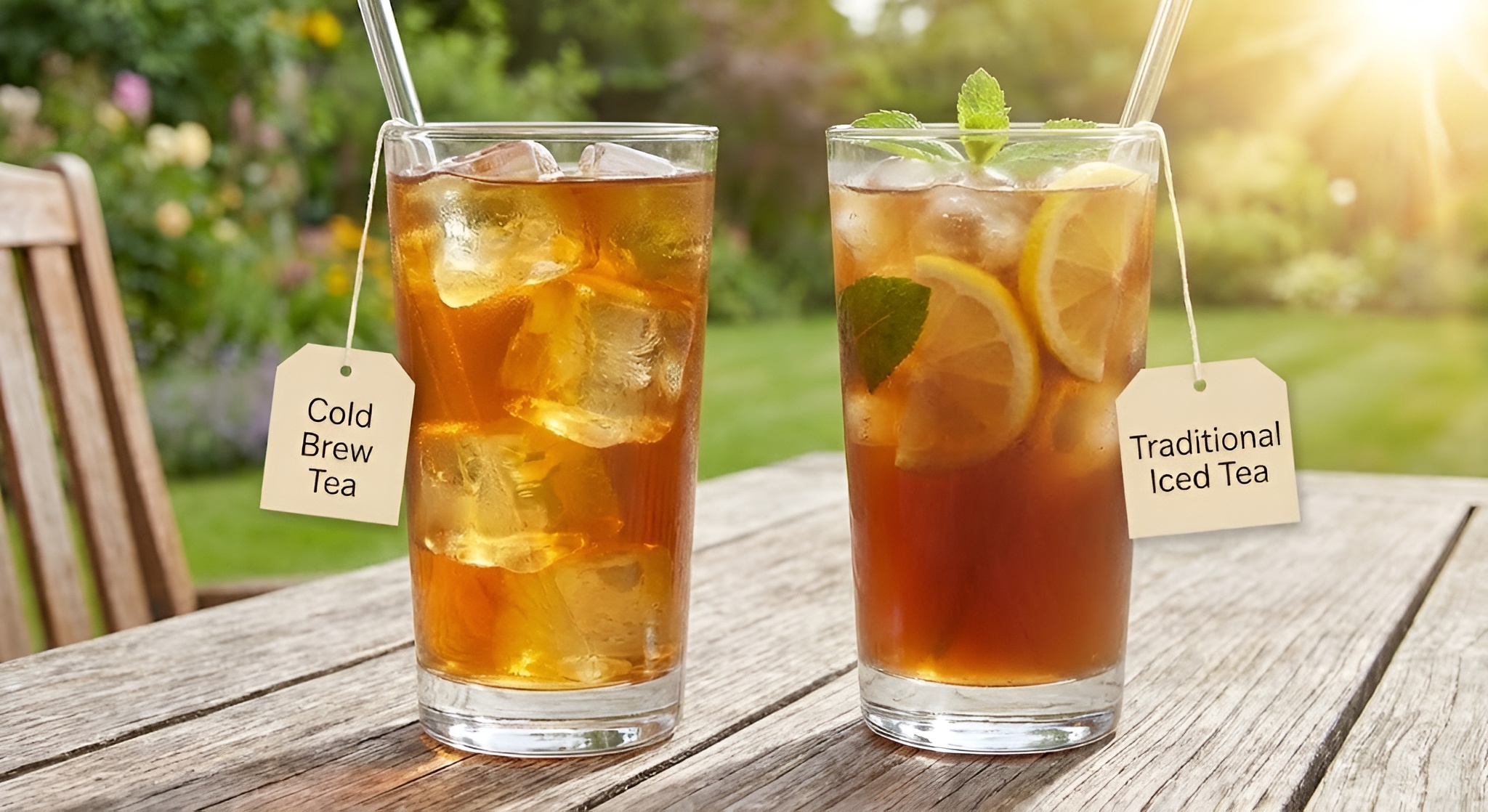
1. Defining the Two Methods: What Actually Counts as Iced Tea and Cold Brew Tea
Iced tea is any tea brewed hot (typically 70–100°C depending on type) and then cooled, either by pouring over ice or refrigerating. The method is fast—steeping takes 2–5 minutes, and if you pour directly over ice you can drink immediately. The trade-off is control: hot water is an aggressive solvent, extracting polyphenols, caffeine, amino acids, and volatile aromatics at speed. If your timing or temperature is off, you'll pull astringent tannins and bitterness that chilling can't mask. Many commercial iced teas are brewed double-strength to account for ice dilution, which compounds the risk of over-extraction.
Cold brew tea steeps loose leaf or bags in room-temperature or refrigerated water for 6–12 hours (sometimes longer). No heat is applied at any stage. The slow, gentle extraction favours sugars, L-theanine, and volatile esters while leaving behind catechins and tannins that require heat to dissolve efficiently. The result is a naturally sweet, smooth liquor with minimal astringency. Cold brew is passive—you set it and forget it—but it demands patience and fridge space. The chemical selectivity of cold water is the method's defining feature, not just a happy accident.
A third category, flash-chilled or Japanese-style iced tea, brews hot directly onto ice in a controlled ratio, locking in aromatics while preventing bitterness. We'll touch on it where relevant, but this guide focuses on the two dominant methods UK consumers encounter: traditional iced (brew, then cool) and full cold brew.
The Dilution Question
If you're pouring hot tea over ice, brew at 1.5–2× your usual leaf ratio to offset meltwater dilution. Cold brew needs no compensation—it's already designed to drink as-is.
2. A Brief History: Where Each Method Comes From
Iced tea as we know it emerged in the United States in the early 20th century, though the idea of chilling hot tea appears in British colonial records from India and in 19th-century American cookbooks. The 1904 St. Louis World's Fair is often (apocryphally) credited with popularising it, but iced tea was already a Southern U.S. staple by then, sweetened and served at room temperature or cooler. In the UK, iced tea remained a niche café curiosity until the 1990s, when bottled brands—often cloyingly sweet—began appearing on supermarket shelves. Today, British iced tea culture is bifurcating: mass-market RTD (ready-to-drink) products dominate volume, while speciality cafés and home brewers have rediscovered the method's potential with quality loose leaf.
Cold brew tea has murkier origins. Cold-water steeping of tea appears in historical Japanese and Chinese practices, though it was never formalised into a named method. The modern cold brew movement—technique, terminology, and dedicated equipment—piggybacked on speciality coffee's cold brew boom in the 2010s. By the mid-2010s, UK tea retailers and cafés began marketing cold brew kits and ready-made bottles, positioning the method as gentler, healthier, and more Instagram-friendly than traditional iced tea. The science behind cold extraction was already well understood in food chemistry, but consumer awareness only took off in the last decade.
3. The Chemistry and Flavour Science: Why They Taste So Different
Temperature is the decisive variable. Hot water (above 60°C) rapidly dissolves caffeine, catechins (the astringent polyphenols responsible for tea's 'briskness'), amino acids like L-theanine, and volatile aromatics. This creates a full-bodied, complex cup with pronounced top notes—floral, grassy, malty, or fruity depending on the tea. But catechins, especially epigallocatechin gallate (EGCG), also contribute bitterness and a drying, puckering mouthfeel. Over-steep by even a minute and these compounds dominate, turning your iced tea harsh and unbalanced.
Cold water (4–20°C) works on a different timescale. Caffeine and L-theanine dissolve slowly but steadily over hours. Sugars and some volatile esters extract well, giving cold brew its characteristic sweetness and delicate aroma. Crucially, many catechins remain largely locked in the leaf—their solubility at low temperature is poor—so astringency and bitterness stay low even after 12+ hours. The trade-off is body and brightness: without heat to coax out the full range of phenolic compounds and oils, cold brew can taste lighter and less aromatic, especially with robust teas that shine when brewed hot.
Oxidation and pH also shift. Hot brewing accelerates oxidation of polyphenols during the steeping window, which can dull bright greens but deepens blacks. Cold brew, being slower and cooler, maintains more of the leaf's original character—greens stay vivid, whites remain ethereal—but lacks the caramelised, rounded notes that heat develops in darker teas. Neither profile is superior; they're complementary tools.
Matching Method to Tea Type
Delicate teas (white, green, oolong, jasmine) thrive in cold brew—heat often scalds them. Robust blacks, pu-erh, and strong breakfast blends benefit from hot brewing and icing to unlock their full punch.
4. Caffeine Content: Which Method Delivers More (and Why It's Complicated)
Caffeine is more soluble in hot water than cold, so iced tea (brewed hot) generally contains 10–30% more caffeine per serving than cold brew tea, all else being equal. A typical 200 ml cup of hot-brewed black tea contains 40–70 mg caffeine (depending on leaf type, steep time, and ratio); chill it over ice and that figure holds (dilution reduces concentration per ml, but total caffeine remains the same). Cold brew black tea steeped for 8 hours at room temperature might yield 30–50 mg per 200 ml—lower, but not dramatically so, because the long contact time compensates for reduced solubility.
The picture muddies with variables: leaf size (broken grades release caffeine faster), water temperature during cold brew (room temp vs. fridge—warmer extracts more), and steep duration. A 12-hour cold brew can approach the caffeine level of a 3-minute hot brew, especially if you use a generous leaf ratio. For UK consumers seeking a gentler lift, cold brew offers a reliable way to moderate caffeine without sacrificing volume, but it's not a guarantee of a low-caffeine drink unless you shorten the steep or choose naturally low-caffeine teas (white, some greens).
Importantly, L-theanine—the amino acid associated with calm focus—extracts well in both methods, so the caffeine-to-theanine ratio remains fairly stable. The subjective 'buzz' may differ slightly (some drinkers report cold brew feels smoother), but this is likely due to lower astringency rather than a meaningful neurochemical difference.
5. Taste Test: Flavour Profiles, Texture, and When Each Method Wins
Darjeeling first flush (iced, hot-brewed): Bright, floral, with pronounced muscatel notes and a crisp, slightly astringent finish. The chill accentuated its elegance. Cold brew: Sweeter, gentler, almost honey-like, but the signature brightness was muted—lovely, but no longer recognisably Darjeeling to some tasters. Verdict: Iced won for those who prize terroir and complexity; cold brew for easy-drinking sweetness.
Assam TGFOP (iced): Bold, malty, full-bodied—everything you want from Assam, intensified by the temperature contrast. A tiny edge of bitterness, correctable with a 30-second shorter steep. Cold brew: Thin, oddly flat, with malt present but lacking punch. The robust character that defines Assam needs heat. Verdict: Iced, decisively.
Chinese Sencha (iced): Grassy, brisk, vibrant—but a whisker over-steeped would turn it harsh. Cold brew: Smooth, subtly sweet, with delicate umami and zero astringency. Tasters split, but most preferred the cold brew's forgiving sweetness. Verdict: Cold brew by a nose, especially for novices.
Bai Mu Dan (iced): Floral and clean, but hot water—even at 75°C—risked washing out its nuance. Cold brew: Ethereal, honeyed, with lingering white-floral notes. A clear showcase for the method. Verdict: Cold brew, emphatically.
Taiwanese oolong (iced): Complex, creamy, with orchid and stone-fruit notes that heat coaxed out beautifully. Cold brew: Pleasant but one-dimensional, missing the roasted, layered character. Verdict: Iced, though flash-chilled would be even better.
Earl Grey (iced): Bergamot oil sang against the black tea base; chilling sharpened the citrus. Cold brew: Bergamot was muted, almost soapy, and the base tea too light to support it. Verdict: Iced, no contest.
The Sweetness Advantage
If you habitually add sugar to iced tea, try cold brew first—its natural sweetness often eliminates the need, saving calories and letting the tea's own character shine.
6. Practical Brewing: Time, Equipment, and Convenience Compared
Iced tea is the faster route: heat water (1–2 minutes in a kettle), steep 2–5 minutes, pour over ice or refrigerate. Total active time under 10 minutes, drinkable immediately if using the ice method. You need a kettle, teapot or infuser, and either ice or fridge space. The main pitfall is timing—miss your steep window and you've wasted leaf and time. For UK households already equipped for hot tea, iced is essentially free and requires no new habits beyond remembering to boil extra water.
Cold brew tea demands patience but almost no skill. Combine leaf and cold water in a jug, jar, or dedicated cold brew pitcher, refrigerate or leave at room temperature for 6–12 hours, strain, and drink. Active time is under 2 minutes; passive time is the trade-off. You can't over-steep in the traditional sense (no bitterness spike), which makes it forgiving for beginners. The downside is planning—you must think a day ahead, and fridge space in a UK summer can be precious. Purpose-built cold brew bottles (with built-in filters) streamline the process, but a jam jar and sieve work fine.
Time and temperature interact: room-temperature cold brew (18–20°C) extracts faster and yields more body than fridge cold brew (4°C), but spoilage risk increases beyond 12 hours in warm weather. Most UK users refrigerate from the start and steep 8–12 hours. For both methods, water quality is critical—cold brew especially magnifies chlorine, limescale, and mineral off-flavours because there's no heat to drive them off. Filter your water if it's hard or chemically treated.
7. Cost, Shelf Life, and Batch Brewing for UK Households
Leaf cost per litre is nearly identical: both methods use roughly the same ratio (8–12 g per litre for most teas, adjusted to taste). Cold brew's longer contact time doesn't mean you use less leaf—it means you extract different compounds. If anything, some cold brewers use more leaf to compensate for the lighter body, which can tip the per-litre cost slightly higher. In practice, the difference is negligible unless you're brewing industrially.
Shelf life favours cold brew. Because it never heats, enzymatic activity and oxidation proceed slowly; a well-sealed jug of cold brew will hold in the fridge for 3–4 days with minimal flavour degradation (some delicate greens and whites fade faster). Iced tea brewed hot and then chilled starts to oxidise and develop stale, metallic notes within 24–36 hours, though robust blacks last longer. Both are safe to drink for up to a week if refrigerated, but quality drops. For batch brewing ahead of a gathering, cold brew's stability is a clear win.
Equipment costs are low for both. A £3 jug and £2 sieve handle cold brew; a £15–30 purpose-built cold brew pitcher with filter adds convenience but isn't essential. Iced tea needs only what you already own. Running costs (energy, water) are trivial either way—cold brew uses no power, iced tea a few pence of kettle electricity per litre.
Batch Ahead for Summer Gatherings
Cold brew a double batch (2–3 litres) the night before a garden party—it stays fresh, won't turn bitter, and you can decant into jugs or bottles without fuss.
8. Which Teas Work Best for Each Method: A UK Buyer's Guide
Best for cold brew: White teas (Silver Needle, Bai Mu Dan), Japanese greens (Sencha, Gyokuro), high-mountain oolongs, jasmine pearls, chamomile, and fruit/floral tisanes. These teas are either heat-sensitive (greens, whites), naturally sweet (oolong, jasmine), or benefit from the gentle, extended extraction that highlights their aromatic esters without bitterness. UK stockists like Jing Tea, Postcard Teas, and What Cha offer excellent cold-brew-friendly selections; look for whole-leaf, minimally processed grades.
Best for iced (hot-brewed, chilled): Assam, Ceylon, Keemun, strong Yunnan blacks, robust Sencha or Gunpowder green, chai blends, Earl Grey, English Breakfast, and any tea where you want bold, punchy flavour. These teas have the body and tannin structure to stand up to ice dilution and chilling, and their best qualities emerge under heat. Supermarket own-brand loose blacks (Tesco Finest, Waitrose, M&S) are surprisingly good for iced tea and cost-effective for high-volume summer drinking.
Avoid cold brewing: Very robust, high-tannin blacks (cheap CTC Assam) and heavily roasted oolongs can turn muddy or flat without heat to balance them. Avoid hot-brewing for iced: Delicate whites and first-flush Darjeelings risk losing their nuance if over-chilled, though careful technique can work. Experiment to find your preference—taste is subjective, and some drinkers love cold-brewed Earl Grey.
For both methods, whole-leaf or large-grade teas outperform dust and fannings. Broken grades over-extract in hot water (turning iced tea bitter) and clog cold brew filters. Invest in a £10–15 sample set from a UK speciality retailer and trial both methods side by side; you'll quickly learn which teas suit your palate and summer routine.
The Hybrid Approach
Can't decide? Keep cold brew whites and greens in the fridge for everyday sipping, and hot-brew robust blacks on demand when you want immediate, full-flavoured refreshment. You'll cover all moods and timescales.



Comments