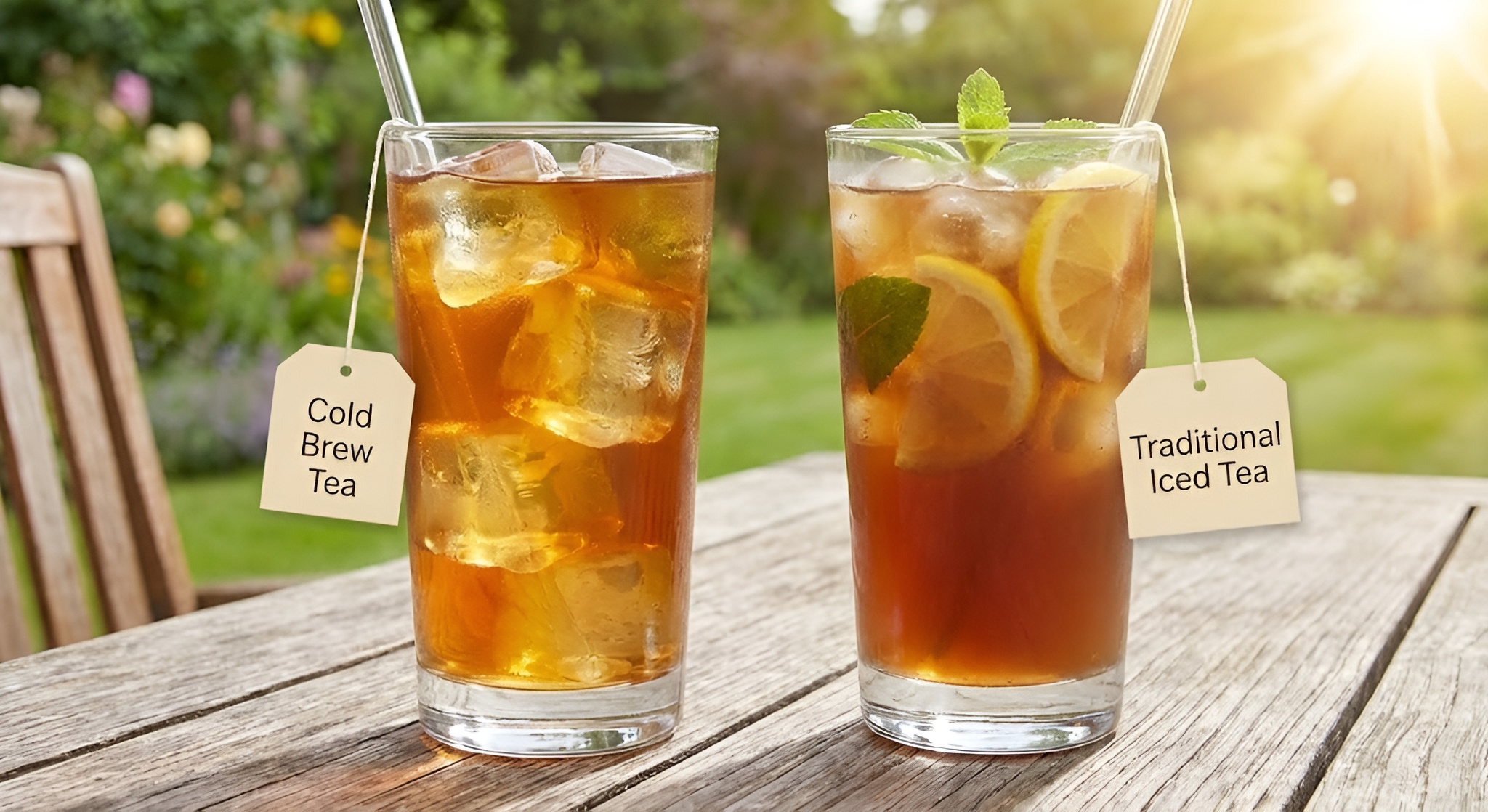
1. What Ready-to-Drink Iced Tea Actually Is
Ready-to-drink (RTD) iced tea is any commercially prepared, shelf-stable or chilled tea beverage sold in single-serve or multi-serve bottles, cans or cartons, sweetened or unsweetened, and ready to consume without brewing. In the UK market, this category spans three broad manufacturing approaches: brewed tea from whole or cut leaf, steeped, filtered and bottled (the method closest to home brewing); tea extract or concentrate, a dehydrated or liquid tea essence reconstituted with water and flavourings; and tea-flavoured soft drinks, where a small quantity of tea extract provides the legal 'tea' claim but the drink is primarily fruit juice, flavourings and sweetener. Each approach produces a different sensory profile, ingredient list and price point.
Brewed-leaf iced teas typically list 'water, tea (black tea / green tea / white tea)' at the top of the ingredient panel, sometimes specifying origin—Assam, Ceylon, Fujian—or leaf grade. The tea is steeped hot or cold, filtered to remove solids, then blended with sweetener, acid (citric, ascorbic) and natural flavours before pasteurisation or high-pressure processing and bottling. Extract-based drinks use tea extract or tea powder, concentrated forms made by brewing large batches, removing water under vacuum, and spray-drying or freeze-drying the solids. Reconstituted extract can taste flat or astringent compared to fresh-brewed leaf, so manufacturers add more flavouring—lemon oil, peach essence, bergamot—to build complexity. Tea-flavoured soft drinks may contain as little as 0.1–0.5 % tea extract by volume, enough to label the product 'iced tea' but functionally a sweetened fruit drink. Understanding which type you're holding tells you whether you're paying for tea or for packaging and branding.
In UK retail, brewed-leaf RTD iced teas cluster in the premium chiller section (£2–3 per 330–500 ml bottle), extract-based midrange bottles sit on ambient shelves or multipacks (£1–1.50), and tea-flavoured soft drinks overlap with lemonade and cola in promotional two-litre formats (under £1.50). The legal definition under UK and EU food-labelling law requires only that the product contain tea and be presented as iced tea; there is no minimum tea content, no ban on artificial sweeteners, and no obligation to brew from leaf. If you want the closest bottled equivalent to home-brewed iced tea, look for 'brewed tea' or 'infused tea' on the front label and check the ingredient order.
2. Real-Leaf Brewing vs Extract and Concentrate
Brewed-leaf RTD iced tea starts with bulk steeping: whole or cut tea leaves are placed in large stainless-steel vessels with temperature-controlled water (70–95 °C depending on tea type), steeped for 3–10 minutes, then filtered through mesh or bag systems to remove particulate. The resulting liquor is cooled rapidly—often flash-chilled to prevent oxidation—and blended with sweetener, preservatives (potassium sorbate, sodium benzoate) and, if flavoured, natural fruit or botanical extracts. The liquid is pasteurised (typically 72 °C for 15 seconds) or treated by high-pressure processing (HPP), which uses 600 MPa pressure to inactivate microbes without heat, preserving volatile aromatics. Brewed-leaf methods retain more of the tea's original polyphenol profile, nuanced astringency and layered flavour, but they require more raw material, longer processing time and tighter cold-chain logistics, all of which raise cost.
Tea extract and concentrate are industrially efficient alternatives. Extract production brews tea at high leaf-to-water ratios, filters the liquor, then removes 90–95 % of the water by vacuum evaporation or reverse osmosis, yielding a syrup or, after spray-drying, a powder. These concentrates are shelf-stable, compact to ship and easy to dose: manufacturers reconstitute them with water, carbonation or juice, add flavourings and sweeteners, and bottle. The trade-off is flavour loss. Vacuum evaporation strips volatile esters and aldehydes—compounds that give fresh tea its floral, grassy or malty top notes—and spray-drying can denature polyphenols, increasing astringency and flatness. To compensate, formulators layer in 'natural flavours': isolated linalool (floral), citral (lemon), ethyl butyrate (peach), or vanillin (sweet), which create a rounded taste but one that diverges from steeped leaf. If you compare a brewed-leaf bottle side by side with an extract version of the same tea type, the brewed version will taste more complex, less one-dimensional and closer to a mug you'd steep yourself.
Instant tea powder is the most processed form: freeze-dried or spray-dried extract milled to a fine powder, reconstituted on demand. It appears in budget multipacks and vending-machine formats. Powdered iced tea often includes maltodextrin, anti-caking agents (silicon dioxide) and synthetic vitamins, and the tea character is minimal—think of the difference between instant coffee and filter. If you want genuine tea flavour, avoid ingredients lists that lead with 'tea powder' or 'instant tea extract'; if convenience and cost matter more than nuance, powder-based drinks are hydrating, shelf-stable and very cheap per litre. For more control and fresher taste, consider bottled iced-tea concentrates you dilute yourself, or cold-brew your own and refrigerate.
Spot Real Brewing in Three Seconds
Turn the bottle and read the first three ingredients: if it says 'water, tea, sugar' or 'brewed tea (water, black tea), cane sugar', it's leaf-brewed. If it says 'water, sugar, tea extract, natural flavours', it's reconstituted concentrate. The higher 'tea' appears, the more actual leaf went into the bottle.
3. Sugar, Sweeteners and the UK Soft Drinks Industry Levy
The UK Soft Drinks Industry Levy, effective from April 2018, charges manufacturers 18 p per litre for drinks with 5–8 g total sugar per 100 ml and 24 p per litre for ≥8 g/100 ml. Drinks with <5 g/100 ml are exempt, as are milk-based drinks, meal-replacement formulas and pure fruit juices (though juice added to iced tea does count toward the threshold). The levy reshaped the RTD iced-tea market: by 2020, most major brands had reformulated to sit at or below 4.9 g sugar per 100 ml, replacing cane sugar with non-nutritive sweeteners—stevia (steviol glycosides), erythritol (a sugar alcohol), sucralose or aspartame—often blended with small amounts of cane sugar or fruit juice to mask aftertaste. The result is a proliferation of 'low-sugar' and 'zero-sugar' iced teas that are legally levy-free but may taste noticeably different from pre-2018 versions.
Stevia is the most common reformulation sweetener in premium RTD iced teas. Extracted from Stevia rebaudiana leaves and purified to remove bitter glycosides, stevia (specifically rebaudioside A) is 200–300 times sweeter than sucrose, calorie-free, and does not spike blood glucose. Its drawbacks are a liquorice-like aftertaste and slight metallic edge, which manufacturers mask by blending stevia with erythritol (a sugar alcohol that adds bulk and mouthfeel without calories) or a small amount of cane sugar (keeping total sugar below 5 g/100 ml). Erythritol contributes ~0.2 kcal/g, is 60–70 % as sweet as sucrose, and in some people causes mild laxative effects above ~10 g per serving. Sucralose (600 times sweeter than sugar) and aspartame (200 times sweeter) are synthetic high-intensity sweeteners still used in budget iced teas; both are stable in acidic drinks, but aspartame degrades above 30 °C and loses sweetness over shelf life, which is why some ambient bottles taste less sweet near their best-before date.
If you prefer full-sugar iced tea, you can still find it—look for glass-bottled imports, craft brands in farm shops, or multipacks labelled 'original' that accept the levy cost and pass it to the consumer (typically 20–30 p more per litre). A traditionally sweetened iced tea will list 'sugar' or 'cane sugar' high in the ingredients and deliver 8–12 g per 100 ml, yielding 20–30 g in a 250 ml serving (roughly five teaspoons). If you want tea flavour without sweetness, several brands now offer unsweetened or barely sweetened (1–2 g/100 ml) chilled green or black teas; these taste most like home-brewed cold-brew tea and pair well with food rather than standing as a soft-drink substitute. Check the nutrition panel: 'Carbohydrates of which sugars' tells you total sugar per 100 ml, and you can multiply by the bottle volume to find the per-serve load.
The 4.9 g Sweet Spot
Many UK iced teas cluster at exactly 4.8–4.9 g sugar per 100 ml—just below the levy threshold. If you see that number, the recipe was designed around the tax, not around taste. It's not bad, but it's policy-driven, and you'll often notice stevia or erythritol lower in the ingredient list.
4. Natural Flavours, Additives and Ingredient Transparency
'Natural flavours' or 'natural flavouring' on a UK iced-tea label means flavour compounds isolated from plant, fruit, spice or fermentation sources—not synthesised from petrochemicals—but processed to concentrate specific molecules. For example, natural peach flavour might contain gamma-decalactone and linalool extracted from peach skins, diluted in propylene glycol or ethanol, while natural lemon flavour is typically citral and limonene from lemon peel oil. These are natural in the regulatory sense (derived from biological sources) but highly refined, single-note and very different from steeping tea with fresh peach slices. The term is broad and opaque: under UK and EU law, manufacturers need not disclose which plants the flavours came from or how many are blended, only that they meet the 'natural' definition. In practice, natural flavours let brands create consistent peach, mango, raspberry or elderflower iced teas year-round without seasonal fruit, but they can also mask thin or over-extracted tea bases.
Common additives in RTD iced tea include citric acid (adjusts pH to ~3.5, brightens flavour, acts as preservative), ascorbic acid (vitamin C; antioxidant that prevents browning and off-flavours from polyphenol oxidation), sodium benzoate and potassium sorbate (preservatives effective below pH 4.5, preventing yeast and mould in chilled drinks), and natural colour (caramel, beetroot, anthocyanins from fruit or flowers). All are approved by the UK Food Standards Agency and considered safe at typical use levels (0.01–0.1 % by weight), but if you prefer minimal processing, look for short ingredient lists: water, tea, sugar or honey, lemon juice, and perhaps ascorbic acid. Organic-certified iced teas cannot use synthetic preservatives, so they rely on lower pH (more citric acid or juice), pasteurisation and refrigeration, which shortens shelf life to 30–60 days versus six months for preserved ambient bottles.
Transparency varies. Premium glass-bottled brands often specify tea origin (Darjeeling, Assam, Kenyan), harvest season (first flush, autumn), and organic or Rainforest Alliance certification, and they may list brewing method ('cold-brewed 8 hours') on the back label. Budget multipacks rarely go beyond 'black tea' or 'green tea' and lead with flavourings. If ingredient honesty matters to you—perhaps you want to know if the peach iced tea contains any actual peach, or whether the 'lemon' is all citral—email the brand's customer service or check their website for full formulation notes. Many craft producers publish brew sheets. If they don't, assume natural flavours are doing most of the work. For a fuller picture of how peach iced-tea products are formulated, see our dedicated review.
5. Caffeine Content, Hydration and Health Claims
Caffeine in RTD iced tea comes from the tea itself—naturally occurring methylxanthine alkaloids in the leaf—and varies by tea type, steep time, and dilution ratio. A typical 250 ml serving of black-tea-based iced tea contains 15–40 mg caffeine (roughly a quarter to half that of a mug of builder's tea), green tea 10–30 mg, white tea 5–15 mg, and herbal or rooibos blends zero (they are not Camellia sinensis). Some brands add caffeine extract from coffee beans or guarana to market 'energy iced tea' at 60–80 mg per serving, competing with soft-drink cola (~35 mg per 330 ml) and energy drinks (80–160 mg). UK law requires caffeine content declaration if the drink contains >150 mg/litre (~37.5 mg per 250 ml serving), so check the nutrition or ingredients panel. If you want a caffeinated lift, choose black or green tea bases and look for the declaration; if you want to avoid caffeine in the afternoon, pick white tea, rooibos or fruit-infusion iced teas.
Hydration is frequently cited in iced-tea marketing ('refreshing hydration,' 'better than water'), and while any fluid contributes to daily intake, the presence of sugar, caffeine or diuretics complicates the picture. Moderate caffeine (under 50 mg per serve) has negligible diuretic effect in habitual tea drinkers; the water in the drink more than compensates for any fluid loss. High-sugar iced teas (≥8 g/100 ml) can slow gastric emptying and, in large volumes on a hot day, may feel less thirst-quenching than water or low-sugar alternatives. Unsweetened or lightly sweetened (1–2 g/100 ml) iced teas hydrate as effectively as plain water and deliver polyphenols—antioxidants that may support vascular health—though evidence for meaningful benefit from ready-to-drink formats is limited and dose-dependent. Don't choose iced tea instead of water if you're dehydrated after exercise or in heat; use it as a flavoured option within your total fluid intake.
Health claims on UK iced-tea packaging must comply with EU Nutrition and Health Claims Regulation (retained UK law post-Brexit). Permitted claims include 'source of antioxidants' (if the drink provides ≥15 % of vitamin C or polyphenol reference intake per 100 ml) and 'no added sugar' (if no monosaccharides or disaccharides were added, though sweeteners are allowed). Claims such as 'boosts metabolism,' 'detoxifies,' 'burns fat' or 'supports immune function' are not authorised for tea and should be treated as marketing puff unless backed by a specific approved wording. Kombucha-hybrid iced teas may carry 'contains live cultures,' which is descriptive, not a health claim; whether those cultures survive pasteurisation and confer probiotic benefit is another question (most RTD kombuchas are flash-pasteurised post-fermentation, killing the majority of live organisms). Read claims critically, and if they sound too good, ignore them and assess the drink on tea quality, sugar content and price.
Caffeine: Look for the Lightning Bolt
UK bottles with >150 mg caffeine per litre must carry a warning label—often a lightning-bolt icon and 'High caffeine content' text. If you want energy, that's your cue; if you don't see it, expect modest or negligible caffeine from the tea alone.
6. Glass vs PET Packaging: Does It Change the Tea?
Glass bottles are traditional, inert, infinitely recyclable and completely impermeable to oxygen and light (if tinted brown or green). They protect tea flavour better than plastic over shelf life: iced tea contains phenolic compounds and volatile esters that can oxidise when exposed to UV or react with polymer surfaces, leading to stale, cardboard or metallic off-notes after a few months. Brown glass filters out most UV-A and UV-B; clear glass offers no protection, which is why you rarely see premium iced tea in clear glass. The downsides of glass are weight (a 330 ml bottle weighs ~200 g empty vs ~20 g for PET), fragility, and transport carbon; heavier lorries mean higher emissions per litre delivered. Glass also costs more to produce and collect for recycling, so glass-bottled iced teas typically retail at £2–3 vs £1–1.50 for equivalent PET.
PET (polyethylene terephthalate) plastic is light, shatterproof, cheap and widely recycled in UK kerbside schemes, though actual recycling rates hover around 45 % and PET can only be downcycled a few times before quality degrades. Clear PET lets in UV, which accelerates polyphenol oxidation and vitamin C breakdown; this is why many brands use amber or green PET (light-barrier plastic that mimics tinted glass) or label wraps that cover the bottle, reducing light exposure. Oxygen permeability is the bigger issue: over six to twelve months, oxygen molecules slowly diffuse through PET walls, oxidising catechins and theaflavins and flattening flavour. High-barrier PET adds a thin layer of ethylene vinyl alcohol (EVOH) or silicon oxide to slow oxygen ingress, but it is more expensive and less recyclable. If you buy PET-bottled iced tea, check the best-before date—drink it within three to six months of bottling for best flavour, and store it in a cool, dark cupboard (not a sunny windowsill).
Aluminium cans are increasingly popular for premium RTD iced tea (especially nitro-infused or sparkling styles) because they are light, fully opaque, impermeable to oxygen and light, and recycled efficiently in the UK (closed-loop aluminium recycling has ~75 % participation). The interior is lined with a thin food-safe epoxy or polymer to prevent metal contact with acidic tea, and the format suits on-the-go, single-serve consumption. Cans chill faster than glass and are less likely to shatter in a gym bag or festival rucksack. If you value sustainability and flavour protection equally, cans and tinted glass are both good choices; if you want the lowest per-litre price and don't mind drinking within a few months, PET multipacks are fine. For more on premium canned iced teas, see our dedicated review.
Best-Before Dates Matter More in Plastic
Glass and cans stay stable for 12–18 months; PET-bottled iced tea tastes noticeably flatter after six months, especially in clear bottles. If you're buying multipacks, check the date code on the cap or label and pick the freshest batch on the shelf.
7. What to Look for in Organic, Fairtrade and Craft Iced Teas
Organic certification (UK / EU Soil Association, USDA Organic) guarantees the tea was grown without synthetic pesticides, herbicides or fertilisers, and that processing used only approved additives (no synthetic preservatives, colours or flavours). Organic RTD iced teas typically use cane sugar or honey (both allowed), natural fruit juice, citric acid (permitted) and ascorbic acid, and they must be pasteurised or HPP-treated to achieve shelf life without sodium benzoate or potassium sorbate. The sensory result can be 'cleaner'—fewer off-notes, simpler ingredient list—but also more perishable (shorter best-before, refrigeration required) and more expensive (organic tea leaf costs 20–50 % more than conventional). If pesticide residues or environmental impact concern you, organic is a meaningful choice; if you prioritise cost and convenience, conventional RTD iced tea from reputable brands is safe and well-regulated.
Fairtrade certification ensures tea smallholders received a guaranteed minimum price plus a social premium for community projects—schools, clinics, infrastructure. It does not directly affect flavour or farming method (Fairtrade tea can be conventional or organic), but it signals ethical sourcing. Many premium UK iced-tea brands combine Fairtrade with Rainforest Alliance or direct-trade relationships, and they highlight origin transparency: 'Kenyan black tea from Kericho,' 'Assam CTC from smallholder co-ops.' If supply-chain ethics matter, look for certification logos on the label and check brand websites for sourcing stories. Be aware that craft iced-tea producers who buy direct from estates may not carry Fairtrade logos (the certification costs money and requires audits) but may offer more traceability and higher farmgate prices than certified mass-market brands; judge case by case.
Craft and micro-batch iced teas are made by small producers—often speciality tea roasters or café chains—who cold-brew loose-leaf tea, lightly sweeten with honey or agave, bottle in glass, and distribute locally via independent shops, farmers' markets and box schemes. These products usually lack the preservatives and shelf life of commercial RTD iced teas (best-before 30–60 days, keep chilled) and cost £3–4 per 330–500 ml, but they offer the closest bottled experience to home brewing: nuanced flavour, recognisable tea character, minimal additives. If you want to support local producers and enjoy fresh, high-tea-content drinks, seek out craft brands at farm shops, speciality grocers or direct from roaster websites. For broader availability and longer shelf life, stick to established premium RTD brands that bridge the gap between craft and commodity. If you prefer full control and fresh brewing, explore cold-brew pitchers and make your own.
8. A Practical Shopping Checklist for UK Buyers in 2026
Step one: read the ingredient list. Look for 'tea' (black tea, green tea, white tea, oolong) in the first three ingredients, ideally before 'natural flavours.' If the list starts 'water, sugar, citric acid, natural flavours, tea extract,' you're buying a tea-flavoured soft drink, not a tea drink. Brewed-leaf iced teas will say 'brewed tea (water, black tea)' or similar near the top. Check for origin or certification (Darjeeling, Assam, organic, Fairtrade) if transparency matters to you.
Step two: check the sugar and sweetener. Look at 'Carbohydrates of which sugars' per 100 ml. Below 5 g/100 ml usually means stevia, erythritol or sucralose are present—scan the ingredients for these. If it says 'sugar' or 'cane sugar' and lists 8–12 g/100 ml, you're holding a full-sugar drink that pays the levy. If you want zero sugar, look for 'no added sugar' (natural fruit-juice sweetness only) or 'zero sugar' (high-intensity sweeteners). Taste preference is personal; try a few formulations to find which sweetener profile you prefer. For kids, check total sugar per serve (multiply by bottle volume) to stay within recommended daily limits (19 g for 4–6 year-olds, 24 g for 7–10, 30 g for 11+).
Step three: check caffeine and serving size. If you want energy or need to avoid caffeine, look for caffeine content on the label (required if >150 mg/litre) or infer from tea type: black or green = moderate, white = low, herbal = none. Note the bottle size—many single-serve bottles are 330–500 ml, delivering 1.3–2 servings' worth of sugar and caffeine in one go. If you're watching intake, choose smaller formats (250 ml) or pour half and refrigerate the rest.
Step four: assess packaging and shelf life. Glass or tinted PET (amber, green) protects flavour longer than clear plastic. Check the best-before date: if it's more than nine months away on a PET bottle, flavour may already have faded—pick a fresher batch if possible. Cans are ideal for portability and flavour stability. If you're buying multipacks for home, PET is fine if you'll drink them within a few weeks; for slower consumption or gifting, glass or cans are better.
Step five: decide on price and occasion. Budget multipacks (under £1 per 500 ml) suit everyday hydration, packed lunches and parties; expect extract base, high sweetener content and basic flavours. Premium chilled single-serves (£2–3) offer brewed leaf, organic ingredients and nuanced taste—treat them as a café-replacement drink or a summer refreshment for festivals or picnics. If cost per litre matters most, buy iced-tea concentrate (£4–6 per bottle yielding 2–3 litres) or brew your own and refrigerate in a jug or infuser bottle. The most economical and controllable option is always home brewing, but RTD bottles win on convenience and grab-and-go portability.
Try Before You Bulk-Buy
Sweetener tolerance is highly individual: one person's 'refreshing stevia iced tea' is another's 'metallic aftertaste nightmare.' Buy single bottles of two or three brands before committing to a multipack or subscription, and taste side by side at fridge temperature to find your favourite.



Comments