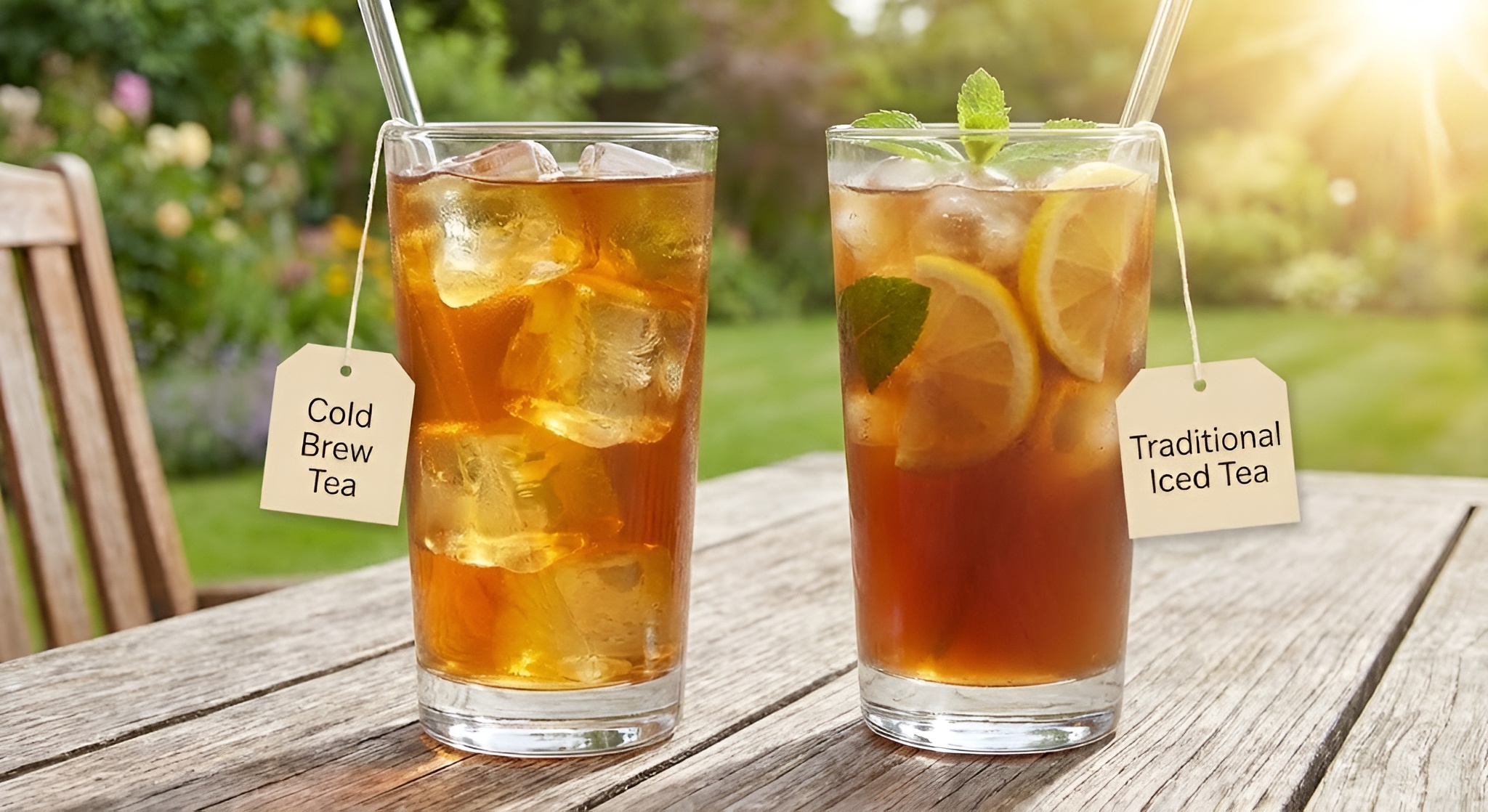
1. What Is Iced Tea Concentrate and Why Brew in Batches?
Iced tea concentrate is tea brewed at a leaf-to-water ratio two to four times stronger than a standard cup, designed to be diluted—either by ice melt in the glass or by adding cold water in a serving jug—back to drinking strength. The technique originated in the early twentieth century alongside commercial bottling and soda-fountain service, when operators needed shelf-stable, portioned syrups that could be reconstituted quickly during rush periods. Today it remains the workhorse method for any scenario where you need to serve iced tea to more than a handful of people without monopolising hob space, fridge shelves, or preparation time.
Batch concentrate brewing offers three decisive advantages over pot-by-pot service. First, space efficiency: 2 litres of 4× concentrate occupies one large jug yet yields 8 litres of finished tea, freeing refrigerator real estate for ice, garnishes, or other drinks. Second, consistency: a single large brew guarantees uniform flavour and strength across every glass, eliminating the risk of over- or under-steeped pots when you're juggling multiple tasks. Third, flexibility: you can sweeten, flavour, or carbonate the diluted tea in smaller batches to suit different guest preferences—mint and lemon for one table, elderflower for another—without wasting a full brew. For outdoor weddings, village fetes, or festival catering, where service speed and volume matter, concentrate is the only practical route.
The method does impose two non-negotiable disciplines: precision in ratios (guesswork produces either dishwater or tannin bombs) and strict adherence to food-safety cooling timelines, because large volumes of warm, leaf-infused liquid sit squarely in the bacterial danger zone if left at room temperature. Master those two pillars and batch concentrate brewing becomes faster, cheaper, and more reliable than any other iced-tea service model.
The 2× / 3× / 4× Rule
Use 2× concentrate when dilution comes from ice in the glass; 3× or 4× when you're adding cold water in bulk jugs or kegs. Higher ratios save fridge space but demand more careful leaf selection to avoid astringency.
2. Choosing Teas That Hold Flavour at High Strength
Not every tea tolerates concentrate brewing. Delicate varietals—white tea, Japanese sencha, Darjeeling First Flush—rely on subtle aromatics that turn grassy, metallic, or flat when steeped at double or triple strength, and their low tannin content offers little body to survive dilution. Ceylon black tea is the category gold standard: its bright, malty profile and moderate astringency deliver clean, refreshing iced tea even at 4× concentration, and it stays clear and stable for 48 hours under refrigeration. Assam and Darjeeling second-flush also perform well, though Assam's heavier malt can dominate lighter accompaniments and Darjeeling's muscatel sweetness is best reserved for smaller, premium batches.
Lightly oxidised oolongs—particularly Taiwanese high-mountain or Fujian Tieguanyin—offer floral complexity without the tannic bite of full blacks, making them excellent for concentrate if you're willing to pay the higher leaf cost (typically £18–35 per 100 g versus £6–12 for Ceylon). They also tolerate cold cold-brew concentrate methods, which sidestep astringency altogether but require 12–16 hours lead time. Avoid heavily roasted oolongs (Wuyi rock teas, dark-roast Tieguanyin), which can turn bitter and oily at high strength.
Flavoured and blended teas merit caution. Earl Grey's bergamot oil can separate and pool unpleasantly in concentrate; if you use it, stir or shake vigorously before each dilution. Fruit tisanes (hibiscus, rosehip) produce intensely tart concentrates that need careful sweetening; they work well for festival catering where bold, punchy flavours cut through heat and noise, but can overwhelm a refined garden-party setting. Plain green teas generally fail at concentrate strength—Chinese Longjing and Mao Feng turn vegetal and sour, Japanese sencha goes seaweedy—though a few robust Chinese greens (Gunpowder, Chun Mee) survive 2× brewing for immediate ice dilution.
3. Ratios, Dilution Maths, and Cost per Serving
The arithmetic of concentrate brewing pivots on a single principle: total soluble solids remain constant; you're simply redistributing them across more water. If a standard cup uses 2.5 g leaf per 250 ml (a 1:100 ratio by weight), then 2× concentrate uses 5 g per 250 ml, 3× uses 7.5 g, and 4× uses 10 g. After dilution, each method yields the same final strength—but higher concentrations let you store and transport less liquid. For a 50-person event at 250 ml per head (12.5 litres total), a 3× concentrate requires 4.2 litres of concentrate brewed from ~210 g leaf, which you then dilute with 8.3 litres of chilled water. A 4× concentrate cuts the brew volume to 3.1 litres from 156 g leaf, but risks astringency if your tea isn't robust enough.
Costing is straightforward once you know your leaf price. Mid-range loose-leaf Ceylon retails at £8–12 per 100 g; at 2.5 g per 250 ml serving, that's £0.20–0.30 per glass for leaf alone. Budget supermarket blends (£4–6 per 100 g) drop the cost to £0.10–0.15, while premium single-estate or organic lots (£16–22 per 100 g) push it to £0.40–0.55. Add sugar (£0.02–0.04 per serving for 10–15 g), lemon (£0.05–0.08 per slice), ice (negligible if you make your own, £0.10–0.15 if bought bagged), and your all-in cost per 250 ml glass sits between £0.08 and £0.60, depending on leaf quality and garnish. For wedding or festival pricing, caterers typically apply a 300–400 % markup, landing at £2.50–3.50 per glass retail—still cheaper and faster than espresso-based drinks.
A worked example for 30 litres (120 servings, sufficient for a marquee wedding of ~80–100 guests allowing for refills): using 3× concentrate, you need 10 litres of concentrate brewed from 500 g leaf. At £10 per 100 g Ceylon, leaf cost is £50. Add 1.5 kg sugar (£1.20), 8 lemons (£2), and bagged ice for service (£8). Total: £61.20, or £0.51 per serving before labour. Compare that to commercial syrups (£0.40–0.70 per serving but zero labour) or ready-to-drink bottles (£1.20–2.00 per 500 ml, roughly £0.60–1.00 per 250 ml pour).
Build in a 10 % Wastage Buffer
Leaves soak up liquid, ice baths cause minor spills, and guests knock over cups. For every 10 litres finished tea, brew 11 litres' worth of concentrate to avoid running short mid-event.
4. Hot-Brew Concentrate: Step-by-Step Method and Equipment
Hot brewing remains the fastest route to concentrate—15–20 minutes from boil to strained liquid—and produces the brightest, most aromatic iced tea, because heat extracts volatile oils and polyphenols that cold water misses. The trade-off is thermal shock risk (rapid cooling can crack cheaper glassware) and the need for meticulous food-safety discipline. You will need: a large stockpot or preserving pan (10–12 litres for batches above 20 litres), a digital scale accurate to 1 g, a thermometer, a fine-mesh strainer or muslin, a large ice bath (a sink or tub filled with ice and cold water), and refrigerator space for at least two large jugs or a drinks dispenser.
Weigh your leaf to the target ratio—for 3× concentrate at 2.5 g per 250 ml standard strength, that's 7.5 g per 250 ml concentrate, or 30 g per litre of concentrate. Boil the required volume of water (filtered or bottled if your tap water is heavily chlorinated), then let it cool to the appropriate temperature: 85–90 °C for Ceylon and Assam, 75–80 °C for oolong, 70–75 °C for robust greens. Add the leaves, stir gently, cover, and steep for 5–7 minutes for blacks, 4–5 minutes for oolong. Strain immediately and thoroughly—any leaves left in the concentrate will continue extracting and turn the tea bitter within hours.
Transfer the hot concentrate into clean, heat-safe containers and plunge them into the ice bath, stirring every few minutes to promote even cooling. Your target is 5 °C or below within 90 minutes; beyond that window, you enter the bacterial danger zone (5–63 °C), where spoilage organisms multiply rapidly in nutrient-rich tea. A 5-litre batch in a wide, shallow tub typically hits safe temperature in 45–60 minutes; a single narrow jug can take two hours and must be stirred more aggressively. Once chilled, cover and refrigerate immediately. Label each container with the brew date and a 48-hour discard deadline.
Pre-Chill Your Dilution Water
Store your dilution water in the fridge overnight or add ice to it an hour before service. Mixing warm concentrate with room-temperature water pushes the final drink above safe serving temperature and forces you to over-ice, which further dilutes flavour.
5. Cold-Brew Concentrate: Overnight Method for Clarity and Smoothness
Cold brewing eliminates the risk of astringency and clouding (the latter caused by polyphenol-caffeine complexes that precipitate when hot tea chills rapidly), and it requires no active heating or cooling—just time. The method is ideal for oolongs, delicate blacks, and any scenario where you can plan 12–24 hours ahead, such as preparing concentrate the night before a garden party. The downsides are a less vibrant aroma (volatile oils remain locked in the leaf at cold temperatures) and longer occupation of fridge space during the steeping window.
Use the same leaf ratios as hot brewing: 7.5 g per 250 ml for 3× concentrate, or 30 g per litre. Combine leaf and cold filtered water in a large jug, pitcher, or dedicated cold-brew vessel, stir briefly, cover, and refrigerate for 12–16 hours. Longer steeps (up to 24 hours) are safe for robust blacks but can turn oolongs grassy. Strain thoroughly through fine muslin or a purpose-built filter—cold-brewed leaf tends to shed more fines than hot-brewed. The resulting concentrate is ready to dilute immediately and holds in the fridge for the same 48-hour window as hot-brewed.
Cold-brew concentrate scales less elegantly than hot: a 10-litre batch occupies 10 litres of fridge space for half a day, whereas hot-brewed concentrate can be chilled in an external ice bath and moved into the fridge only once cool. For large events, consider a hybrid approach—cold-brew smaller, flavour-focused batches (oolong, premium Ceylon) and hot-brew workhorse blacks for volume. Dedicated cold-brew machines with built-in filtration and taps simplify service at the 5–10 litre scale; beyond that, you're into commercial-grade urns and chillers.
6. Dilution, Sweetening, and Flavour Adjustments Before Service
Dilution transforms concentrate into drinkable tea and offers your last opportunity to correct strength, sweetness, and flavour before guests arrive. For ice-in-glass service, pour 2× concentrate directly over a full glass of ice; the melt brings it to drinking strength within a minute, and you can adjust per glass—stronger for some guests, weaker for others. For bulk jug or dispenser service, dilute 3× or 4× concentrate with chilled water in the serving vessel, using the inverse ratio: 1 part concentrate to 2 parts water for 3×, 1:3 for 4×. Stir gently but thoroughly; concentrates can stratify, leaving the top weak and the bottom over-strong.
Sweetening is most efficient at the concentrate stage if everyone prefers the same level, because sugar dissolves more readily in the smaller, warmer volume. A typical target is 40–60 g sugar per litre of finished tea (10–15 g per 250 ml glass), which translates to 120–180 g per litre of 3× concentrate. Dissolve the sugar in the hot concentrate immediately after straining; trying to dissolve it in cold diluted tea takes ages and leaves gritty sediment. If you're serving a mixed crowd, leave the concentrate unsweetened and offer simple syrup (equal parts sugar and water, heated until dissolved and then chilled) or flavoured syrups on the side.
Flavour additions—lemon juice, mint, elderflower cordial, ginger, carbonation—should be added post-dilution, so you can taste and adjust without wasting expensive concentrate. A squeeze of lemon (5–10 ml per 250 ml) brightens malty blacks; fresh mint or basil adds aromatic lift to oolongs; a splash of elderflower (15–20 ml cordial per litre) suits second-flush Darjeeling. For tennis garden parties or formal receptions, consider a separate jug of unsweetened, unflavoured tea for purists. Always taste the final diluted product before service—concentrate strength can vary by ±10 % depending on leaf grade and steep time, and it's easier to add water than to fix an over-diluted batch.
The Refractometer Shortcut
Professional caterers use a refractometer (£20–40) to measure total dissolved solids in concentrate, ensuring batch-to-batch consistency. For home use, a simple taste test against a known-good reference glass is faster and just as reliable.
7. Food Safety, Storage, and Shelf Life for Batch Production
Iced tea concentrate is a potentially hazardous food under UK Food Standards Agency guidelines: it is low-acid (pH typically 5.5–6.0, above the 4.6 threshold that inhibits Clostridium botulinum), high in moisture, and rich in nutrients that support bacterial growth. The two critical control points are rapid cooling and refrigerated storage below 5 °C. Hot-brewed concentrate must reach 5 °C within 90 minutes of straining; if it takes longer, bacteria such as Bacillus cereus (which survives boiling and germinates during slow cooling) can proliferate to unsafe levels. Use shallow containers, ice baths, and active stirring to meet this deadline, and log your cooling times if you're operating under a formal HACCP plan for commercial catering.
Once chilled, concentrate holds safely for 48 hours in a domestic fridge (assuming stable 3–5 °C and minimal door-opening). Beyond that, colour fades, volatile aromatics dissipate, and microbial load climbs even without visible spoilage. For longer storage—useful if you're pre-brewing several days before an event—pasteurisation is the only reliable route: heat the finished, diluted tea to 75 °C for 15 seconds, then cool and bottle in sanitised, airtight containers. This extends shelf life to 7–10 days refrigerated, though flavour quality declines after day five. Freezing concentrate is theoretically possible (it thaws without separation if you used filtered water and robust blacks) but impractical at scale; you'll need 10–15 litres of freezer space and 24 hours thawing time.
For outdoor events in warm weather, invest in insulated urns or drinks dispensers with ice reservoirs, and replace the ice every 2–3 hours to keep the tea below 10 °C. Tea left at ambient temperature for more than four hours should be discarded, not refrigerated for later—bacteria will have multiplied beyond safe levels. If you're hiring wedding catering equipment, specify chilled service; if you're DIYing, use large cool-boxes with frozen gel packs and decant in smaller batches from concentrate stored in a separate, refrigerated cool-box.
The 48-Hour Discard Rule
Label every container of concentrate with the brew date and a discard-by time 48 hours later. Food poisoning from spoiled tea is rare but not unknown, and liability at a paid event is not worth the cost of a single batch of leaves.
8. Scaling Hardware: Pots, Chillers, and Service Vessels for 10–50 Litres
Domestic kettles and teapots top out at ~2 litres per brew, which makes them adequate for 6–8 litres of finished 3× concentrate tea (24–32 servings) if you're willing to brew three or four sequential batches. Beyond that, you need catering-scale hardware. A 10–12 litre stainless-steel stockpot or preserving pan (£30–60) lets you brew 8–10 litres of concentrate in a single session; pair it with a 15-litre insulated cool-box for the ice bath and a long-handled mesh skimmer or large muslin bag for straining. For 30+ litres, commercial tea urns (20–30 litre capacity, £120–250) with thermostatic control and built-in taps eliminate much of the manual handling, though they require mains power and are overkill for occasional garden parties.
Refrigeration becomes the bottleneck at scale. A typical domestic fridge (200–300 litres total capacity) can comfortably hold 10–15 litres of concentrate across three or four large jugs or a single drinks dispenser, but 30+ litres demands a dedicated larder fridge (£200–400 second-hand) or multiple large cool-boxes with frozen blocks, rotated to maintain sub-5 °C temperatures. For multi-day events or festival trading, portable 12V cool-boxes (£80–150) running off a car battery or solar panel offer off-grid refrigeration, though their cooling performance drops in direct sun—always site them in shade and monitor internal temperature with a probe thermometer.
Service vessels shape guest experience. Tall tumblers (300–400 ml) with long-handled spoons suit individual pours; 3–5 litre glass or acrylic dispensers with ice chambers and taps are elegant for self-service tables; 10-litre insulated urns with drip trays handle high-volume queues at fetes or festivals. Budget £1.50–3 per reusable tumbler, £25–50 per dispenser, £80–150 per urn. For zero-waste events, encourage guests to bring reusable cups or charge a £1 deposit on house tumblers; for high-turnover festival stalls, compostable PLA cups (£0.12–0.18 each in bulk) satisfy most local-authority event-waste regulations.



Comments