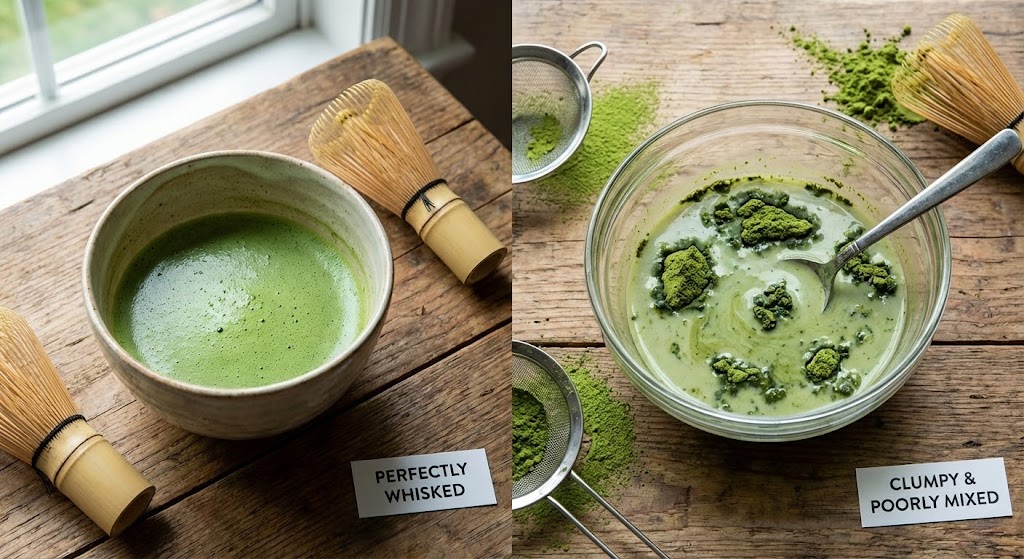
1. Why Matcha Clumps in Cold Drinks: The Physics of Particle Suspension
Matcha is stone-ground tencha leaf milled to a particle size of roughly 5–10 microns—finer than espresso grind, coarser than cornflour—and those tiny fragments carry a high surface area relative to mass. In warm water (60–80 °C) the particles hydrate quickly, the residual heat helps break surface tension, and a bamboo whisk or electric frother generates enough shear to disperse them into stable colloidal suspension. Drop that same powder into ice-cold water or milk, however, and three things conspire against you: low temperature slows hydration, surface oils on the particle (remnants of the tea leaf's waxy cuticle) become more viscous and sticky, and cold liquid has higher viscosity than hot, so shear from whisking is less effective. The result is visible clumping—matcha particles aggregate into little rafts that resist further breakdown.
Once clumps form they're surprisingly resilient. Even vigorous shaking in a cocktail shaker will coat them in foam or trap them against ice cubes rather than shearing them apart, because the clump's interior remains dry or only partially wetted. This is why anti-clumping technique always starts with pre-hydration: you need to wet every particle surface before the liquid cools, then lock that dispersion in place before ice dilutes or chills the mixture further. It's not about buying a premium grade or a magic whisk; it's about managing temperature and sequence so the physics work in your favour rather than against it.
Oxidation exacerbates clumping. Matcha exposed to air, light, or warmth develops tacky, polymerised surface compounds (oxidised catechins and chlorophyll degradation products) that act like weak glue. A fresh tin whisks smooth in seconds; a six-month-old tin left at room temperature will clump stubbornly even in hot water. For cold drinks, where hydration is already slower, stale matcha is nearly unworkable—another reason to store opened tins in the freezer and treat the powder as perishable.
2. The Two-Stage Method: Whisking Warm, Then Chilling Cold
The single most reliable technique for clump-free iced matcha is progressive dilution: whisk your matcha with a small volume of temperate or warm water to create a smooth concentrate, then lengthen that concentrate with cold milk or water and ice. Measure 1–2 g matcha (½–1 tsp) into a wide bowl or mug, add 20–30 ml water at 40–70 °C—warm enough to aid hydration but cool enough that you're not cooking the chlorophyll or driving off volatile aromatics—and whisk briskly in a zig-zag or 'W' motion with a bamboo chasen for 15–20 seconds until the paste is uniform and lump-free. You're aiming for the consistency of single cream, with no visible dry powder or floating islands.
Once your concentrate is smooth, you have options. For an iced matcha latte, fill a tall glass with ice, pour in 150–200 ml cold milk (oat milk, whole dairy, or your preferred alternative), then pour the warm matcha concentrate over the top; the density difference creates a layered effect that you can stir through or leave Instagram-ready. For a shaken iced matcha, transfer the warm concentrate to a cocktail shaker with a handful of ice cubes, shake hard for 10–15 seconds to chill and aerate, then strain into a glass—shaking after whisking gives you the cold, frothy texture of a café shaken matcha without the clumps that result from shaking dry powder.
Temperature precision matters less than sequence. Some baristas use boiling water for the initial whisk and rely on ice to bring the drink down to serving temperature; others prefer 50–60 °C to preserve delicate umami notes. Experiment within the 40–80 °C window to find your preference, but never skip the warm hydration step—pouring cold milk directly onto dry matcha, or adding matcha to a cold shaker, will always produce inferior texture no matter how long you shake or how expensive your powder.
The Paste Test
Before adding cold liquid, check your concentrate: it should flow off the whisk in a thin, even stream with no lumps or dry spots. If you see grainy texture at this stage, no amount of shaking or stirring later will fix it—re-whisk with a splash more warm water until smooth.
3. Shaker vs Whisk vs Frother: Which Agitation Method Works Best Cold
The bamboo whisk (chasen) remains the gold standard for the initial hydration stage because its fine tines create high shear in a small volume of liquid, and the wide, shallow whisking bowl maximises surface contact. An electric milk frother with a coil whisk attachment works nearly as well if you pulse it in short bursts to avoid overheating, and it's faster for making multiple servings. Both methods excel at breaking matcha into suspension before the drink is chilled; neither performs well if you try to use them directly in a glass full of ice, because ice cubes block the whisk motion and reduce shear.
The cocktail shaker enters the workflow after you've whisked a smooth concentrate. Shaking with ice serves two purposes: it chills the drink rapidly (avoiding the slow dilution of simply pouring over ice) and introduces air, creating the frothy, slightly aerated texture that defines a shaken iced matcha latte. The turbulence inside the shaker can break up minor clumps if your pre-whisking wasn't perfect, but it cannot disperse dry powder—trying to shake matcha, milk, and ice from scratch yields a foamy mess with powder stuck to the ice and shaker walls. If you don't own a shaker, a clean jam jar with a tight lid works identically; the key is a sealed vessel that allows vigorous, three-dimensional agitation.
Blenders and stick blenders are overkill for a single serving and tend to over-aerate, turning your drink into green foam rather than smooth liquid. They can be useful for batch prep—whisking 10–20 g matcha with warm water in a jug blender, then storing the concentrate in the fridge to portion out over ice through the day—but for one or two drinks the whisk-then-shake sequence is faster, quieter, and gives you finer control over texture. Reserve the blender for smoothies or frozen matcha drinks where air incorporation is desirable.
4. Choosing Matcha Grades for Cold Drinks: Ceremonial, Culinary, and the Freshness Override
The ceremonial-versus-culinary binary is marketing shorthand, not a regulated distinction, but it does correlate loosely with particle size and leaf quality. Ceremonial-grade matcha is typically milled finer (closer to 5 microns), sourced from first-flush spring leaves, and costs £20–40 per 30 g in the UK; that finer grind disperses faster and produces smoother mouthfeel, which matters in a minimalist hot usucha where texture is everything. Culinary-grade matcha uses later-harvest or slightly coarser milling, costs £8–15 per 30 g, and carries more astringency and vegetal bite—fine for lattes where milk and sweetener will temper bitterness, less ideal for straight sipping.
For iced drinks, especially milky lattes, a fresh culinary grade often outperforms stale ceremonial. The key variables are harvest date (spring 2026 beats autumn 2025, which beats anything from 2024) and storage conditions (frozen beats refrigerated beats ambient). A culinary matcha opened last week and stored in the freezer will whisk smoother and taste brighter than a ceremonial tin opened six months ago and left in a cupboard, because oxidation degrades both flavour and dispersibility faster than grade differences can compensate. If your supplier lists harvest date, prioritise that over grade; if they don't, buy small tins and replace them often rather than hoarding a large ceremonial tin that goes stale.
For straight iced matcha (whisked with water, no milk), ceremonial grade's delicate umami and low astringency are worth the premium—cold water amplifies bitterness, so you want the sweetest, least astringent base available. For iced matcha lattes with milk and optional sweetener, a good culinary grade saves money without sacrificing texture, provided you follow proper hydration technique. Blind taste tests in a milky, sweetened context rarely favour ceremonial by a wide margin, so reserve your expensive tins for hot usucha and deploy affordable culinary matcha for summer iced drinks and batch recipes.
The Freezer Rule
Store opened matcha tins in a sealed zip-lock bag in the freezer, not the fridge. Freezing halts oxidation almost entirely; refrigeration only slows it. Let the tin come to room temperature before opening to prevent condensation, which will clump the powder irreversibly.
5. Ice Timing and Dilution Control: When to Add Ice Without Ruining Texture or Strength
Ice is both essential and destructive: it chills your drink to refreshing temperature but dilutes flavour and, if added too early, shocks matcha particles into clumping before they're fully hydrated. The solution is to add ice only after your matcha concentrate is completely smooth. In the two-stage method (whisking warm, then chilling), ice enters at stage two—either by pouring your warm concentrate over a glass of ice and cold milk, or by shaking the concentrate with ice in a sealed shaker. Both approaches give the matcha time to hydrate in warm water before temperature drops, preventing the cold-induced clumping that occurs when powder meets ice directly.
Dilution control hinges on ice-to-liquid ratio and melting time. A glass packed with large ice cubes melts slower than one filled with small cubes or crushed ice, so for minimal dilution use the largest cubes your freezer produces and pour cold liquid over them just before serving. If you're making iced matcha in advance, consider freezing matcha or milk into ice cubes—as they melt they add flavour and body rather than plain water. For shaken drinks, shake with regular ice to chill rapidly, then strain into a fresh glass of clean ice; the shaker ice has already done its job (chilling and aerating) and will be partly melted and diluted, so discarding it and serving over fresh ice maintains strength.
If you find your iced matcha too weak, resist the temptation to add more powder mid-drink—it will clump. Instead, start with a stronger concentrate (2 g matcha in 30 ml water rather than 1 g, or reduce the final milk volume) and adjust sweetness or milk quantity to taste. The concentration-ratio logic from iced tea applies here: brew (or in matcha's case, whisk) stronger than you want to drink, then dilute to target strength with ice and cold liquid, leaving headroom for melt.
The Double-Strain Trick
When shaking iced matcha, pour through a fine-mesh tea strainer as you decant into the serving glass. This catches any ice chips or residual clumps, guaranteeing silky texture even if your whisking wasn't flawless.
6. Milk, Sweeteners, and Stabilisers: What Helps Suspension and What Makes Clumping Worse
Milk—whether dairy or plant-based—does more than add creaminess; fat and protein molecules help stabilise matcha particles in suspension, reducing the perception of graininess even if microscopic clumps remain. Whole dairy milk (around 3.5 % fat) and barista-formulation oat milks (typically 3–4 % fat with added emulsifiers like gellan gum or sunflower lecithin) perform best in cold matcha lattes, coating particles and preventing re-aggregation. Skimmed milk and thin plant milks (almond, rice) lack the fat and protein to stabilise effectively, so texture suffers and any minor clumping becomes more obvious on the tongue.
Sweeteners affect viscosity and therefore dispersion. Simple syrup (equal parts sugar and water, dissolved) blends seamlessly into cold drinks without the graininess of granulated sugar, and its slight viscosity helps suspend matcha particles. Honey and agave are thicker and stickier, which can paradoxically trap small clumps rather than dispersing them—if you use them, dissolve in your warm matcha concentrate before adding cold milk. Artificial sweeteners and stevia dissolve well but add no viscosity, so they won't help texture; they're fine for flavour if you prefer zero-calorie options, but don't expect them to smooth out a clumpy drink.
Some UK cafés add a pinch of lecithin (soy or sunflower) or a drop of vanilla extract to iced matcha—not for flavour, but because lecithin is a powerful emulsifier that keeps fat, water, and matcha particles from separating. A 1/16 tsp per serving is invisible to taste but noticeably improves mouthfeel and suspension stability, especially if you're making drinks in advance or bottling iced matcha for picnics. You can buy food-grade sunflower lecithin powder online; it's the same ingredient that makes barista oat milk froth reliably. Add it to your warm matcha concentrate and whisk through before chilling—it's optional, but if you're chasing café-level texture at home it's one of the few 'secret' ingredients that genuinely works.
7. Troubleshooting Grainy Texture: Diagnosing and Fixing Clumps on the Fly
If your iced matcha is grainy despite following the two-stage method, the culprit is almost always one of four things: stale matcha, insufficient whisking at the concentrate stage, water that was too cold during hydration, or powder added directly to cold liquid somewhere in the process. Start by checking your matcha's age and storage—if it's more than two months past opening or was stored at room temperature, oxidation has likely degraded dispersibility. Replace it with a fresh tin and store properly; no technique fixes stale powder.
If your matcha is fresh but still clumping, revisit your hydration step. Are you using enough warm water (20–30 ml minimum) and whisking for a full 15–20 seconds until the paste is completely smooth, with no visible dry spots or floating particles? Under-whisking is the most common mistake—people whisk for five seconds, see the powder turn green, and assume it's done, but true dispersion takes longer. The paste should be glossy, flow evenly off the whisk, and show no grainy texture when rubbed between your fingers. If it feels gritty, keep whisking or add a few more drops of warm water and re-whisk until smooth.
If clumping appears after you add ice or cold milk, your concentrate was probably fine but the temperature shock or dilution ratio caused re-aggregation. This is rare if you've whisked properly, but it can happen with very fine ceremonial matcha in extremely cold liquid—try pouring your concentrate more slowly, or warming your milk slightly (to 10–15 °C rather than fridge-cold 4 °C) to reduce thermal shock. Finally, if you're shaking matcha and ice together without pre-whisking, that's your problem: always whisk the concentrate smooth first, then shake or pour over ice. There are no shortcuts that work reliably.
The Sieve Fix
If you've already mixed a clumpy drink and don't want to start over, pour it through a fine-mesh sieve into a clean glass—most clumps will catch in the mesh. It's not ideal (you'll lose some matcha) but it salvages an otherwise undrinkable drink in seconds.
8. Batch Prep and Scaling for Crowds: Making Smooth Iced Matcha for UK Summer Gatherings
Making iced matcha for a garden party or summer tea menu is entirely feasible if you prepare a concentrated matcha base in advance and let guests (or you) dilute to taste with ice and milk at serving time. Whisk 10–15 g matcha with 200–300 ml water at 60–70 °C in a jug or blender until completely smooth, then refrigerate the concentrate in a sealed bottle or cold-brew pitcher. It will hold for 4–6 hours without significant oxidation (colour will dull slightly, but texture remains smooth), and each 30 ml pour over ice and 150 ml milk yields one serving. Label the concentrate clearly so guests know to dilute it—straight concentrate is intensely bitter and astringent.
For truly large crowds (20+ servings), consider a two-jug system: one jug of matcha concentrate, one of cold milk, plus a big bowl of ice and a stack of iced tea glasses. Guests pour their own ratio—useful because matcha tolerance varies widely, and some prefer strong, barely sweetened drinks while others want milky, dessert-like lattes. Provide simple syrup or honey on the side rather than pre-sweetening, and have a small whisk or spoon available for stirring, because even a well-made concentrate can settle slightly if it sits for an hour.
If you're using an iced tea maker or infuser pitcher for other teas at the same event, keep matcha separate—it doesn't cold-brew the way sencha or mizudashi greens do, and dumping powder into a cold-brew basket guarantees clumping and waste. Matcha's ultra-fine grind and suspension behaviour require the whisk-warm-then-chill method even at scale; there's no passive cold-brew shortcut. That said, the active prep time is under five minutes for a batch serving ten, so it's less labour-intensive than it sounds and far more impressive than pouring instant iced tea powder from a packet.


Comments