1. What Does 'Aged Pu-erh' Mean?
Aged pu-erh refers to tea from Yunnan Province that has undergone a period of post-production microbial and chemical transformation, yielding flavours and aromas not present in fresh leaf. The term encompasses two distinct processes. Sheng (raw) pu-erh is sun-dried maocha that ferments naturally over years or decades through slow oxidation and microbial activity; young sheng is often astringent and vegetal, mellowing into smooth, honeyed, woody, or camphor-like notes as it matures. Shou (ripe) pu-erh, invented in the 1970s, undergoes wo dui pile-fermentation—a high-temperature, high-humidity process that mimics decades of natural aging in weeks—producing an earthy, peaty, sometimes fishy liquor straight away. Both categories can continue to evolve after production, but their aging trajectories differ profoundly.
In the collector's context, 'aged' usually means tea stored for at least five to ten years, though some purists reserve the label for cakes older than fifteen or twenty. The critical point is that age alone does not guarantee quality: a poorly made or badly stored cake will not improve, no matter how many years pass. Conversely, a well-crafted sheng from a reputable factory or single-estate producer, stored in stable conditions, can transform into something genuinely special. Understanding the baseline—what the tea was before aging—is as important as knowing how long it has been kept.
Age Is Not a Proxy for Quality
A ten-year-old sheng made from plantation leaf and stored poorly will taste flat or musty; a five-year-old gu shu (ancient tree) cake stored dry in the UK can already show complexity. Always ask: what is aging, and how?
2. Sheng vs Shou: Which to Collect?
Sheng pu-erh is the traditional choice for long-term collectors. Its natural fermentation is unpredictable and slow, but the potential for transformation is vast. A young sheng cake purchased today may remain sharp and grassy for five to eight years, then begin to sweeten and deepen, reaching a plateau of maturity somewhere between fifteen and thirty years, depending on storage. Collectors prize sheng for its transparency—the tea's terroir, processing skill, and raw-material quality all remain legible in the cup—and for the anticipation of watching it evolve. However, sheng demands patience and proper storage; mistakes or neglect can stall development or ruin the tea entirely.
Shou pu-erh offers a different proposition. Because pile-fermentation front-loads much of the microbial activity, shou is drinkable immediately and changes more subtly over time. Well-aged shou (ten years or older) can lose rough edges, develop sweetness, and acquire a smoother, rounder mouthfeel, but the dramatic metamorphosis of sheng is absent. For UK buyers, shou has practical advantages: it is more forgiving in dry storage, less sensitive to humidity fluctuations, and often cheaper per gram. Some collectors focus exclusively on shou for these reasons, treating it as a 'drink now, improve later' category. Others view it as a supplement to a sheng-focused collection, useful for immediate enjoyment while sheng matures.
There is no 'correct' choice—your decision should reflect your drinking habits, storage capacity, and willingness to wait. Many serious collectors hold both: a rotating stock of shou for daily drinking and a sealed reserve of sheng for the future. If you are new to aged pu-erh investing, consider starting with a mix of five-to-ten-year-old shou and young sheng (three to five years old), then sampling across age brackets to calibrate your palate.
3. Wet Storage vs Dry Storage: Why It Matters
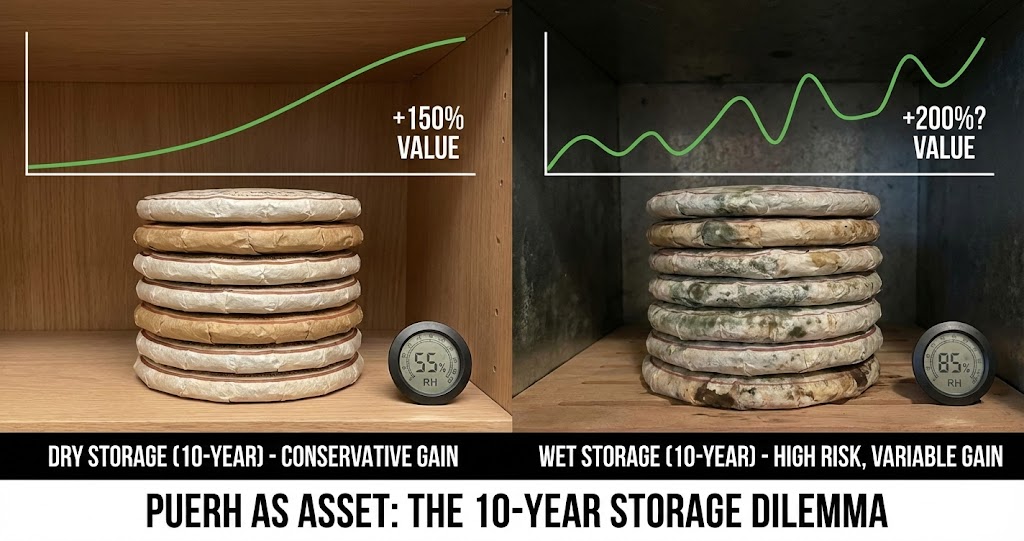
Storage environment is the single most influential variable in how pu-erh ages. Dry storage—broadly, relative humidity below 65% and moderate temperatures (15–25°C)—produces clean, bright, slower-maturing tea with minimal risk of mould or off-flavours. This is the norm in much of northern China, Taiwan, and the UK. Dry-stored sheng retains floral or fruity top notes longer and can take twenty to thirty years to reach full maturity. Wet storage (also called 'traditional' or 'Hong Kong storage') uses higher humidity (70–85%) and warmer temperatures to accelerate fermentation. Wet-stored cakes darken faster, developing earthy, medicinal, or woody notes within a decade, but they risk mustiness, sour funk, or a 'storage taste' that some drinkers find unpleasant.
Neither method is inherently superior—preference is subjective—but transparency is essential. Unscrupulous sellers sometimes pass off wet-stored tea as dry-aged or vintage, charging premium prices for cakes whose rapid maturation masks flaws or low-grade leaf. Wet storage also increases the likelihood of microbial contamination if conditions are poorly controlled. For UK collectors, dry storage is the default: our climate is naturally drier than Yunnan or Guangdong, and most homes lack the humidity infrastructure to replicate wet conditions safely. This means cakes you purchase will age more slowly than their Hong Kong or Malaysian counterparts, but the flavour profile will be cleaner and more predictable.
When evaluating aged pu-erh for purchase, always ask the vendor about storage history. Look for terms like 'Kunming dry storage,' 'Taiwan natural storage,' or 'UK home storage'—these signal lower humidity and minimal intervention. Be wary of vague claims like 'traditional aging' without specifics, or cakes that smell damp, sour, or overly earthy relative to their stated age. For guidance on managing your own collection in the British climate, see our UK-specific storage strategies.
Sniff Before You Buy
A healthy aged sheng should smell woody, sweet, or camphor-like—never sour, fusty, or reminiscent of damp cardboard. If a vendor won't let you smell a sample, walk away.
4. Evaluating Quality: Leaf, Liquor and Provenance
Assessing aged pu-erh requires looking beyond the wrapper and the date. Begin with the dry leaf: high-quality sheng should show intact, evenly compressed leaves with visible tips and minimal breakage. Colour will vary by age—young sheng is green to olive; ten-year-old sheng turns amber or reddish-brown; twenty-year-old dry-stored sheng can be deep mahogany. Avoid cakes that are uniformly black (a sign of wet storage or artificial darkening) or that crumble to dust (over-drying or poor storage). Shou should have a clean, earthy aroma without mustiness or fishy off-notes; well-aged shou often smells sweet, like dark chocolate or forest floor.
Next, examine the liquor. Steep a small sample using parameters from our decade-by-decade steeping chart. The tea should be clear or slightly hazy, never cloudy or murky. Taste for complexity, balance, and mouthfeel: aged sheng should have sweetness, depth, and a smooth, velvety texture; harsh astringency or bitterness suggests the tea is under-aged, poorly stored, or made from low-grade material. Aged shou should taste rich and rounded, with layered earthy or woody notes—flatness or one-dimensional funk indicates mediocre leaf or rushed pile-fermentation.
Finally, investigate provenance. Reputable vendors will provide the producer's name (e.g., Menghai Tea Factory, Xiaguan, or a named artisan), the batch or recipe number, the harvest year, and storage history. Cross-reference this information with online archives, collector forums, or the vendor's own documentation. Genuine aged cakes from famous factories often have distinctive wrappers, stamps, and neifei (inner tickets) that can be verified against reference images. If the seller cannot or will not supply this detail, assume the risk is high.
The 'Hui Gan' Test
Hui gan (returning sweetness) is a hallmark of quality sheng: a lingering, saliva-inducing sweetness that builds in the throat minutes after swallowing. If a ten-year-old sheng has no hui gan, it probably won't improve further.
5. Spotting Fakes and Mislabelled Vintages
The aged pu-erh market is rife with fraud. Counterfeits range from outright forgeries—fake wrappers and neifei on recent cakes sold as 1980s or 1990s vintages—to subtler misrepresentations, such as blending old and new leaf, artificially accelerating aging with steam or heat, or re-wrapping damaged cakes. The economic incentive is clear: a genuine 1990s 'Red Label' from Menghai Tea Factory can command thousands of pounds, while a convincing fake costs pennies to produce.
Key warning signs include: price too good to be true (a twenty-year-old gu shu cake for £40 is almost certainly fake or mislabelled); suspiciously uniform colour (real aged sheng shows variation in leaf tone, especially around the edges of the cake); wrapper inconsistencies (font errors, wrong factory logos, or paper that looks too clean for the claimed age); and vague or absent documentation. Some counterfeiters even forge Dayi (Menghai) batch codes or Taiwan collector stamps, so cross-check details against known references or ask experienced collectors for second opinions.
Another common trick is blending vintages: wrapping a core of cheap, recent maocha inside a shell of older, oxidised leaf to give the impression of uniform age. When you break open a sample, check that inner and outer leaves match in colour and aroma. For high-value purchases, request a full cake inspection or buy from vendors who guarantee authenticity and offer returns. In the UK market, reputable specialists include established importers who source directly from trusted factories or storage facilities; building relationships with these sellers is your best defence against fraud.
Compare Wrapper Fonts and Stamps
Menghai and Xiaguan wrappers changed typefaces, logo designs, and paper stock over the decades. Side-by-side comparison with verified examples (available in collector databases) reveals most fakes instantly.
6. Building a Sensible Collection: Strategy and Budget
A well-structured aged pu-erh collection balances drinking stock, medium-term holds, and long-term reserves. Start by identifying your own drinking pace: if you steep pu-erh twice a week, a 200g cake lasts roughly two months, so a dozen cakes represents a year's supply. Allocate a portion of your budget to ready-to-drink aged shou (ten years or older) and mid-aged sheng (eight to fifteen years) that you can enjoy immediately. This ensures you have something to pour while younger cakes mature and helps you learn your own palate.
Next, invest in young-to-mid-aged sheng (three to eight years old) from reputable producers. These cakes are still affordable, have demonstrated initial quality, and will continue to develop over the next decade. Look for single-estate or ancient-tree sourcing, as these tend to age more gracefully than plantation blends. Buy in small quantities (one or two cakes per producer) to diversify risk: if one cake stalls or disappoints, others may excel. Finally, if budget permits, consider a sealed reserve—a small number of highly regarded young sheng cakes (one to three years old) that you commit not to open for ten or fifteen years. Store these in a stable environment and resist the temptation to sample; this patience is what separates casual drinkers from serious collectors.
Set a realistic annual budget and stick to it. Pu-erh collecting can become expensive quickly, especially if you chase rare or hyped releases. A sensible UK collector might spend £200–£500 per year, acquiring eight to twelve cakes across age brackets and styles. Track your purchases in a simple spreadsheet: record producer, year, storage location, and tasting notes after each session. This log becomes invaluable for understanding which teas improve, which stall, and where your own preferences lie. Remember, the goal is to build a collection you will drink—not a speculative portfolio you hope to flip for profit.
7. UK-Specific Considerations: Climate, Sourcing and Legality
The UK's temperate, relatively dry climate presents both advantages and challenges for pu-erh collectors. On the positive side, low ambient humidity (typically 50–60% indoors) minimises mould risk and keeps cakes clean. On the downside, such dryness can slow sheng fermentation to a crawl; some collectors report negligible change in cakes stored in centrally heated British homes for five or more years. To mitigate this, store cakes in a dedicated, unheated space—an insulated garage, a spare room, or a cupboard away from radiators—and consider using a small humidifier or humidity-control packs (such as Boveda) to maintain 60–65% RH. Avoid sealing cakes in airtight plastic, which traps off-gassing and can promote mustiness; instead, use breathable cotton bags, cardboard cartons, or purpose-built pu-erh storage boxes. For detailed strategies, consult our UK-specific storage guide.
Sourcing aged pu-erh in the UK has improved markedly in recent years. Specialist online retailers now stock a range of factory and artisan cakes, often with detailed provenance and tasting notes. Prices are typically 20–40% higher than buying direct from China or Taiwan, reflecting import duties, VAT, and the vendor's curation and quality assurance. Some collectors do source directly via Taobao, Alibaba, or WeChat dealers, but this carries risks—language barriers, shipping delays, and the difficulty of verifying authenticity without in-person inspection. For your first purchases, stick to UK-based vendors with strong reputations; as you gain experience, you can explore international sourcing if the savings justify the hassle.
Legally, importing pu-erh for personal use is straightforward: there are no import restrictions on tea itself, though you will pay VAT (20%) and possibly a small customs handling fee on shipments over £135. Be aware that some sellers undervalue parcels to evade duty, which is technically illegal and can result in confiscation. If you later decide to sell or trade cakes, note that the UK has no specific regulations on reselling aged tea, but you must comply with general food-safety and trading-standards rules—especially if you claim health benefits or make unverifiable age statements. For most private collectors, this is not an issue; just keep your own records accurate.
Track Your Cakes Digitally
Photograph wrappers, note storage dates, and log tasting sessions in a shared spreadsheet or app like Google Sheets. If you ever sell or trade, this documentation proves provenance and builds buyer confidence.
8. When to Drink, When to Hold, and When to Sell
Deciding when a cake has reached its peak is both art and science. For sheng, the general rule is that dry-stored cakes begin to hit their stride at ten to fifteen years, plateau between twenty and thirty, and can remain excellent (if well stored) for fifty years or more. However, 'peak' is subjective: some drinkers prefer the bright, complex notes of a twelve-year-old sheng, while others seek the deep, meditative calm of a thirty-year-old. The best approach is to sample periodically—break off a small piece every two or three years, steep it, and assess whether the tea is moving in a direction you enjoy. If it is improving, hold; if it has stalled or started to decline (flatness, mustiness, loss of sweetness), drink it up.
For shou, the window is narrower. Most shou reaches its best expression between five and fifteen years; beyond that, diminishing returns set in. If you have a ten-year-old shou that tastes rich and smooth, it is probably ready to drink. For both categories, consider your own cellar depth: if you have more aged tea than you can drink in a decade, it may be time to sell or trade. The secondary market for aged pu-erh exists primarily in China, Taiwan, and among international collectors on platforms like Instagram, Reddit's r/puer, or specialist forums. Selling in the UK can be slow unless you have rare, well-documented cakes; most transactions happen peer-to-peer rather than through formal auction houses.
Finally, remember that drinking is the point. Even if a cake has appreciated in value, the ultimate return on investment is the pleasure and insight you gain from tasting it. Aged pu-erh teaches patience, attentiveness, and humility—qualities that extend well beyond the teacup. If you approach collecting with curiosity rather than greed, you will build a cellar that rewards you year after year, regardless of market trends.



Comments