1. What Moisture Equilibrium Means for Tea
Equilibrium moisture content is the steady-state water level a tea leaf reaches when water molecules adsorbing onto the leaf surface and into capillaries balance those evaporating back into the air. Unlike fresh leaf—which starts above 75 % moisture and actively respires—dried tea is metabolically dormant but physically porous, riddled with micro-capillaries left by cell rupture, air pockets between twisted layers, and polar hydroxyl groups on cellulose and pectin chains that attract water. Because vapour pressure inside the leaf seeks equilibrium with vapour pressure in the surrounding air, the leaf will never stay at the 3 % moisture a producer measures immediately after firing if the storage RH is higher; conversely, over-dry air will pull residual moisture out until the leaf becomes brittle.
This exchange is purely physical—a function of vapour-pressure gradients—but its consequences are chemical: water acts as a plasticiser, increasing molecular mobility and enabling oxidation, Maillard browning, lipid hydrolysis and volatile loss. At the same time, liquid water above a critical threshold (aw ≈ 0.65) allows fungal spores to germinate. Producers therefore aim for a final fired moisture of 3–5 % and pack the tea in barrier film or airtight caddies to lock in that low EMC. Once the seal is broken, the leaf begins its slow march toward whatever equilibrium the cupboard or kitchen offers.
Understanding equilibrium helps you diagnose storage problems—why a tin of Earl Grey that arrived crisp now feels soft, why Japanese sencha loses its grassy snap after a humid August, or why an elderly oolong tastes musty rather than mellow. It also reveals why vacuum-foil pouches, nitrogen flush and refrigerated storage all work: each technique delays or arrests the leaf's journey to equilibrium with room air.
EMC Is a Moving Target
Even inside a closed tin, if the lid is not truly airtight, leaf and headspace air exchange moisture over days until both stabilise—meaning your caddy's internal RH is the leaf's EMC environment.
2. Water Activity and Relative Humidity: The Driving Forces
Water activity (aw) is defined as the ratio of the vapour pressure of water in the leaf (p) to the vapour pressure of pure water at the same temperature (p0): aw = p / p0. For practical purposes, aw expressed as a decimal is numerically equal to equilibrium relative humidity (ERH) expressed as a percentage: a leaf at aw = 0.50 will neither gain nor lose moisture in an environment held at 50 % RH. When the leaf is exposed to higher RH, vapour pressure in the air exceeds that at the leaf surface, and water condenses onto—and diffuses into—the leaf until pressures equalise; the reverse happens in drier air.
Crucially, it is aw, not absolute moisture content, that governs microbial and chemical stability. Moulds require aw ≥ 0.65 to grow, most spoilage yeasts need ≥ 0.70, and bacteria ≥ 0.85. [[Oxidation-relative-humidity-moisture-control-oxidation|Non-enzymatic browning]] and lipid oxidation accelerate steeply above aw ≈ 0.50–0.60, because water molecules plasticise the cell matrix, increasing reactant mobility and catalysing free-radical chain reactions. This is why tea packed at 5 % moisture (aw ≈ 0.35–0.40) remains stable for years, while the same tea equilibrated to 8 % moisture at 70 % RH (aw ≈ 0.70) will degrade within months.
Because vapour pressure is temperature-dependent—doubling roughly every 10 °C—warmer storage at the same RH delivers higher absolute humidity and faster moisture uptake. A kitchen at 25 °C and 60 % RH presents more water molecules per cubic metre than a cellar at 15 °C and 60 % RH, so the leaf equilibrates at slightly higher moisture and oxidises faster. Conversely, refrigeration at 4 °C slows both equilibration kinetics and the chemical reactions moisture enables, which is why commercial distributors cold-store high-grade Japanese greens and why collectors cellar aged oolongs and pu-erh in climate-controlled rooms.
3. Sorption Isotherms: Mapping Equilibrium Moisture Content
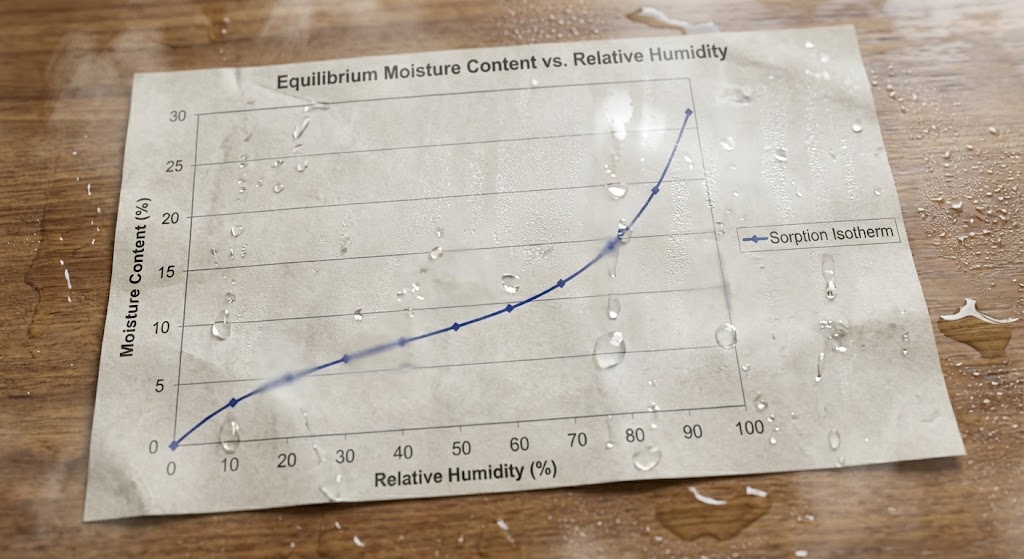
A sorption isotherm is a graph plotting equilibrium moisture content (% dry basis) against water activity (or RH) at constant temperature. For tea, the curve is sigmoid (S-shaped), reflecting three moisture-binding regimes. At low aw (0.0–0.3), water binds tightly to a monolayer of polar sites—hydroxyl groups on cellulose, carboxyl groups on pectins, amine groups on residual proteins—so each increment in RH adds only a small amount of moisture. In the middle range (aw 0.3–0.7), additional water molecules form multilayers and fill fine capillaries; the slope steepens. Above aw ≈ 0.7, capillary condensation dominates: water fills larger pores as if they were tiny reservoirs, and moisture content climbs steeply.
Published isotherms for black, green and oolong teas show that at 60 % RH (aw = 0.60) most teas reach EMC of 6–8 % moisture (dry basis); at 50 % RH, EMC drops to roughly 5–6 %; at 40 % RH, to 4–5 %. These values shift slightly with leaf structure: cut or crushed leaves—common in tea bags—expose more internal surface and bind more water at a given RH than whole orthodox leaf. Conversely, tightly rolled or heavily fired teas (e.g., charcoal-roasted oolongs) may show slightly lower EMC because firing denatures some polar binding sites and Maillard products form hydrophobic compounds.
Isotherms also reveal hysteresis: a leaf equilibrated by adsorption (starting dry and gaining moisture) often reaches a different EMC than one equilibrated by desorption (starting moist and drying out) at the same RH. The gap reflects capillary trapping and structural collapse. For practical storage, this means that once tea has absorbed excess moisture, simply lowering the RH may not fully reverse the damage—volatiles already lost to hydrolysis or evaporation will not return, and any mould spores that germinated remain as metabolic by-products.
Target Storage Below 50 % RH
Keeping ambient RH under 50 % holds most teas at or below 5 % moisture (aw ≈ 0.50), the sweet spot where oxidation is slow, moulds cannot grow, and aroma volatiles remain stable for a year or more.
4. Why Leaf Structure and Processing Affect Hygroscopicity
The same cultivar processed two different ways will yield isotherms that differ by several percentage points, because mechanical treatment and heat alter the leaf's physical architecture and chemical composition. [[Leaf-cell-wall-rupture-rolling-releases|Rolling]] and cutting rupture cell walls, exposing internal membranes, vacuolar polysaccharides and cytoplasmic proteins—all rich in polar groups that adsorb water. CTC (crush-tear-curl) and fanning-grade teas therefore exhibit higher EMC at any given RH than large-leaf orthodox grades, because their vastly increased surface area and disrupted structure offer more binding sites and capillary pathways.
Firing and roasting also matter. High-temperature drying (above 110 °C) partially denatures proteins, caramelises sugars and polymerises polyphenols, forming less-polar Maillard products and cross-linked cell-wall matrices. The net effect is a modest downward shift in the isotherm: charcoal-roasted Wuyi oolongs or heavily pan-fired lapsang souchong may equilibrate 0.5–1 percentage point drier than lightly steamed Japanese greens at the same RH. Conversely, teas rich in water-soluble polysaccharides—such as young sheng pu-erh with intact pectin—can be slightly more hygroscopic.
[[Assess-leaf-thickness-visual-touch|Leaf thickness]] and density introduce another variable: thicker, less compressed leaves present lower external surface area per gram, slowing the rate of equilibration (kinetics) even if the final EMC remains similar. This is why tightly compressed pu-erh bricks or balls take weeks to fully equilibrate after unwrapping, whereas loose fanning-grade tea in a tea bag reaches EMC within days. It also explains why professional graders and moisture-meter users must account for grade and particle size when interpreting readings.
5. Seasonal and Geographic Variation in the UK
The UK's maritime climate ensures that outdoor RH rarely drops below 60 % for long, and indoor winter heating or summer ventilation can push kitchen or living-room RH anywhere from 40 % to 75 %. A caddy of Earl Grey on a Welsh windowsill in February (RH 70–80 %, cool) will equilibrate near 8–9 % moisture, favouring mould risk and rapid aroma loss; the same tin in a centrally heated London flat in January (RH 35–45 %, warm) may drop to 4 % moisture, preserving the bergamot oil but risking brittle, over-dry leaf that fractures into dust.
Summer humidity is the greater threat: June through September often sees indoor RH above 60 %, especially in poorly ventilated kitchens or coastal homes. At 65 % RH and 22 °C, most teas climb to 7–8 % moisture within two to three weeks if the caddy seal is imperfect. This puts them into the aw 0.65–0.70 range where moulds can germinate on any dust or spillage, and where oxidation and volatile loss accelerate. The problem is compounded for teas with added oils (e.g., bergamot in Earl Grey, jasmine absolutes in scented greens) because moisture catalyses ester hydrolysis, stripping the fragrance.
Practical defences include choosing true airtight caddies with silicone gaskets, decanting large purchases into smaller tins to minimise headspace turnover, and storing high-value or delicate teas (Japanese greens, white teas, lightly oxidised oolongs) in a cool cupboard away from the kettle. For collectors or bulk buyers, a sealed plastic tub with sachets of silica gel or molecular-sieve desiccant can hold internal RH below 40 %, ensuring multi-year stability even in damp climates.
Monitor with a Hygrometer
A small digital hygrometer inside your tea cupboard reveals whether RH stays below 50 %; if it climbs above 60 % in summer, move tins to a cooler, drier room or add desiccant sachets to the caddy headspace.
6. Commercial Packing Strategies: Vacuum, Nitrogen and Foil
Because equilibration begins the moment dried tea meets ambient air, premium producers and importers use barrier packaging to delay—or arrest—moisture uptake until the consumer opens the pack. Vacuum-sealed foil pouches remove most headspace air, dropping the internal partial pressure of water vapour near zero; with no vapour source, the leaf cannot re-equilibrate upward. Any residual oxygen also drops, slowing oxidative rancidity of lipids and catechins. Provided the foil laminate (typically aluminium between polyethylene layers) remains intact, the leaf stays at its packed moisture (3–5 %) for months or years.
Nitrogen flushing (modified-atmosphere packing) displaces air with inert N2 before sealing. Because nitrogen is dry and non-reactive, the leaf remains in a low-RH, low-O2 environment. This technique is common for high-grade Japanese greens and competition-grade oolongs, where even slight oxidation dulls the signature aromatics. Once opened, however, the protective atmosphere is lost, and the leaf begins equilibrating with room air within hours.
Silica-gel sachets inside tins or jars adsorb moisture, lowering the headspace RH and pulling the leaf's EMC downward. Food-grade silica is effective to about 40 % of its weight in water; a 5 g sachet can protect roughly 100 g of tea in a moderately sealed container, provided the tin is not opened daily. Desiccant works best in conjunction with a good seal; in a loosely lidded tin it merely buffers day-to-day fluctuations rather than holding long-term low RH. Molecular-sieve desiccants (zeolites) offer even lower target RH but are less common in consumer packs.
Repack After Opening Foil
Once you break a vacuum or nitrogen-flush seal, transfer the tea to an airtight caddy or re-seal with a clip and store in a cool, dark cupboard—foil pouches alone offer little barrier if left open between brews.
7. Measuring and Monitoring Leaf Moisture at Home
Professional moisture testing relies on oven-drying (ISO 1573 method: 103 °C for three hours) or calibrated pin and capacitance meters, neither of which are practical—or necessary—for home storage. Instead, you can infer moisture status from tactile and olfactory cues: properly stored tea should feel crisp and spring back slightly when pinched; leaves that feel leathery, damp or clump together have likely climbed above 7 % moisture. Aroma should be clean and bright; any musty, earthy or flat notes suggest elevated aw and incipient spoilage.
A more objective approach is to place a small digital hygrometer inside your main storage caddy or cupboard for a week. If the reading stabilises below 50 % RH, your teas are safely below aw 0.50; readings above 60 % mean leaves are gaining moisture faster than you can drink them. For high-value or long-term storage (aged oolongs, competition greens), some collectors invest in a humidity-controlled cabinet or wine fridge, dialled to 15 °C and 40–45 % RH, ensuring stable EMC year-round.
[[Commercial-producers-moisture-meters-whether-home|Handheld moisture meters]] marketed for coffee or grain can measure tea, but they require calibration curves specific to tea's density and dielectric properties; out-of-the-box readings may be ±2 percentage points off. If you do buy a meter, validate it against a known-dry sample (oven-dried to constant weight) and note that readings vary with leaf thickness and particle size. For most home users, combining a hygrometer reading with a monthly sniff-and-pinch check provides adequate early warning of moisture creep.
8. Practical Storage Rules and Troubleshooting
To keep tea at safe EMC year-round, follow three principles: low humidity (target storage RH ≤ 50 %), stable temperature (avoid daily swings that pump moist air in and out of containers), and effective seals (airtight lids, vacuum pouches or desiccant). In practice, this means choosing double-lidded tins or screw-top jars with silicone gaskets, storing them in a cool cupboard away from the kettle, hob or dishwasher steam, and avoiding the refrigerator unless the tea is sealed in vapour-proof packaging (condensation during temperature cycling will spike moisture instantly).
If you detect softening, clumping or off-odours, act quickly. Small moisture gains (up to ≈7 %) can sometimes be reversed by spreading the tea on a baking tray and gently warming it in an oven at 60–80 °C for 20–30 minutes, then re-sealing immediately while still warm (so it cools in dry, sealed headspace). This evaporates the adsorbed multilayer moisture without re-firing the leaf. If the tea smells musty or shows visible mould, discard it—mycotoxins may be present even if growth is localised.
For long-term cellaring (pu-erh cakes, competition oolongs), some enthusiasts adopt controlled micro-climate storage: placing cakes in glazed ceramic jars with a small hygrometer and desiccant, then wrapping the jar in cloth to buffer rapid swings, stored in a dark, cool room. This mimics traditional Guangdong or Taiwan storage (RH 60–65 %, 18–22 °C) that allows gentle post-fermentation while staying below mould thresholds. The key is monitoring: check RH monthly and replace desiccant when it saturates, ensuring the leaf never climbs above aw 0.65 unless you are deliberately pursuing high-humidity aged character—a specialist pursuit beyond everyday drinking.
One Caddy per Tea Type
Mixing teas in a single tin averages their EMC and cross-contaminates aromas; store delicate greens separately from smoky blacks to preserve each tea's equilibrium and character.
Comments