
1. What Is Oxidation and Why It Defines Tea Categories
Oxidation is the enzymatic reaction between polyphenol compounds in the tea leaf and atmospheric oxygen, catalysed by naturally present polyphenol oxidase (PPO) and peroxidase enzymes. When leaf cells are ruptured—through withering, rolling, shaking, or bruising—these enzymes meet their substrates (catechins, primarily) and oxygen rushes in, triggering a chain of transformations: catechins polymerise into theaflavins and thearubigins, chlorophyll breaks down, and volatile aroma compounds shift from grassy aldehydes and alcohols toward fruity esters, floral terpenes, and, at high oxidation, malty pyrazines and sweet caramel notes. The colour change is the most visible signal—from bright green through jade, yellow, amber, orange, to deep coppery red-brown—but the taste shift is equally dramatic, moving from fresh astringency and vegetal bite toward roundness, sweetness, and body.
It is not fermentation in the microbiological sense: no bacteria, yeasts, or moulds are doing the work in green, oolong, or black tea production (the historical term 'fermented tea' for black tea is a translation artefact and scientifically incorrect). True microbial fermentation occurs in post-fermented teas like pu-erh and liu bao, where Aspergillus and other organisms break down cell walls and metabolise polyphenols over months or years. Oxidation, by contrast, happens in hours, is entirely enzymatic, and is stopped by heat (kill-green, or 'fixing') which denatures the PPO enzymes and locks in whatever level of oxidation the maker desires. This control—when to start it, how fast to let it run, and when to arrest it—is the art and science that separates a 0% steamed sencha from a 30% Bao Zhong, a 50% Dong Ding, and a 90% Keemun.
The six classic tea categories (white, green, yellow, oolong, black, dark/post-fermented) are defined first by processing method and oxidation level, not by varietal or terroir. A single-origin leaf can become green, oolong, or black depending solely on how the maker handles it after plucking. In practice, certain cultivars perform better at certain oxidation windows—Tieguanyin cultivar for light oolongs, Assamica for full blacks—but the processing decision is what writes the category. Understanding oxidation as a spectrum rather than discrete buckets helps explain why some oolongs overlap greens at the low end and blacks at the high end, and why you can find 'greenish' blacks (lightly oxidised CTC) and 'dark' oolongs (70% Wuyi rock teas) that challenge tidy definitions.
Oxidation Is Not Time Alone
Leaving plucked leaf on a bench for six hours does not guarantee high oxidation if the cells are intact and the room is cool. Bruising (cell rupture) and warmth are equally critical—makers can achieve 50% oxidation in two hours with aggressive rolling at 25 °C, or stall at 10% over twelve hours in a chilled room with minimal handling.
2. The 0–100% Spectrum: Where Each Style Sits and Why Percentages Are Approximate
White tea: ~0–5%. Minimal processing—pluck, wither gently (often outdoors or in shade), then dry slowly at low temperature. Enzymes remain active during withering, so strictly speaking whites are not zero oxidation; careful study of Bai Mudan and Silver Needle shows 2–8% oxidation depending on withering length and weather. The slow, cool wither allows some polyphenol conversion, contributing a subtle honey sweetness and pale straw liquor, but the low temperature and lack of aggressive bruising keep the change minimal. Because kill-green is omitted (the leaf is simply dried), oxidation can creep forward very slowly in storage if humidity is high, which is why aged whites develop darker liquor and richer, fruity notes over years.
Green tea: 0–2%. The archetypal non-oxidised category. Kill-green happens immediately after plucking—either by steaming (Japanese style: sencha, gyokuro) or pan-firing/tumbling in a hot wok (Chinese style: Longjing, Bi Luo Chun)—to denature PPO enzymes before oxidation can begin. Steaming is faster and more complete, locking in a vivid emerald colour and marine, umami-rich flavour; pan-firing allows fractionally more oxidation (perhaps 1–2%) and imparts a toasted, chestnut note. Shading (as in kabusecha and gyokuro) boosts chlorophyll and amino acids before plucking but does not directly alter oxidation level—it changes the substrate, not the process. Any oxidation in a finished green is considered a flaw.
Yellow tea: ~5–10%. A rare, labour-intensive category centred in Hunan, Sichuan, and Anhui. After an initial pan-firing to halt most oxidation, the warm, damp leaves are wrapped in cloth or piled and left to 'smother' (men huan), inducing slight non-enzymatic oxidation and gentle microbial activity. The liquor turns pale yellow, astringency softens, and a honeyed, hay-like sweetness emerges. Production volumes are tiny, and many so-called yellows in the UK market are re-labelled greens; true yellows occupy a narrow oxidation band just above green and well below any oolong.
Oolong: 10–70%. The widest, most diverse range. Light oolongs (10–30%)—Bao Zhong, modern 'jade' Tie Guan Yin, high-mountain Taiwan oolongs—are withered and gently tossed or shaken to bruise leaf edges, then fired early, yielding floral, orchid, or creamy flavours and a greenish-yellow liquor. Some are so lightly oxidised they appear greener than pan-fired Chinese greens, which is why oxidation percentage alone does not define category. Medium oolongs (30–50%)—traditional Tie Guan Yin, Dong Ding, some Phoenix Dancong—show amber liquor, stone-fruit and honey notes, balanced astringency and sweetness. Dark oolongs (50–70%)—Wuyi rock teas (Da Hong Pao, Rou Gui), heavily roasted Dong Ding—offer roasted grain, dark fruit, chocolate, and minimal astringency; they edge toward black tea in colour but retain the complex, layered mouthfeel that defines oolong craftsmanship.
Black tea (or 'red tea', hong cha, in Chinese): 80–100%. Orthodox black teas—Keemun, Dian Hong, Darjeeling second flush, Assam—undergo full withering (12–18 hours to reduce moisture ~40–50%), aggressive rolling or cutting to rupture all cells, then a dedicated oxidation phase (1–3 hours in a warm, humid room) before final firing. The liquor is deep amber to reddish-brown, the flavour malty, sweet, fruity, or wine-like, with low astringency because most catechins have polymerised. CTC (crush-tear-curl) black teas reach near 100% oxidation very rapidly due to the mechanical maceration, producing a strong, brisk cup prized in blends. Some artisan blacks are halted at ~80% for a brighter, more aromatic profile, blurring the line with very dark oolongs and underscoring that '100%' is a practical ceiling, not a chemical absolute.
Why percentages are indicative, not absolute: No ISO standard defines 'oxidation level' in tea. The figures (10%, 50%, 80%) are traditional workshop shorthand, based on visual inspection of leaf colour, liquor hue, tasting notes, and experience, not laboratory polyphenol assays. Research papers measure theaflavin and thearubigin concentrations or残存 catechin ratios, but commercial makers rely on sensory benchmarks and real-time judgment—ambient temperature, humidity, cultivar enzyme activity, and even seasonal variation mean two batches processed identically may finish at slightly different points. For the buyer, the key is to treat oxidation levels as a guide to flavour and brewing, not a rigid specification: a '30% oolong' will be lighter, more astringent, and more delicate than a '60% oolong,' but those numbers summarise a complex chemical reality rather than defining it precisely.
3. How Oxidation Is Controlled: Withering, Bruising, Temperature, and Kill-Green
Withering is the opening act: freshly plucked leaves are spread on bamboo racks or troughs, indoors or outdoors, to lose 20–50% of their moisture. As water evaporates, cell walls soften, membranes become permeable, and the leaf becomes pliable enough to roll without shattering. Withering also concentrates sugars and amino acids, and—crucially—begins to activate PPO enzymes as cells start to break down. Time and conditions vary: a black-tea wither may run 12–18 hours at 20–25 °C and 60–70% relative humidity; a white-tea wither is gentler, slower, and cooler (sometimes 24–48 hours); oolongs often use a solar wither (brief outdoor sun exposure) followed by indoor withering with periodic tossing. The longer and warmer the wither, the more oxidation can begin even before deliberate bruising.
Bruising and rolling rupture the leaf cells, releasing enzymes and substrates into direct contact with air. In oolong production, this happens via 'shaking' or 'tossing' (yao qing or zuo qing)—leaves are gently tumbled in a rotating drum or by hand, bruising the edges while leaving the centre relatively intact, creating the characteristic red-rimmed leaf. The process may be repeated in cycles (shake, rest, shake) to fine-tune oxidation speed. Black-tea makers use heavy rolling machines or CTC cutters to break all cells simultaneously, flooding the leaf with oxygen and driving rapid, uniform oxidation. Green-tea makers avoid bruising entirely: kill-green happens before any significant cell rupture, so enzymes are denatured while still compartmentalised.
Temperature and humidity govern oxidation rate once cells are open. PPO enzymes are most active at 25–30 °C; above 40 °C they start to denature, below 10 °C they slow dramatically. Relative humidity around 90–95% prevents the leaf from drying out (which would halt oxidation by removing the aqueous medium enzymes need) but avoids condensation (which can dilute substrates or encourage spoilage). Professional oxidation rooms maintain these parameters with HVAC systems; smaller artisan workshops rely on seasonal weather, which is why spring and autumn crops often yield the most nuanced oolongs—cooler nights slow oxidation, giving the maker finer control. Some innovative producers now use chilled rooms or even refrigeration to 'pause' oxidation mid-process, extending working hours or allowing overnight rests, a technique documented in contemporary oxidation-rate studies.
Kill-green (fixing, sha qing) is the off-switch. Heating the leaf above ~70 °C denatures the PPO enzymes irreversibly, stopping oxidation within minutes. Methods include steaming (Japan), pan-firing in a wok (China), tumbling in a heated cylinder, or baking. The choice affects not just oxidation but also flavour: steaming preserves chlorophyll and creates a grassy, umami profile; pan-firing introduces Maillard browning and nutty, toasted notes. For oolongs and blacks, kill-green (often called 'firing' or initial drying at this stage) comes after the desired oxidation level is reached, locking in the polyphenol profile. Timing is critical—fire too early and you get a greener, astringent cup; too late and you lose the bright aromatics that distinguish a 30% oolong from a 50%. Experienced makers judge by aroma (the shift from grassy to floral to fruity), leaf colour (green to brown), and sometimes just intuition honed over decades.
Why Some Oolongs Are Lighter Than Greens
A 10–15% oolong like Bao Zhong or modern Tie Guan Yin may look jade-green and taste floral-grassy, lighter in both colour and oxidation than a pan-fired Longjing (which has ~1–2% oxidation but more Maillard browning from the wok). The difference is method—oolong = wither, bruise edges, fire; green = fire immediately, no bruising—not a strict oxidation threshold.
4. The Chemistry Behind Colour and Flavour Changes at Each Stage
At the molecular level, oxidation dismantles simple catechins and builds complex polymers. Fresh leaf contains four main catechins—epicatechin (EC), epigallocatechin (EGC), epicatechin gallate (ECG), and the abundant epigallocatechin gallate (EGCG)—which are colourless to pale yellow and taste sharply astringent. When PPO acts, catechins are oxidised to o-quinones, which spontaneously polymerise and condense into theaflavins (bright orange-red pigments, responsible for the 'briskness' and golden hue of black tea) and, with further polymerisation, thearubigins (high-molecular-weight brown polymers that give deep amber or reddish-brown colour and smooth, malty body). Low-oxidation teas retain high catechin levels (hence astringency and pale liquor); high-oxidation teas have low catechins, high theaflavins and thearubigins, yielding sweetness, colour, and reduced astringency.
Aroma evolution is equally dramatic. Fresh leaf is rich in C6 'green-leaf volatiles'—hexanal, hexanol, cis-3-hexenol—that smell grassy or cucumber-like. Early oxidation (10–30%) generates floral terpenes (linalool, geraniol), fruity esters (methyl salicylate, benzyl acetate), and light honey notes. Mid-range oxidation (40–60%) produces stone-fruit lactones, caramel furanones, and deeper floral compounds. Full oxidation (80–100%) shifts toward malty pyrazines, sweet vanillin, and dried-fruit aldehydes, with concurrent Maillard reactions during firing adding roasted, biscuit, or cocoa notes. The interplay of enzymatic oxidation and thermal processing (roasting, baking) creates the layered aromatic profiles that distinguish a lightly roasted high-mountain oolong from a heavily roasted Wuyi rock tea, even if both started at similar oxidation percentages.
Chlorophyll breakdown is the visible marker: chlorophyll a and b degrade via pheophytin (olive-brown) and pheophorbide pathways, losing the bright green and revealing yellow xanthophylls and orange carotenoids beneath. Low oxidation preserves chlorophyll (green liquor); moderate oxidation exposes carotenoids (yellow to amber); high oxidation sees full chlorophyll loss and dominance of theaflavin/thearubigin pigments (orange to red-brown). Interestingly, some cultivar and growing conditions affect baseline enzyme activity and polyphenol composition—Tieguanyin cultivar has lower PPO activity and higher floral-precursor terpenes, favouring light oolongs; Assamica leaf has vigorous PPO and high catechin content, ideal for full blacks. This is why the same oxidation protocol applied to different cultivars can yield different results, and why terroir and processing are inseparable in defining tea character.
5. Practical Implications: Brewing Temperature, Steeping Time, and Storage by Oxidation Level
Lower oxidation = higher astringency, more delicate aromatics, and greater sensitivity to over-extraction. Whites and greens (0–5%) should be brewed at 70–80 °C to avoid scalding the leaf and releasing excessive bitterness; steeping times are short (1–2 minutes for greens, 2–3 for whites) with the option of multiple infusions. Light oolongs (10–30%) benefit from slightly hotter water (80–85 °C) and Gongfu-style brewing—short, repeated steeps (20–40 seconds) that gradually unfold floral and creamy layers without tipping into astringency. If you're using a convenient all-in-one infuser mug at the office, drop the temperature and watch the clock closely for these delicate teas.
Mid-range oolongs (30–50%) tolerate—and often reward—hotter water (85–95 °C) and slightly longer steeps (30–60 seconds Gongfu, or 2–3 minutes Western). The higher theaflavin content balances astringency with sweetness, and the leaf is robust enough to handle thermal stress without bitterness. Many UK drinkers find this range the sweet spot: complex enough to explore, forgiving enough for everyday brewing. Dark oolongs and black teas (50–100%) want full boiling water (95–100 °C) to extract the rich, malty, fruity notes locked in thearubigins. Steeping can run 3–5 minutes Western style, or 10–20 seconds for the first Gongfu infusion, building to a minute by the fifth steep. The low astringency means over-steeping yields strength and body rather than harsh tannin, though aroma will flatten if pushed too far.
Storage requirements shift with oxidation level. Low-oxidation teas (whites, greens, light oolongs) are chemically unstable: residual PPO enzymes (never 100% denatured), remaining catechins, and volatile aromatics will continue to evolve in the presence of oxygen, moisture, light, and warmth. Store these in airtight containers (opaque tins or vacuum-sealed bags) in a cool, dark place—or even the refrigerator for greens and very light oolongs—to slow degradation. High-oxidation teas (dark oolongs, blacks) are more stable because catechins are already polymerised, but still benefit from airtight, cool storage to preserve volatile esters and prevent mustiness. Some heavily roasted oolongs and aged blacks actually improve with moderate air exposure over months, as residual moisture dissipates and harsh roast notes mellow, but this is the exception. For UK buyers with central heating and variable humidity, vacuum-sealing and fridge storage for anything below ~40% oxidation is cheap insurance against staleness, especially if you're cellaring multiple teas and opening them infrequently.
Match Water Temperature to Oxidation
As a rule of thumb: 0–20% oxidation → 70–80 °C; 20–50% → 80–90 °C; 50–100% → 95–100 °C. A variable-temperature kettle with keep-warm function lets you dial in the precise heat for each tea and maintain it across multiple infusions, essential for exploring the oxidation spectrum without guesswork.
6. Common Misconceptions: 'Fermentation,' Aged Whites, and Caffeine Myths
Misconception 1: Black tea is 'fermented.' As noted, the term persists in older English-language sources (and in marketing), but it is chemically wrong. Black tea undergoes oxidation, an enzymatic process; true fermentation is microbial and occurs in pu-erh, liu bao, and other dark teas. The confusion arose from early translations of Chinese hong cha (red tea) and a misunderstanding of the warm, humid oxidation rooms, which superficially resemble fermentation chambers. Modern tea literature and the specialty trade have largely corrected this, but you'll still see 'fully fermented black tea' on supermarket boxes—ignore it.
Misconception 2: Oxidation level directly predicts caffeine content. It does not. Caffeine is a stable alkaloid, unaffected by oxidation; its concentration is determined by cultivar (Assamica > Sinensis), leaf grade (bud and first leaf > mature leaf), growing conditions (shade-grown has more), and infusion parameters (time, temperature, leaf-to-water ratio). Some assume black tea is 'stronger' in caffeine because it tastes stronger, but a shade-grown gyokuro (0% oxidation) can contain more caffeine than a large-leaf Yunnan black. A detailed comparison of oolong versus black caffeine levels confirms oxidation tells you about flavour and colour, not stimulant load.
Misconception 3: Aged white or oolong teas continue to 'oxidise' in storage into something like black tea. The truth is more nuanced. PPO enzymes lose activity over time (especially after any firing step), and true enzymatic oxidation slows to near-zero within weeks of production. What does happen is slow, non-enzymatic (autoxidation) and minor microbial changes if moisture is present—similar to the 'aging' of pu-erh but much gentler. A ten-year-old Bai Mudan will develop amber liquor, dried-fruit sweetness, and mellowed astringency, but it won't taste like a black tea; the catechin-to-theaflavin shift happens during production, not in your cupboard. Proper aging requires stable, moderate humidity (~50–60%) and cool temperatures (~15–20 °C), conditions rarely achieved in UK homes, so most aged whites and oolongs in the British market are professionally stored in origin or by importers before sale.
Misconception 4: All oolongs sit in the middle of the oxidation spectrum. The category is defined by method (wither, bruise, partial oxidation, fire) not a fixed range. A 10% oolong is closer to green than to a 70% oolong, and the latter is closer to black. The word 'oolong' tells you the leaf was handled a certain way—bruised edges, careful oxidation control—but without the percentage (or tasting notes) you can't predict the cup. This flexibility is oolong's glory and its challenge for learners: always ask the seller for the oxidation level or roast intensity, and if they don't know, request a sample before committing to a large tin.
Cold Brew Favours Higher Oxidation
Cold-water extraction is slow and selective, pulling sweetness and body while leaving astringent catechins behind—ideal for blacks and dark oolongs (50–100%), less rewarding for greens. A side-by-side cold-brew test shows 60–80% oolongs yield the best balance of clarity, fruit, and refreshment in chilled form.
7. How to Identify Oxidation Level When Buying (and Why Some Labels Lie)
UK retailers in 2026 are improving, but oxidation-level labelling remains inconsistent. Premium loose-leaf specialists—online-only importers, subscription services, and a handful of independent shops—will often list '30% oxidised' or 'lightly oxidised' on oolong tins and provide tasting notes that confirm it. Mass-market brands and supermarket 'oolong' sachets rarely specify, and some mislabel: a tea sold as 'oolong' may be a full black or a flavoured green with oolong dust, and 'white tea' blends sometimes contain oxidised leaf that's closer to yellow or light oolong. How to verify: inspect the dry leaf (oolong should show partial browning, often at edges; greens are uniformly olive or jade; blacks are fully dark brown or black), smell it (floral/orchid = light oolong, roasted grain/fruit = mid-to-dark, malty/cocoa = black, grassy/marine = green), and taste a sample brew—the liquor colour and astringency level will confirm placement on the spectrum.
For oolongs, ask three questions: (1) What is the oxidation percentage or 'light/medium/dark' classification? (2) What is the roast level (none, light, medium, heavy)? Heavy roasting can darken a 30% oolong's liquor to near-black and add roasted flavours that mask the underlying oxidation, so you need both numbers. (3) What is the origin and cultivar? Anxi Tieguanyin and Taiwan high-mountain teas trend light; Wuyi and Guangdong Dancong trend medium-to-dark. (2) and (3) together usually predict (1) even if the label is silent. Reputable sellers will provide harvest season, elevation, and processing notes—these signal care and transparency.
Beware of 'artisan' premium pricing on commodity oxidation. Some importers charge £15–25 per 50 g for a 'hand-processed oolong' that, upon tasting, reveals itself as a straightforward 40–50% Dong Ding or Muzha Tieguanyin—delicious, but widely available at £8–12 from other vendors. The oxidation level is a chemical/processing fact, not intrinsic to price; what you're paying for is terroir, cultivar rarity, maker reputation, and import/handling care. Compare across suppliers, join UK tea forums or specialist groups to share sourcing intel, and when possible buy samples (10–25 g) before committing to full tins. In 2026, several UK subscriptions offer curated oolong flights expressly to teach the oxidation spectrum—excellent value for learners.
Finally, trust your palate over the label. If a tea sold as '20% oxidation' tastes and looks like a 40%, it probably is—either the producer's estimate was off (common, given the non-laboratory nature of the figure) or the batch varied, or the label is recycled from a different lot. Oxidation benchmarks are guides; your sensory experience—aroma, colour, astringency, sweetness, finish—is the ground truth. As you explore the spectrum, keep tasting notes with each tea's claimed oxidation level, and you'll calibrate your own internal scale, making you a more confident and discerning buyer in a market where transparency is still evolving.
8. Buying and Brewing Recommendations for the UK Market in 2026
Where to buy across the oxidation spectrum: For whites and greens, seek out specialist importers who source direct from Japan (for sencha, gyokuro, kabusecha) and Zhejiang/Fujian (for Longjing, Bi Luo Chun, Silver Needle). Check the harvest date—spring 2026 first-flush greens and whites arrived in the UK between April and June, and freshness matters. Vacuum-sealed, nitrogen-flushed packaging is ideal; avoid tins that have sat on a warm shelf for months. For light oolongs (10–30%), Taiwan high-mountain (Ali Shan, Shan Lin Xi) and modern Anxi Tieguanyin dominate the quality end; expect to pay £10–20 per 50 g for competition-grade leaf. Mid-range oolongs (30–50%) offer the best variety: Dong Ding, traditional Tieguanyin, lighter Phoenix Dancong, and some Wuyi are all accessible at £8–15 per 50 g. Dark oolongs (50–70%)—Da Hong Pao, Rou Gui, aged Baozhong—are prized by collectors; prices vary wildly (£10–50+ per 50 g) based on terroir, age, and roast. For blacks, orthodox Darjeeling (second flush, autumn flush), Keemun, Dian Hong, and Assam single-estate are widely stocked by UK independents; CTC blacks (Assam, Kenya) are commodity-priced and best bought for strong morning blends.
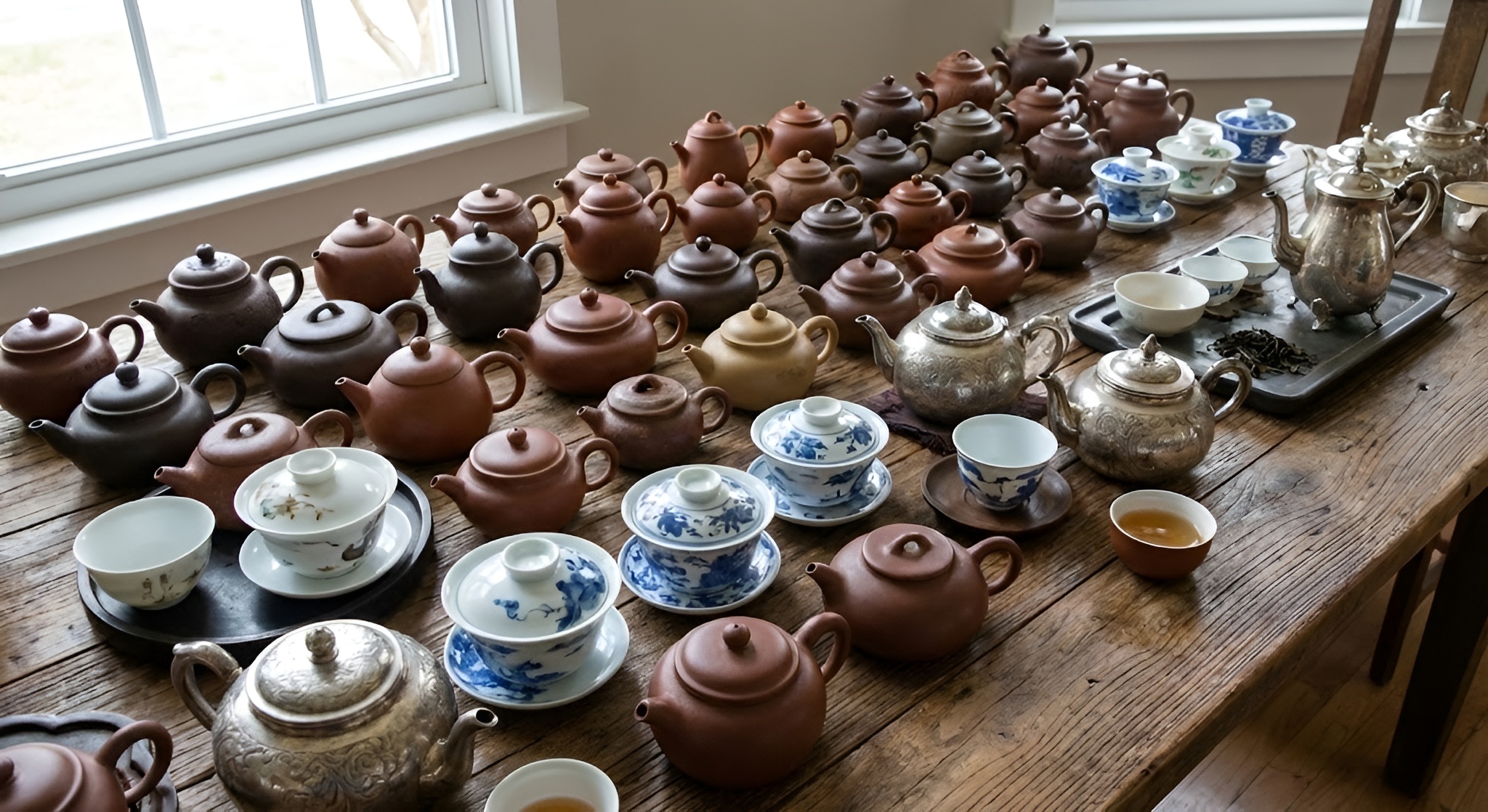
Brewing kit for the oxidation explorer: A variable-temperature kettle is non-negotiable—being able to hold 75 °C for your Silver Needle, 85 °C for Bao Zhong, and 100 °C for Keemun in the same session transforms your tasting accuracy. A small gaiwan (100–120 ml) or Yixing pot for Gongfu brewing unlocks the multi-steep potential of oolongs across the spectrum; a glass or porcelain mug with a built-in infuser works for Western-style brewing and side-by-side comparisons. If you're commuting or brewing at work, a quality all-in-one infuser mug with a deep basket and lid will handle everything from green to black, though you'll sacrifice some control over steep time. A tea strainer spoon is handy for quick single-cup tests when you're evaluating a new tea's oxidation level.
Storage strategy: Dedicate one airtight container per oxidation band—label them 'Low (0–20%)', 'Mid (20–50%)', 'High (50–100%)'—and store the low-oxidation bin in the fridge or a cool cupboard away from light. Within each bin, use individual foil or Mylar pouches to prevent cross-contamination of aromas (a floral Bao Zhong will pick up roasted notes from a nearby Da Hong Pao in days). For long-term cellaring of aged whites or special oolongs, vacuum-seal in 10–25 g portions so you can open one without exposing the rest to air. British homes typically run 18–22 °C and 50–70% RH year-round (higher in winter with heating, lower in summer)—acceptable for blacks and dark oolongs, marginal for greens and light oolongs without additional climate control.
Tasting progression for learners: Start at both ends—brew a Japanese sencha (0%) and an Assam orthodox black (90%) side by side to anchor the spectrum's extremes in your sensory memory. Then explore the middle: a 15% Bao Zhong, a 40% Dong Ding, a 60% Rou Gui. Note the colour gradient (pale green → amber → red-brown), the astringency curve (high → moderate → low), and the aroma shift (grassy → floral → fruity → malty). Repeat with the same water temperature and steep time to isolate oxidation as the variable. Once you can reliably blind-identify a light versus dark oolong, you've internalised the spectrum and can navigate the UK market—and any tea menu—with confidence. Many specialist retailers and tea schools in London, Bristol, and online now offer 'oxidation spectrum' tasting kits (five or six 10 g samples spanning 0–100%) for exactly this purpose; they're worth the £20–30 investment if you're serious about developing your palate.
Use a Tasting Journal to Map Your Preferences
Record each tea's claimed oxidation level, your actual brew parameters (temp, time, leaf weight), and your flavour impressions. After a dozen sessions, patterns emerge—most people discover a 'home range' (e.g. 30–50% oolongs, or 80–100% blacks) they return to, with occasional excursions. Knowing your range saves money and shelf space, and helps you ask better questions when you visit a new shop.


Comments