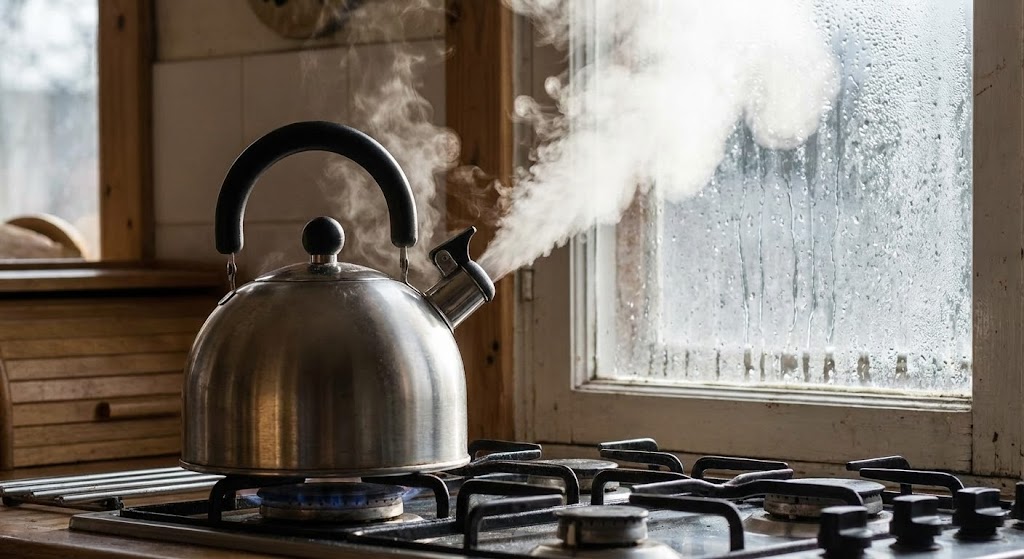
1. What Happens When Water Boils—and Reboils
Boiling drives off dissolved gases—chiefly oxygen, nitrogen, and carbon dioxide—because their solubility in water drops sharply as temperature rises. At 20 °C, fresh tap water typically holds 8–10 mg/L of dissolved oxygen; by the time it reaches 100 °C, that figure falls close to zero. When the kettle clicks off and water begins to cool, some oxygen re-dissolves from the air, but equilibrium takes time: water left standing for a few minutes will recover only a fraction of its original dissolved-gas load. Reboiling that same water repeats the cycle, and each iteration leaves progressively less opportunity for gas to return.
Minerals, by contrast, do not evaporate. Calcium, magnesium, bicarbonate, and trace elements remain in solution even at boiling point. The small volume of steam that escapes during boiling is almost pure H₂O, so if you were to boil away half a litre from a one-litre kettle, the remaining 500 mL would indeed contain double the original concentration of dissolved solids. But reboiling a full kettle once or twice loses only a few millilitres to vapour—far too little to cause meaningful concentration. The scare stories about 'dangerous' nitrate or fluoride build-up assume you are repeatedly topping up and boiling the same residue dozens of times, a scenario that rarely happens in domestic use.
The most relevant chemical shift is the loss of dissolved oxygen and CO₂. Oxygen contributes a faint sweetness and perceived 'liveliness' to water, though its direct flavour impact is modest; carbon dioxide, when dissolved, forms carbonic acid (H₂CO₃) and lowers pH slightly. Once driven off by boiling, CO₂ can re-enter from the atmosphere as the water cools, nudging pH back down. The net result is that freshly boiled water is briefly more alkaline, then drifts back toward its starting pH—or slightly lower if it sits open to air for an extended period.
2. Dissolved Oxygen: Measured Loss and Flavour Implications
Dissolved oxygen (DO) is often cited as the key variable in reboiled-water debates, and it is true that boiling strips most of it out. Laboratory measurements confirm that water at a rolling boil contains effectively zero dissolved O₂; upon cooling to 80 °C—a common temperature for green tea—DO might recover to 2–4 mg/L if the water is left exposed to air, compared with 8–10 mg/L in unboiled tap water. Reboiling that same batch will start from a lower baseline and yield even less dissolved oxygen once cooled.
Does this matter for tea flavour? The consensus among flavour chemists is that dissolved oxygen plays a minor role in aroma release and mouthfeel, but the effect is subtle and easily masked by other variables—water hardness, mineral composition, leaf quality, and brewing time all exert stronger influence. Some professional tasters report that tea brewed in low-DO water tastes marginally 'flatter' or less aromatic, particularly with delicate Japanese greens and high-altitude oolongs. Controlled sensory trials have produced mixed results: panels can sometimes distinguish fresh-boiled from reboiled water in side-by-side tests, but preference is inconsistent and the difference is small.
Practical takeaway: if you are brewing a rare, high-grade sencha or a floral Baozhong, filling the kettle fresh and boiling once is a low-cost way to preserve dissolved oxygen. For everyday black tea or roasted oolong, the difference is unlikely to be perceptible, and reboiling is perfectly acceptable.
Fresh Fill for Delicate Greens
If you're steeping a premium Japanese green, fill the kettle fresh and pour as soon as it's cooled to temperature—residual dissolved oxygen is highest in the first few minutes after boiling.
3. Mineral Concentration: Myth Versus Arithmetic
The claim that reboiling 'concentrates toxins' rests on a misunderstanding of evaporation rates. When a domestic kettle boils, only a small fraction of the total volume escapes as steam—typically 10–30 mL per boil, depending on kettle design and boiling duration. If you start with one litre of water at 150 mg/L total dissolved solids (TDS)—a typical figure for moderately hard UK tap water—and lose 20 mL to vapour, the remaining 980 mL will contain approximately 153 mg/L TDS, an increase of 2 per cent. Reboil that same water and you might reach 156 mg/L. These shifts are trivial and well within the natural variation in mains supply.
Where concentration does become measurable is in scenarios where the same small volume is repeatedly topped up and boiled—for example, a large commercial hot-water boiler that runs all day, or a kettle repeatedly filled to the minimum line and boiled ten or twenty times without emptying. In those cases, minerals such as calcium and magnesium can accumulate, and you will see faster limescale deposition on the element. But for home use—boiling a full kettle once, twice, or even three times before refilling—the arithmetic does not support the scare stories.
Nitrate and fluoride, the two compounds most often named in online warnings, are present in UK tap water at levels far below safety thresholds (the legal limit for nitrate is 50 mg/L, and most supplies sit well under 20 mg/L; fluoride, where added, is capped at 1 mg/L). Even if you somehow quintupled their concentration through repeated evaporation, you would still be nowhere near harmful levels. The genuine risk with reboiling is not toxicity but limescale build-up in hard-water areas, which shortens element life and can impart a chalky off-taste. For that reason, periodic descaling and occasional fresh fills are good practice—not because reboiled water is dangerous, but because residue accumulates.
Limescale, Not Toxins
In hard-water regions, reboiling accelerates limescale on the element. Descale monthly and rinse the kettle when you see white deposits—it's scale that affects taste, not 'concentrated' minerals in the water itself.
4. pH Shift and Carbon Dioxide Re-Absorption
Boiling drives off dissolved CO₂, which in turn raises pH temporarily. Fresh tap water in equilibrium with atmospheric carbon dioxide typically sits around pH 7.0–7.5 (slightly higher in hard-water areas due to bicarbonate buffering); immediately after boiling, pH can climb to 7.5–8.0 because the carbonic acid (H₂CO₃) formed by dissolved CO₂ has been expelled. As the water cools and sits open to air, CO₂ re-dissolves, pH drops back, and you may end up a few tenths of a pH unit lower than you started if the water has been left standing for an hour or more.
Reboiling that water repeats the cycle: pH rises again during the boil, then falls as it cools. The net effect over multiple boil–cool cycles is a gradual drift toward lower pH, though the magnitude is small—typically 0.1–0.3 units—and unlikely to cross a threshold that changes tea flavour noticeably. Tea scum formation is more strongly influenced by calcium and bicarbonate levels than by pH alone, so hard-water drinkers will see a film on their tea regardless of whether the water was boiled once or three times.
Practical implication: pH shifts from reboiling are real but minor. If you live in a soft-water area and want to maximise extraction of bright, acidic notes in a high-grown black tea, boiling fresh may offer a marginal edge. For most teas and most UK water supplies, the difference is academic.
5. Volatile Compounds: Chlorine, Chloramine, and Odours
Free chlorine evaporates readily during boiling, which is why a kettle-full of heavily chlorinated tap water tastes noticeably cleaner after the first boil. Chlorine is volatile, and even a brief period at 100 °C drives most of it into the air. Chloramine—a more stable disinfectant used by some UK water companies—is less volatile and breaks down more slowly, but extended boiling (several minutes) will still reduce it substantially. Once the chlorine or chloramine is gone, reboiling the same water will not remove it further, because there is nothing left to remove.
If your tap water has a strong chemical or musty odour, boiling once will help, but it is not a complete solution. Chloramine, geosmin (the earthy compound responsible for 'pond' smells), and certain organic volatiles are better handled by activated-carbon filtration before boiling. Reboiling already-treated water offers no additional benefit and may, in fact, concentrate any non-volatile organic residues that survived the first boil, though in practice these are present at such low levels that the effect is imperceptible.
Best practice: if you use a water filter or charcoal filter, fill the kettle with filtered water and boil once. Reboiling filtered water is fine, but you will not improve taste further by doing so. If you rely on unfiltered tap water and it smells of chlorine, boil once, let it cool, and use it; there is no flavour advantage to reboiling.
Filter First, Boil Once
A simple carbon filter removes chlorine and organic odours more effectively than multiple boils. Install a filter jug or in-kettle cartridge, then boil the filtered water once for best results.
6. Which Teas Are Most Sensitive to Reboiled Water?
Delicate, minimally oxidised teas—white tea, green tea, and lightly oxidised oolongs—are the styles most likely to show a perceptible difference when brewed in reboiled water. These teas rely on volatile aromatics and fresh, vegetal notes that can seem muted if dissolved oxygen is very low. Professional tasters brewing competition-grade Japanese greens or high-mountain Taiwanese oolongs often insist on fresh water for each session, and some describe reboiled water as producing a 'duller' or 'heavier' cup. The effect is real but marginal, and casual drinkers may not notice it at all.
Fully oxidised black teas, by contrast, are robust and less sensitive to dissolved-gas levels. The bold, malty flavours of an Assam or the brisk astringency of a Ceylon are driven more by polyphenol oxidation and theaflavin content than by dissolved oxygen. In side-by-side tests, most panels cannot reliably distinguish black tea brewed in fresh versus twice-boiled water, especially when milk is added. Milk's casein proteins bind polyphenols and mask subtle aroma differences, so for a builder's brew or a classic English breakfast, reboiling is entirely acceptable.
Roasted oolongs and aged teas—such as charcoal-roasted Tieguanyin or ripe pu-erh—are likewise forgiving. The roasting or fermentation processes develop stable, caramelised flavours that do not depend on high dissolved oxygen. If anything, slightly lower pH from reboiled water can accentuate sweetness in aged tea, though the effect is subtle. In summary: reboil with confidence for black tea, roasted oolong, and aged styles; consider a fresh fill for premium greens, whites, and floral high-mountain oolongs.
Match Water Freshness to Tea Grade
For everyday black tea or roasted oolong, reboiling is fine. Reserve fresh fills for competition-grade greens and delicate, high-aroma oolongs where every volatile counts.
7. Kettle Design, Standing Time, and Practical Hygiene
Kettle material influences how quickly water cools and, to a lesser extent, how much dissolved oxygen can re-enter. Stainless-steel and glass kettles are inert and do not leach flavours, but steel retains heat longer than glass, which means water cools—and re-oxygenates—more slowly. If you reboil water that has been sitting in a hot steel kettle for five minutes, it will have lower dissolved oxygen than water that cooled rapidly in a thin glass vessel. In practice, the difference is small, and other factors—fill volume, ambient temperature, lid position—matter more.
Standing time is critical. Water left in a kettle for hours or overnight will pick up dust, volatile organics from plastic components (if any), and atmospheric CO₂, all of which can impart off-flavours. Reboiling stale water that has been sitting since yesterday is more problematic than reboiling fresh water a second time within the same tea session. If you do leave water in the kettle, store it covered and use it within a few hours; beyond that, tip it out and start fresh. Limescale and biofilm can also accumulate in kettles that are refilled without rinsing, especially in hard-water areas. Periodic descaling and a quick rinse before refilling will do more for water quality than obsessing over the number of boils.
For high-volume or commercial use, electric water boilers and instant hot-water dispensers hold large volumes at temperature for extended periods. These systems often incorporate filters and automatic flushing to prevent staleness, but they are effectively 'reboiling' water continuously as it cycles through the heating element. Professional tea bars using such equipment pay close attention to water filtration and regularly purge the tank to maintain quality. For home users, a simple rule suffices: if the water has been sitting more than a few hours, tip it out and refill.
Empty the Kettle Overnight
Water left standing in the kettle picks up dust and volatiles. Tip out leftover water at the end of the day and fill fresh in the morning—staleness matters more than reboiling.
8. Practical Recommendations for UK Tea Drinkers
Reboiling water once or twice is harmless and, for most teas and most UK water supplies, has no perceptible impact on flavour. The measurable changes—slight loss of dissolved oxygen, trivial mineral concentration, minor pH drift—are real but small, and they matter only at the margins: premium greens, competition tastings, and very soft or very hard water. For everyday black tea, builder's tea with milk, or roasted oolong, reboil with confidence. The energy saved by not refilling the kettle every time is non-trivial over a year, and the environmental case for reboiling—reducing water waste and electricity use—is stronger than any flavour argument against it.
When to fill fresh: if you are brewing a high-value, delicate tea; if the water has been standing for more than a few hours; if your kettle has visible limescale or off-odours; or if you live in a hard-water area and want to avoid progressive scale build-up. In those scenarios, the small effort of refilling pays dividends. Otherwise, reboil freely. If taste is your priority and you suspect your tap water is the weak link, invest in a filter jug or purifier rather than worrying about the number of boils—starting water quality matters far more than whether you heat it once or twice.
Temperature accuracy is more important than boil count. Over-boiling or letting water sit too long before pouring will degrade flavour more reliably than reboiling per se. Use a thermometer or a temperature-controlled kettle for greens and whites, and pour promptly once the water reaches the target. If you do reboil, bring the water back to a full boil rather than stopping short—partial reheating can leave the kettle's element encrusted with limescale and may not reach temperatures high enough to suppress bacterial growth if the water is old. Boil decisively, cool to the right temperature, and pour. That simple discipline will do more for your cup than any fetish about fresh versus reboiled water.
Comments