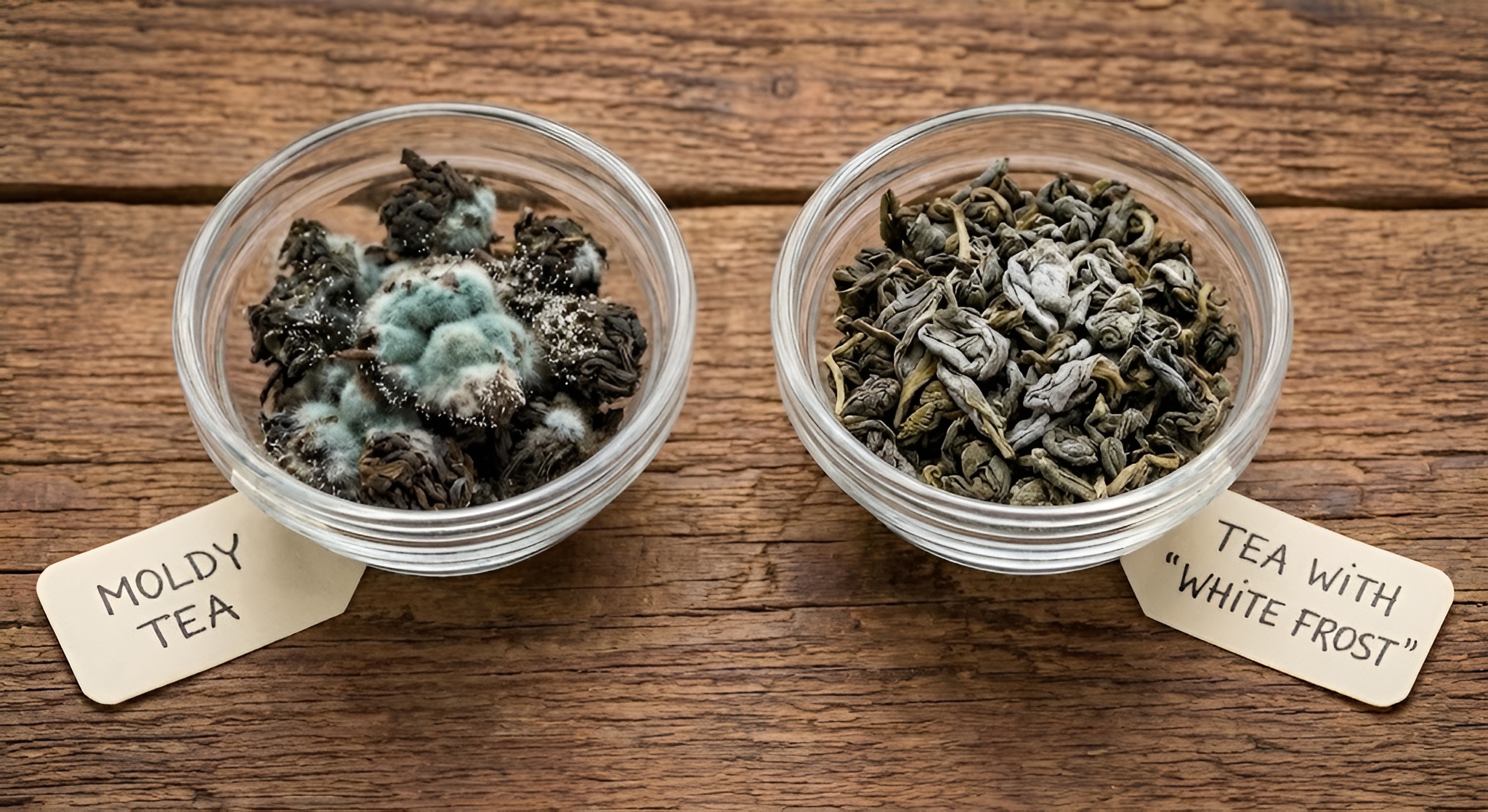
1. Introduction: The Micro-Ecological Complexity of Post-Fermented Tea
However, unlike green or oolong teas, which are defined by enzymatic oxidation and thermal fixing, post-fermented teas are defined by microbial activity. They are, in a very literal sense, "living" food products. The maturation of a vintage Pu-erh cake over decades is not merely a chemical oxidation process but a succession of ecological states dominated by bacteria, yeasts, and filamentous fungi.1
For the collector, the investor, and the consumer, this biological reality presents a critical diagnostic challenge. The appearance of white, yellow, or green substances on the surface of a tea cake represents a narrow threshold between desirable maturation and pathological spoilage. Is the substance "Bai Shuang" (White Frost), a crystalline precipitate indicative of high polyphenol content and successful aging? Is it "Jin Hua" (Golden Flower), a prized probiotic colonization? Or is it a mycotoxic fungal colony like Aspergillus flavus or Penicillium? The stakes of this distinction are high. On one hand, misidentifying a benign crystalline bloom as mold can lead to the destruction of valuable, high-quality tea. On the other, consuming tea contaminated with aflatoxins or ochratoxins poses significant chronic health risks.2 This report provides an exhaustive, multi-disciplinary analysis of the chemical and biological phenomena occurring on the surface of aged teas. By synthesizing data from mycology, food chemistry, agricultural storage science, and historical production techniques, we establish a definitive framework for distinguishing between abiotic precipitates, beneficial probiotic colonization, and harmful spoilage organisms. Furthermore, we examine the storage dynamics that promote these states, offering rigorous protocols for environmental control to mitigate risk while preserving the integrity of the tea.
Part of a Series
This article is part of our Tea Storage & Aging Series. Check out our other deep dives:
What is a Pumidor? The Science of Storage →
How to Build Your Own Pumidor (DIY Guide) →
1.1 The Nature of Post-Fermentation: A Living Substrate
To understand surface phenomena, one must first understand the substrate. Puerh and Dark Tea are unique in that they undergo "Wo Dui" (wet piling) or prolonged dry aging. These processes are designed to cultivate a microbiome. Unlike "black tea" which is fully oxidized by endogenous enzymes, dark tea is "post-fermented" by exogenous microbes.1 The tea leaf itself acts as a nutrient source, providing polysaccharides, catechins, and proteins. As the tea ages, microbial enzymes break these large molecules down. Eurotium cristatum, for instance, secretes amylases and oxidases that transform astringent catechins into smoother theabrownins and theaflavins.4 This biological activity generates heat, moisture, and metabolites. The "surface" of the tea cake is the interface between this internal metabolic engine and the external environment. Consequently, visual changes on the surface are often external manifestations of these internal biochemical engines. A "white frost" is often the migration of internal lipids and flavonoids to the surface; a "golden flower" is the fruiting body of the internal fermenter. Understanding the difference requires a nuanced understanding of this "living" status, moving beyond the binary of "clean vs. dirty" to a spectrum of "biotic vs. abiotic" and "symbiotic vs. pathogenic".6
2. 'Bai Shuang' (White Frost): Chemical Composition and Formation Mechanisms
The phenomenon known as "Bai Shuang" or "White Frost" is frequently observed on high-quality aged Pu-erh, particularly those co-fermented with citrus (Xiao Qing Gan) or specific varieties of Oolong and green tea like Liu An Gua Pian. To the untrained eye, this white dusting mimics the appearance of early-stage mold growth, specifically the hyphal development of white molds. However, comprehensive chemical analysis reveals a fundamentally different origin and composition.
2.1 Chemical Constituents of White Frost
"White Frost" is primarily a crystalline precipitate formed by the migration of volatile oils, flavonoids, and alkaloids to the surface of the tea or its citrus container. It is an abiotic substance—it is not alive, does not reproduce, and does not produce spores.
2.1.1 Flavonoid Precipitation in Camellia and Vine Teas
In the context of standard tea leaves (Camellia sinensis) and related species like Vine Tea (Ampelopsis grossedentata), the white frost often consists of crystallized catechins and flavonoid glycosides. Research indicates that the content of flavonoids in certain vine teas can reach upwards of 40%. During processing, particularly steps that involve rolling or maceration, the original cellular structure of the leaf is damaged.7 This mechanical disruption releases cell sap rich in flavonoids. As the leaves undergo drying, the moisture content evaporates, but the heavy solute load (the flavonoids) remains. When the concentration of these compounds exceeds their solubility limit in the remaining moisture, they precipitate out of solution. This forms "white frost-like solids" on the surface of the leaves. This is not a defect; rather, it is a marker of high phytochemical density. Experimental groups of vine tea processed for 3, 6, and 9 hours showed progressive accumulation of this frost, confirming that it is a time-dependent physical migration of internal compounds.7
Expert Tip: The "White Frost" Mechanism
White frost is caused by capillary migration. As internal moisture moves to the surface to evaporate, it carries dissolved oils, caffeine, and sugars. When the water evaporates, these solids are left behind, crystallizing like salt on a drying ocean rock. It is physics, not biology.10
2.1.3 Citrus Oil Crystallization (Limonene and Hesperidin)
The most prominent and frequently misunderstood manifestation of white frost occurs in Xiao Qing Gan (Green Mandarin Pu-erh) and Ganpu tea. Here, the tea leaves are packed inside a hollowed-out mandarin peel. The "frost" that forms on the peel is a crystallization of citrus oils.10 D-Limonene: A volatile oil abundant in citrus rinds. Hesperidin: A flavanone glycoside. Research comparing raw Pu-erh with Ganpu tea revealed significant chemical disparities. While phenolic acids decreased during the co-fermentation, quercetin glycosides, myricetin glycosides, and significantly, hesperidin, increased substantially.11 Hesperidin, previously believed to exist solely in the citrus peel, was found to migrate into the Pu-erh tea leaves during the co-fermentation process. The "white frost" on the peel is essentially a bloom of these compounds. It occurs after the sun-drying and low-temperature baking processes. These thermal cycles cause the volatile oils to expand and seep through the pores of the peel. Upon hitting the air and cooling, they crystallize. This frost is rich in limonene, giving it a potent lemon-like fragrance and therapeutic properties such as cough relief.10
2.3 Visual, Olfactory, and Tactile Differentiation from Mold
Distinguishing Bai Shuang from mold is critical for consumer safety. The following characteristics are definitive and can be assessed without laboratory equipment.
| Feature | White Frost (Bai Shuang) | White Mold (Early Spoilage) |
|---|---|---|
| Origin | Abiotic precipitation of oils/flavonoids7 | Biotic growth of fungal mycelium14 |
| Structure | Crystalline, geometric, granular12 | Filamentous, fuzzy, thread-like13 |
| Scent | Fragrant, Citrus, Sweet, Tea-like10 | Musty, Damp, Earthy (Bad), Sour14 |
| Touch | Dry, sandy, powdery10 | Sticky, slimy, soft, smeary14 |
| Distribution | Often uniform coating or following veins | Patchy, circular colonies, irregular spots |
| Reaction to Heat | Melts or burns to ash (sugar/oil)15 | Shrivels, smells like burning protein/hair16 |
3. The 'Golden Flower' (Eurotium cristatum): Beneficial Mycology
While white frost is non-living chemistry, "Golden Flowers" (Jin Hua) represent a specific, highly desirable biological colonization. This phenomenon is most famous in Fuzhuan brick tea (a type of Dark Tea) but can occur in aged Pu-erh under specific conditions. Understanding Eurotium cristatum is essential to differentiating "good mold" from "bad mold" and debunking the myth that all fungal growth is harmful.
3.1 Taxonomy and Genomic Profile
Eurotium cristatum is the sexual state (teleomorph) of Aspergillus cristatus. It is a xerophilic fungus, meaning it thrives in environments with relatively low water activity ($a_w$) where other bacteria and pathogenic fungi cannot compete.17
Expert Tip: Identifying "Golden Flowers"
Golden Flowers (E. cristatum) look like tiny yellow granules or seeds (like millet), not fuzz. They often grow inside the brick, not just on the surface. They smell sweet and mushroomy, never sour or rotting.13
3.3 Health Implications: The Probiotic Fungus
Eurotium cristatum is widely recognized in scientific literature as a probiotic fungus. Its safety and benefits have been validated through various studies. Modulation of Gut Microbiota: Research on rat models has shown that E. cristatum (strain EC-520) significantly enhances the intestinal barrier and modulates the gut microbiome. It significantly increases the abundance of beneficial bacteria such as Bacteroidota and reduces harmful Proteobacteria.20
4. Pathogenic Contamination: Identifying Harmful Molds
Not all fungal growth on tea is benign. Improper storage—specifically excessive humidity (>75% RH), condensation events, and lack of airflow—can lead to the proliferation of mycotoxigenic fungi. The most common contaminants in tea are species of Aspergillus (other than cristatum), Penicillium, and Rhizopus.2
4.1 The Spectrum of "Bad" Mold
Unlike the uniform crystalline appearance of frost or the specific golden granules of E. cristatum, harmful molds exhibit a variety of alarming visual and olfactory characteristics. Green and Blue Mold (Penicillium spp.): This is the most common spoilage phenotype in Puerh. It typically appears as fuzzy patches in shades of blue-green or grey-green. This color is distinct from the natural "jade green" of dry tea leaves. It indicates significant moisture damage and "Wet Storage" failure.23 Black Mold (Aspergillus niger variants): While A. niger is used in industrial fermentation, uncontrolled black mold on tea suggests advanced decomposition. If accompanied by slime or a "wet dog" odor, it indicates that the tea has been wet for a prolonged period.14 Web-like/Hairy Growth (Rhizopus and Mucor): These fungi are characterized by distinct "hairy" strands (mycelium) that bridge gaps between tea leaves or cover the cake in a grey/white web ("cobwebs"). This appearance is fundamentally different from the powdery nature of white frost. These are fast-growing "sugar fungi" that attack accessible carbohydrates.13
5. Storage Dynamics: The Engineering of Aging
The presence of mold or frost is ultimately a function of storage conditions. The debate between "Wet Storage" (Shi Cang) and "Dry Storage" (Gan Cang) defines the Pu-erh world, but the line between "Wet" and "Moldy" is maintained by rigorous physics and environmental engineering.
5.1 The "Goldilocks Zone" of Humidity
Data from tea storage experts and mycologists suggests that the ideal Relative Humidity (RH) for aging Pu-erh in a home environment is between 60% and 70%.26 The Risk of Low Humidity (< 55% RH): If RH drops below 55%, the hygroscopic water within the tea leaf evaporates. The tea enters a dormant state where enzymatic and microbial activity stalls. Consequence: The tea stops aging.28 The Risk of High Humidity (> 72-75% RH): This is the "Danger Zone." At this level of ambient humidity, the equilibrium moisture content (EMC) of the tea leaf rises to a point where Water Activity ($a_w$) becomes sufficient for the germination of spoilage spores. Consequence: Aspergillus flavus and Penicillium spores germinate. Rapid mold bloom occurs.30
5.2 The "Pumidor" Solution: Construction and Management
For collectors in non-native climates (e.g., dry Western winters or variable temperate zones), the "Pumidor" (Pu-erh Humidor) is the standard solution. This involves creating a micro-environment using a modified fridge, wine cooler, or sealed Mylar system.26 Active Humidity Control: The use of two-way humidity control packs (specifically Boveda) is the industry standard for maintaining equilibrium. Recommended Levels: 69% RH or 65% RH packs are most commonly used.27 Hygrometer Calibration: Cheap digital hygrometers are notoriously inaccurate. The "Salt Test" is the gold standard for calibration.35
7. Remediation and Safety: Can Moldy Tea Be Saved?
When a collector discovers growth on a tea cake, the decision to salvage or discard is complex. The internet is rife with conflicting advice, ranging from "brush it off" to "burn it." A scientific approach dictates a risk-based assessment.
Expert Tip: The "Brush and Sun" Protocol
For minor white surface mold only:
1. Brush gently with a soft toothbrush outdoors.
2. UV Sterilize by exposing to indirect morning sunlight for 1-2 hours.
3. Air Out in a dry room (50% RH) for 2 weeks to force the mold into dormancy.40
Expert Tip: The "Rinse" Myth
Rinsing tea with boiling water kills active bacteria, but it does not remove mycotoxins like aflatoxin, which are stable up to 230°C. If the tea has toxic mold (green/blue/black), boiling water will not make it safe. Discard it.25
9. Conclusion
The distinction between "Bai Shuang" (White Frost) and mold is not merely a matter of semantics but of fundamental chemistry and microbiology. White frost is an abiotic crystalline precipitate of valuable tea compounds (oils, flavonoids), signaling quality and aging potential. "Golden Flowers" are a specific, beneficial fungal colonization (Eurotium cristatum) that enhances the tea's health profile through enzymatic transformation. True spoilage mold, characterized by fuzzy textures, off-colors (green/black), and offensive odors, represents a health risk due to potential mycotoxin production.
Final Verdict: The Sensory Checklist
Verify Crystals: Use a loupe. Geometric crystals = Frost. Threads = Mold.
Trust the Nose: Clean earth/citrus = Good. Sharp mildew/ammonia = Bad.
Safety First: When in doubt—especially with green/blue mold—discard.
Works Cited
- Anhua Dark Tea 101: 10 Essential Facts You Need to Know, accessed November 26, 2025, https://chineseteaalliance.com/blogs/tea-magazine/anhua-dark-tea-101-10-essential-facts-you-need-to-know
- Identification and quantification of fungi and mycotoxins from Pu-erh tea - PubMed, accessed November 26, 2025, https://pubmed.ncbi.nlm.nih.gov/23973844/
- Mycotoxins in Tea: Occurrence, Methods of Determination and Risk Evaluation - PMC - NIH, accessed November 26, 2025, https://pmc.ncbi.nlm.nih.gov/articles/PMC6266826/
- Overview of Eurotium cristatum and its Fermentation Application in Tea, accessed November 26, 2025, https://www.xiahepublishing.com/2835-6357/FIM-2023-00077
- Overview of eurotium cristatum and its fermentation application in tea - EurekAlert!, accessed November 26, 2025, https://www.eurekalert.org/news-releases/1047846
- Is Pu-erh Tea Moldy? Understanding Its Unique Fermentation-TeaTsy Official Website, accessed November 26, 2025, https://teatsy.com/blogs/blog/is-pu-erh-tea-moldy-understanding-its-unique-fermentation
- Widely targeted metabolomic analysis reveals effects of yellowing process time on the flavor of vine tea (Ampelopsis grossedentata) - PMC - PubMed Central, accessed November 26, 2025, https://pmc.ncbi.nlm.nih.gov/articles/PMC11154209/
- The Mechanism of Frost-like Powder and Its Effects on Lu′anguapian Tea Quality, accessed November 26, 2025, https://www.tea-science.com/EN/10.13305/j.cnki.jts.2018.05.006
- Green tea Melon Seeds - Liu An Gua Pian 六安瓜片 - History and Processing | GoodTea.eu, accessed November 26, 2025, https://www.goodtea.eu/a/green-tea-melon-seeds-liu-an-gua-pian-history-and-processing
- What's the white frost on little orange pu erh tea? - Teasenz.eu, accessed November 26, 2025, https://teasenz.eu/blogs/tea-magazine/white-frost-mold-little-orange-pu-erh-tea
- Xinhui Puerh (Ganpu Cha): Mandarin Tea - Wanderlustea, accessed November 26, 2025, https://www.wanderlustea.com/post/xinhui-puerh-ganpu-cha-mandarin-tea
- Pu-erh white frost vs mould - Valley Green Tea, accessed November 26, 2025, https://www.valleygreentea.com.au/pu-erh-tea/pu-erh-white-frost-vs-mould.html
- What Is the Golden Flower in Fu Brick Tea? A Deep Look at Jīn Huā - Orientaleaf, accessed November 26, 2025, https://orientaleaf.com/blogs/tea-101/what-is-the-golden-flower-in-fu-tea
- Mold In Puer Tea: Friend or Foe? - J-TEA INTERNATIONAL LLC, accessed November 26, 2025, https://jteainternational.com/blog/mold-in-puer-tea-friend-or-foe/
- The Burn Test To Identify Textile Fibers 1 | PDF - Scribd, accessed November 26, 2025, https://www.scribd.com/document/584386894/The-Burn-Test-to-Identify-Textile-Fibers-1
- Forensics - Wiki - Scioly.org, accessed November 26, 2025, https://scioly.org/wiki/Forensics
- Inhibitory Effects of Eurotium cristatum on Growth and Aflatoxin B1 Biosynthesis in Aspergillus flavus - Frontiers, accessed November 26, 2025, https://www.frontiersin.org/journals/microbiology/articles/10.3389/fmicb.2020.00921/full
- Everything About Fu Brick Tea: Health Benefits, Brewing & Beyond - Orientaleaf, accessed November 26, 2025, https://orientaleaf.com/blogs/tea-101/everything-about-golden-flower-fuzhuan-brick-tea
- Comparative analysis of Eurotium cristatum E1 and Aspergillus cristatus... - ResearchGate, accessed November 26, 2025, https://www.researchgate.net/figure/Comparative-analysis-of-Eurotium-cristatum-E1-and-Aspergillus-cristatus-GZAAS-201005_fig3_358671814
- Genomic Characterization and Functional Evaluation of Eurotium cristatum EC-520: Impacts on Colon Barrier Integrity, Gut Microbiota, and Metabolite Profile in Rats - MDPI, accessed November 26, 2025, https://www.mdpi.com/2304-8158/14/9/1569
- KR20140103590A - Eurotium cristatum sp. strain, golden flower fungi isolated from Chinese Fuzhuan brick-tea - Google Patents, accessed November 26, 2025, https://patents.google.com/patent/KR20140103590A/en
- Using the Eurotium cristatum Fungus for Preparing Fermented Herbal Teas - ResearchGate, accessed November 26, 2025, https://www.researchgate.net/publication/351878491_Using_the_Eurotium_cristatum_Fungus_for_Preparing_Fermented_Herbal_Teas
- Pu-Erh Cake -- Is this Mold? : r/tea - Reddit, accessed November 26, 2025, https://www.reddit.com/r/tea/comments/16zv7gi/puerh_cake_is_this_mold/
- This is mold? : r/puer - Reddit, accessed November 26, 2025, https://www.reddit.com/r/puer/comments/16smxc5/this_is_mold/
- Would you consider pan frying your tea leaves if they smelt moldy or seemed like moisture caught them in a clump? - Reddit, accessed November 26, 2025, https://www.reddit.com/r/tea/comments/1ophdqt/would_you_consider_pan_frying_your_tea_leaves_if/
- Wet vs Dry Storage Puerh: Mastering Aging for Flavor & Investment - Orientaleaf, accessed November 26, 2025, https://orientaleaf.com/blogs/tea-101/puerh-wet-vs-dry-storage-guide
- Master Pu-erh Tea Storage: 7 Secret Tips for Perfect Aging in 2025 - Orientaleaf, accessed November 26, 2025, https://orientaleaf.com/blogs/tea-101/pu-erh-tea-storage-guide
- 5 Golden Rules of Tea Storage - white2tea, accessed November 26, 2025, https://white2tea.com/blogs/blog/5-golden-rules-of-tea-storage-puer-tea-puerh
- How To Store Pu-erh At Home For Aging, accessed November 26, 2025, https://pathofcha.com/blogs/all-about-tea/how-to-store-pu-erh-at-home-for-aging
- Correcting Your Storage & Preventing Mold. What are Safe Parameters? - TeaDB, accessed November 26, 2025, https://teadb.org/correcting-your-storage-preventing-mold/
- Ideas of proper puerh storage - A Tea Addict's Journal, accessed November 26, 2025, https://marshaln.com/2012/03/ideas-of-proper-puerh-storage/
- Question about storing Pu-ehr. Beyond the basics : r/puer - Reddit, accessed November 26, 2025, https://www.reddit.com/r/puer/comments/yk8vfx/question_about_storing_puehr_beyond_the_basics/
- Pumidors 101. Designing & Maintain Your Own Pumidor - TeaDB, accessed November 26, 2025, https://teadb.org/pumidors-101-designing-maintain-your-own-pumidor/
- Aging and storing puerh in the west, accessed November 26, 2025, https://puerh.uk/2022/03/26/aging-and-storing-puerh-in-the-west/
- What are the most accurate ways to calibrate hygrometers? - ThermoPro, accessed November 26, 2025, https://buythermopro.com/blogs/news/accurate-ways-to-calibrate-hygrometers
- Hygrometer Calibration Kit (75% RH) - Boveda packs, accessed November 26, 2025, https://store.bovedainc.com/products/calibration-kit
- What is the White Stuff on Mandarin Orange Pu-erh? - Teavivre, accessed November 26, 2025, https://www.teavivre.com/info/the-white-stuff-on-mandarin-orange-pu-erh.html
- Does ultraviolet (UV) radiation from UV lamps kill mold? | US EPA, accessed November 26, 2025, https://www.epa.gov/mold/does-ultraviolet-uv-radiation-uv-lamps-kill-mold
- Why Is Sunshine The Best Way To Kill Mould Naturally? - Mouldmen, accessed November 26, 2025, https://www.mouldmen.com/sunshine-mould/
- Mold - Steepster, accessed November 26, 2025, https://steepster.com/discuss/13434-mold
- How to proceed with moldy pu erh? : r/tea - Reddit, accessed November 26, 2025, https://www.reddit.com/r/tea/comments/vvrhjx/how_to_proceed_with_moldy_pu_erh/
- Pu Erh Mold? : r/puer - Reddit, accessed November 26, 2025, https://www.reddit.com/r/puer/comments/1mxyjye/pu_erh_mold/