1. What Thermal Shock Is and Why Teapots Crack
Thermal shock is the mechanical stress induced when a temperature change occurs faster than heat can diffuse through the material. Ceramics are brittle; they tolerate compression well but fracture under tension. When boiling water floods a cold teapot, the inner surface expands rapidly while the outer surface remains cool. Because the layers cannot expand in unison, tensile stress builds in the outer wall. If that stress exceeds the ceramic's tensile strength, a crack propagates—often starting at a flaw, a thin spot, or an attachment seam where geometry concentrates force.
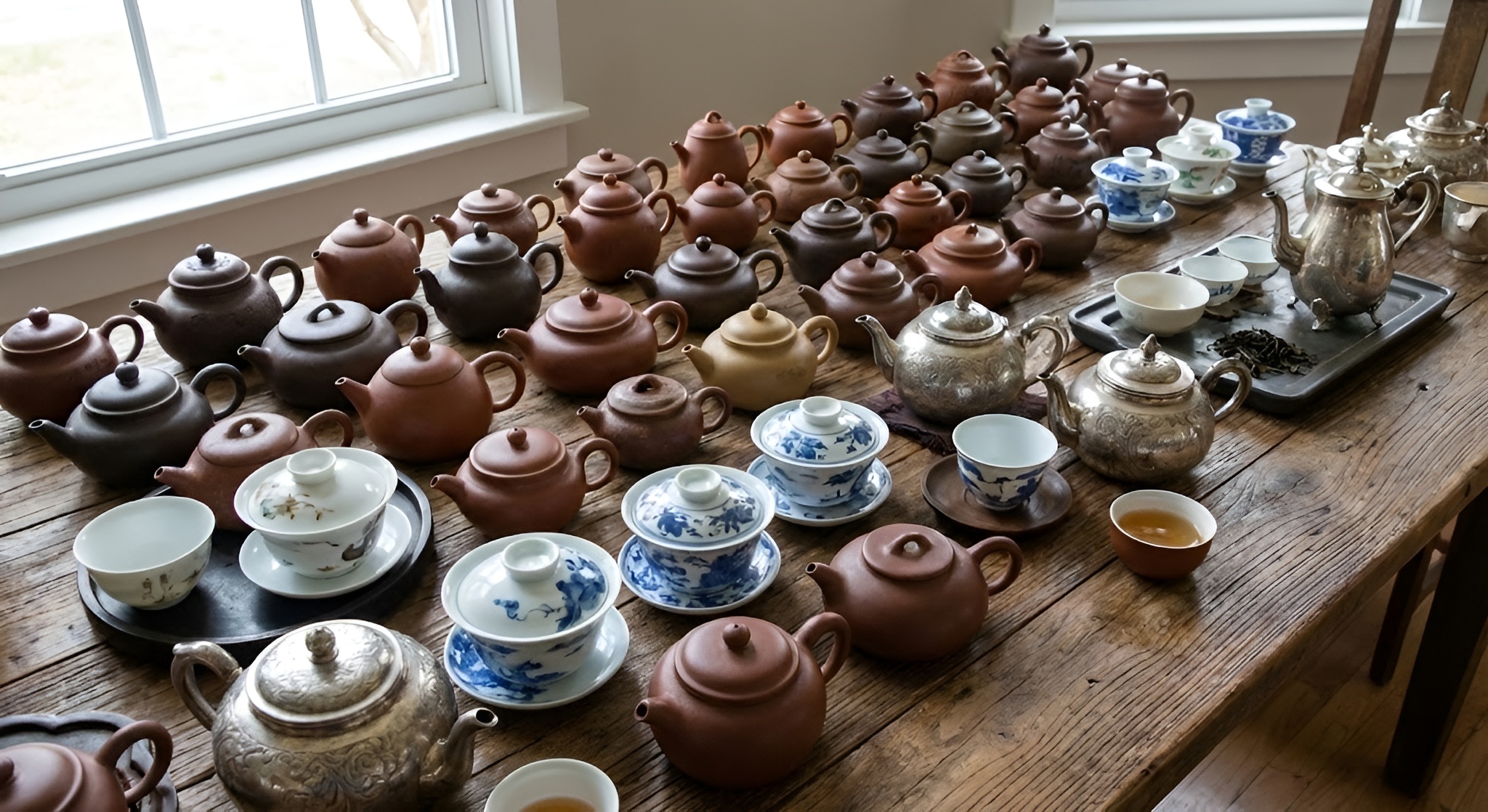
The severity of thermal shock depends on three interrelated properties: the coefficient of thermal expansion (CTE), which quantifies how much the material grows per degree; thermal conductivity, which governs how quickly heat spreads; and Young's modulus, a measure of stiffness. High CTE and low conductivity is the worst combination—expansion is large but uneven. Porcelain, for example, has a CTE around 4–7 × 10⁻⁶ /°C and relatively low conductivity; thick-bodied stoneware has similar CTE but often greater mass and conductivity, spreading the gradient over time. Unglazed high-fired clays like those used in Yixing and Tokoname pots offer moderate CTE and decent conductivity, but their walls are often thin, so the gradient is steep.
Geometry amplifies or mitigates shock. Thin walls heat faster and equalise temperature more quickly, reducing the duration of stress—but they also have less material to absorb force. A squat, thick-walled pot distributes stress over a larger cross-section; a tall, narrow vessel with a thin base concentrates it. Vessel shape physics predict that corners, joins, and abrupt thickness changes act as stress risers, sites where microfractures nucleate. That is why handles and spouts—where clay slabs meet or where glaze pooling creates differential expansion—are the most common initiation points for visible cracks.
The Cold-Base Failure Mode
Most cracks start at the base-to-wall junction, where the pot rests on a cold counter and the walls above receive hot water first. Elevating the pot on a wooden trivet or cloth before preheating reduces this gradient by insulating the base.
2. Material Composition and Thermal-Shock Resistance
Not all ceramics are equally fragile. Porcelain—a high-fired vitreous body of kaolin, feldspar and quartz—is prized for translucency and a smooth, non-porous surface, but its low thermal conductivity and moderate CTE make it vulnerable to rapid temperature swings. Fine bone china, which incorporates calcined bone ash, has a lower CTE than hard-paste porcelain and slightly better shock resistance, but remains delicate. By contrast, stoneware—fired at 1200–1300 °C from ball clay, kaolin and feldspar—is denser, less vitreous, and often thicker-walled, giving it superior shock tolerance. Industrial hotel-ware stoneware is engineered for repeated thermal cycling; artisan stoneware varies widely depending on clay blend and firing schedule.
Unglazed high-fired clays occupy a middle ground. Yixing zisha (purple sand) comprises iron-rich clays with quartz and mica; firing near 1150–1200 °C yields a semi-porous, moderately conductive body. Because there is no glaze, there is no glaze-body CTE mismatch—one fewer failure mode. Chaozhou red clay and Tokoname shudei are similar in profile. Yet all three are typically thin-walled to optimise heat retention and tea flavour, so absolute shock resistance is lower than thick stoneware, even though the material itself is robust. Japanese Banko-ware, often featuring a high proportion of petalite (a lithium aluminium silicate), has an exceptionally low CTE—around 2–3 × 10⁻⁶ /°C—and is among the most shock-resistant traditional teapot materials.
Glazes add complexity. A glaze is a thin glass layer fused to the clay body; if its CTE does not closely match the body's, cooling after firing locks in residual stress. A glaze with higher CTE than the body goes into compression, making the surface durable but increasing the risk that thermal cycling will flex the interface and cause crazing—a network of fine cracks in the glaze itself. Crazing is mostly cosmetic, though it can trap tea scum and limescale. A glaze with lower CTE than the body goes into tension and may spall or chip. Modern glazing chemistry uses computer-modelled fit, but many artisan and vintage pots were glazed empirically, and mismatch is common. Repeated thermal shock can propagate a craze through the glaze into the body, turning a cosmetic flaw into a structural fracture.
3. The Physics of Preheating and Gradient Reduction
Preheating is the single most effective intervention to prevent thermal shock. The goal is to raise the pot's baseline temperature so that the differential when boiling water enters is smaller. Pouring 80 °C water into a pot that sits at 20 °C imposes a 60 °C gradient; preheating the pot to 50 °C reduces the gradient to 30 °C—half the stress, dramatically lower fracture probability. The exact temperature gain depends on preheat water temperature, duration, wall thickness, and ambient conditions, but even a brief rinse with hot tap water (typically 55–65 °C in the UK) can raise a thin-walled pot by 25–35 °C.
The mechanism is simple conduction. Hot water in contact with the inner wall transfers heat through the ceramic until the outer surface equilibrates. Thin walls reach equilibrium in 20–40 seconds; thick stoneware may require 60–90 seconds. The Biot number—a dimensionless ratio of internal thermal resistance to surface resistance—predicts whether a pot heats uniformly (low Biot, thin wall, high conductivity) or develops a lingering gradient (high Biot, thick wall, low conductivity). For most teapots, a single preheat rinse lasting 30–60 seconds, swirling the water to contact all surfaces, is sufficient. Discarding the preheat water and immediately adding brew-temperature water minimises the time the pot spends cooling back toward ambient, preserving the thermal advantage.
Some practitioners advocate staged preheating: a first rinse with warm water (50–60 °C), a second with hotter water (75–85 °C), and finally the boiling brew water. This approach is conservative and effective for valuable or known-fragile pots, though it adds time and water. The principle is to step the temperature in increments smaller than the shock threshold, never exceeding the material's gradient tolerance. There is no universal threshold—published data for historical teapot clays is sparse—but anecdotal workshop experience and ceramic engineering literature suggest that ΔT > 60 °C in under 10 seconds is high-risk for fine porcelain, while stoneware and Banko-ware tolerate ΔT > 80 °C. Preheating brings every vessel into the safer range.
The Two-Rinse Rule
For any pot worth over £100, or any porcelain pot, always preheat twice: once with hot tap water, once with near-boil water from the kettle. The second rinse also warms the lid and ensures uniform temperature before the first infusion.
4. Attachment Points, Stress Concentration and Common Fracture Sites
Handles, spouts and lid-seat rims are the Achilles' heel of teapot design. Each represents a discontinuity—a change in geometry, thickness or material continuity—that concentrates stress during thermal expansion. A handle is typically a separate clay extrusion or pulled form, attached to the body by slip (liquid clay) and firing. The bond is strong, but the joint creates a line where the expansion of two masses—body and handle—must synchronise. If one expands faster, shear stress builds along the seam. A sudden thermal shock can snap the handle off cleanly or propagate a crack into the pot wall.
Spouts follow similar mechanics. A spout may be thrown separately and luted on, or cut from the body wall and formed in place. The latter is structurally superior—no seam—but the thinning of the wall around the spout base, and the abrupt change in thickness, creates a stress riser. Spouts also cool faster than the body (greater surface-to-volume ratio), exacerbating gradients. Handles insulated by wrapping (rattan, cane) fare better because the wrap slows heat loss; bare clay handles in direct contact with cold air are more vulnerable. Lid-seat rims, being thin and exposed, expand and contract more than the body; chips and cracks here are common after repeated lid-on-during-preheat cycles, when steam pressure and thermal expansion combine.
Fractures at the base are equally frequent but less visible until leakage begins. The base is often thicker than the walls (for stability) and rests on a cold surface, so it lags in temperature. When boiling water fills the pot, the walls expand upward and outward while the base remains cool, creating tension at the junction. Over time, micro-cracks accumulate; a single severe shock event can propagate them into a visible fracture. Elevating the pot on an insulating surface during preheat and use, and never placing a hot pot directly onto cold stone or metal, reduces base stress substantially.
5. Preheating Protocols for Different Teapot Materials
A one-size protocol does not fit all teapots. Porcelain demands caution: preheat with 60–70 °C water (hot tap in most UK homes), let stand 30 seconds, discard, then add 85–95 °C water, stand 20 seconds, discard, and finally brew. Never pour boiling water directly into a cold porcelain pot. For bone china, which has slightly lower CTE, the same staged protocol is advisable, though a single 75 °C preheat may suffice if the pot is known to be robust. Always check the base for manufacturer guidance; vintage or hand-thrown porcelain may be more fragile than modern industrial ware.
Yixing, Chaozhou and Tokoname unglazed clays benefit from preheating but tolerate steeper gradients than porcelain. A single rinse with 90–95 °C water, swirled for 20–30 seconds, is usually adequate. Because these pots are used daily in gongfu practice, they remain at or near room temperature only briefly; regular use seasons the clay and may slightly improve shock tolerance through micro-structural changes and oil infusion, though hard evidence for this is anecdotal. Do not assume an aged Yixing pot is indestructible—always preheat. Stoneware is the most forgiving: a single hot-tap preheat or even none at all may be safe, but best practice remains one 80 °C rinse to ensure even heating and to warm any glaze layer uniformly.
Banko-ware and other petalite-heavy clays are engineered for direct heat (some Banko pots are stovetop-safe). Preheating is still courteous to the material, but a single 95 °C rinse is sufficient. For any teapot used with cold-brew or iced tea, reverse shock—filling a warm pot with ice-cold water—poses similar fracture risk; let the pot cool to room temperature first, or use a dedicated cold-brew vessel. Infuser baskets and internal fittings (often stainless steel or silicone) have vastly different CTE from ceramic, so minimise metal-ceramic contact during rapid temperature changes.
The Ambient-Temperature Rule
A pot that has been in a cold room overnight is at true ambient; one that just finished a session may still be 10–15 °C above room temperature, reducing shock risk. Touch the base—if it feels warm, you can skip the first preheat stage.
6. Identifying Damage: Crazing, Hairline Cracks and Structural Fractures
Not every crack is catastrophic, and not every crazing line signals failure. Crazing is a network of fine lines in the glaze caused by CTE mismatch or thermal cycling. It is cosmetic—the clay body beneath remains intact—but it does compromise the glaze's barrier function. Tea scum and limescale accumulate in crazed glaze, darkening the lines over time. In UK hard-water areas, crazing can become unsightly within months. Crazing does not weaken the pot structurally, but it can propagate into the body if thermal cycling continues, especially if the glaze is under tension.
A hairline crack extends into the clay body but may not yet cause leakage if it is shallow or sealed by tea residue and mineral deposits. Hold the pot to bright light or shine a torch through the wall; hairlines often show as dark lines or slight translucency changes. Tap the pot gently with a fingernail: a clear ring indicates structural integrity; a dull thud suggests a crack has severed continuity. Hairlines at the base or handle junction will leak eventually, as water pressure and moisture penetration widen the gap. A hairline in the upper body or lid may remain stable for years if not subjected to further shock.
Structural fractures—visible, through-wall cracks—render the pot unusable for brewing unless repaired. Fractures that propagate across the base or through the wall near the spout will weep or pour during use. A severed handle or spout is mechanically compromised and unsafe to use under load. Inspect any pot that has suffered a drop, a severe thermal shock, or rough handling; cracks may not appear immediately but can propagate over the next few heat cycles as residual stress redistributes. If in doubt, fill the pot with water and let it stand on absorbent paper overnight; any seepage confirms a through-wall crack.
7. Repair Techniques: Epoxy, Kintsugi and Food-Safety Considerations
Repairing a cracked teapot ranges from simple cosmetic bonding to labour-intensive traditional art. Two-part epoxy adhesives (e.g. Araldite, J-B Weld) can re-attach a clean break—handle, spout, or body shard—with tensile strength approaching that of the original clay. Surface preparation is critical: clean both faces with isopropanol, roughen lightly with fine sandpaper to increase surface area, align precisely, clamp or tape, and cure per manufacturer instructions (typically 24 hours at 20 °C, or accelerated at 60 °C). Epoxy repairs are not food-safe unless the adhesive is explicitly certified (most are not), so repaired pots should be used for display or low-stakes cold brewing only. Epoxy also cannot withstand boiling water repeatedly; thermal cycling will degrade the bond within months.
Kintsugi—the Japanese art of repair with lacquer and gold powder—is both aesthetic and philosophical, celebrating the pot's history rather than hiding damage. Traditional kintsugi uses urushi (cashew or lacquer-tree sap) mixed with rice paste, applied in thin layers over weeks, then dusted with gold or silver. The repair is durable, food-safe once fully cured, and adds value to certain pots. Modern kintsugi kits use epoxy or acrylic with gold pigment; these are faster and cheaper but less durable and rarely food-safe. Kintsugi is best suited to pots with clean breaks and sentimental value; hairline cracks are difficult to fill decoratively, and structural integrity is not fully restored—the pot remains display-ware.
For hairline cracks that weep but do not separate, some collectors apply cyanoacrylate (superglue) along the crack line, allowing capillary action to draw the adhesive in. This can seal small leaks temporarily, but it is not heat-resistant and will fail under boiling water. Silicone sealants are heat-stable but non-bonding and cosmetically poor. No adhesive repair restores the original strength or thermal-shock resistance; a repaired pot should never be subjected to the conditions that caused the first fracture. The safest use case is decorative display, or brewing at moderate temperatures (60–80 °C) for personal, non-gifting use.
The £150 Threshold
Professional ceramic restoration (invisible joins, structural reinforcement, food-safe finish) starts around £120–200 in the UK. If the pot cost less than £150 and the crack is structural, replacement is usually more economical than repair.
8. Replacement Economics, Insurance and Buying Advice for Shock-Resistant Pots
The decision to repair or replace hinges on the pot's monetary value, sentimental importance, and replaceability. A £300 antique Yixing or a family-heirloom Victorian porcelain teapot justifies professional restoration or kintsugi; a £40 mass-produced gaiwan does not. For mid-range pots (£60–150), consider the crack location: a base or body fracture usually means end-of-life, while a broken handle or spout may be repairable for personal use. Home contents insurance in the UK sometimes covers accidental breakage of valuables, but teapots are rarely itemised unless appraised above £500, and claims often require proof of value and circumstances. Check your policy's accidental-damage excess; a £75 excess on a £120 pot makes a claim uneconomic.
When replacing, prioritise shock-resistant materials and geometry. Banko-ware, modern stoneware, and thick-walled porcelain from reputable makers (e.g. Arita, Jingdezhen state-owned factories, UK studio potters) offer better durability than ultra-thin novelty pots. Avoid pots with sharp angles, abrupt thickness changes, or complex handle attachments; rounded forms with gradual transitions distribute stress more evenly. For daily use, consider a robust stoneware or Yixing pot over delicate porcelain. If aesthetics demand porcelain, commit to rigorous preheating and accept higher replacement risk. Gift-quality teapots should come with care instructions; if you are giving a pot, include a printed card explaining preheating—most recipients are unaware of thermal-shock risk.
For collectors and enthusiasts, building a rotation of pots reduces thermal fatigue. A pot used once a day and allowed to cool fully between sessions experiences fewer cumulative cycles than one used three times daily. Store pots in a stable-temperature environment—not in an unheated conservatory or near a radiator—to minimise baseline thermal stress. When travelling or gifting, wrap pots in bubble wrap and insulating layers; a cold pot exposed to a warm car interior or vice versa can crack in transit. Finally, inspect new pots for manufacturing flaws—glaze pinholes, uneven wall thickness, loose handles—before first use, and return any defective item within the retailer's return window. A pot that survives its first ten heat cycles without issue is likely sound; the highest failure rate occurs in the first month of use, when latent manufacturing stresses and hidden flaws reveal themselves under thermal load.
Comments