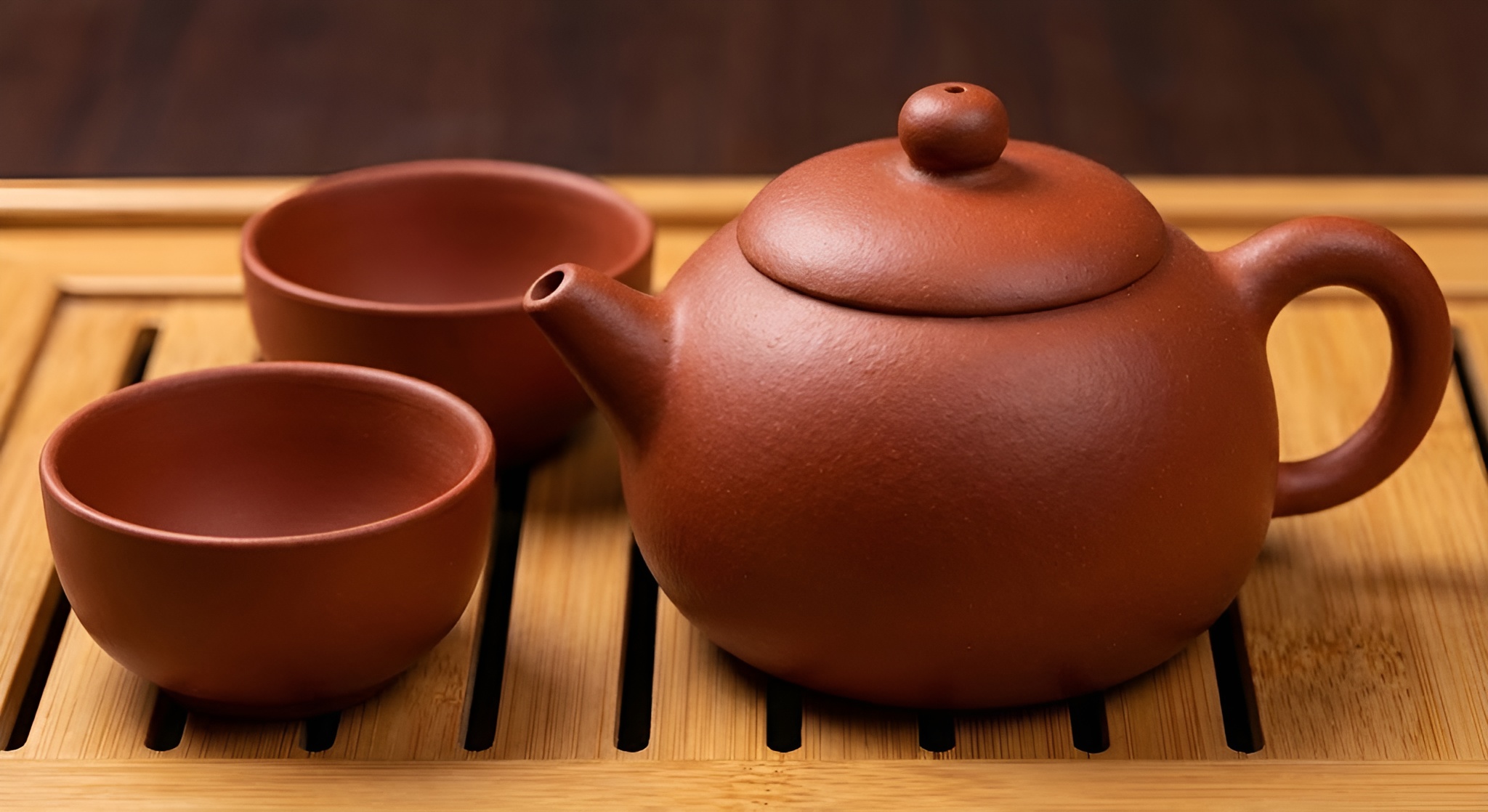
1. The Geography: Fengxi's Red Secret
Chaozhou pottery comes from the Fengxi region in Guangdong province, historically known for its vast deposits of mineral-rich red clay. Unlike the varied purple, green, and black clays of Yixing, Chaozhou clay is predominantly iron-oxide red.
This clay is geologically distinct. It is finer and more plastic than Yixing ore. When fired, it turns a vibrant, brick-red orange. The high iron content isn't just aesthetic; iron ions interact with the water, often "softening" the mouthfeel and reducing the astringency of heavy teas. This is why locals say a Chaozhou pot makes the water "sweet."
2. The Technique: Wheel vs. Slab
This is the fundamental difference that defines the two styles of Chinese pottery.
Yixing (Slab Building): The craftsman pounds the clay into flat sheets (slabs), cuts them into shapes, and paddles them together. This technique allows for complex, geometric, and square shapes, but it requires thicker walls to maintain structural integrity.
Chaozhou (Wheel Throwing): Chaozhou masters use a potter's wheel (La Pi). They pull the clay up from a spinning mound. This centrifugal force aligns the clay particles tightly and allows the potter to pull the walls paper-thin.
This thinness is the secret weapon. A good Chaozhou pot feels impossibly light in the hand, sometimes weighing less than 80 grams. The lid fit is also legendary. Because the lid and body are thrown together and fired at high shrinkage rates, they form a near-vacuum seal. A standard test for a quality Chaozhou pot is to hold the knob, cover the spout hole, and flip the pot upside down. The lid should not fall off.
3. The Physics of Brewing: Why Thin is In
Why does wall thickness matter? It comes down to Thermal Capacity.
When you brew a heavy Shou Pu-erh, you want heat retention. You want a thick Yixing pot to "stew" the leaves and extract the deep, earthy flavors over a long period.
However, when you brew a floral Dan Cong Oolong (like Duck Shit or Honey Orchid), prolonged heat is the enemy. If you stew these delicate leaves, the bitter tannins leech out, overpowering the floral aromatics ("cooking" the tea).
A thin-walled Chaozhou pot heats up instantly but also sheds heat rapidly ("flash brewing"). This allows you to use boiling water to extract the aroma immediately, but the temperature drops quickly enough to prevent the extraction of excessive bitterness. It creates a liquor that is highly aromatic but crisp and clean.
Expert Tip: The Lid Drop Test
When testing a Chaozhou pot, place the lid on the pot and spin it gently. It should rotate smoothly without grinding. Then, pour water and hold the lid button. The water stream should be a solid, glassy column (Laminar Flow) that is roughly the length of a chopstick before it breaks up. This indicates perfect spout engineering.
4. Yixing vs. Chaozhou: The Showdown
| Feature | Yixing (Zisha) | Chaozhou (Red Clay) |
|---|---|---|
| Construction | Slab-Built (Paddled) | Wheel-Thrown |
| Wall Thickness | Thick / Medium | Paper Thin |
| Porosity | High (Absorbs flavor) | Low (Reflects flavor) |
| Shrinkage Rate | 10% - 12% | 15% - 20% |
| Best Tea Pairing | Pu-erh, Black Tea | Dan Cong, Wuyi Oolong |
5. Seasoning and Care
Like Yixing, Chaozhou pots are unglazed and must be raised. However, because they are less porous (due to higher firing temperatures and shrinkage), they season slower. They don't absorb as much tea oil deep into the body, but they develop a beautiful external patina (gloss) faster due to the fine clay texture.
The Protocol:
1. Boil the pot in clean water for 30 minutes to remove kiln dust.
2. Dedicate the pot to one type of tea (e.g., High Mountain Dan Cong).
3. Never use soap. Rinse with hot water only.
4. Rub the pot with a tea towel while it is hot to distribute the oils and build the shine.
Ready to Upgrade?
If you are drinking premium Oolong from a mug, you are missing half the flavor. We reviewed the best entry-level Gongfu sets to get you started.
See Best Gongfu Tea Sets
Comments