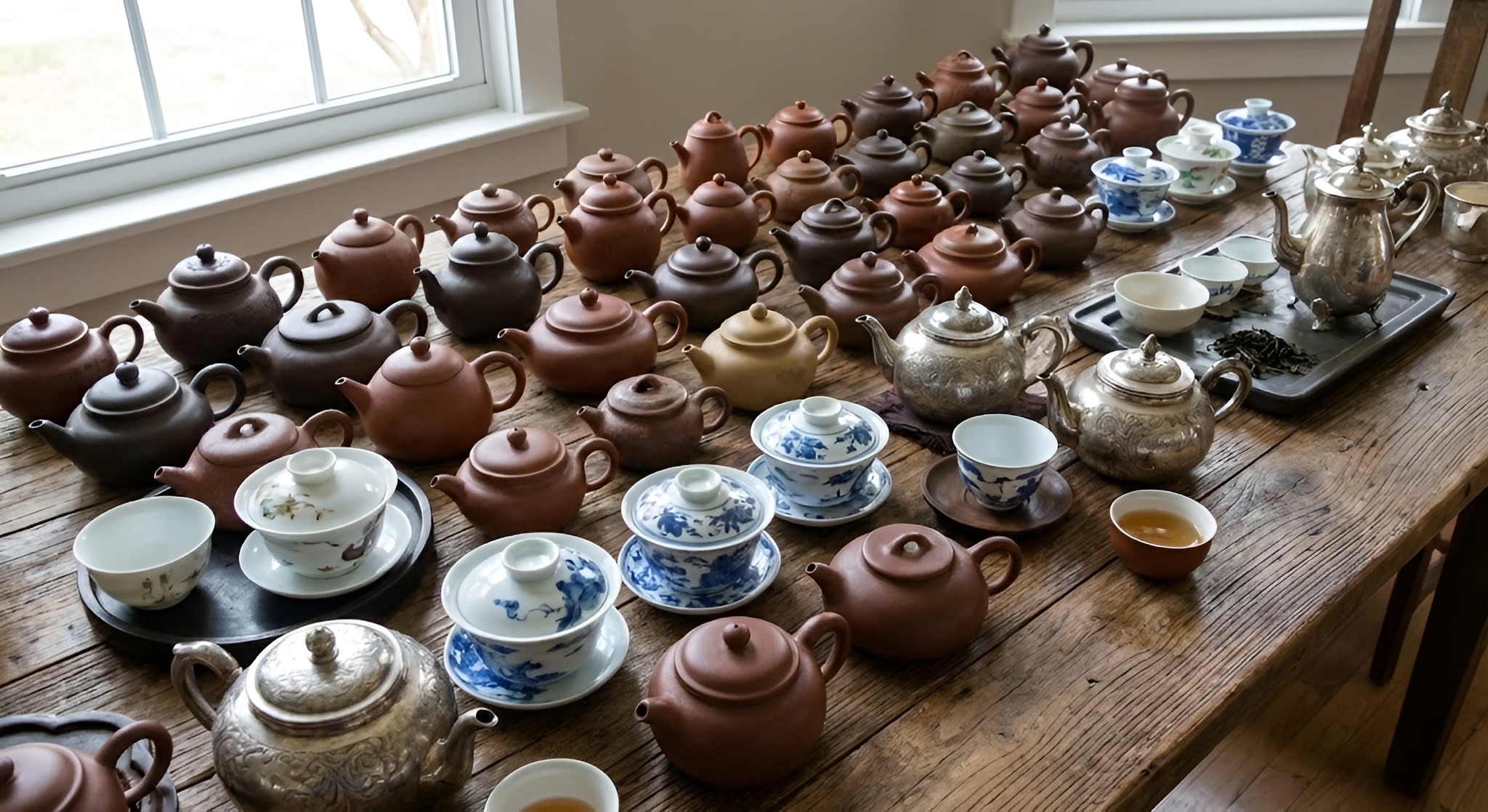
1. The Enhancers: Unglazed Clay
Unglazed clay teapots are alive. Because they lack a glass coating (glaze), the tea liquor interacts directly with the minerals in the clay body. This creates a "muting" or "rounding" effect. The porous surface traps high-frequency volatile aromatics (the sharp, bitter notes) while emphasizing the deep, bass notes of the tea. This is why clay is often called an "enhancer"—it can fix a tea that is slightly too aggressive.
Yixing Zisha (Purple Sand)
The king of teapots. Mined in Jiangsu, China, this clay is rich in quartz and mica. It has a unique "double pore" structure (open pores connected by closed pores) that allows it to hold heat incredibly well while still being breathable. Over years of use, a Yixing Teapot absorbs tea oils, eventually becoming so seasoned that you can brew tea by just adding hot water.
Best For: Ripe Pu-erh, Roasted Oolong, Black Tea.
Avoid For: Green Tea (it cooks the leaves).
Chaozhou (Red Clay)
The specialist. Hailing from Guangdong, this clay is finer and richer in iron than Yixing. The pots are hand-thrown on a wheel (unlike Yixing, which is slab-built) and have much thinner walls.
The Physics: Thin walls dissipate heat faster than thick Yixing. This is crucial for high-fragrance teas like Dan Cong Oolong, where you want to extract aroma without "stewing" the leaves. The high iron content also seems to brighten the high notes of the tea.
Tokoname (Japanese Clay)
The engineer. Japanese clay from Aichi prefecture is dense and iron-rich. The key innovation here isn't just the clay, but the shape. The Kyusu (side-handled pot) usually features a built-in clay mesh filter designed specifically for deep-steamed teas. The clay is often burnished to a smooth finish, making it less porous than Yixing but still interactive.
Best For: Sencha, Fukamushi, Gyokuro.
One Pot, One Tea
Because unglazed clay is porous, it absorbs flavor memory. If you brew a smoky Lapsang Souchong in your pot today, your delicate Green Tea will taste like smoke tomorrow. Serious connoisseurs dedicate one Yixing pot to one specific type of tea (e.g., "The Shou Pu-erh Pot").
2. The Mirrors: Porcelain & Glass
If clay modifies the tea, porcelain tells the truth. Porcelain is a vitrified ceramic fired at extremely high temperatures (1300°C+). The surface is glass-like, non-porous, and chemically inert.
Why use it? Evaluation. When a tea master buys a new batch of tea, they always use a porcelain Gaiwan (lidded bowl). They don't want the pot to "fix" the tea's flaws; they want to taste every sharp edge, every bitter note, and every floral nuance. Porcelain reflects the true profile of the leaf.
Thermal Properties: Porcelain has lower thermal retention than clay. It sheds heat quickly. This makes it ideal for delicate Green and White teas that are easily scalded by retained heat.
Glass: Glass is even more neutral than porcelain and dissipates heat the fastest. It is the best choice for visual teas like Jasmine Pearls or flowering teas, where the display is part of the experience.
3. The Alchemists: Silver & Iron
Metal teaware doesn't just hold water; it changes it. The interaction between metal ions and water molecules can fundamentally alter the texture of your brew.
Silver Teapots (The Purifier)
Pure silver (99.9%) releases trace amounts of silver ions into the water. This is known as the Oligodynamic Effect (antibacterial), but for tea, it does something else: it "softens" the water texture. Tea brewed in silver feels silkier, sweeter, and brighter. It is the ultimate luxury for brewing high-end Oolongs or Sheng Pu-erh.
Note: Silver conducts heat instantly. The handle *will* get hot unless insulated. It is the Ferrari of teaware: high performance, high maintenance.
Tetsubin (Cast Iron Kettles)
The Myth: Most "Cast Iron Teapots" sold on Amazon are enamel-lined. They are just heavy glass pots. They do nothing for the water.
The Reality: A true Tetsubin is an unlined cast iron kettle (for boiling water, not brewing tea). As the water boils, it reacts with the iron, releasing ferrous ions ($Fe^{2+}$). This supplements iron intake and removes the "chlorine" taste from tap water, making it taste sweet and round. It is the perfect partner for Matcha preparation.
Water Chemistry 101
Even the best silver pot can't fix bad water. If your tap water is hard (high calcium), it will flatten the tea. Learn how to fix your base solvent in our Water Quality Guide.
4. The Mechanics of Pouring: Why Flow Matters
A teapot is a hydraulic machine. The spout shape determines the flow rate and turbulence.
Laminar Flow: A good teapot should pour in a solid, glassy column of water (laminar flow) rather than a splashing, chaotic stream (turbulent flow). Laminar flow minimizes heat loss during the pour and ensures even agitation of the leaves.
Ball Filter vs. Single Hole: Modern pots often have "ball filters" (many holes) behind the spout. This allows for faster pouring, which is essential for gongfu brewing where seconds count. Traditional pots with a single hole often clog with large leaves like Oolong.
5. The Science of "Seasoning" (Raising a Pot)
When you buy a raw Yixing pot, it smells like dust and fire. You must "raise" it. This process involves boiling the pot in clean water to open the pores, and then boiling it in strong tea to begin the seasoning process.
The Chemistry: Over time, the tea oils (polyphenols and lipids) polymerize inside the microscopic pores of the clay. This creates a patina on the outside and a seasoning layer on the inside. A well-raised pot will smell sweet even when empty. Read our Step-by-Step Guide to Seasoning Yixing Here.
Comments