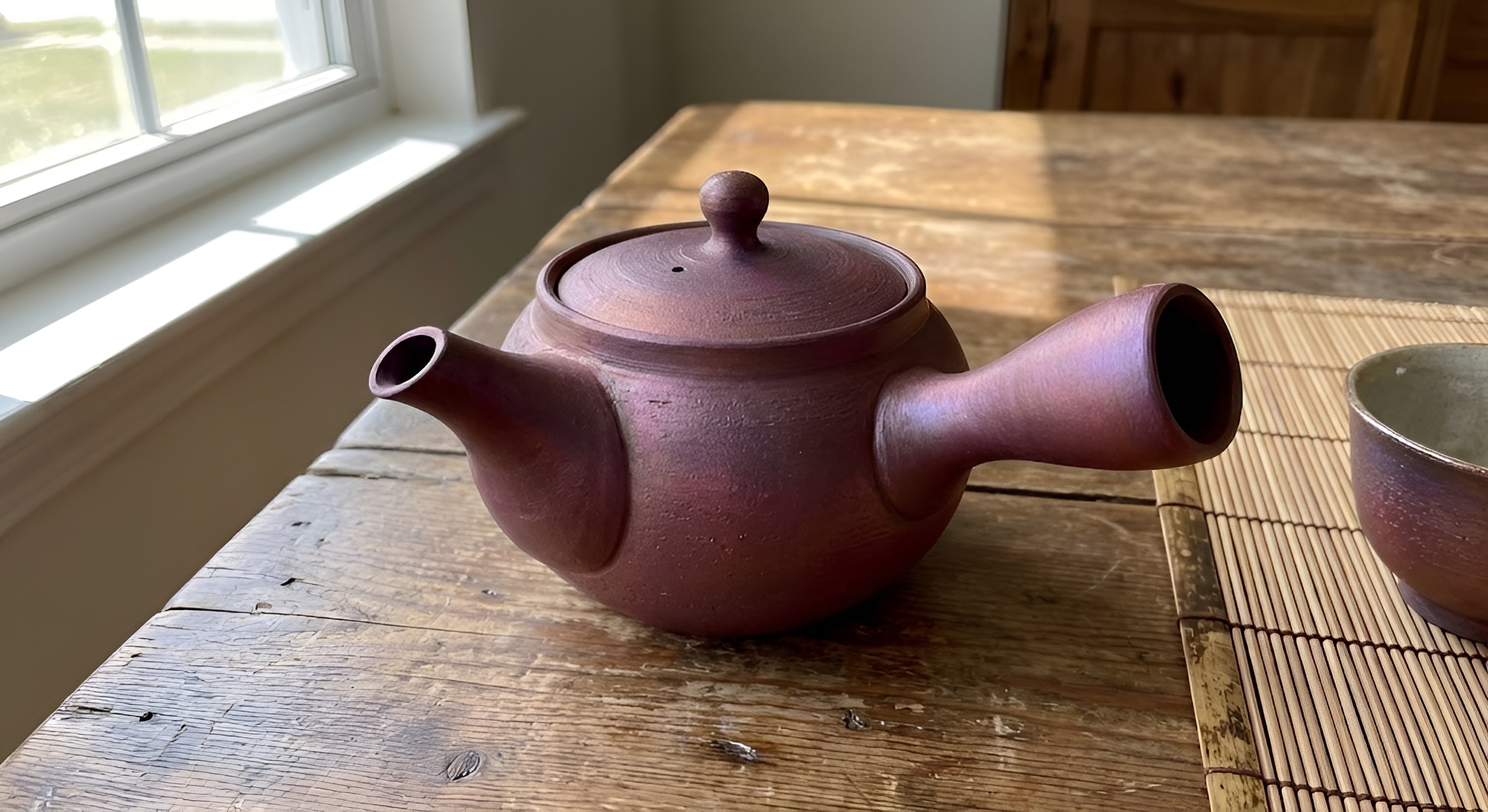
1. The Alchemy: Reduction Firing (Kangen-yaki)
The defining characteristic of Banko ware is its firing process. Most pottery is fired in an oxygen-rich environment (oxidation Firing), where fire needs oxygen to burn. Banko potters do the opposite.
The Process:
1. The kiln is sealed tight to prevent air from entering.
2. The fire consumes all available oxygen in the chamber.
3. Desperate for fuel, the fire begins to chemically strip oxygen atoms from the clay minerals themselves (specifically Red Iron Oxide, $Fe_2O_3$).
4. This chemical reaction converts the iron into Blue/Black Ferrous Oxide ($FeO$).
When the pot cools and is exposed to the atmosphere, a thin layer re-oxidizes to red. The combination of the deep blue interior and the reddish surface creates the signature "Purple Mud" (Shidei) color. This is fundamentally different from Yixing-teapot.html" class="internal-link">Yixing Zisha, which is naturally purple rock that is mined from the ground.
The Durability Factor
Because Reduction Firing requires extreme temperatures (over 1200°C) to maintain the reaction, Banko ware is technically Stoneware (high-fired), not Earthenware. This makes the clay particles fuse tighter (sintering), resulting in a pot that is thinner yet more durable than low-fired clays.
2. Porosity vs. Aroma: The Umami Enhancer
Banko clay is famous for its interaction with water. It is unglazed, meaning the tea touches the raw clay surface.
The Iron Effect: Banko clay contains roughly 6-7% iron. When hot water sits in the pot, iron ions are released in trace amounts. These ions react with the tannins (astringency) in tea, chemically neutralizing them. This creates a "rounding" effect where the tea tastes smoother, sweeter, and less bitter.
The Trade-off: This muting effect is great for bitterness, but it also dampens high aromatic notes (floral top notes).
Therefore, Banko is bad for highly fragrant teas like Dan Cong Oolong or Jasmine, which rely on crisp aroma.
But it is perfect for savory teas like Gyokuro, where you want to emphasize the deep, broth-like body (Umami) and suppress any grassy bite.
3. The Showdown: Banko vs. Yixing vs. Tokoname
How does it stack up against the other giants of the clay world?
| Feature | Banko (Mie, Japan) | Tokoname (Aichi, Japan) | Yixing (Jiangsu, China) |
|---|---|---|---|
| Clay Color | Purple/Brown (Artificial Reduction) | Vermilion Red (Oxidation) | Natural Purple/Red/Green |
| Firing Temp | High (~1200°C) | Medium (~1100°C) | Medium (~1100°C) |
| Manufacturing | Wheel-Thrown | mold or Wheel | Slab-Built (Paddled) |
| Flavor Effect | Enhances Umami / Mutes Aroma | Neutral / Slight Rounding | Absorbs Flavor / Increases Body |
| Best Pairing | Gyokuro, Kabusecha | Fukamushi Sencha | Pu-erh, Oolong |
4. Why Gyokuro Loves Banko
If you visit a high-end tea house in Kyoto and order Gyokuro, it will almost always be served in a small, handle-less Banko vessel called a Houhin or Shiboridashi.
Gyokuro is brewed at low temperatures (50°C - 60°C). At this temperature, aroma is minimal anyway, so the "aroma dampening" effect of Banko clay is irrelevant. The goal of Gyokuro is texture—thick, oily, savory soup. The iron in the Banko clay reacts with the water to enhance this texture, making the tea feel heavier and silkier on the tongue. The high heat retention of the dense stoneware also keeps the water temperature stable during the long, slow extraction required for shade-grown tea.
5. History: The "Constant Eternity"
The name "Banko" comes from a wealthy merchant named Nunami Rozan in the mid-18th century. He was a tea fanatic who wanted to create wares that would last forever. He stamped his pots with the phrase Banko Fueki ("Constancy for Eternity").
While the original kiln died out, the style was revived in the late 19th century in Yokkaichi. Today, Banko-yaki is designated as a Traditional Craft of Japan (1979), though the number of master potters is dwindling. Modern Banko is often associated with the Donabe (clay cooking pot) because the high heat resistance of the petalite-infused clay makes it perfect for cooking over an open flame. However, the purple clay teapots remain the crown jewel for tea connoisseurs.
Start Your Collection
Authentic Banko ware is becoming rare as master potters retire. We reviewed the best sources for genuine Japanese teaware, including the famous Suigetsu kiln.
See Best Japanese Teaware
Comments