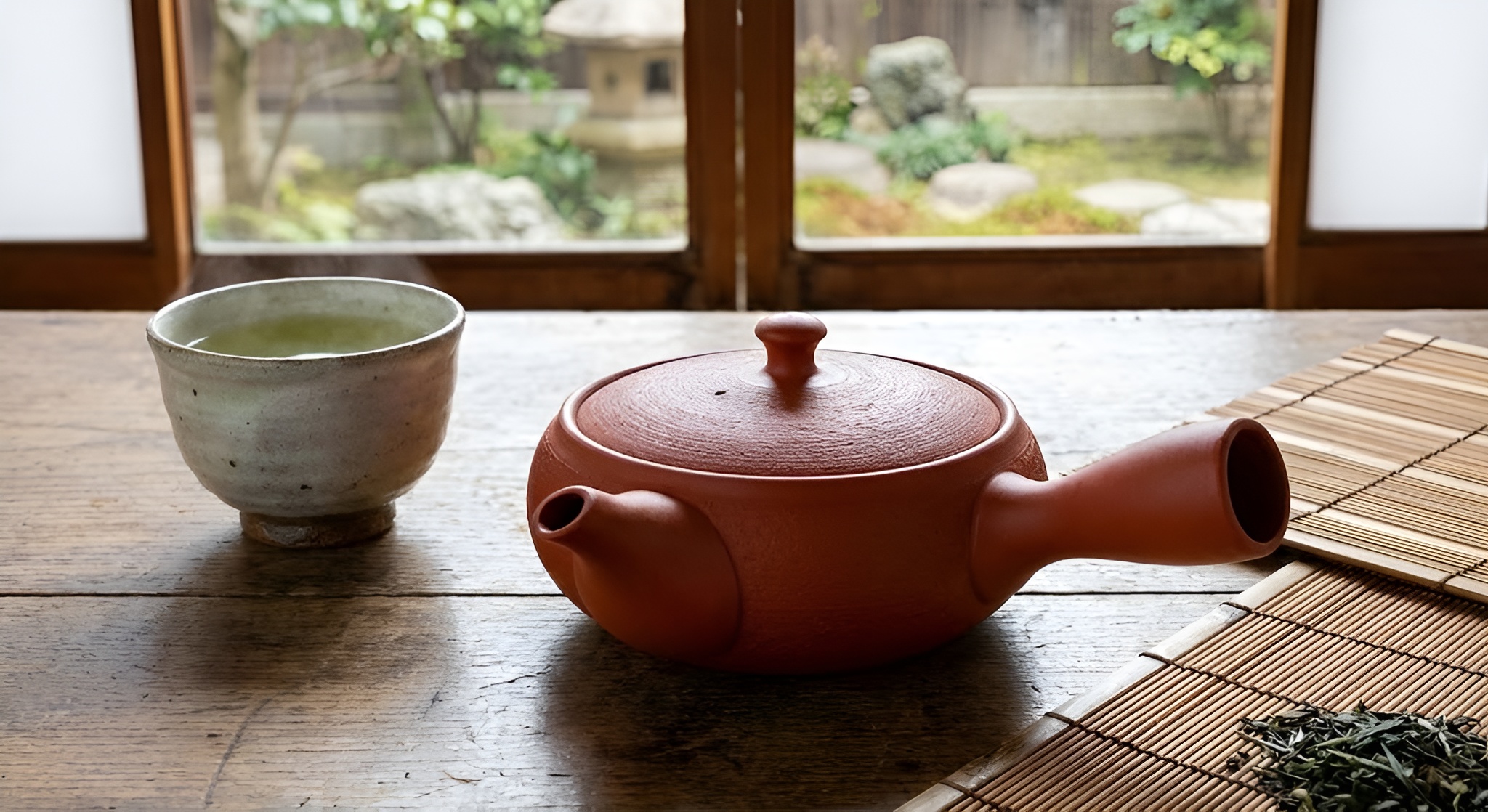
1. The Ergonomics: Why the Side Handle?
Western teapots have a handle on the back (Ushirode). Chinese pots often have a handle on top (Uwade). But Japanese pots place the handle at 90 degrees to the spout (Yokode). Why?
The Biomechanics: Japanese tea (Sencha) is brewed in small amounts (200ml) but poured into 3-5 tiny cups. To ensure every guest gets the same strength tea, the host must pour a little into cup 1, then cup 2, cup 3, then back to cup 3, cup 2, cup 1. This cycle is repeated rapidly.
If you use a back-handle pot, this rapid back-and-forth motion requires twisting your wrist repeatedly, which is tiring and imprecise. With a side-handle Kyusu, you simply rotate your thumb. The motion is purely rotational, generated by the forearm, not the wrist. It is ergonomically superior for the specific ritual of Japanese service.
Expert Tip: The "Golden Drop" Technique
When pouring from a Kyusu, you must pour until the absolute last drop. In Japanese, this is called Kin-no-Shizuku (Golden Drop). This last drop contains the highest concentration of Umami and flavor. If you leave liquid in the pot, the leaves will continue to steam and stew, making your second infusion bitter. Shake the Kyusu firmly at the end of the pour to extract it.
2. The Clay: Vermilion "Shudei" & Burnishing
Tokoname is famous for Shudei (Red Mud) clay. This clay is naturally rich in iron oxide, which turns a vibrant brick-red when fired in an oxidation kiln.
Unlike Yixing clay, which is often left raw and sandy, Tokoname clay is extremely fine-grained. Master potters often burnish the pot before firing—rubbing it with a cloth or spatula until the raw clay becomes shiny and smooth. This creates a surface that is less porous than Yixing.
Flavor Impact: Because it is smoother and harder, Tokoname clay does not "drink" the tea flavor as aggressively as Yixing. It provides a slight rounding effect (neutralizing some bitterness via iron interaction) but largely preserves the fresh, top-note aroma of the tea. This makes it ideal for Green Tea, which relies on fresh, vegetal aromatics that would be dulled by a heavy Yixing pot.
3. The Innovation: The Sasame Filter
This is the killer feature. Traditional Chinese pots use a single hole or a simple 7-hole ball filter. This works for large whole leaves (like Oolong) but clogs instantly with Japanese tea.
Japanese tea, especially Fukamushi (Deep Steamed), breaks down into tiny, needle-like particles. To filter this, Tokoname potters invented the Sasame (or "Sesame") filter. It is a hemispherical ceramic dome built into the spout base, punctured with hundreds of tiny holes.
Ceramic vs. Steel Mesh: Many modern pots use a stainless steel mesh belt that wraps around the inside. While effective, steel can impart a metallic taste to delicate teas. The Sasame is made of the same clay as the pot, ensuring zero flavor contamination while providing maximum surface area for drainage. It is the hallmark of a high-quality Kyusu.
Expert Tip: Cleaning the Sasame
Never scrub the ceramic filter with a brush or poke it with a toothpick; you will break the delicate clay lattice. To clean a clogged Sasame filter, simply rinse it with high-pressure water from the outside (spout in) to push the leaves back into the pot. If it gets stained, boil the pot in water—do not use soap.
4. The Comparison: Tokoname vs. The World
| Feature | Tokoname (Red) | Banko (Purple) | Yixing (Purple) |
|---|---|---|---|
| Origin | Aichi, Japan | Mie, Japan | Jiangsu, China |
| Firing | Oxidation (Red) | Reduction (Purple) | Natural Oxidation |
| Porosity | Low (Smooth) | Medium/Low | High (Porous) |
| Handle | Side (Yokode) | Side or None | Back or Top |
| Best Tea | Sencha, Fukamushi | Gyokuro | Pu-erh, Oolong |
Expert Tip: The "Mogake" Pattern
Some Tokoname pots have a unique pattern that looks like burnt seaweed. This is called Mogake (Seaweed Firing). The potter wraps dried seaweed (Amamo) around the pot before firing. The salt in the seaweed reacts with the clay, creating distinctive organic streaks. This is purely aesthetic but highly prized by collectors.
5. Seasoning: Does Tokoname Need It?
Unlike Yixing, which needs months of seasoning to perform well, a Tokoname Kyusu is ready to use almost immediately. Because the surface is burnished and less porous, it doesn't drink up tea oils as greedily.
However, over years of use, the interior will darken with tea tannins (tea incrustation). Do not scrub this off! This layer contributes to the "rounding" effect of the pot. A 20-year-old Kyusu will produce a mellower, sweeter Sencha than a brand new one.
Expert Tip: One Hand Pouring
To look like a pro: Place your thumb on the lid knob to secure it. Wrap your fingers around the side handle. Pour by simply rotating your wrist inward. Do not use your second hand to hold the lid—a well-made Kyusu lid fits tightly enough that thumb pressure alone is secure.
Find Your Kyusu
Authentic Tokoname pots are stamped by the artist. We reviewed the best sources for handmade Japanese teaware, ensuring you get a real Sasame filter, not a metal mesh insert.
See Japanese Teaware Guide
Comments