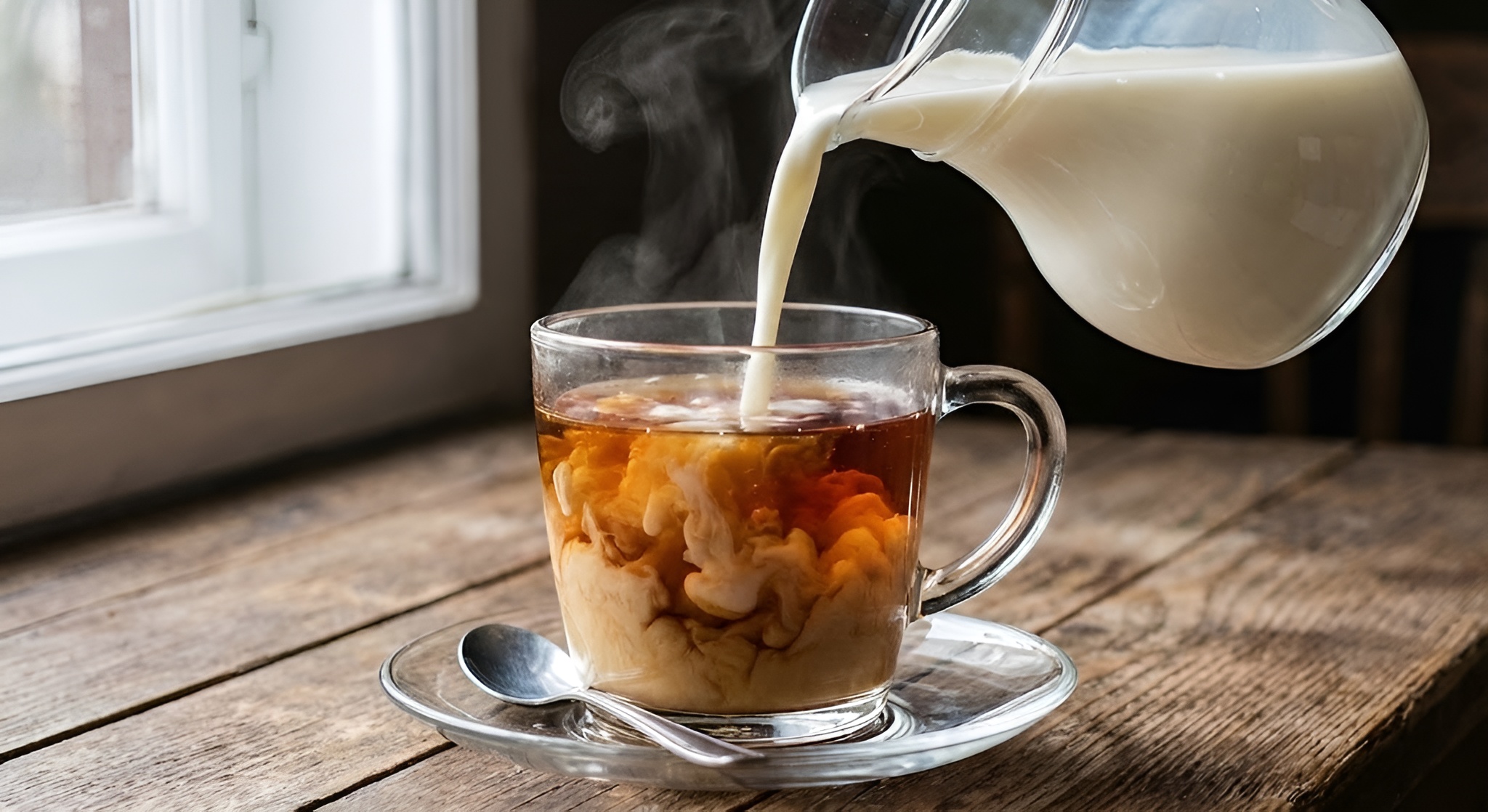
1. The Snobbery Trap: History of the Pour
Why do we even debate this? It started with ceramics.
In the 18th century, high-quality porcelain from China (and later Bone China from England) was heat-shock resistant. It could handle boiling water without cracking. The wealthy used this fine china and poured their tea first to show off the translucency of the liquor.
The working class used soft-paste earthenware or cheap clay. If you poured boiling water directly into these cups, they would shatter. To prevent this, they poured cold milk in first to act as a heat sink (thermal buffer).
Thus, "Milk Last" became a status symbol. It signaled: "I am rich enough to own cups that don't break." But status is not science. While the rich were saving their image, the poor were saving the flavor.
2. The Chemistry: You Are Cooking Your Milk
Milk is an emulsion of fats and proteins (Casein and Whey). The critical proteins here are Beta-Lactoglobulin and Alpha-Lactalbumin.
These proteins begin to unravel (denature) when they hit temperatures above 75°C (167°F). When they unravel, they release sulfur compounds (giving a cooked cabbage smell) and lose their structural ability to hold water, creating that dreaded "skin" on top of the cup.
Scenario A: Milk Last (The Snob's Way)
You have a cup of black tea at 95°C. You pour in a splash of cold milk. As the tiny stream of milk hits the bulk liquid, those specific milk droplets are instantly surrounded by near-boiling water. They flash-heat to 95°C before they can mix. Result: Immediate Scalding. The proteins denature instantly.
Scenario B: Milk First (The Scientist's Way)
You have cold milk in the cup. You pour hot tea onto it. The tea mixes with the milk volume immediately, and the temperature of the *mixture* rises uniformly. It likely never exceeds the 75°C danger zone because the cold milk cools the tea as it hits. Result: Creamy Emulsion. The proteins stay intact, preserving the natural sweetness (Lactose) of the milk.
Expert Tip: The Tannin Binding
The interaction between milk protein and tea tannins is what reduces astringency. This reaction happens smoother at lower temperatures. If you scald the proteins first, they become less efficient at binding with the Assam tannins, leaving your tea tasting harsher and more bitter.
3. The ISO Standard: Official Ruling
It isn't just us saying this. The Royal Society of Chemistry issued a formal statement in 2003 titled "How to make a Perfect Cup of Tea". Their verdict? Milk First.
They cite the exact denaturation mechanism described above. Furthermore, ISO 3103 (the international standard for brewing tea for sensory analysis) describes the procedure for adding milk to the bowl before pouring the brewed tea, to ensure consistency in flavor evaluation.
4. The Verdict
If you are drinking tea from a bag in a builder's mug, do whatever you want. But if you are brewing premium loose leaf Irish Breakfast or a Single Estate Assam, you owe it to the leaf to treat the milk with respect.
Put the milk in first. Ignore the scowls of your grandmother. Tell her you are following the Laws of Thermodynamics.
Cast Your Vote: Are You Team Science or Team Tradition?
Join the 15,000+ people who have argued in our comments.
Comments