1. The "Dust" Problem: Why Tea Bags Taste Bitter
The biggest difference isn't the packaging; it's what's inside. Tea is graded by size, and this grading determines flavor, price, and brewing speed.
Whole Leaf (Orthodox)
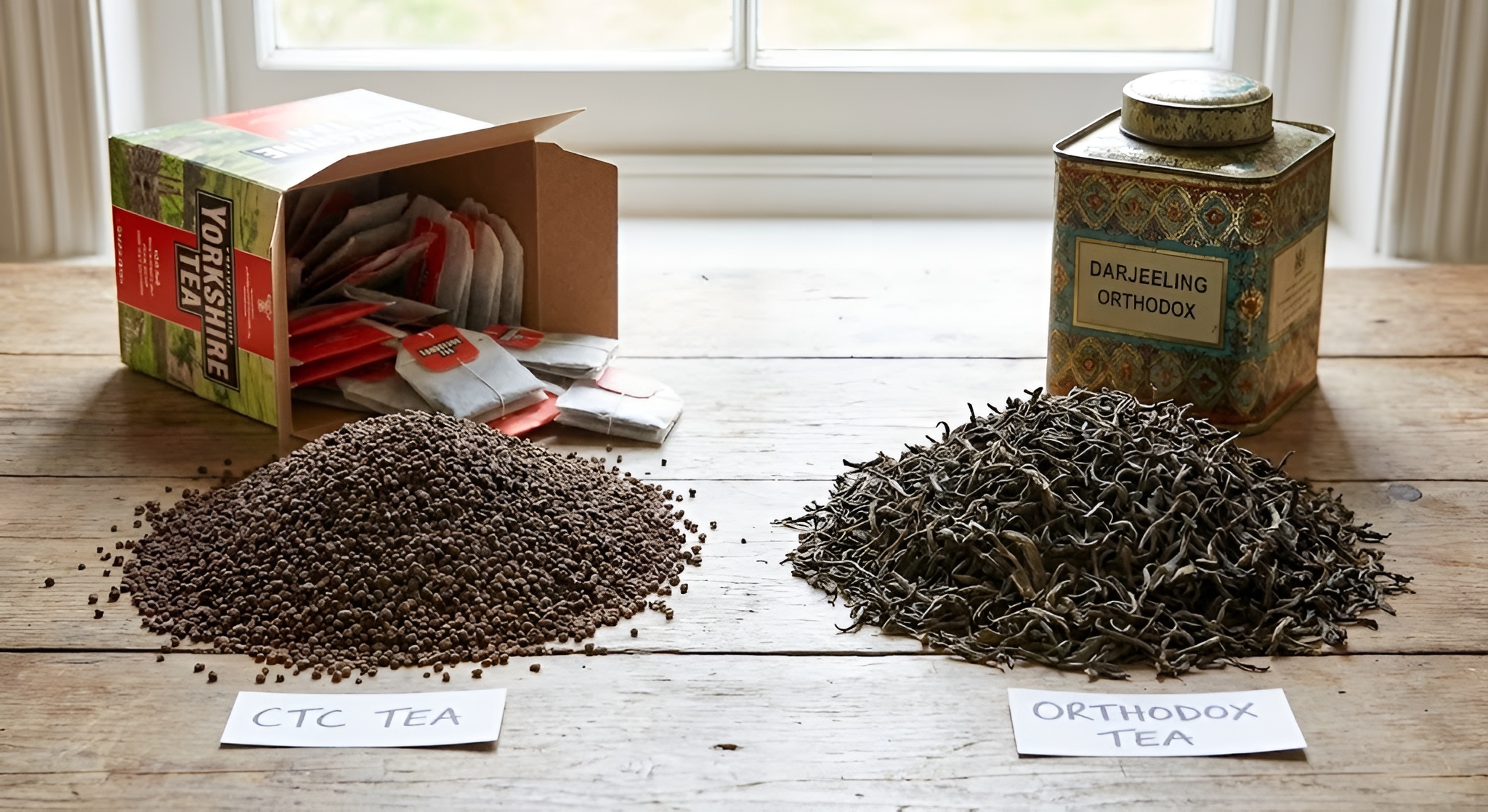
Loose leaf tea is typically "Orthodox" tea. The leaf is plucked, withered, and rolled gently to preserve its integrity. Because the leaf is whole (or large pieces), it has a small surface area relative to its volume. This means it releases flavor slowly over 3-5 minutes.
The Result: A multi-layered taste. You might taste flowers first, then fruit, then a woody finish. The tannins (bitterness) are released last, giving you a sweet cup.
Fannings/Dust (CTC)
Standard tea bags contain "Dust" or "Fannings." This is the "shake" left over after the good tea is sorted, or tea processed via the CTC (Crush, Tear, Curl) method. The leaf is pulverized into tiny particles to fit into a small paper envelope.
The Result: Massive surface area. When hot water hits it, everything is released instantly—flavor, color, caffeine, and tannins. This is why bagged tea gets bitter if you leave it for 30 seconds too long. It offers a bold, one-dimensional punch but lacks nuance.
Why CTC is the Exception
Not all small particles are bad. CTC (Crush, Tear, Curl) tea is intentionally processed into pellets for strength. This is what gives Assam and English Breakfast their "punch." If you want strong milk tea, a high-quality CTC bag is actually a great choice. Read more: CTC vs. Orthodox Explained →
2. The Manufacturing Difference: Cost Drivers
The price difference isn't arbitrary. It reflects the labor and technology required to produce the tea.
The Cost of Orthodox Production
Producing loose leaf tea is labor-intensive. Skilled workers must pluck "two leaves and a bud" by hand to avoid damaging the delicate shoots. The processing involves careful withering, rolling (often by hand or specialized machines), and firing. This artisanal care preserves the essential oils but drives up the cost of production. You are paying for human skill and time.
The Economy of Scale with CTC
CTC tea is designed for mass production. Harvesters (often machines) strip the bushes, collecting older, tougher leaves along with the buds. These are fed into the CTC machines, which process tons of tea per hour. The efficiency is incredibly high, and the resulting product is consistent and cheap. However, the aggressive processing destroys the delicate volatile oils, leaving mostly the robust tannins.
3. The "Math" of Tea: Is Loose Leaf Expensive?
This is the biggest myth in tea. Consumers see the £10 price tag on a pouch and assume it's a luxury item. Let's do the actual math based on "Cost Per Cup."
| Factor | Supermarket Tea Bag | Premium Loose Leaf |
|---|---|---|
| Upfront Cost | £3.00 for 50 bags | £12.00 for 50g |
| Serving Size | 1 Bag (2g) | 5g per pot |
| Servings | 50 | 10 |
| Re-Steeps | 0 (Tastes like water) | 5 (Tastes great) |
| Total Cups | 50 | 50 |
| Cost Per Cup | £0.06 | £0.24 |
Yes, loose leaf is 4x the price of a cheap bag. But compare that to a £3.50 coffee shop latte. You are getting a luxury, artisanal beverage—often hand-picked on a mountain in Taiwan or Darjeeling—for 24p. It is arguably the cheapest luxury product in the world.
4. The Hidden Plastic: Are Tea Bags Safe?
In recent years, brands have switched to "Silky" or "Pyramid" bags to make them look premium. While they look nice, many are made of food-grade Nylon or PET plastic.
A landmark study by McGill University found that a single plastic tea bag can release 11.6 billion microplastics and 3.1 billion nanoplastics into your cup when steeped at 95°C. Even paper bags are often sealed with polypropylene glue to keep them shut.
composting Reality
Many brands claim their bags are "biodegradable" because they use PLA (cornstarch plastic). However, PLA only breaks down in industrial composting facilities with high heat. If you throw a PLA bag in your home compost, it will likely remain intact for years.
The Solution: Loose leaf has zero packaging in your cup. It is just leaves and water. It is the only way to guarantee a plastic-free brew.
Want Safe Tea Bags?
If you must use bags for convenience, look for brands that use plastic-free materials like biodegradable cornstarch (PLA) or stitched (not glued) paper. We list the safest eco-friendly brands in our reviews. Check out: The Best Plastic-Free Tea Bags →
5. The Convenience Myth: "Grandpa Style" Brewing
People avoid loose leaf because they think they need a teapot, a timer, a scale, and a ceremony. You don't.
In China, millions of people brew "Grandpa Style" (Cha Bei). It is the simplest way to make tea:
- Throw a pinch of leaves in a tall glass or mug.
- Pour hot water.
- Wait for the leaves to sink to the bottom.
- Drink. (The leaves act as their own filter).
- When you reach the halfway mark, refill with hot water.
No strainer. No mess. This method works perfectly for Oolong, Green Tea, and Pu-erh because the whole leaves are heavy and sink. It does not work for dusty tea bags, which float and choke you.
6. The Verdict: When to Use Which?
| Scenario | Winner | Why? |
|---|---|---|
| Morning Rush (with Milk) | Tea Bag | You need strong, fast tannins to cut through milk and sugar. A high-quality CTC bag (like Yorkshire Gold or Vahdam) is perfect here. |
| Relaxing Weekend | Loose Leaf | This is about the ritual, the aroma, and the complex flavor evolution. |
| Office Desk | Basket Infuser | Get a stainless steel basket for your mug. It is as easy as a tea bag (lift it out when done) but lets you use premium leaf. |
| Iced Tea | Cold Brew Bottle | Loose leaf in a bottle in the fridge overnight. Zero effort, zero bitterness. |
Need the Right Gear?
Switching to loose leaf doesn't mean buying expensive china. A simple Basket Infuser costs £10 and lasts forever. See our essential tool guide: The 6 Teaware Tools You Actually Need →
Comments