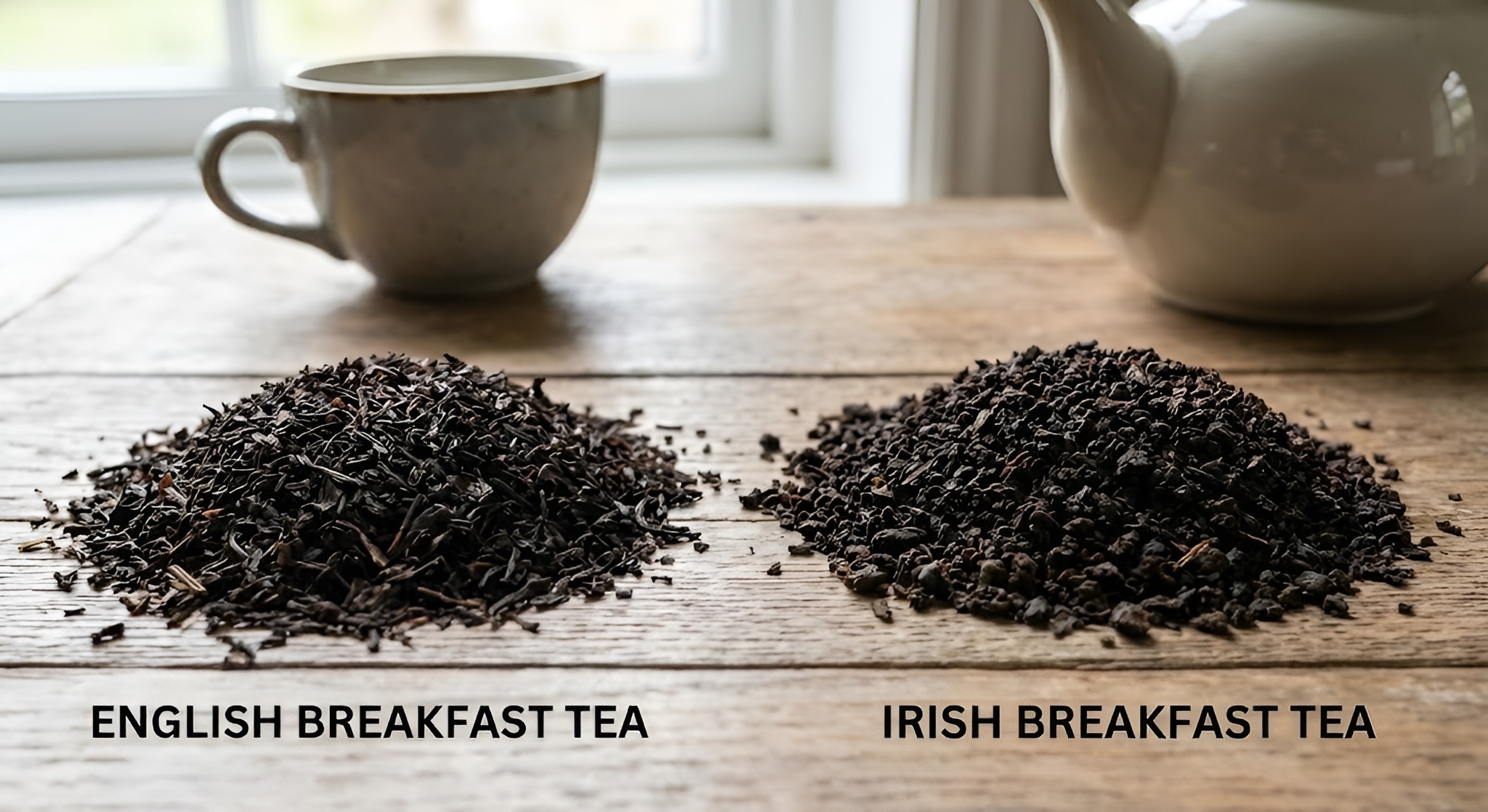
1. English Breakfast: The Diplomat
English Breakfast is the most popular tea blend in the world. Its defining characteristic is consistency. It was originally designed to provide a uniform flavor profile that didn't change from batch to batch.
The Blend: Traditionally, it is a mix of three origins:
- Assam (India): Provides the malty base and body.
- Ceylon (Sri Lanka): Adds citrusy, piney high notes and brightness.
- Kenya (Africa): Adds color (reddish-copper) and a brisk punch.
This creates a cup that is "brisk" (astringent) but complex. You can taste floral notes from the Ceylon that cut through the heaviness of the Assam.
Expert Tip: When to choose English
Choose English Breakfast if you want a refined cup. If you prefer to drink your tea black or with lemon, English is the superior choice because the Ceylon notes provide flavor complexity that stands on its own without needing the fat of milk to soften it.
2. Irish Breakfast: The Powerhouse
Irish tea culture is distinct. Historically, Ireland imported more tea from India (Assam) than from China or Sri Lanka. The Irish palate developed a craving for a tea that was thick, dark, and strong enough to wake you up on a rainy Dublin morning.
The Blend: Irish Breakfast is almost exclusively composed of Assam tea (often roughly 80-90% of the blend), sometimes supported by strong Kenyan leaf. It rarely includes the delicate Ceylon leaf found in English blends.
Because it relies so heavily on Assam, it has a deep, malty flavor profile often described as "stout-like" or "chocolaty."
Expert Tip: CTC vs. Orthodox
Most Irish blends use CTC (Crush, Tear, Curl) Assam. This processing method creates small pellets that release flavor instantly. This is why Irish tea brews dark red in 30 seconds, while English (often Orthodox leaf) takes 3 minutes to develop.
3. The Strength Comparison
If "strength" is defined by caffeine content, boldness of flavor, and color, Irish Breakfast wins on all counts.
| Feature | English Breakfast | Irish Breakfast |
|---|---|---|
| Main Origin | Ceylon / Assam / Kenya | Assam (Heavy) |
| Flavor Profile | Bright, Coppery, Citrusy | Malty, Thick, Robust |
| Milk? | Optional (Dash) | Mandatory (Splash) |
| Caffeine | Moderate (~40mg) | High (~60mg+) |
Expert Tip: What about Scottish Breakfast?
There is a third contender. Scottish Breakfast is even stronger than Irish. Scotland has incredibly soft water. Soft water makes tea taste weaker (it lacks minerals to pull out flavor). To compensate, Scottish blenders use the strongest, most bitter African teas available. If you brew Scottish tea in hard water (London/USA), it often tastes painfully bitter.
4. Buying Guide: What to look for
Not all boxes labeled "Irish Breakfast" are authentic. Real Irish blends (like Barry's or Thompson's) are often sold as "Gold Blend" rather than explicitly "Irish Breakfast" in their home country.
Conversely, many generic supermarket "English Breakfast" bags are just 100% cheap Kenyan dust. To get the true experience, you need to buy reputable brands that actually adhere to the traditional blending recipes.
Ready to upgrade your morning cup?
We tested the top brands from the UK and Ireland—from the creamy Barry's Gold to the classic Twinings. See which one came out on top in our new guide: The Best English & Irish Breakfast Teas of 2025 →
More reviews: Barry's vs Lyons | Best Breakfast Tea | Best Black Tea Bags
Comments