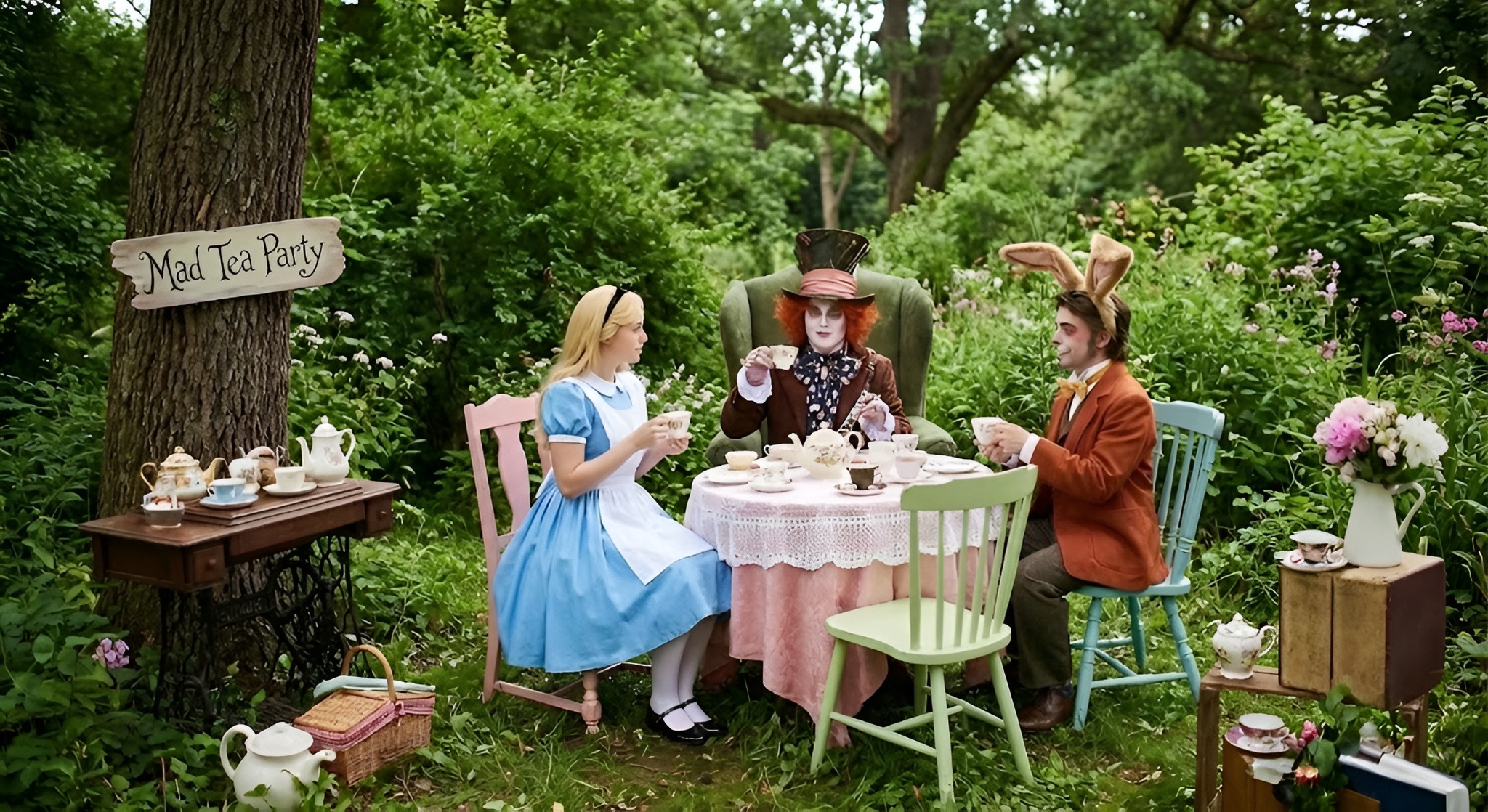
1. "It's Always Six O'Clock Now"
"If you knew Time as well as I do," said the Hatter, "you wouldn't talk about wasting it... It's always six o'clock now."
This quote is the central engine of the scene. Because the Hatter has "murdered time," he is trapped in an eternal tea time. In the Victorian era, the distinction between Afternoon Tea and High Tea was rigid, class-defined, and strictly timed. Afternoon tea (Low Tea) was served around 4 PM with light snacks to bridge the gap between lunch and dinner for the upper class. High Tea, however, was a working-class meal served at 6 PM, consisting of heavy meats and strong tea.
By trapping the party at 6:00, Carroll might be hinting at the exhaustion of the working class, or simply the absurdity of a ritual that never ends. The dirty cups piling up on the table represent the nightmare of the Victorian hostess: the inability to maintain order, cleanliness, and propriety in the face of chaos. In a properly managed household, tea rotation was seamless; in Wonderland, it is a filthy, unending loop.
Expert Tip: The Industrial Time
The obsession with "Time" in the book reflects the 19th-century anxiety over the Industrial Revolution. For the first time in history, factory whistles and train schedules dictated life, replacing the natural rhythm of the sun. The Hatter's watch (which tells the day of the month, not the hour) is a rebellion against this industrial precision—a device that measures the passing of seasons rather than the minutes until the next shift.
2. "Have Some Wine," The March Hare Said
"Have some wine," the March Hare said in an encouraging tone. Alice looked all round the table, but there was nothing on it but tea. "I don't see any wine," she remarked. "There isn't any," said the March Hare.
This interaction is a direct violation of hospitality etiquette. In Victorian society, offering a guest something you do not have was considered a grave social sin—a mockery of the guest's needs. The scene highlights the rudeness of the Hare, contrasting Alice's polite, well-trained manners (she tries to be civil despite the provocation) with the anarchy of Wonderland.
However, tea and alcohol were often linked in that era. "Tea Punches" involving rum, brandy, or arrack were common at social gatherings. The medicinal "Hot Toddy" was also a staple in damp British winters. Today, we see this revival in cocktails like the Earl Grey Martini or Hot Toddy, blending the comfort of tea with the kick of spirits—perhaps what the March Hare wished he could serve.
3. The Dormouse in the Teapot
The sleepy Dormouse is eventually stuffed headfirst into the teapot. While comical, this image might be a nod to the Tea Cosy, a padded fabric cover used to keep teapots warm, which often resembled sleeping animals (cats, mice, or rabbits). It highlights the sheer size of Victorian teapots, which were often massive porcelain or silver vessels designed to serve extended families.
The Dormouse's constant sleepiness is also significant. In Victorian times, dormice were often kept as children's pets in old teapots filled with moss. The image of the mouse inside the pot is a surreal inversion of domestic pet-keeping. If you are struggling with your own teapot issues (perhaps not a rodent, but a crack or a leak), check our guide on How to Fix a Cracked Teapot using food-safe methods.
Expert Tip: Treacle Wells
The Dormouse tells a confusing story of three sisters living in a "Treacle Well." In medieval England, "Treacle" referred to a medicinal compound (theriac) used to treat poison. "Treacle Wells" were holy wells believed to have healing properties. It wasn't until later that treacle came to mean sugar syrup/molasses. By the 1860s, a "Treacle Well" would have sounded as absurd as a "Honey Fountain," adding to the dream-like logic.
4. "Take Some More Tea"
"Take some more tea," the March Hare said to Alice, very earnestly. "I've had nothing yet," Alice replied in an offended tone, "so I can't take more." "You mean you can't take LESS," said the Hatter: "it's very easy to take MORE than nothing."
This linguistic gymnastics is typical of Lewis Carroll (who was, in real life, Charles Dodgson, a mathematician and logician). It plays on the ambiguity of language. But it also satirizes the intense social pressure of the host to constantly feed the guest. In a proper tea setting, the cup is never allowed to be empty. The host must constantly be vigilant—a rule the Hatter twists into a logic puzzle to torment Alice.
Alice's frustration stems from the violation of the "Social Contract" of tea: that it should be relaxing and nourishing. Instead, she is met with riddles and emptiness. To avoid the Hatter's confusion in your own home, explore our guide on Tea & Pastry Pairing to ensure you always have the right "more" to offer your guests—whether that's scones, sandwiches, or cake.
5. What Were They Actually Drinking?
Based on the 1865 publication date and the typical imports of the British Empire, the tea in the Hatter's pot was likely one of three types:
- Chinese Congou: A base grade black tea that was the standard "daily drinker" of the era. It was often the foundation of what we now call English Breakfast.
- Assam: The British Empire was heavily pushing Indian tea from Assam to break the Chinese monopoly. It would have been strong, malty, and served with plenty of milk and sugar to mask any bitterness.
- Bohea: A lower grade Wuyi oolong/black tea blend that was cheap and popular among the working classes, though often adulterated with other leaves.
They certainly weren't drinking delicate herbal blends or green teas (which had fallen out of fashion in Britain by the mid-19th century). If you want to replicate the strength of Victorian tea, look for our reviews of the Best Strong Assam Teas or check out English vs. Irish Breakfast blends.
Expert Tip: Bread and Butter
The Hatter spreads butter on his pocket watch with a bread knife, lamenting it was the "best butter." Bread and butter was the staple of the Victorian tea table, usually served before the cakes. The satire here is the misuse of a luxury item (butter) on a mechanical device, highlighting the Hatter's detachment from reality. It also reflects the Victorian fear of food adulteration—even the "best" butter couldn't fix a broken watch.
6. The Legacy: From Book to Cup
Alice in Wonderland has spawned countless modern tea blends. "Alice" blends often feature bergamot (Earl Grey) and vanilla (representing the creamy dream-state). "Mad Hatter" blends are often spicy and chaotic, featuring peppercorns, chai spices, or even gunpowder green tea.
If you want to host your own Mad Tea Party, authenticity matters less than atmosphere. Consider serving Earl Grey Shortbread for a nod to the Victorian palate, or a whimsical Blue Cloud Tea Latte to capture the surrealist vibe of Wonderland. For the truly adventurous, try brewing a Spicy Masala Chai to represent the chaos of the scene.
7. The Mad Hatter's Disease
Why is the Hatter mad? The phrase "Mad as a Hatter" predates Carroll. In the 18th and 19th centuries, mercury nitrate was used in the felting process for hat making. Hatters worked in poorly ventilated rooms, inhaling mercury vapors daily. This led to erethism (mercury poisoning), characterized by tremors, slurred speech, social anxiety, and erratic behavior—symptoms clearly displayed by Carroll's character.
While the tea party is funny, the Hatter is a tragic figure of industrial occupational hazards. His twitchy, nonsensical behavior is a direct result of the toxic trade that clothed the heads of polite society. It adds a layer of grim reality to the otherwise whimsical scene.
Find Your Spirit Tea
Are you a traditional Alice (English Breakfast), a sleepy Dormouse (Chamomile), or a chaotic Hatter (Spicy Chai)? Take our quiz to find out which tea matches your personality.
Quiz: Which Tea Are You?
Comments