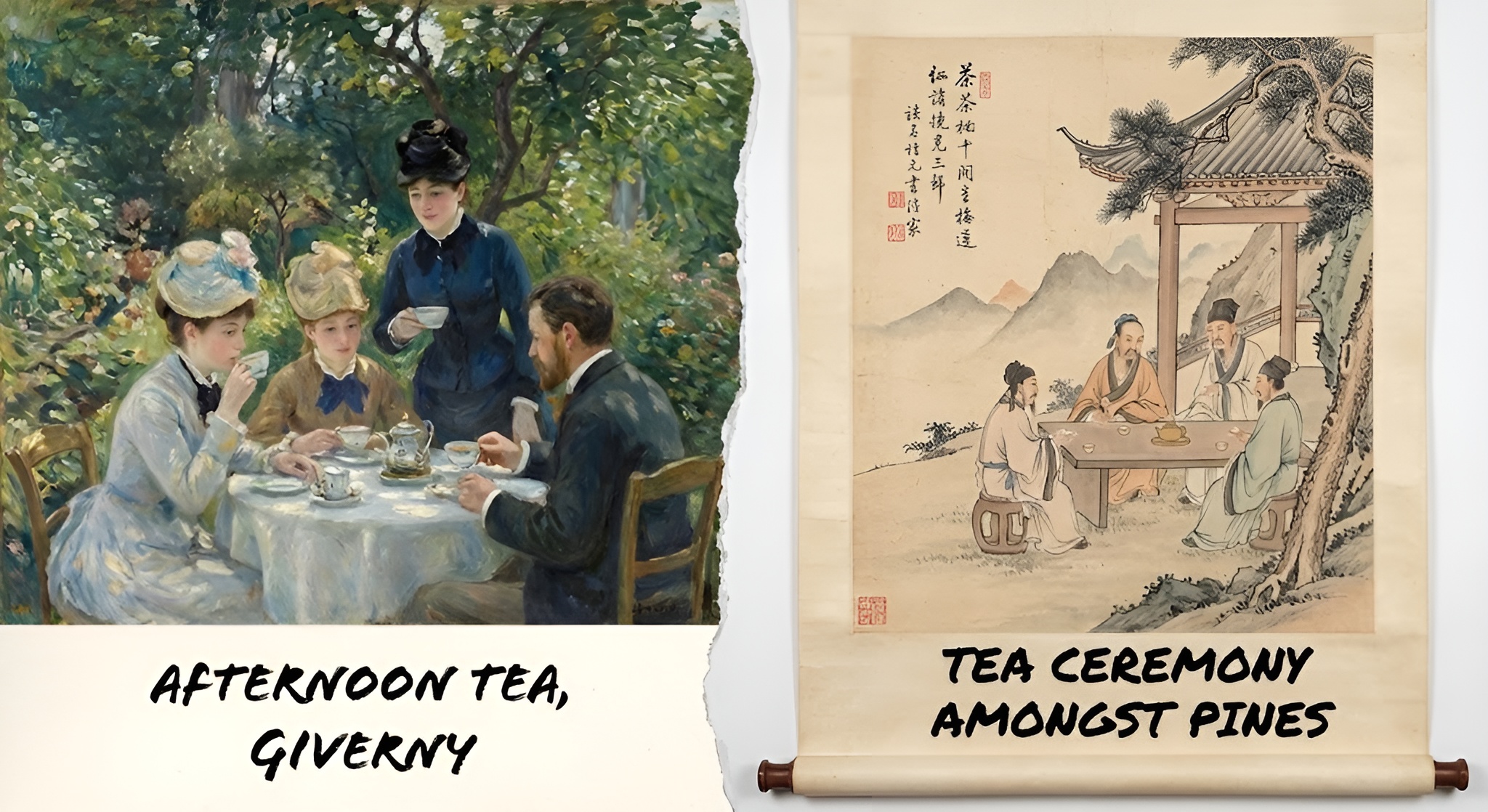
1. The Western Tradition: Tea as Social Performance
In 19th-century Europe and America, tea was the fuel of the upper-middle class. It was a symbol of status, empire, and politeness. For the Impressionists, and specifically the American expatriate Mary Cassatt, it became a vehicle to explore modern life and the agency of women.
Mary Cassatt: The Painter of the Tea Table
Mary Cassatt (18441926) occupies a unique space in art history. While her male counterparts like Degas and Renoir painted dancers, bars, and public spectacles, Cassatt was restricted by her gender to the domestic sphere. However, she transformed this limitation into a study of feminine power. Her most notable works, The Cup of Tea (1880) and Five O'Clock Tea (1880), elevate the tea ritual to high art.
In The Cup of Tea, Cassatt depicts her sister Lydia holding a delicate porcelain cup to her lips. The painting is not really about the black tea in the cup, but the act of consumption and the sensory experience. The loose brushwork captures the steam, the clink of china, and the fleeting moment of pleasure. The tea service often looms large in the foreground, creating a barrier between the subject and the viewer, emphasizing the privacy of the moment.
Expert Tip: The "Gloves On" Rule
Notice that in Cassatts The Cup of Tea, the subject is wearing gloves while holding her cup. This is a deliberate social signal. In the 19th century, keeping one's gloves on during a visit implied a short, formal stay. Taking them off signaled intimacy and a longer duration. This detail tells us the tea is being consumed in a semi-formal social context, distinct from the relaxed High Tea of the working class.
The Influence of "Japonisme"
It is impossible to discuss Cassatt's tea paintings without acknowledging the East. After Japan opened its borders in 1853, Japanese woodblock prints (Ukiyo-e) flooded Paris, influencing artists from Van Gogh to Monet. This trend, known as Japonisme, profoundly affected Cassatt.
She adopted the Eastern technique of flattened perspectivecompressing the 3D space into a 2D patternand the cropping of subjects at the edge of the frame. In a way, the Western "Tea Painting" owes its stylistic revolution to the home of tea itself. The subjects may be drinking Earl Grey, but the artistic language is deeply rooted in the aesthetic of the Japanese tea house.
2. The Eastern Tradition: Tea as Spiritual Path
If Western art focused on the social aspect of teawho is drinking it and with whomChinese and Japanese art focused on the spiritual aspect. In Chinese scrolls, you rarely see a crowded parlor. Instead, you see a solitary scholar in a mountain hut, or a monk meditating with a bowl.
Evolution of Tea in Chinese Art
The depiction of tea in Chinese art evolves alongside the history of tea processing itself. The art tells us how the leaf was consumed in each era.
- Tang Dynasty (618907): The Era of Boiling. Paintings like Tang Palace Musicians show tea being prepared in large cauldrons. At this time, tea was compressed into cakes, roasted, ground, and boiled with salt and spices. It was a hearty soup, often depicted in lively, communal banquet settings.
- Song Dynasty (9601279): The Era of Whisking. This is the golden age of tea art. Emperor Huizong, a tea master himself, painted scenes of tea preparation. The focus shifted to the froth and the elegance of the whisking motiona direct precursor to the modern Matcha and the Japanese Tea Ceremony. Scrolls from this era often feature detailed depictions of ceramic bowls, highlighting the appreciation for teaware.
- Ming Dynasty (13681644): The Era of Steeping. The Ming emperor banned compressed tea cakes to relieve the burden on farmers, moving the culture toward loose leaf tea. Art reflected this simplicity. Scrolls from this period depict scholars brewing loose leaves in Yixing teapots in nature, emphasizing a return to naturalism and a break from rigid court rituals.
The "Lu Yu" Symbolism
Many Chinese landscape scrolls depict a tiny figure of an old man supervising a boy fanning a stove. This figure is often a homage to Lu Yu, the "Tea Sage" who wrote the Cha Jing (Classic of Tea) in the Tang Dynasty. Even centuries after his death, his image represents the ultimate devotion to the leaf. To spot him, look for the "Three Friends of Winter" (Pine, Bamboo, Plum) usually painted nearby.
3. Comparative Analysis: West vs. East
To truly understand the divergence in artistic representation, we must look at the structural elements of the artworks.
| Feature | Western Art (e.g., Cassatt, Monet) | Eastern Art (e.g., Song Scrolls) |
|---|---|---|
| Setting | Indoor Parlors, Domestic Spaces, Manicured Gardens | Mountains, Waterfalls, Wild Nature (Shan Shui) |
| Focus | Social Interaction, Status, Fashion, Conversation | Solitude, Philosophy, Contemplation, The Dao |
| Tea Type | Black Tea with Sugar/Milk (Porcelain Service) | Green/Whisked Tea (Ceramic Bowls, Iron Kettles) |
| Perspective | Intimate, Close-up, Human-Centric | Vast, Landscape-Centric (Humans are tiny) |
Tea Pets in Art?
While Western art focuses on the silver teapot, Chinese art often includes subtle details like Tea Petssmall clay figures of toads or pigs placed on the tea tray. These are rarely the subject of the painting but appear as "Easter eggs" for the knowledgeable viewer, symbolizing luck and wealth. Read our guide to Tea Pets here.
4. The British "Conversation Piece"
Bridging the gap between the solitary Eastern scholar and the intimate Cassatt portrait is the 18th-century British genre known as the "Conversation Piece." Artists like William Hogarth and Johan Zoffany painted wealthy families gathered around the tea table.
Unlike Cassatts intimate, cropped views, these were wide-angle group portraits designed to "flex" wealth. The tea table was a stage for the British Empire. The porcelain was imported from China, the sugar from the Caribbean plantations, and the tea itself from the East India Company's trade. These paintings serve as historical documents of the British Raj and the global trade networks that tea created.
However, there is a darkness hidden in the polite society of these paintings. The availability of tea in these artworks was directly funded by the Opium trade, a connection often obscured by the elegance of the silver service. Learn more about the Opium Wars and Tea Trade here.
Taste the History
Want to drink the tea depicted in these British paintings? We reviewed the best "British Legacy" teas, including Fortnum & Mason (founded 1707) and their modern American challenger.
Review: Harney & Sons vs. Fortnum & Mason5. The Japanese Tea Ceremony in Art
Japanese art takes tea appreciation a step further by treasuring the utensils themselves as art objects. In the West, a teapot is a vessel; in Japan, a Chawan (tea bowl) is a universe.
The aesthetic of Wabi-Sabi (finding beauty in imperfection) dominates Japanese tea art. A rustic, uneven, hand-molded tea bowl is often valued more highly than a perfect gold one. This philosophy is captured in ink wash paintings of the Tea Ceremony (Chanoyu), where the focus is on the humility of the host and the stark simplicity of the tea room. The art demands that the viewer pause and reflect, much like the tea ceremony itself.
The Color of Tea in Art
You can identify the era of a painting by the color of the tea liquid. In Chinese Song dynasty art, the tea is often depicted as white or bright green (whisked foam). In Victorian British art, it is dark amber or red (oxidized black tea). This visual cue instantly tells you the processing methodsteaming vs. oxidationused in that specific era.
6. Conclusion: The Canvas of Culture
Whether it is a pastel sketch of a Parisian woman in gloves or an ink wash of a scholar in the mist, art history proves that tea is never just a drink. It is a mirror. In the West, it reflects our need for connection, status, and social warmth. In the East, it reflects our need for solitude, nature, and internal peace. To study tea in art is to study the history of human civilization itself.
Comments