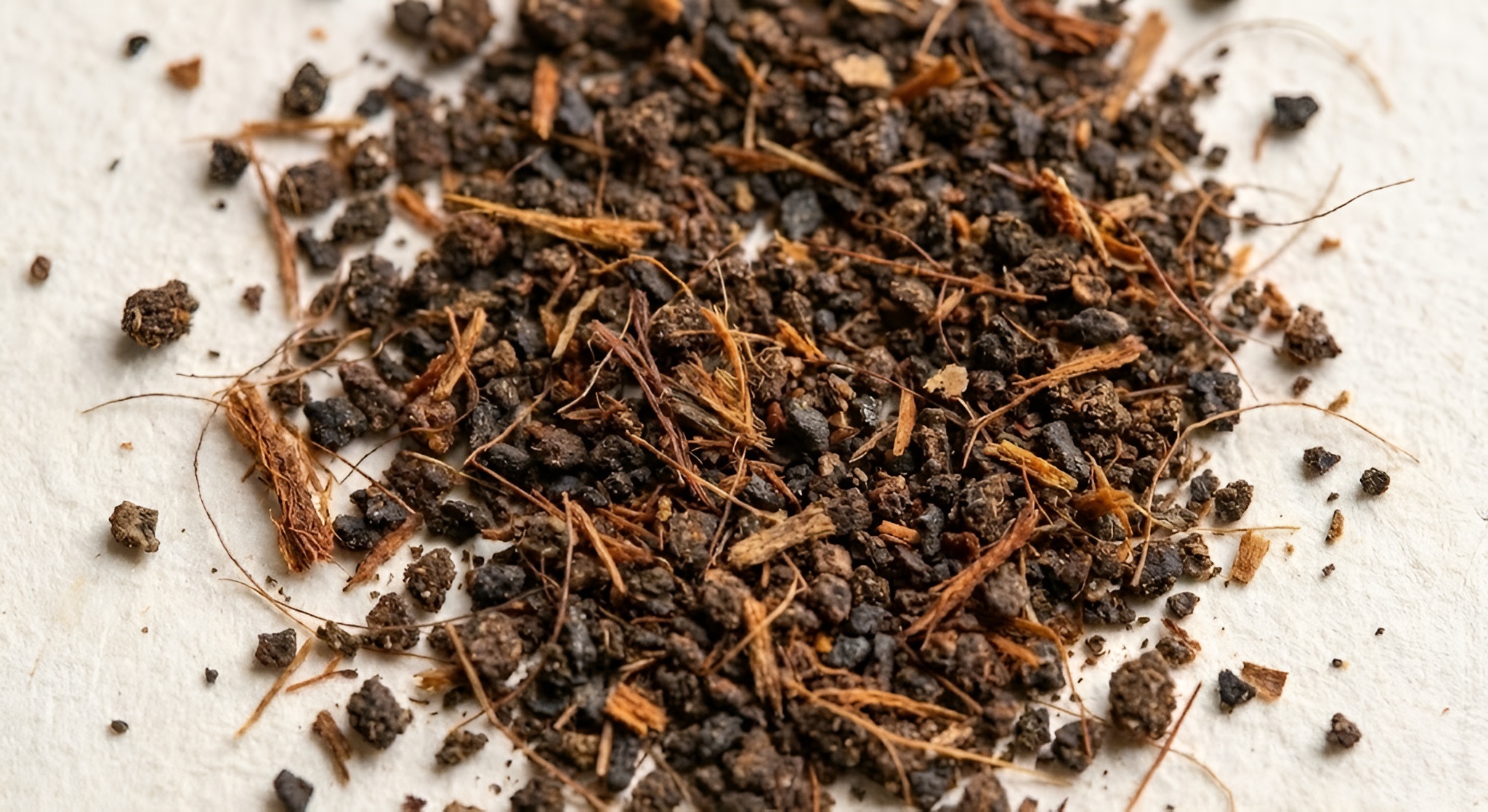
1. Anatomy of the "Hair": Why It Looks Like Copper Wire
To understand what you are seeing, we must look at the botany of the tea bush. High-quality tea is harvested using a standard called "Two Leaves and a Bud" (see our guide on Plucking & Harvesting). This ensures only the succulent, tender parts of the plant are picked.
However, industrial mechanical harvesting often cuts deeper, taking the older, tougher stems and stalks along with the leaves. These stems are structurally different from the leaf:
- Lignin Content: The stems are "lignified," meaning they have become woody to support the plant. They are tough and fibrous.
- Vascular Bundles: The "hairs" you see are actually the Xylem and Phloem tubes—the plant's plumbing system that transports water and nutrients. When crushed, these tubes shred into thin, hair-like filaments.
Expert Tip #1: The Water Test
Think it might be plastic? Drop the "hair" into hot water. If it eventually softens or absorbs water (even slightly), it's plant fibre. Plastic will remain rigid and float indefinitely. Furthermore, tea fibre will burn to ash, while plastic melts.
2. The Science of Color: Why Didn't It Turn Black?
You might wonder: "If it's part of the tea plant, why isn't it black like the rest of the tea?"
Black tea gets its color from Oxidation (fermentation). When tea leaves are bruised, an enzyme called Polyphenol Oxidase reacts with oxygen to turn the green leaf brown/black, creating theaflavins and thearubigins (flavor compounds).
The Stalk Problem: The fibrous stalk contains almost none of this enzyme and very few polyphenols. Therefore, while the leaf around it turns black, the stalk essentially just dries out. It retains a pale, rusty, yellowish-red hue. In the trade, a tea with too much fibre is described as having a "Red Spider" taint.
3. Manufacturing: How Fibre Gets into the Bag
Fibre is a byproduct of the CTC (Crush, Tear, Curl) manufacturing process. This method uses heavy stainless steel rollers with teeth to macerate the tea into small pellets.
When "Two Leaves and a Bud" go through a CTC machine, the leaf turns into pellets, but the woody stem is shredded into fibrous strands. In premium manufacturing, this fibre is removed. In budget manufacturing, it is kept.
Expert Tip #2: Check the "Dust" Grade
Fibre is most common in "Dust" grade tea (the finest particles found in round or square tea bags). If you switch to "Leaf" or even "Fannings" grade (pyramid bags), the fibre content drops significantly because larger leaf grades are easier to clean. Learn more in our Guide to Tea Grades.
4. The Clean-Up: Electrostatic Separation
High-quality tea producers invest heavily in removing this fibre. But how do you separate thousands of tiny orange hairs from millions of tiny black tea grains?
The solution is static electricity. During the Tea Sorting phase, the dried tea is passed under large, statically charged rollers (often made of PVC or felt). Because the fibre is lighter and has a different moisture density than the black tea pellets, it is more susceptible to static attraction.
The rollers attract the orange hairs, lifting them out of the tea bed like a magnet picking up iron filings. This waste product is collected and usually sold for caffeine extraction or as fertilizer.
The Reality: If you find orange hairs in your tea bag, it means the manufacturer either skipped this step to save money or intentionally blended the waste fibre back in.
Expert Tip #3: The "Clean Common" vs. "Stalky Common"
In tea auctions, buyers grade teas based on cleanliness. A "Clean Common" is a basic tea with fibre removed. A "Stalky Common" is the same tea left dirty. Big supermarkets often buy "Stalky" teas to hit a specific low price point (e.g., £1 for 80 bags).
5. ISO Standards: How Much Hair is Legal?
Believe it or not, there is a legal limit to how much of this "trash" can be in your tea. The international standard for Black Tea (ISO 3720) dictates that crude fibre content must not exceed 16.5% by dry weight.
Premium tea brands typically aim for under 5% fibre. However, many "Value" or "Economy" brands skirt dangerously close to that 16.5% legal limit. They are essentially selling you 16% wood shavings by weight.
6. Impact on Flavor and storage
Fibre doesn't just look ugly; it actively degrades your brewing experience. The stalk is "woody" and lacks the essential oils, theanine, and antioxidants found in the leaf.
- Taste Profile: High fibre content leads to a "flat," cardboard-like flavor. It creates a thin liquor that lacks body. It contributes to "coarse" astringency (a scratchy dry mouth) without the pleasant "briskness" of a good Assam.
- Keeping Quality: Fibre is porous and hygroscopic—it acts like a sponge. It absorbs moisture from the air much faster than the sealed leaf surface. This makes high-fibre tea bags go stale, soft, and "musty" much faster than clean tea. (See our Storage Guide).
Expert Tip #4: The Visual "Salt and Pepper" Test
Open a tea bag and pour it onto a white sheet of paper. A good black tea should be uniformly black or dark brown. If the pile looks "salt and pepper" (lots of yellow/white flakes mixed with black), it is full of stalk and fibre. Avoid it.
7. Is This Related to Microplastics?
It is important to distinguish between the bag and the contents.
- The Orange Hair: This is biological plant matter. It is not plastic.
- The Bag Itself: This is where the plastic usually hides. Many "paper" tea bags contain polypropylene plastic to heat-seal the edges.
If you are worried about foreign objects in your cup, you should be more concerned about the invisible bag material than the visible tea stalk. We conducted a deep investigation into this in our article: The Silent Contaminant: Microplastics in Tea Bags.
Expert Tip #5: Upgrade Your Daily Brew
You don't have to spend a fortune to avoid fibre. Simply upgrading from "Value" bags to a reputable brand that uses "Secondary Grades" rather than "Off-Grades" makes a huge difference. Check our Best Assam Tea Bags Review for clean, strong recommendations.
8. Final Verdict: Should You Drink It?
Drinking tea with orange fibres is safe. It is natural plant material and poses no health risk. However, it is a culinary compromise.
You are essentially brewing wood. It dilutes the caffeine, dilutes the antioxidants, and ruins the flavor profile. If you see orange hairs, you are paying for filler. We recommend switching to loose leaf tea or higher-grade tea bags where the fibre has been electrostatically removed.
Expert Tip #6: Whole Leaf vs. Broken
In the debate of Loose Leaf vs Tea Bags, the difference is clear. Whole leaf tea (Orthodox) rarely contains fibre because the stalk is large and easily picked out by hand or machine. It doesn't get shredded into "hairs" like it does in the CTC process.
Comments