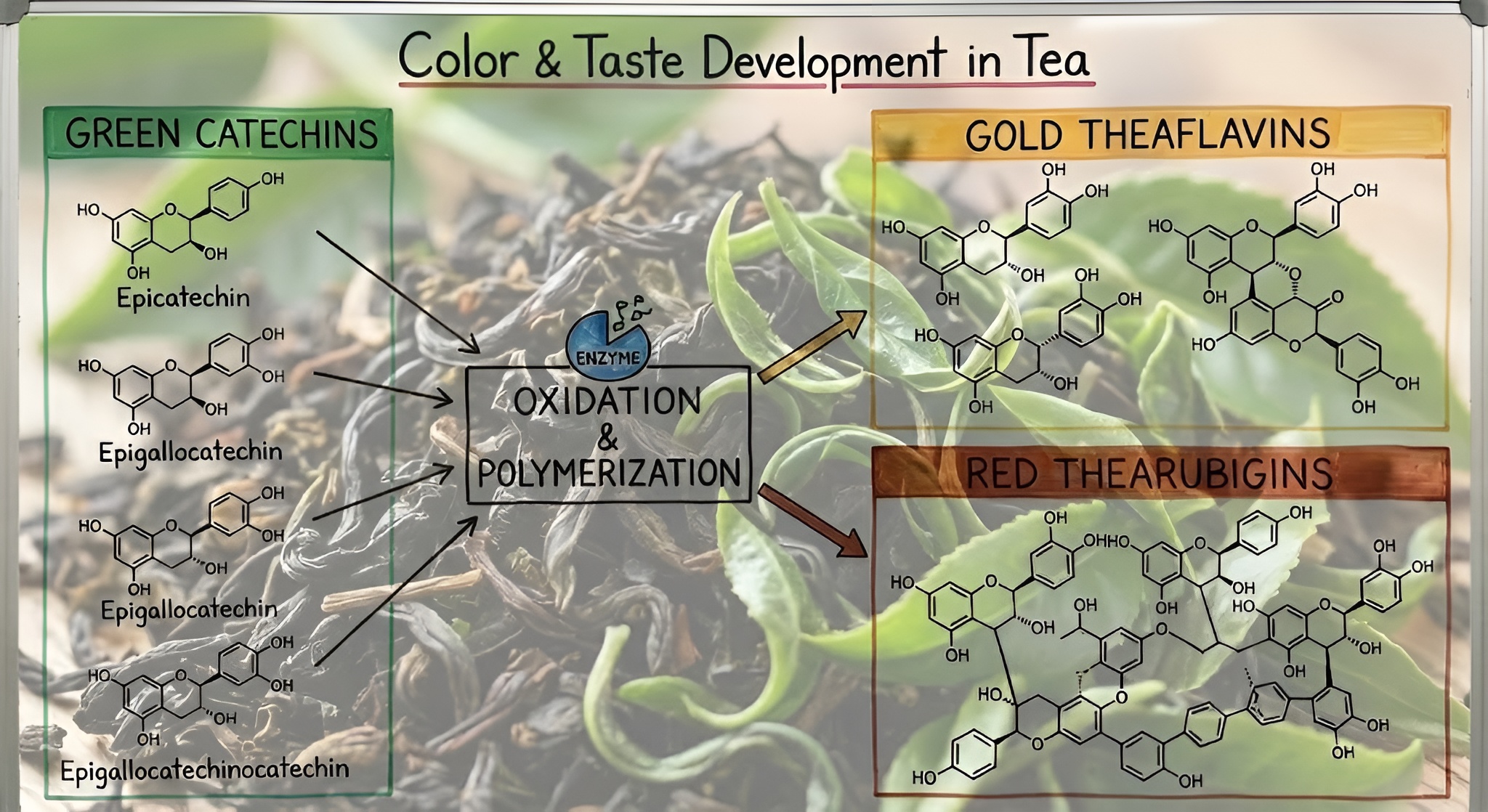
1. Biosynthesis: The Oxidation Cascade
Green Tea is green because the enzymes are killed early, preserving the Catechins. Black Tea is black because the enzymes are allowed to run wild.
The Enzyme: Polyphenol Oxidase (PPO).
The Substrate: Catechins (EGCG, ECG, EGC, C).
Step 1: Dimerization (Theaflavins): When PPO attacks the catechins, it pairs them up (dimerization). Two catechins fuse to form one Theaflavin molecule. This molecule is bright orange/gold and tastes "Brisk" (a pleasant, refreshing astringency).
Step 2: Polymerization (Thearubigins): If oxidation continues, the Theaflavins react further with other catechins to form massive, complex polymers called Thearubigins. These molecules are dark red/brown and taste "Rich" (less astringent, more body).
The Balance: The tea maker's job is to stop oxidation at the exact moment where there is enough Theaflavin for "Zing" but enough Thearubigin for "Body." Stop too early? Thin and metallic. Stop too late? Flat and muddy.
2. The Cultivar Connection: Why Assam is King
To get high levels of TF and TR, you need a leaf packed with Catechins to begin with.
The Camellia sinensis var. assamica (Broad Leaf) variety naturally has a much higher polyphenol content than the Chinese variety. This makes it the perfect factory for producing bold Black Teas.
Within Assam, specific clones like TRRF-1 are bred to maximize PPO activity, ensuring a rapid and violent fermentation that creates the deep red liquor of a breakfast tea.
Expert Tip: Why CTC Tastes Stronger
The CTC (Crush, Tear, Curl) process macerates the leaf completely, mixing enzymes and polyphenols instantly. This leads to a massive, rapid spike in Thearubigins (Body/Color) but often sacrifices the delicate Theaflavins (Briskness/Gold). Orthodox tea preserves more Theaflavins because the roll is gentler.
3. The "Cream Down" Phenomenon
Have you ever brewed strong tea, put it in the fridge, and found it turned cloudy and muddy? That is called "Cream Down" (or Tea Cream).
The Science: Theaflavins and Thearubigins are large molecules. They have a natural affinity for caffeine. In hot water, they bounce around separately (Brownian motion). As the water cools, the energy drops, and the TF/TR molecules complex with Caffeine to form large, insoluble particles that precipitate out of the solution.
The Verdict: While it looks ugly, heavy Cream Down is actually a sign of High Quality. It proves the tea is rich in Polyphenols and Caffeine. If your Iced Tea stays crystal clear, it's probably weak tea. See our full guide on Tea Cream Down Science.
| Molecule | Color | Taste | Stability |
|---|---|---|---|
| Theaflavins (TF) | Bright Golden Orange | Brisk, Astringent, "Alive" | Unstable (Degrades to TR) |
| Thearubigins (TR) | Deep Red / Brown | Rich, Smooth, Heavy | Stable (End Product) |
| Catechins | Colorless / Pale Green | Bitter, Metallic | Precursor |
4. Health: The Super-Catechins
Green tea gets all the health fame for EGCG, but Theaflavins are powerhouse antioxidants in their own right.
Studies suggest Theaflavins (specifically TF-3) may be even more effective than EGCG at lowering cholesterol and inhibiting viral replication. They are unique to Black Tea. So, drinking a robust Assam isn't just about the caffeine wake-up call; it's a unique bioactive cocktail.
Find the Golden Ring
The sign of high Theaflavin content is a "Golden Ring" at the edge of the cup. We have reviewed the briskest, brightest Assams and Ceylons.
Best Malty Assams
Comments