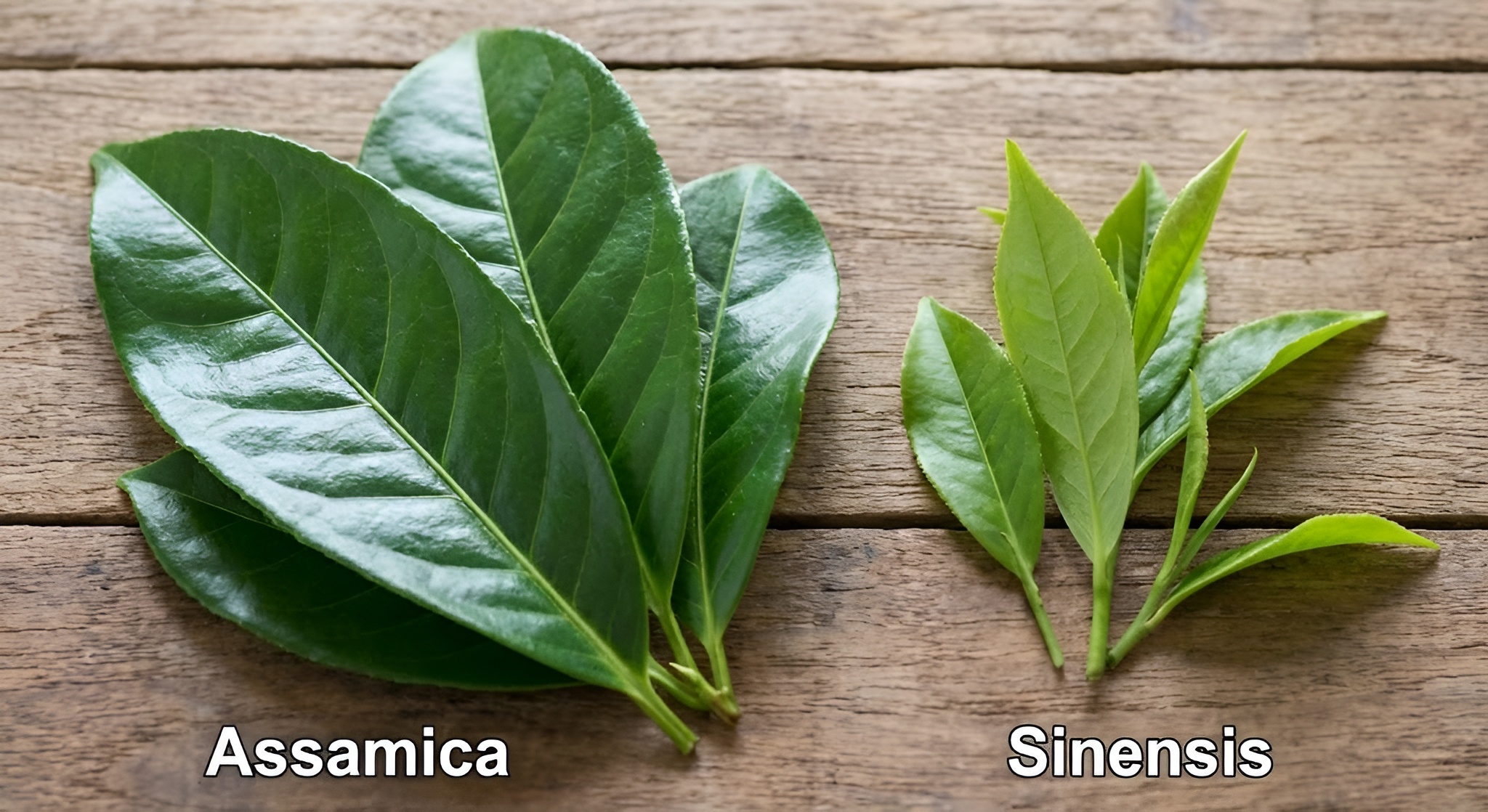
Taxonomy and Discovery: The "Jungle Tea"
For centuries, the Western world believed all tea came from China. The botanical name Camellia sinensis literally means "Flower of China." However, in the 1820s, a Scottish adventurer named Robert Bruce made a discovery that would change the economic history of the world.
While traveling in the kingdom of Ahom (modern-day Assam, India), Bruce noticed the local Singpho tribes drinking a brew made from wild trees growing in the jungle. These trees were massive—some reaching 50 feet in height—with leaves as large as a man's hand. This was not the delicate, shrub-like plant known in China. This was a distinct variety, perfectly adapted to the sweltering heat of the tropics.
It was eventually classified as Camellia sinensis var. assamica. This discovery allowed the British Empire to break the Chinese monopoly on tea, leading to the establishment of the massive plantations in India and later Africa. Read more about the history of the British Raj and Tea here.
Morphology: Identifying the Plant
If you stood an Assamica plant next to a Sinensis plant, the difference would be obvious immediately. Assamica is built for rapid growth in high-energy environments.
| Feature | Var. Sinensis (Chinese) | Var. Assamica (Indian) |
|---|---|---|
| Growth Habit | Shrub / Small Bush (1-3m) | Tree / Arbor (Up to 20m) |
| Leaf Size | Small, narrow (3-6cm) | Large, broad, glossy (10-20cm) |
| Leaf Texture | Thicker, leathery, rigid | Thinner, supple, fleshy |
| Hardiness | Cold tolerant (can survive frost) | Tropical (dies in frost) |
| Yield | Lower yield, slower growth | High yield, rapid flushing |
The Root System
One of the key differences is underground. Assamica trees typically have a deep taproot, anchoring them firmly and allowing them to access deep groundwater. This makes them drought-resistant but difficult to transplant. Sinensis bushes tend to have shallower, spreading root systems.
Phytochemistry: The Engine of Black Tea
The physical differences are just the surface. The true distinction lies in the leaf chemistry. The Assamica variety has a unique metabolic profile that predisposes it to making excellent Black Tea and Pu-erh.
1. High Polyphenol Content
Assamica leaves are rich in polyphenols, specifically simple catechins. When these leaves are crushed and exposed to oxygen (oxidation), these simple catechins polymerize rapidly into Theaflavins and Thearubigins. These are the compounds responsible for the deep red color, bold body, and "brisk" astringency of breakfast tea. Because Assamica has more of the raw material (catechins) to begin with, it produces a stronger, more robust cup than the Chinese variety.
To understand the specific breakdown of these chemicals, refer to our Polyphenols Glossary.
2. High caffeine
In the jungle, caffeine acts as a natural pesticide. Because Assamica evolved in tropical environments teeming with insects, it developed higher caffeine levels as a defense mechanism. A cup of Assam or Kenyan tea will almost always have more caffeine than a cup of Chinese green tea or Oolong.
3. "Malty" Volatiles
The genetic makeup of Assamica produces specific volatile organic compounds (VOCs) during processing that create "malty," "earthy," and "spicy" notes. This is distinct from the "floral," "nutty," or "vegetal" notes typical of Sinensis varieties.
Terroir: The Tropical Greenhouse
Botany cannot be separated from geography. The Assamica plant is a tropical creature. It demands heat, high humidity, and heavy rainfall.
The Assam Valley: In its namesake region of Assam, India, the plant grows in a unique low-altitude valley (almost at sea level) that acts like a greenhouse. Temperatures hover between 30°C-35°C (86°F-95°F) with crushing humidity. This intense metabolic rate causes the plant to "flush" (produce new leaves) very quickly, allowing for multiple harvests per year.
Global Spread: Because of its high yield and bold flavor, the British took Assamica seeds to other tropical colonies. Today, the tea industries of Kenya, Sri Lanka (Low Grown), and Indonesia are dominated by Assamica cultivars. Read more about Kenya's Assamica success story here.
Processing Suitability: Why It Rules the Supermarket
The physical structure of the Assamica leaf—large, fleshy, and full of fluid—makes it uniquely suited for mechanical processing.
In the 1930s, the invention of the CTC (Crush, Tear, Curl) machine revolutionized the industry. These machines require a leaf that can withstand intense maceration without losing all flavor. The delicate Chinese leaf would turn into dust and lose its nuance. The robust Assamica leaf, however, releases a potent, quick-brewing liquor when crushed. This is why 95% of the world's tea bags (from Yorkshire Tea to PG Tips) are filled with Assamica tea.
However, it is also processed using Orthodox methods (rolled, not crushed) to create premium single-estate teas that retain the golden tips (buds) and offer a more complex, less astringent flavor.
The Puerh Connection
It is a common misconception that all Chinese tea is var. sinensis. The famous fermented Pu-erh tea from Yunnan province is actually made from a specific sub-variety of Assamica known as "Da Ye" (Big Leaf). These ancient tea trees in Yunnan are the genetic ancestors of the plants found in Assam. The high polyphenol content of the Big Leaf is what allows Pu-erh to age and ferment over decades without spoiling. See our Top Pu-erh Recommendations.
Modern Cultivars and Cloning
While the wild "Jat" (seed-grown) plants discovered by Bruce still exist, modern agriculture relies on clones. Tea research institutes in Tocklai (Assam) and Kericho (Kenya) have spent decades breeding "Super Assamica" cultivars.
- TV1 (Tocklai Vegetative 1): One of the first released clones, known for high quality and golden tips.
- TRFK 306 (Purple Tea): A Kenyan mutation of Assamica rich in anthocyanins.
- Yunnan Da Ye: The broad-leaf variety used for Puerh, known for its ruggedness and aging potential.
Comments