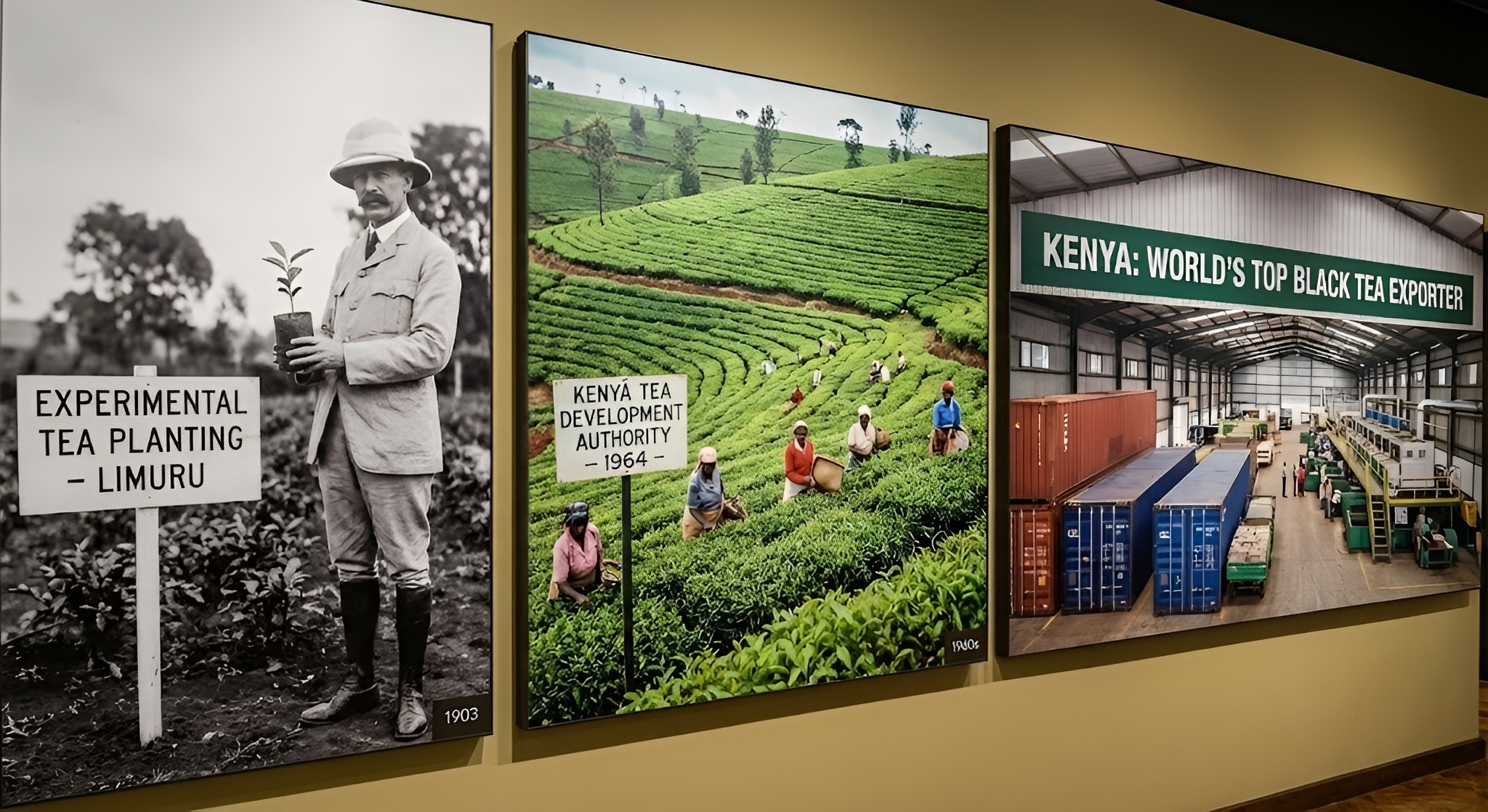
1903: The Accidental Beginning
Unlike Sri Lanka, where tea was introduced as a desperate savior following a coffee blight, tea arrived in Kenya almost by accident. In 1903, an English settler named G.W.L. Caine imported some tea seeds from India. He planted them in Limuru (near Nairobi) purely as ornamental plants for his garden.
These first bushes were never intended for commercial use, but they thrived. Caine—and other settlers who followed—soon realized that the Kenyan highlands offered a unique advantage. Situated on the equator but at high altitude (1,500m to 2,700m above sea level), the region enjoyed cool air, consistent rainfall, and crucially, no dormant winter season.
In key tea regions like Darjeeling, tea bushes go dormant for months during winter. In Kenya, tea could be harvested every two weeks, year-round. This biological advantage laid the foundation for an industry built on volume and consistency.
Expert Tip: The Equatorial Advantage
Because the sun rises at 6am and sets at 6pm every single day of the year in Kenya, the photosynthesis of the tea bushes is perfectly consistent. This means the flavor of Kenyan tea doesn't fluctuate wildly between seasons like it does in Assam or Darjeeling. It is reliable, strong, and constant.
The Colonial Era: A Forbidden Crop
It took two decades for commercial potential to be realized. In the 1920s, large British companies like Brooke Bond and James Finlay began clearing forests in Kericho and Limuru to establish massive plantations. By 1924, commercial production had officially begun.
However, this era has a controversial legacy. Under the colonial administration, the "Native Lands Trust Ordinance" prohibited indigenous Kenyans from growing cash crops like tea and coffee. The British feared that if local Africans grew tea, they would lower the quality and drive down prices, threatening the profits of the European settlers.
For decades, Kenyans worked the fields as laborers but were forbidden from owning the bushes they tended. It wasn't until the 1950s, with the Mau Mau uprising putting pressure on the colonial government, that the Swynnerton Plan (1954) was passed, finally allowing indigenous farmers to plant cash crops. This policy shift would change everything.
Expert Tip: The Red Soil Secret
Kenya's secret weapon is its soil. The tea-growing regions in the Rift Valley are situated on deep, reddish-brown volcanic soil. This soil is highly acidic (pH 4.5 to 5.5), which tea bushes love, and is rich in aluminum. This contributes to the brisk, punchy flavor profile of Kenyan tea—a profile that cuts through milk better than almost any other. Learn more about how terroir affects flavor.
The KTDA Revolution: Power to the Smallholder
When Kenya gained independence in 1963, the new government faced a challenge: how to transfer the wealth of the tea industry to the people without destroying the plantations that drove the economy. Their solution was revolutionary.
They created the Kenya Tea Development Authority (KTDA). The model was simple but powerful: instead of nationalizing the big British estates, the government encouraged small-scale farmers to grow tea on their own plots of land (often less than an acre). The KTDA would provide the seedlings, fertilizers, and technical advice. They would then send trucks to collect the green leaf, process it in shared factories, and sell it on the global market.
The success was staggering. Today, over 600,000 small-scale farmers own the KTDA. These "smallholders" produce over 60% of the country's total tea output, dwarfing the production of the large multinational estates.
Expert Tip: The "Bonus" System
For a Kenyan farmer, the most important day of the year is "Bonus Day." Farmers are paid a small monthly fee for their green leaf, but the KTDA sells the processed tea throughout the year. At the end of the financial year (usually October), the profits are tallied and distributed as a lump sum "bonus." This payment often funds school fees and new homes.
The CTC Revolution: Fueling the Tea Bag
While Kenya was building its agricultural base, the global tea market was shifting. In the 1960s and 70s, the Western world fell in love with the convenience of the tea bag. Traditional "Orthodox" processing (rolling the whole leaf to preserve its shape) was slow, expensive, and the resulting leaves were often too large to infuse quickly inside a paper bag.
Kenya made a strategic decision to embrace the CTC (Crush, Tear, Curl) method. In this mechanical process, withered leaves are passed through a series of cylindrical rollers with serrated teeth. The rollers crush, tear, and curl the leaves into small, hard, brown pellets.
Why CTC Won
These pellets look like gravel, but they are engineering marvels. They have a massive surface area relative to their volume, meaning they release flavor, color, and caffeine almost instantly when hot water hits them. This made Kenyan tea the perfect filler for tea bags.
Because Kenya focused on CTC while India and Sri Lanka maintained much of their Orthodox production, Kenya became the supplier of choice for major blenders. If you are drinking a supermarket English Breakfast tea bag (like PG Tips, Tetley, or Yorkshire Tea), there is a 90% chance the bulk of that blend is Kenyan CTC. Read our full guide on CTC vs Orthodox manufacturing to understand the difference.
Expert Tip: Grading the Gravel
In the CTC world, tea isn't graded by flavor nuance but by particle size. BP1 (Broken Pekoe 1) is the largest pellet, pRized for its golden color. PF1 (Pekoe Fannings 1) is smaller and is the gold standard for tea bags. PD (Pekoe Dust) is the finest, used for ultra-quick brewing. To decipher these codes, check out our guide on Understanding Tea Grades.
The Mombasa Auction: Setting the Price
All this tea has to be sold somewhere. Every week, buyers from London, Cairo, Karachi, and Moscow descend on the port city of Mombasa for the Mombasa Tea Auction. It is the second-largest tea auction in the world (after Colombo) and handles tea not just from Kenya, but from Uganda, Rwanda, Tanzania, and Malawi.
It is here that the global price of commodity tea is largely determined. The auction operates on a "hard currency" basis, bringing crucial foreign exchange into the Kenyan economy. For decades, tea was Kenya's top foreign exchange earner, only recently rivaled by tourism and horticulture.
Expert Tip: Understanding "Hard Currency"
The Mombasa Auction is unique because all transactions must be done in US Dollars. This policy stabilizes the Kenyan Shilling and ensures that the tea industry remains a vital pillar of the nation's financial stability. When you buy Kenyan tea, you are participating in a massive global forex market.
Beyond the Commodity: Purple Tea
For decades, Kenya was known for quantity over quality—producing reliable, strong filler tea. However, relying on commodity markets is risky; prices fluctuate, and farmers suffer. To break this cycle, Kenya has been innovating.
The most exciting development is Purple Tea (TRFK 306). Developed by the Tea Research Foundation of Kenya after 25 years of research, this new cultivar has purple leaves rich in anthocyanins (the same antioxidant found in blueberries and acai). It is drought-resistant, frost-resistant, and commands a much higher price than black CTC tea.
Purple tea is processed like a green tea (steamed, not oxidized), resulting in a drink that is low in caffeine but incredibly high in antioxidants, offering a new, lucrative future for Kenyan farmers beyond the commodity trap.
Expert Tip: Brewing Purple Tea
If you get your hands on Kenyan Purple Tea, do not brew it with boiling water! Treat it like a delicate Green Tea. Use water at 80°C (175°F) and steep for 3 minutes. If you add a squeeze of lemon juice, the anthocyanins react to the pH change, turning the tea a vibrant pink color!
Today, Kenya is the third-largest producer of tea (after China and India) but the number one exporter. This distinction is important: China and India have massive populations that drink most of their own tea. Kenya exports over 90% of what it grows.
The industry faces significant challenges—climate change is causing erratic rainfall in the Rift Valley, and rising labor costs are driving mechanization that threatens jobs. Yet, the resilience of the Kenyan smallholder remains. From a few garden seeds in 1903 to the engine of a nation's economy, Kenya's tea journey is a modern agricultural miracle.
Comments