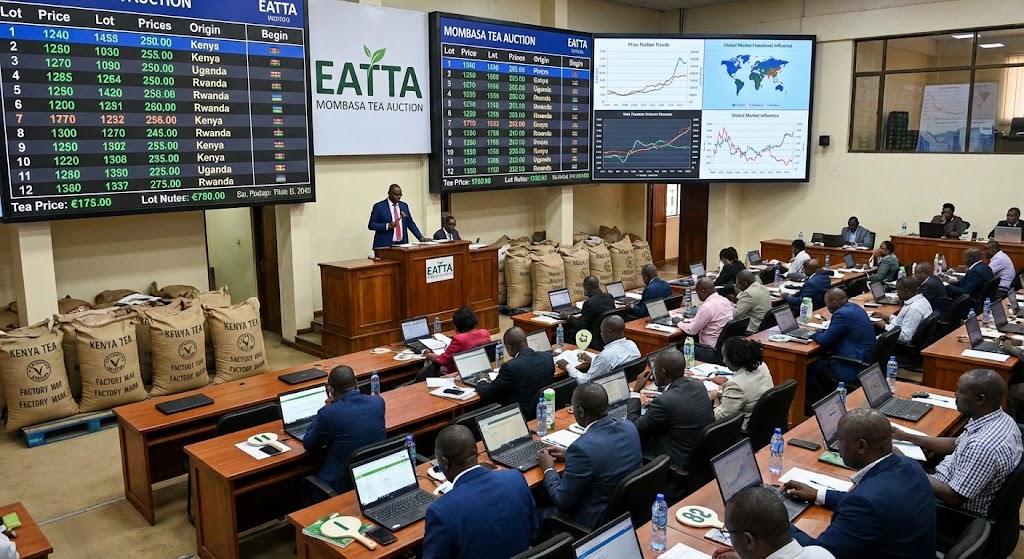
1. Why Mombasa Matters: The World's Second-Largest Tea Auction
Global auction ranking: #1°Kolkata (India) = 250-300 million kg annually (largest volume—Assam + Darjeeling + South India production, see Assam seasonality), #2 Mombasa (Kenya) = 200-250 million kg (rising—overtaking Colombo, African tea powerhouse), #3 Colombo (Sri Lanka) = 120-150 million kg (declining market share—ceylon tea premium niche vs. commodity bulk). Why Kenya dominates Africa: CTC production (crush-tear-curl processing—low-cost high-volume, ideal for tea bags, 95% of Kenyan tea), year-round production (equatorial climate—no winter dormancy unlike India, consistent 12-month supply), efficient logistics (Mombasa port proximity—estates to auction to export rapid, logistics efficiency matters).
Price-setting role globally: "Mombasa Benchmark" = Informal global CTC baseline (buyers compare—"Kenyan BP1 + $0.20" pricing other origins relative to Mombasa, like Brent crude for oil), European tea bag market (UK/Germany/Ireland—Kenya supplies 40-60% of CTC, Mombasa prices directly impact Tesco/Lidl shelf costs), Egyptian/Pakistani buyers (major importers—Mombasa auction sets what Cairo blenders pay, influences retail across Middle East/South Asia). Why auctions persist (despite direct trade growth—auctions provide price discovery transparency, thousands of buyers/sellers establish fair market value, alternative to opaque bilateral negotiations).
2. Auction Mechanics: From Garden to Hammer
Pre-auction process (weeks before sale): Estate sends samples (50-100g per lot—tasting samples to brokers, represents bulk shipment quality), broker catalogs lot (assigns lot number + grade description—see section 4, publishes in auction catalog distributed to buyers), buyers taste samples (tea tasters cup 200-500 teas per auction—rapid sensory evaluation, see report interpretation, note quality + estimate value). Valuation preparation: Buyers check previous auction prices (last week's BP1 average—baseline expectation, adjust for quality differences), currency fluctuations (Kenyan Shilling vs. USD/EUR—affects import costs, buyers hedge exposure), weather reports (drought in Kenya—expect lower volume + higher prices, rain = larger supply downward pressure).
Auction day (Monday mornings Mombasa): Physical auction hall (East Africa Tea Trade Association building—buyers seated, auctioneer at podium, tradition continues despite electronic alternatives emerging), lot-by-lot sale (auctioneer announces lot number + quantity + grade—brokers shout bids, rapid-fire pace 200-300 lots per hour), ascending bids (start below reserve price—increment by $0.05-0.10 per kg, highest bidder wins lot when no higher bid emerges). Settlement: Buyer pays within 14 days (to broker who remits to estate—minus commission, tea shipped to buyer's warehouse or direct export), prices published immediately (auction results online—market transparency, see reading reports).
Broker Role and Commission Structure
Broker services: Estate pays broker 1-2% commission (on sale price—covers cataloging + storage + tasting room + auction representation), broker doesn't own tea (agent only—estate retains ownership until buyer pays, broker facilitates transaction). Major Mombasa brokers: African Tea Brokers (handles 30-40% of auction volume—largest), Tea Brokers East Africa (second largest—25-30%), smaller regional brokers (10-15% combined—specialize in specific estates/buyers). Why estates use brokers: Market access (brokers have buyer network—estate marketing alone misses international buyers), price expertise (broker advises reserve prices—knows market better than growers), logistics (warehouse + sampling + payment collection—estate focuses on growing not selling).
3. Understanding CTC Grades: BP1, PF1, and the Broken Hierarchy
CTC processing creates particle sizes: CTC method (crush-tear-curl machines—cylindrical rollers with teeth, shreds leaves into granules vs. orthodox hand rolling preserves whole leaf), sieving separates grades (mesh screens—larger particles retained on coarse mesh, smaller pass through, creates size hierarchy). Why size matters: Extraction rate (smaller particles = faster brewing—surface area physics, tea bag industry wants rapid steep), visual appearance (uniform particle size—premium look, mixed sizes = lower grade), packaging efficiency (consistent granules—fill tea bags evenly, dust creates waste/mess).
Primary CTC grades (Kenyan system): BP1 (Broken Pekoe 1) = Largest CTC particles (2-3mm granules—retained on 16-mesh screen, highest CTC grade, commands premium $0.20-0.40/kg over smaller grades), PF1 (Pekoe Fannings 1) = Medium particles (1-2mm—pass through 16-mesh retained on 22-mesh, most common grade for tea bags, largest volume sold at auction), Dust = Finest particles (<1mm—pass through all screens, cheapest grade $0.50-1.00/kg less than BP1, used for instant tea or low-cost tea bags). Secondary grades: PD (Pekoe Dust), D1 (Dust 1), BOPF (Broken Orange Pekoe Fannings)—variations by estate, core BP1/PF1/Dust cover 80% of auction volume.
Pricing hierarchy (typical Mombasa): BP1 = $2.80-3.20 per kg (premium—slower brewing but better flavor retention, blenders pay extra for quality tea bags), PF1 = $2.50-2.90 per kg (workhorse grade—balances cost + quality, standard Tetley/PG Tips base), Dust = $1.80-2.40 per kg (commodity—instant tea or ultra-budget bags, cheapest tea bag economics). Price volatility: Weekly fluctuations ±$0.10-0.30 (supply-demand—drought week prices spike, bumper harvest drops prices, see market dynamics).
| CTC Grade | Particle Size | Typical Price | Primary Use | % of Auction Volume |
|---|---|---|---|---|
| BP1 (Broken Pekoe 1) | 2-3mm | $2.80-3.20/kg | Premium tea bags, retail blends | 15-20% |
| PF1 (Pekoe Fannings 1) | 1-2mm | $2.50-2.90/kg | Standard tea bags (most common) | 50-60% |
| PD (Pekoe Dust) | 0.5-1mm | $2.20-2.60/kg | Budget tea bags, blending filler | 15-20% |
| D1 (Dust 1) | <0.5mm | $1.80-2.40/kg | Instant tea, ultra-budget bags | 10-15% |
4. Lot Numbering and Estate Codes: Decoding Auction Catalogs
Typical lot number format: Estate code + Grade + Lot sequence (e.g., "KER/BP1/2847"—Kericho estate, BP1 grade, lot number 2847), invoice mark (estate's registered trademark—like "Unilever Kenya" or "James Finlay", appears in catalog identifies producer), quantity (kilograms per lot—typically 5,000-20,000 kg packages, large buyers purchase multiple lots). Catalog information: Taster's comments (broker's tasting notes—"bright liquor, good color, slightly thin", see terminology guide), season indicator (harvest period—"May production" signals quality expectations, post-rain tea often weaker).
Reading estate quality signals: Consistent estates (same invoice mark weeks in a row—reliable quality, buyers develop loyalty pay premium for known producers), weather-affected lots ("weathery" taster comment—tea exposed to moisture during processing, flavor impaired, discounted $0.10-0.30/kg), new season marks (first lots after factory maintenance—sometimes higher quality from refreshed equipment, experienced buyers target these). Geographic indicators: Kericho region (Western Kenya—high altitude 2,000m, cooler climate produces brighter teas command premium), Nandi region (similar altitude—quality comparable to Kericho), lowland estates (Eastern Kenya <1,500m—hotter faster growth, plainer flavor lower prices).
5. Buyer Profile: Who Purchases at Mombasa
Major buyer categories: International blenders/packers (Unilever/Tata/Twinings—40-50% of volume, purchase for global brands like Lipton/pg tips), regional exporters (Egyptian/Pakistani buyers—20-25% volume, re-export to Middle East/Asia after blending/repackaging), European importers (UK/German tea companies—15-20%, supply supermarket own-label brands), local Kenyan packers (5-10%—domestic consumption, Ketepa/Chai brands). Buyer concentration: Top 10 buyers purchase 60-70% of total auction volume (oligopsony power—can influence prices, estates dependent on few major customers).
Bidding strategies: Volume buyers (blenders) = Consistent bidding (need steady supply—can't tolerate gaps, pay fair prices secure regular lots vs. chasing bargains risk shortages), price floor support (major blenders provide—prevent total price collapse benefits estates, enlightened self-interest maintains supplier viability). Speculators/traders = Opportunistic (buy low weeks—when drought fear overblown or bumper crop underpriced, store 3-6 months sell later when prices recover, risks quality degradation in storage). Niche buyers = Quality-focused (small specialty brands—target best BP1 lots ignore cheaper grades, pay premiums for exceptional tasters' marks, relationship-building with top estates).
6. Price Drivers: What Makes Mombasa Prices Spike or Crash
Supply-side factors: Kenyan rainfall (primary driver—drought reduces flush volume, 20% supply drop = 15-25% price increase within 2-3 weeks), labor strikes (tea pickers unionized—strikes halt harvest, immediate supply shock prices jump $0.30-0.50/kg), frost damage (rare but devastating—high-altitude estates occasionally hit, kills young shoots reduces quality grades available), competing origins (India/Sri Lanka bumper crops—buyers substitute Kenyan tea, depresses Mombasa demand). Seasonal patterns: April-June peak supply (long rains stimulate growth—flush volumes highest, prices typically lowest $2.40-2.60/kg), January-February tight supply (short rains ended—dry period before main season, prices elevated $2.90-3.20/kg).
Demand-side factors: European tea bag consumption (UK recession—shifts Tesco buyers to cheaper blends, reduces demand for premium BP1 prices fall), Middle East markets (Egyptian political stability—affects tea imports, instability kills demand crashes Mombasa prices), currency movements (Kenyan Shilling weakness—makes tea cheaper for USD/EUR buyers, boosts export demand supports prices even if local supply high). Speculation and psychology: Weather forecasts (drought prediction—buyers panic-buy ahead of shortage, self-fulfilling price spike even before supply actually drops), geopolitical events (Suez Canal closure 2021—shipping delays, logistics costs surge buyers stockpile drove temporary premium).
7. Mombasa vs. Other Auctions: Comparative Dynamics
Mombasa (Kenya CTC) vs. Kolkata (India mix): Kolkata advantages = Diverse offerings (orthodox Darjeeling + CTC Assam—see Darjeeling premium, Mombasa 95% CTC only), established buyer relationships (centuries-old auction—British colonial legacy, traditional European buyers), protected origins (darjeeling gi—commands premiums Kenyan tea can't access). Mombasa advantages = Year-round consistency (equatorial climate—no 4-month winter gap like India, buyers prefer reliable supply), competitive pricing (Kenyan CTC often $0.20-0.50/kg cheaper—than equivalent Indian grades, cost-sensitive buyers favor), quality improvements (Kenyan estates modernizing—gap with Indian quality narrowing, some BP1 rivals Assam).
Colombo (Sri Lanka Ceylon) declining relevance: Why losing market share (ceylon tea premium positioning—targets specialty not commodity, Ceylon brand trades privately not auction increasingly), volume shrinking (150 million kg peak 1990s → 120 million kg 2020s—estates bypass auction for direct trade, auction becoming residual market for lower-grade surplus), political instability (Sri Lankan economic crisis 2022—fertilizer shortages reduced yields, buyers diversified to Kenya/India reducing Colombo dependence). Niche strength: High-grown Ceylon (Nuwara Eliya/Dimbula—delicate bright teas, command $4-8/kg premiums over Kenyan CTC, specialty buyers still value but volumes small 10-15% of auction).
Future auction landscape: Electronic trading emerging (online bidding platforms—COVID accelerated adoption, physical auction attendance declining but tradition persists), direct trade growth (see economics—estates selling direct to brands, bypasses auction + broker commissions, threatens auction relevance long-term), blockchain transparency (experimental traceability—some Kenyan estates pilot programs, could revolutionize auction catalog information). Mombasa staying power (strong for commodity CTC—mass-market tea bags still need price discovery, specialty orthodox tea likely moves off-auction but CTC bulk persists, Mombasa relevant 10-20 years minimum).





Comments