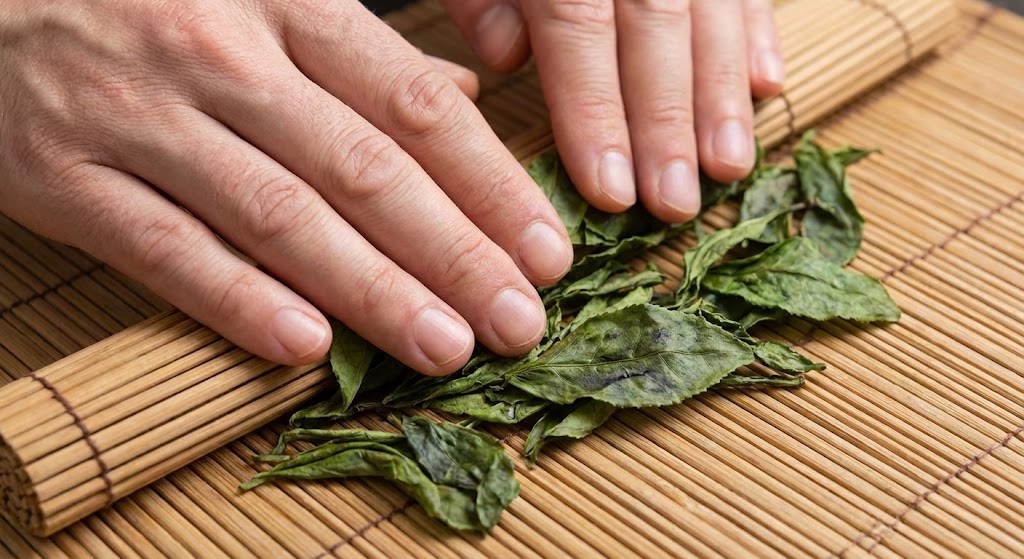
1. Why Hand Rolling Matters: Cell Wall Bruising Physics
The cellular damage imperative: Fresh tea leaves = intact cell walls (plant structure unbroken—essential oils trapped inside vacuoles, polyphenols in separate organelles), unrolled tea brewed = weak pale liquor (minimal extraction—water can't penetrate intact cells efficiently, surface area problem limits steeping). Rolling purpose = rupture cell walls (mechanical pressure breaks membranes—releases oils, enzymes, polyphenols), initiate enzymatic reactions (polyphenol oxidase + catechins now mix—oxidation begins immediately for black tea), improve extraction (broken cells expose interior—hot water reaches compounds during brewing, dramatically improves flavor strength like CTC extraction rates).
Science of bruising vs. breaking: Light rolling/bruising (5-10% cell breakage) = Preserves leaf integrity (visual appeal intact—whole-leaf grades like FTGFOP), slower extraction (requires 3-5 min steep—gourmet application), suitable for oolong + green tea (controlled oxidation—minimal enzyme contact). Heavy rolling/breaking (60-80% cell breakage) = Maximum extraction (quick 2-3 min steep—builder's tea efficiency like strong brews), structural damage (leaves fragment—broken grades BP/BOP), suitable for black tea + CTC (complete oxidation—rapid enzyme mixing). Hand rolling sweet spot = 30-40% cell breakage (balanced—enough oil release for aroma, maintains structural beauty, achieves medium-strength extraction ideal for artisan blends).
2. The Traditional Table-Rolling Method
Equipment setup: Work surface = Smooth bamboo mat traditional (30cm × 50cm—provides gentle friction, absorbent material wicks excess moisture), modern alternatives = clean countertop + parchment paper (non-stick surface—prevents tea staining granite/wood), food-grade plastic cutting board (easy cleanup—dishwasher safe but less traditional aesthetic). Starting material = Withered leaves (30-40% moisture loss—pliable not brittle, still flexible for rolling without cracking), 100-200g batch size (manageable for beginner—larger volumes require experience, professional rollers handle 500g+ but need years practice).
Rolling technique (30-45 minutes total): Stage 1: Initial shaping (10 min) = Gather leaves into loose pile (handful volume—roughly baseball-sized mound), place both palms flat on pile (distribute pressure evenly—heel of hand to fingertips), roll forward with medium pressure (push away from body—compress leaves against mat), release and pull back (gather leaves—return to starting position), repeat 50-60 times (rhythmic motion—meditative pace similar to traditional roasting stirring). Stage 2: Tight rolling (15 min) = Increase pressure significantly (compress harder—more cell breakage now), roll at 45° angle (diagonal motion—twists leaves into spiral shapes), leaves begin to clump (natural adhesion—released juices act as glue), maintain consistent rhythm (don't rush—steady pressure more effective than sporadic heavy force). Stage 3: Separation + final roll (10 min) = Break clumps gently (pull apart stuck leaves—redistribute for even processing), final light rolling (shape refinement—aesthetic finish, less pressure to avoid over-bruising), leaves darken noticeably (oxidation visible—green shifts toward brown/copper for black tea).
Testing Adequate Rolling
Visual check: Leaves should appear twisted/curled (spiral shapes—not flat), glossy surface (oils released—wet sheen visible), darker color (oxidation begun—enzymatic browning for black tea). Tactile check: Handful feels slightly sticky (juice coating—good sign), leaves hold compressed shape briefly (cell damage adequate—spring back slowly not instantly). Aroma check: Strong grassy/floral scent (volatile oils released—nose detects immediately, similar intensity to scented tea but different character). If none of these present = insufficient rolling (continue 10 more min—more pressure needed).
3. Machine-Assisted Rolling: Pasta Maker Technique
Why pasta machines work: Adjustable pressure rollers (gap settings 1-9—controls compression force, mimics hand pressure but consistent), even pressure distribution (entire leaf surface compressed uniformly—eliminates human inconsistency, professional results), repeated passes = cumulative damage (each pass through rollers breaks more cells—5-8 passes achieves 40-50% breakage matching skilled hand rolling). Standard pasta machine = £20-40 investment (KitchenAid/Marcato brands—sturdy construction, clamps to table for stability), manual crank operation (no electricity—portable for outdoor harvest processing).
Pasta maker rolling protocol: Pass 1-2: Wide setting (#7-8) = Gentle introduction (minimal compression—shapes leaves without tearing), feed leaves lengthwise (aligned with rollers—prevents tangling), catch output gently (support falling leaves—don't let drop causes additional damage). Pass 3-4: Medium setting (#5-6) = Significant compression (real cell breakage begins—leaves flatten considerably), rotate 90° between passes (cross-grain rolling—ensures even damage not just lengthwise crushing), leaves darken/moisten (oils express visibly—surface becomes tacky). Pass 5-8: Narrow setting (#3-4) = Maximum safe compression (too tight = paste not tea—#2 setting tears leaves excessively), slow crank speed (controlled feeding—prevents jamming in tight rollers), final output = tightly curled leaves (professional appearance—matches commercial OP grades visually).
Comparison: Hand vs. Pasta Machine: Hand rolling advantages = Traditional authenticity (connoisseurs value artisan character—premium pricing for hand-rolled GI teas), tactile feedback (feel cell breakage—adjust pressure real-time), romantic aesthetic (meditative process—appeals to craft enthusiasts). Machine advantages = Consistency batch-to-batch (uniform quality—eliminates skill variation), speed (8 passes takes 10 min vs. 45 min hand—better for large harvests), reduced labor (minimal effort—accessible for those with hand/wrist issues), scalability (process 500g as easily as 100g—hand rolling fatigue limits batch size).
4. Rolling Pressure: How Much Is Enough?
Quantifying pressure (rough guidelines): Light pressure = 2-5 PSI equivalent (weight of palm resting—minimal compression), produces <10% cell breakage (insufficient for most tea—suitable only for very delicate white tea if rolled at all), leaves remain mostly flat (little curling—poor extraction in brewing). Medium pressure = 10-15 PSI equivalent (active pushing—feel muscles engage), produces 30-40% cell breakage (ideal for hand-rolled black tea—balanced extraction + aesthetics), leaves curl/twist noticeably (proper shape—visually appealing). Heavy pressure = 20-30 PSI equivalent (strong force—tiring after 10 minutes), produces 60-80% cell breakage (commercial CTC level—leaves fragment into granules), suitable for tea bags (fine particles—rapid extraction like commodity tea).
Testing your pressure: Bathroom scale method = Place scale on table, put bamboo mat on scale, roll leaves on mat (display shows actual pressure—press down to see PSI reading), target 10-15 lbs force (this translates to optimal 30-40% breakage—calibrates your muscle memory). Leaf damage assessment = After 10 min rolling, examine 10 random leaves under light (count how many show visible cracks/tears—should be 3-4 out of 10 for proper medium pressure), if <2 damaged = increase pressure (too gentle—insufficient bruising), if >6 damaged = reduce pressure (too aggressive—over-breaking creates fannings).
| Rolling Method | Time Required | Batch Size | Consistency | Best For |
|---|---|---|---|---|
| Hand Table-Rolling | 30-45 min | 100-200g | Variable (skill-dependent) | Artisan/premium tea, traditional aesthetics |
| Pasta Machine | 10-15 min | 100-500g | Excellent (uniform pressure) | Home production, consistent quality |
| Bamboo Roller | 20-30 min | 150-300g | Good (technique-dependent) | Oolong shaping, aesthetic curls |
| Cloth Rolling (Sri Lanka) | 45-60 min | 200-400g | Good (even pressure) | Large batches, traditional Ceylon method |
5. When to Stop Rolling: Identifying Completion
Visual completion indicators: Leaf shape transformation = Flat → tightly curled/twisted (spiral appearance—matches commercial OP grades), edges curl inward (self-wrapping—indicates cell structure broken), color change = Bright green → darker olive/brown (oxidation begun—enzymes mixing for black tea, or retained green for green tea if kill-greened). Surface appearance = Glossy/wet sheen (essential oils expressed—coating leaf surface), leaves stick together slightly (juice adhesion—natural not concerning).
Tactile completion tests: Squeeze test = Grab handful firmly then release (leaves should hold compressed ball shape 2-3 seconds before slowly expanding—indicates adequate cell damage + juice release), if springs back instantly = insufficient rolling (continue 10 min—more breakage needed), if stays permanently compressed = over-rolled (too much damage—may have created paste, dry immediately to salvage). Texture assessment = Rub leaves between fingers (should feel slightly oily/slippery—oils coating skin), noticeable moisture (leaves feel damp—released juices evident), pliable not brittle (still flexible—withered state preserved not dried out from excessive rolling heat).
Aromatic cues: Strong fresh-cut grass scent (for green tea—chlorophyll released, similar to lawn mowing smell), fruity/floral notes (for oolong/black—enzymatic transformation creating esters, detectable before full oxidation), lack of aroma = problem (insufficient cell breakage—volatile oils still trapped, continue rolling until scent emerges strongly). Professional processors rely heavily on nose evaluation (aroma intensity correlates with cell damage—experienced rollers smell completion before seeing it, similar to roasting aroma cues).
6. Post-Rolling: Oxidation vs. Firing Timing
For black tea (oxidize immediately): Transfer to oxidation chamber (see DIY humidity chamber—95% humidity, 25-30°C optimal), spread 2-3cm thick (allows air circulation—oxygen access critical for polyphenol oxidase), oxidize 2-3 hours (monitor color—deep copper/brown indicates completion), then dry immediately (halt enzymes—preserve oxidized flavor). Why rolling then oxidation = Cell breakage during rolling exposes enzymes (polyphenol oxidase + catechins now in contact—reaction begins instantly), extended oxidation period develops complex flavors (theaflavins + thearubigins form—creates malty/fruity notes characteristic of quality black tea like Darjeeling or Assam).
For green tea (fire immediately, no oxidation): Kill-green within 30 min of rolling (see kill-green methods—wok or steam), high heat denatures enzymes (80-100°C—stops polyphenol oxidase preventing browning), preserves green color (chlorophyll intact—no oxidative degradation), then dry to 3-5% moisture. Why immediate firing critical = Rolling initiates oxidation (cell breakage can't be undone—enzymes mixing), delays >30 min = partial oxidation (green tea turns yellowish-brown—off-flavors develop, becomes poorly-made oolong not green tea), professional Chinese green tea = kill-green BEFORE rolling (reverses sequence—prevents any oxidation, produces brighter cleaner flavor but different mouthfeel).
7. Troubleshooting Rolling Problems
Problem: Leaves tearing/shredding excessively: Causes = Over-withered (too dry <20% moisture—brittle not pliable), excessive pressure (crushing not rolling—destroys structure), poor quality leaves (old/damaged—weak from start, harvest timing matters). Solutions: Reduce withering time (stop at 30-35% moisture loss—leaves still flexible), lighten rolling pressure (medium force sufficient—heavy force counterproductive), use tender flush (young shoots more resilient—mature leaves fragment easily). Using torn leaves: Still usable for tea (flavor intact—just broken appearance), suitable for blending (mixed with whole-leaf—less noticeable), or tea bags (broken grades extract faster—commercial advantage).
Problem: No curling/twisting achieved: Causes = Insufficient withering (leaves too wet >50% moisture—slippery not rollable), inadequate pressure (too gentle—cells intact), wrong motion (straight pushing not rolling—lacks twisting action). Solutions: Extend withering (wait until pliable-leathery texture—test by bending leaf, should fold not snap), increase pressure significantly (feel strain in forearms—proper rolling is workout), add circular motion (spiral hand movement—creates twist not just compression, imagine wringing towel). Re-rolling option: Can roll again after brief rest (10 min pause—leaves relax making second roll effective, total rolling time still <60 min to avoid over-processing).
Problem: Leaves turn mushy/paste-like: Causes = Over-rolling (>60 min—excessive cell destruction), too much pressure (crushing to pulp—complete structural breakdown), high moisture content (>50%—cells rupture completely releasing all liquid). Prevention: Stop at 45 min max (even if imperfect—additional rolling marginal benefit), moderate pressure (firm not crushing—calibrate with scale test), proper withering (30-40% moisture loss—critical preparation). Salvaging mushy tea: Shape into compressed tea cakes (like puerh—press into molds, dries into solid form), or tea balls (roll into spheres—decorative presentation, still brewable just unconventional), dry thoroughly (prevents mold—low-temp oven until hard).
Comments