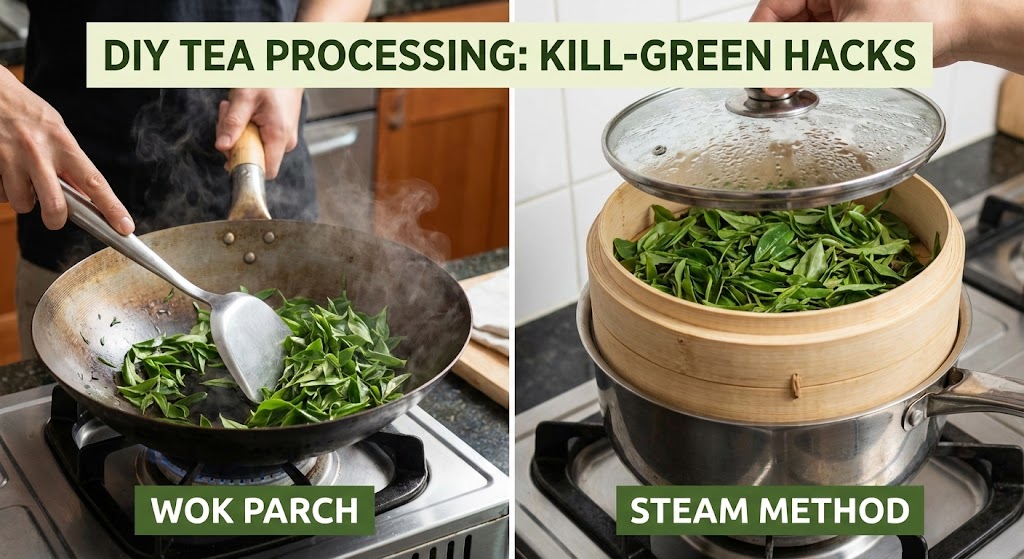
1. The Kill-Green Critical Window: Why Timing Matters
Fresh leaf enzyme activity: Plucked tea leaves = living tissue (cells still respiring—biochemical reactions continue), polyphenol oxidase enzyme activated within minutes (exposure to air triggers—begins oxidizing catechins immediately like black tea oxidation), chlorophyllase enzyme active (breaks down chlorophyll—causes yellowing, green color fades). Kill-green purpose = denature enzymes with heat (protein structures unfold at 70-80°C—enzyme activity stops permanently), preserve green color (chlorophyll intact—no oxidative browning), lock in fresh flavor (grassy/vegetal notes—characteristic of quality green tea like sencha or Longjing).
Time windows from plucking: Immediate processing (0-2 hours) = Ideal (minimal oxidation—bright green color, clean flavor), professional Chinese factories process within 1 hour (deliver fresh from harvest—trucks waiting at field edges), home growers advantage (garden to kitchen instantly—fresher than commercial possible). Delayed 2-4 hours = Acceptable if cool storage (refrigerate harvested leaves—slows enzyme activity, allows flexible processing schedule), slight yellowing acceptable (minor quality loss—still produces drinkable green tea). Beyond 4 hours = Significant degradation (leaves turn yellowish-brown—unintentional partial oxidation), off-flavors develop (stale/flat taste—enzymatic breakdown products accumulate), becomes poor oolong not green tea (better to intentionally oxidize fully and make black tea than mediocre green).
2. Wok Method: Traditional Chinese Pan-Firing
Equipment setup: Carbon steel wok (14-16 inch diameter—large surface area, traditional material conducts heat evenly), gas burner ideal (instant heat control—adjust flame responsive, electric slower but workable), heat to 250-300°C (very hot—water droplet should sizzle/evaporate instantly, smoke point of oil as visual guide but don't add oil). Why wok shape matters: Curved surface allows tossing motion (leaves circulate through hot/cool zones—prevents scorching), large diameter provides rapid moisture evaporation (steam escapes efficiently—leaves dry-cook not steam), sloped sides make stirring easy (spatula glides smoothly—constant motion essential).
Wok kill-green process (10-15 minutes): Stage 1: Initial firing (3-5 min) = Add 100-150g fresh leaves to hot wok (immediate sizzle sound—steam rises dramatically), stir constantly with bamboo tongs/spatula (keep leaves moving—any static leaf scorches within seconds), leaves wilt rapidly (lose 20-30% volume—steam drives moisture out), grassy aroma intensifies (chlorophyll compounds volatilize—kitchen smells like fresh-cut lawn). Stage 2: Enzyme kill (5-7 min) = Reduce heat slightly (medium-high—prevent charring now that moisture reduced), continue vigorous stirring (uninterrupted motion—critical period for even heat exposure), leaves turn darker emerald green (chlorophyll concentrates—water evaporation intensifies color), texture becomes pliable-leathery (no longer crisp—ready for rolling). Stage 3: Initial drying (2-3 min) = Further reduce heat (medium-low—gentle finish), press leaves against wok with spatula (flattening motion—increases surface contact like Longjing shaping), leaves feel dry to touch (surface moisture gone—ready to remove).
Preventing Wok Scorching
Never stop stirring (constant motion essential—even 5 seconds static causes brown spots), use two-handed technique (one hand stirs, other hand fans leaves upward—promotes even heating + moisture release), watch for smoke (if wok smokes = too hot—remove from heat 30 sec, reduce flame). Burnt smell = failure (acrid aroma—batch ruined, discard and start over with lower initial temp). Visual check: Leaves should remain uniformly green (no brown/black spots—even color indicates proper technique), steam should be white (yellow/brown steam = scorching—adjust heat immediately).
3. Steam Method: Japanese Mushidashi Technique
Why steam vs. pan-fire: Chinese pan-firing = Toasted/nutty flavors (Maillard reactions—dry heat develops complexity), Japanese steaming = Grassy/vegetal purity (wet heat preserves fresh character—no toasting, brighter flavor like sencha vs. Chinese green tea contrast). Steam advantages = More forgiving (harder to scorch—even heat distribution), preserves nutrients (lower temp ~100°C vs. 250°C—less vitamin C degradation), authentic Japanese method (cultural appreciation—gyokuro/sencha traditional processing).
Home steamer setup: Bamboo steamer basket (traditional—breathable material prevents condensation drips, 10-12 inch diameter holds 150-200g leaves), metal steamer insert (Western pasta pot steamer—works adequately, more condensation than bamboo), colander over pot (emergency method—line with cheesecloth to prevent leaves falling through, less ideal but functional). Water level critical: Boiling vigorously (full steam production—weak steam insufficient enzyme kill), but water never touches leaves (steam only—direct water contact causes sogginess, ruins texture).
Steam kill-green protocol (2-4 minutes): Preheat steamer (vigorous steam escaping—confirms readiness, cold start = uneven processing), add leaves loosely (spread thin layer 2-3cm—allows steam penetration, thick piles = unprocessed centers), cover tightly (lid seals steam in—maintains 100°C environment), steam 60-90 seconds (shorter than expected—Japanese factories use 30-40 sec for delicate gyokuro, home method needs slightly longer for uneven heat). Test doneness: Leaves turn bright vibrant green (chlorophyll intensifies—vivid color signals completion), texture very soft/pliable (blanched feeling—similar to cooked spinach but less mushy), grassy aroma strong (vegetal smell—confirms enzyme denaturation). Over-steaming (>4 min) = Leaves too soft (structural breakdown—difficult to roll, produces mushy tea), dull olive color (over-cooked—chlorophyll degrades despite gentle heat).
4. Oven Method: DIY Convection Kill-Green
Convection oven advantages: Hands-free operation (no constant stirring like wok—set timer and monitor), large capacity (full baking sheet holds 300-500g—scales better than stovetop), even heating (fan circulation—prevents hot spots, consistent results). Disadvantages = Less traditional (lacks artisan character—automated feel), slower than wok (15-20 min vs. 10 min—extended heat exposure), requires precise temp (too hot = scorched, too cool = incomplete enzyme kill).
Oven kill-green process: Preheat to 120°C (lower than drying temp—goal is enzyme kill not moisture removal yet), spread leaves on parchment-lined baking sheet (single layer ideal—maximum air exposure, overlapping acceptable but less optimal), bake 8-10 minutes (convection fan on—promotes circulation), stir halfway (redistribute at 5 min mark—ensures even processing). Visual endpoint: Leaves wilt completely (no rigid structure—floppy texture), color deepens (darker green—moisture concentration effect), no browning (edges stay green—brown = over-done like roasting which comes later if desired). Immediately proceed to rolling (while leaves still warm-pliable—see rolling techniques, cold leaves harder to shape).
| Kill-Green Method | Temperature | Time | Flavor Profile | Difficulty |
|---|---|---|---|---|
| Wok Pan-Firing | 250-300°C | 10-15 min | Toasted/nutty (Chinese style) | HIGH (constant stirring, scorching risk) |
| Steam (Japanese) | 100°C | 2-4 min | Grassy/vegetal (sencha style) | MEDIUM (timing critical, forgiving heat) |
| Convection Oven | 120°C | 8-10 min | Mild/clean (neutral) | LOW (hands-free, consistent) |
| Microwave (Emergency) | Variable | 3-5 min | Flat/dull (uneven) | VERY LOW (but poor quality) |
5. Rolling Green Tea: Timing and Technique
Chinese method (kill-green BEFORE rolling): Sequence = Pan-fire first (denature enzymes—prevent any oxidation), cool 5 min (manageable handling temp—still warm aids rolling), then roll 20-30 min (shape leaves—cell breakage for extraction), finally dry to 3-5% moisture. Advantages = Zero oxidation risk (enzymes already dead—rolling can't initiate browning), brighter green color (chlorophyll preserved perfectly—premium visual quality like Longjing), cleaner flavor (no enzymatic byproducts—pure tea taste). Disadvantages = Less body/depth (some complexity lost—simpler profile than Japanese method), requires two heating stages (kill-green + drying—more energy/time).
Japanese method (light wither → steam → roll → dry): Sequence = Optional 1-2 hour wither (10-15% moisture loss—enhances sweetness but risks slight oxidation), steam kill-green (short exposure—preserves structure), roll while still hot (immediately after steaming—leaves maximally pliable), dry thoroughly. Advantages = Richer flavor (brief enzymatic activity creates complexity—umami depth characteristic of gyokuro), better mouthfeel (partial cell breakdown before kill-green—improves extraction texture), authentic Japanese character (traditional sencha processing).
Rolling pressure for green tea: Lighter than black tea (10-20% cell breakage sufficient—preserves delicate flavor, vs. 30-40% for black tea), shorter duration (15-20 min adequate—avoids over-bruising), gentler motion (rolling not crushing—aesthetic whole-leaf integrity like premium FTGFOP grades). Shape goals: Twisted needles (like Longjing—flat elongated), curled balls (like gunpowder—pellet-rolled), or loose twist (like sencha—natural crinkle).
6. Final Drying: Preserving Green Tea Quality
Drying temperature critical: Too high (>100°C) = Toasted flavors develop (Maillard reactions—turns green tea into something resembling roasted tea), chlorophyll degrades (browning despite kill-green—negates earlier preservation efforts), harsh astringency (high-temp polyphenol changes—bitterness increases). Too low (<70°C) = Incomplete drying (>5% residual moisture—mold risk in storage), excessive time (4+ hours—occupies oven, energy waste), enzyme reactivation risk (marginal temps may not fully denature remaining enzymes—gradual degradation in storage).
Optimal green tea drying protocol: Two-stage approach (like black tea drying but lower temps): Stage 1 = 80-90°C for 30-40 min (remove bulk moisture—down to 10-15%), stir every 15 min (even drying—prevent hot-spot scorching), Stage 2 = 70-75°C for 20-30 min (final moisture removal—gentle finish to 3-5%), watch for browning (any brown edges = too hot—reduce immediately). Endpoint tests: Leaves snap cleanly (brittle texture—indicates dryness), remain green (no yellowing/browning—quality preserved), strong aroma (grassy/fresh scent—volatile oils intact not driven off by excessive heat).
7. Troubleshooting Green Tea Processing
Problem: Leaves turn brown/yellow during kill-green: Causes = Temperature too high (>300°C wok—scorching chlorophyll), uneven heating (hot spots—some leaves burn while others under-processed), delayed processing (oxidation begun before kill-green—enzymes already active >4 hours post-harvest). Solutions: Lower heat (250°C max for wok—gentler kills enzymes without scorching), constant stirring (every 3-5 seconds—prevents static contact with hot surface), process fresh (<2 hours from plucking—enzymatic browning minimal). Salvage attempt: If only partial browning, rebrand as oolong (partial oxidation = light oolong category—not premium but drinkable), or blend with properly-processed batch (dilutes off-color—camouflages imperfection).
Problem: Grassy flavor too intense/vegetal: Causes = Under-steaming (enzymes partially active—incomplete kill-green), Japanese method used (inherently grassier—steaming preserves chlorophyll volatiles more than pan-firing), fresh young leaves (tender flush—naturally more vegetal than mature leaves). Solutions if undesired: Light roasting post-drying (70-80°C for 30 min—see roasting guide, develops nuttiness without over-toasting), aging 3-6 months (mellows grassiness—flavors round out in storage), or blend with roasted tea (mix with hojicha-style—balances profiles). Note: Grassiness often desired in quality green tea (premium sencha/gyokuro prized for this—Western palate may need adjustment, not always a flaw).
Problem: Tea tastes flat/dull after processing: Causes = Over-steaming (>5 min—breaks down flavor compounds), drying temp too high (>100°C—volatile aromatics evaporate), old/poor quality starting leaves (mature leaves—less intrinsic flavor than tender shoots), incomplete rolling (insufficient cell breakage—weak extraction despite proper kill-green/drying). Solutions: Reduce steam time next batch (aim 2-3 min max—test at 90 sec intervals), lower drying temp (75-85°C range—preserve aromatics), use first flush tender tips (young growth more flavorful—two leaves and bud standard), increase rolling intensity (more cell damage—better extraction compensates for processing flaws). Enhancement option: Jasmine scenting (layer with flowers—adds complexity to flat base tea, traditional Chinese solution for mediocre green tea).
Comments